As Bitcoin holders keep weighing exchange convenience against self-custody risk, the real question is getting more practical: which wallets actually make the move off-platform simple enough for mainstream users? According to Levi, Tangem’s hardware wallet is trying to answer that with tap-to-scan setup, seedless backups, and built-in buying and swapping tools that reduce friction for new users.
Core Thesis
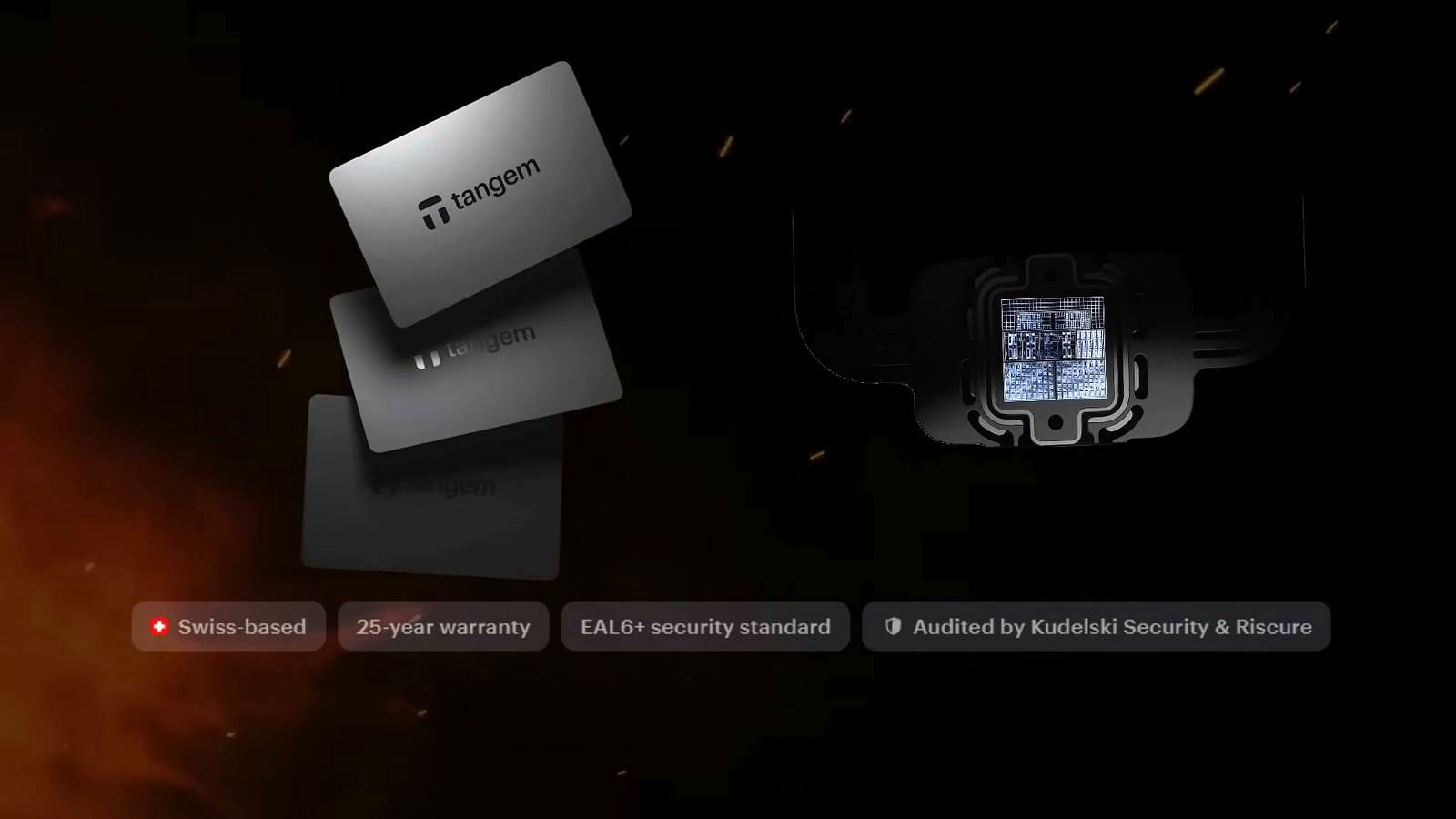
According to Levi, Tangem’s pitch is straightforward: make self-custody feel closer to using a consumer finance app than a traditional hardware wallet. In the video, he walks through a setup process built around scanning a card or ring with a phone, generating private keys inside the card’s chip, and optionally creating a seedless backup system with up to two backup cards. He says the private key is generated directly inside the card’s chip and “never leaves it, ” while the product uses a Samsung chip with EAL6+ certification. He also highlights a manufacturer warranty of 25 years.
That matters because Bitcoin self-custody has long faced a tradeoff: better control usually means more complexity. For many users, seed phrases, firmware management, and manual transaction flows remain barriers. Wallets that abstract some of that complexity have become more relevant as more retail users look to hold BTC outside exchanges, especially after the exchange failures and custody scares that reshaped the market in recent years.
Levi’s framing is broadly aligned with a wider industry trend. Hardware wallet makers increasingly compete not just on security, but on usability, mobile support, token coverage, and integrated on-ramps. The more contrarian angle is his preference for the seedless method as “far more convenient and secure for most people.” Convenience is easy to understand; the security debate is more nuanced. Many Bitcoin purists still prefer transparent, auditable recovery models centered on a seed phrase, because backup independence remains a core principle in self-custody. In other words, Tangem’s approach fits a usability-first market segment, but not every security-conscious BTC holder will view that tradeoff the same way.
Supporting Analysis
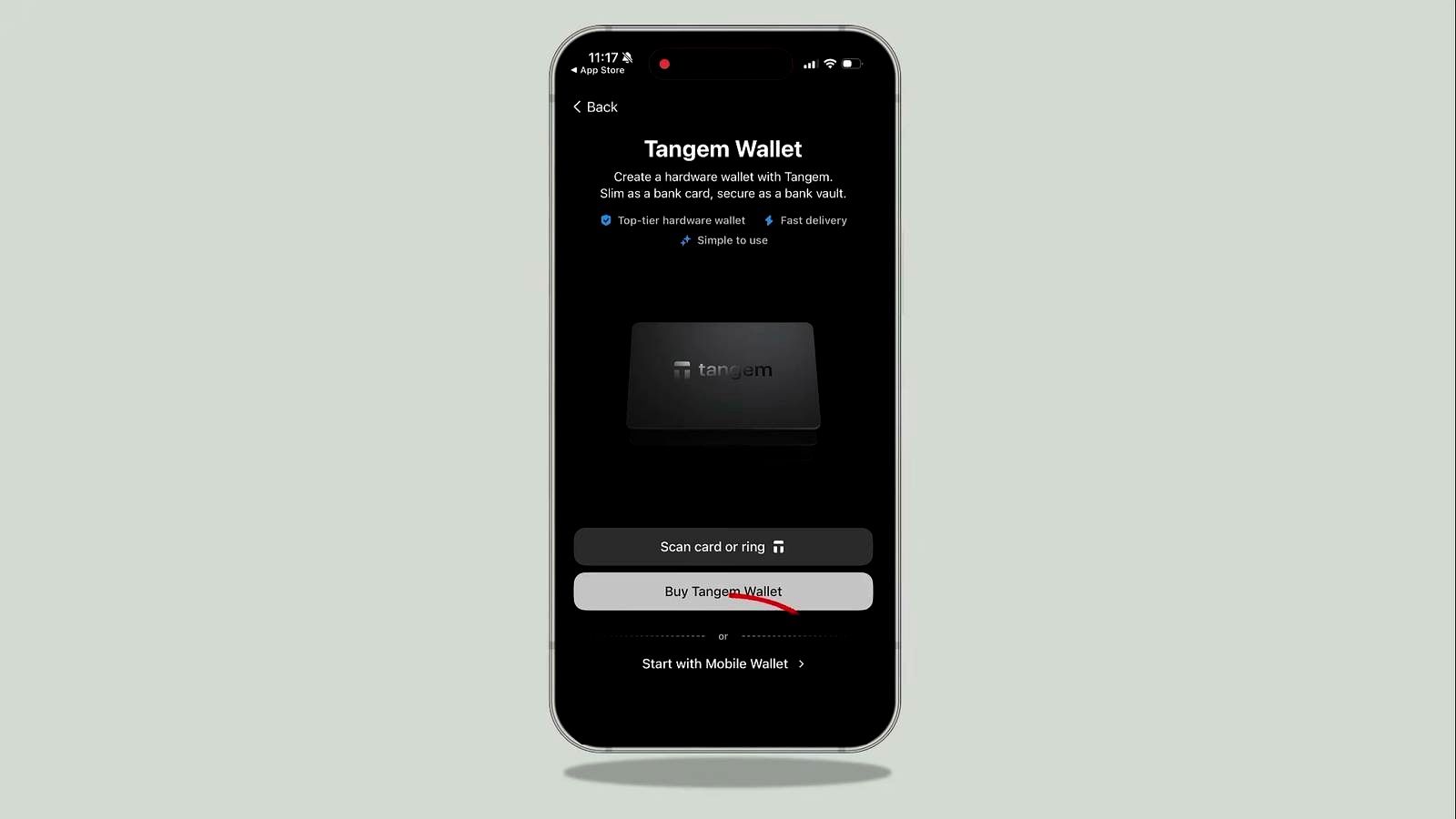
According to Levi, Tangem’s strongest differentiator is that it collapses several steps into one mobile flow. Users can start with a free mobile wallet or scan a physical card or ring. In his demo, setup involves creating an access code, scanning the primary card, then scanning backup devices, including a hold of roughly 15 seconds during one stage of the backup process. He also enables Face ID for wallet access.
The wallet’s value proposition extends beyond storage. Levi says users can add assets such as Bitcoin, Ethereum, and XRP Ledger-based XRP, then buy assets directly in-app. He gives a Bitcoin purchase example, noting the app requires at least $15 for a purchase and demonstrates a $20 buy flow using Apple Pay. He says rates are competitive and that users can review alternate offers, including credit card options that cost more than Apple Pay.
For users who cannot directly buy a given asset on a preferred network, he points to swaps as a workaround. In his example, a user could buy Bitcoin and then swap it into XRP, again using a $20 example to show how the app fetches the current conversion rate. He also says selling crypto through the wallet is unavailable in Canada but available in many other regions, including the United States.
Levi also highlights wallet features that increasingly matter in a multi-asset environment: market data, news feeds, token discovery, chain selection, and DeFi yield access. He references market snapshots in the app showing Bitcoin down 1.88% on the day, Ethereum down 0.72%, and Bittensor up 12%. He says stablecoin holders can earn up to 1.86% APR or APY on USDT or USDC with “no lockups, ” using protocols he describes as decentralized and self-custodial.
For Bitcoin users specifically, the key question is whether these extra features are a benefit or a distraction. Some users will appreciate an all-in-one app that combines storage, buying, swapping, and market monitoring. Others will prefer a narrower Bitcoin-only setup with fewer moving parts and less exposure to third-party integrations.
What Could Go Wrong

The most obvious challenge to Levi’s thesis is that usability and security do not always move in the same direction. A seedless system may reduce user error for some people, but it also changes the recovery model in ways that traditional hardware wallet users may not like. If a user misunderstands how backup cards, access codes, or device recovery works, “easy” can still become fragile under stress.
Another issue is that Tangem’s convenience features rely on external services. In-app buying, swapping, selling, and yield products all introduce dependencies beyond simple Bitcoin storage. Rates may be competitive, but they still come with counterparties, regional restrictions, and varying fee structures. Levi mentions, for example, that selling is unavailable in Canada. That is a reminder that app functionality is not globally uniform.
The yield feature deserves extra scrutiny. Levi says users can earn up to 1.86% on stablecoins and references DeFi infrastructure. Even when products are marketed as self-custodial, yield is not the same as cold storage. Smart contract risk, stablecoin risk, and liquidity conditions remain part of the equation. Bitcoin holders who move into app-based yield products may be taking on a very different risk profile than they intended.
There is also a philosophical counterargument Levi does not dwell on: Bitcoin maximalists often argue that a wallet packed with multi-chain tools, token discovery, swaps, and integrated news can increase attack surface and encourage behavior that is closer to trading than to long-term cold storage.
What to Watch Next

For users evaluating wallets like Tangem, the next checkpoints are practical rather than macro. Watch whether seedless hardware wallets gain broader acceptance among Bitcoin-focused users, not just general crypto traders. Monitor whether integrated buying and swapping remain available across major regions, and whether fee competitiveness holds up in volatile markets.
For this specific product, the concrete details Levi highlights are the ones worth testing: the three-card setup for redundancy, the 15-second scan step during backup, the $15 minimum purchase threshold, and the advertised stablecoin yield of up to 1.86%. If those workflows are smooth in practice, Tangem’s mainstream self-custody pitch gets stronger. If they are inconsistent, the convenience thesis weakens quickly.
FAQ
What does EAL6+ mean in a hardware wallet?
EAL6+ refers to a high level of security certification used to evaluate secure chips. In wallet marketing, it usually signals that the secure element has been tested against strong tamper-resistance standards. It does not mean a wallet is risk-free, but it does indicate a hardened chip environment.
What is a seedless wallet?
A seedless wallet is a wallet design that does not require the user to write down and manage a traditional recovery seed phrase in the usual way. Recovery instead depends on another method, such as backup devices or alternative authentication flows. The tradeoff is usually convenience versus the familiarity and portability of standard seed phrase recovery.
How is this different from a Bitcoin-only hardware wallet?
A Bitcoin-only wallet typically focuses on BTC storage, signing, and recovery with fewer extra features. Tangem, as described by Levi, combines Bitcoin support with multi-asset storage, token swaps, in-app buying, market data, and DeFi access. Some users value that flexibility; others prefer the reduced complexity of a BTC-only device.
Why would someone buy BTC first and then swap into another asset?
That route can be useful when direct purchases are not available for a specific token or network through a wallet’s payment rails. Levi uses XRP as the example: if direct purchase on the XRP Ledger is unavailable through Apple Pay, a user could buy Bitcoin first and then swap it.
What happened last time self-custody demand surged in crypto?
Previous spikes in self-custody demand typically followed exchange failures, insolvencies, or concerns over centralized custody. Those episodes pushed users toward hardware wallets and on-chain withdrawals, but they also exposed how many people found self-custody setup confusing. That is why products focused on simpler onboarding continue to get attention.
Reference Video

An Indian crypto journalist covering the developments in the Bitcoin and blockchain industries. Her work helps readers understand key changes in the world of digital assets.