Was the market supposed to be rallying on a strategic Bitcoin reserve and friendlier regulation by now? According to Common Sense Crypto, the bigger story may be that Bitcoin is no longer the only asset institutions and policymakers are watching.
A bet against Bitcoin maximalism
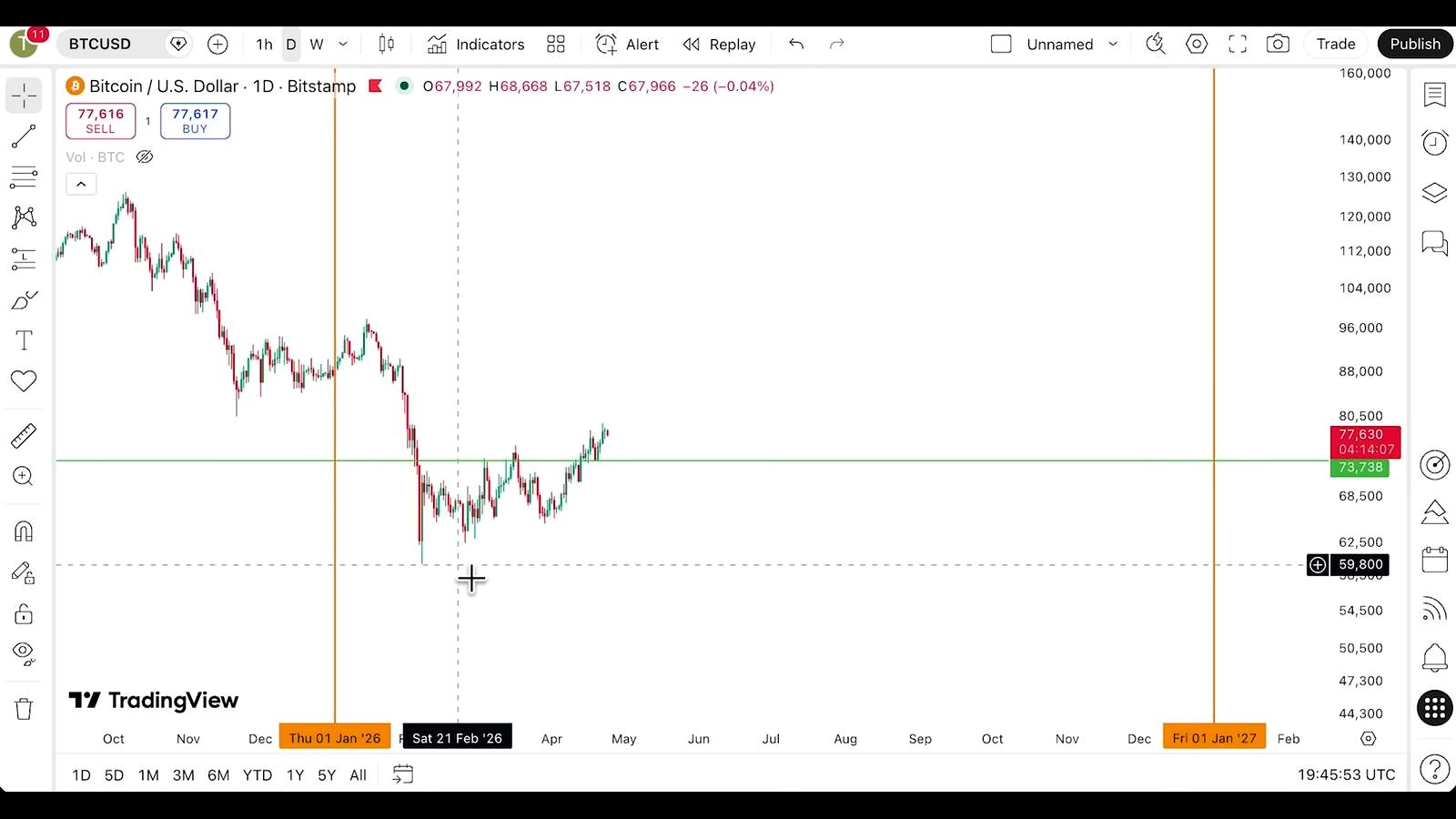
According to Common Sense Crypto, the market has drifted away from the simple “Bitcoin-only” narrative and toward utility-driven crypto infrastructure. The host framed that shift through a contrast borrowed from Crypto Rover: investors were promised a strategic Bitcoin reserve, sensible crypto regulation, and Bitcoin above $150,000, but instead got a digital asset stockpile, trade wars, two presidential meme coins, and Bitcoin below $100,000.
That mismatch, he argues, reflects a broader transition. In his telling, institutions are increasingly interested in blockchain tools that solve operational problems rather than speculative narratives alone. He said the market is moving toward a “new financial system” centered on practical use cases, digital trade, and tokenized finance.
The core claim is straightforward: utility is becoming the deciding factor, and that weakens the old maximalist idea that crypto adoption must flow primarily through BTC.
Why Ripple’s latest institutional signal matters
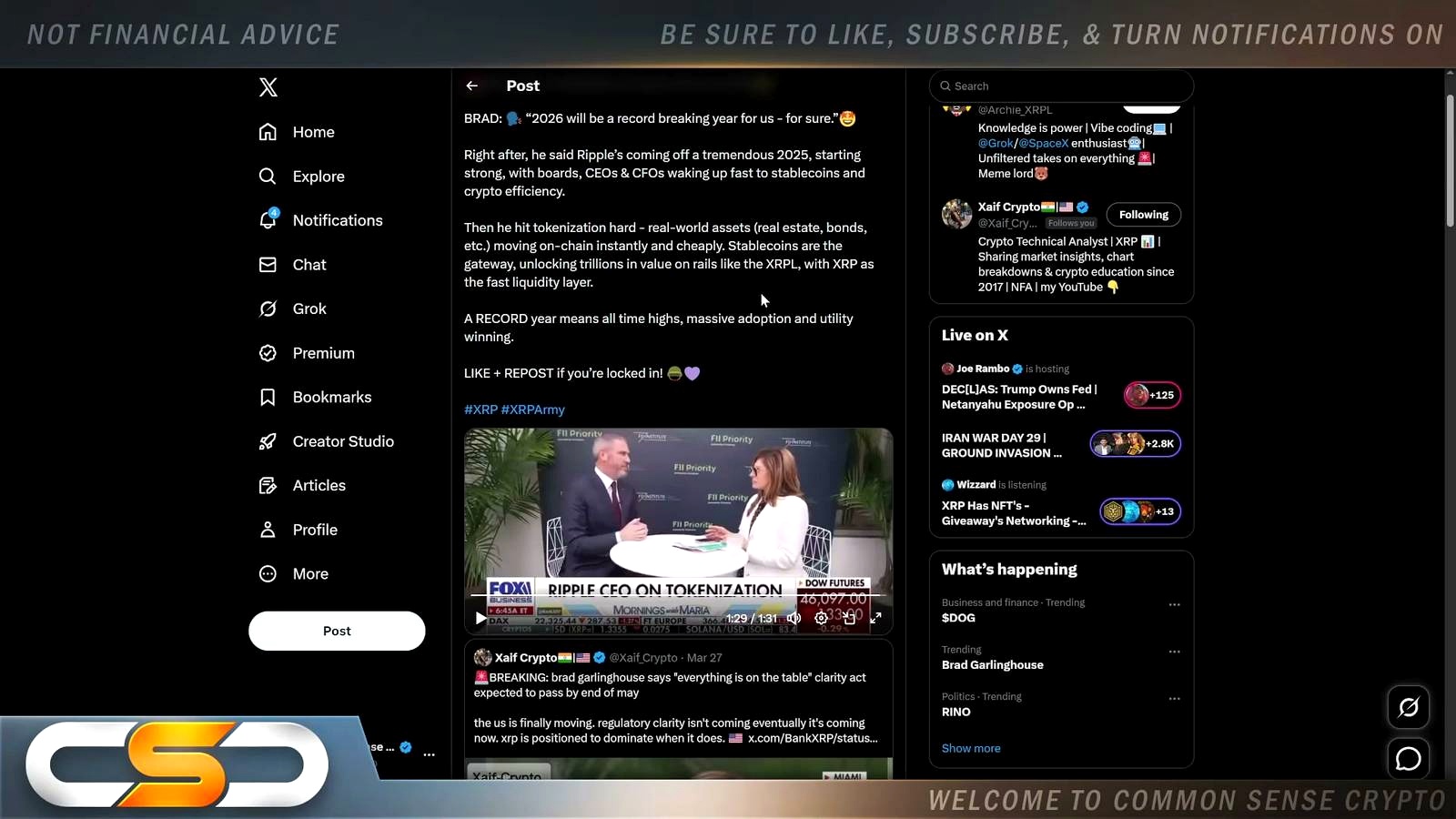
The host’s strongest evidence for that shift came from comments by Ripple CEO Brad Garlinghouse on Fox News. Garlinghouse said major financial players have moved from dismissing crypto as “rat poison” or a “pet rock” to exploring how blockchain technology and stablecoins can improve real-world financial operations.
He also singled out BlackRock CEO Larry Fink as an early high-profile convert who recognized “real technology value” in these systems. Garlinghouse added that corporate leaders across the US are now asking their finance teams whether they should be using stablecoins and whether those tools are more efficient than legacy systems.
One concrete example stood out: Garlinghouse said stablecoins can be used 24/7, unlike legacy financial rails that effectively shut down late in the week. He contrasted that with traditional markets that “close” around 4 or 3:00 on a Friday afternoon, and said on-chain rails could allow something like a real estate transaction to settle on a Saturday.
Common Sense Crypto interpreted the remarks as a sign that institutions are no longer treating crypto as fringe. He went further, saying he believes Ripple and BlackRock may be building something significant behind the scenes, though he offered no evidence beyond his reading of Garlinghouse’s comments.
XRP lending on-ledger is the most actionable development in the video
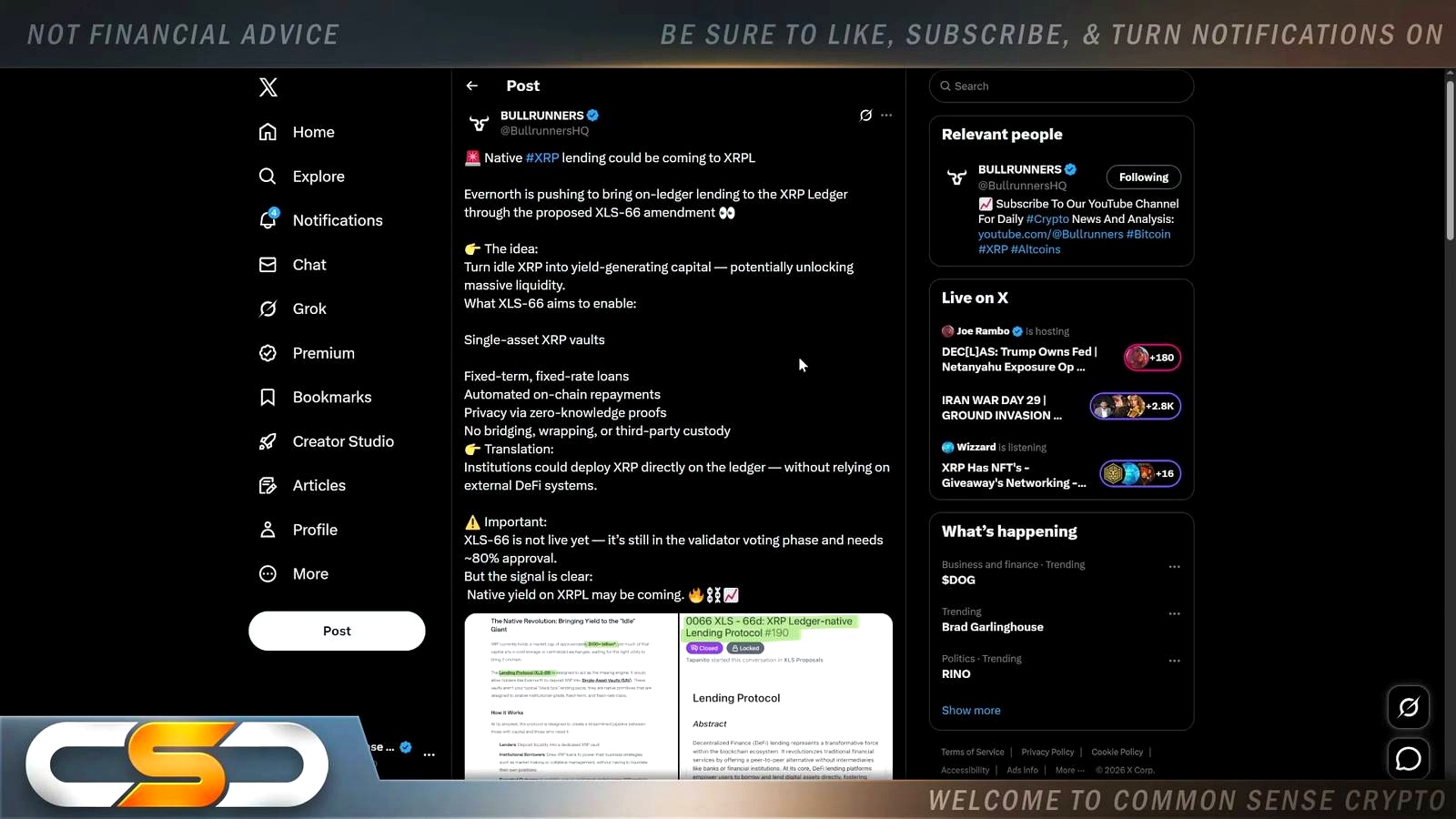
The clearest product-level development discussed in the segment was a proposal tied to the XRP Ledger. Common Sense Crypto highlighted a push by Evernode to bring native lending on-chain through the proposed XLS-66 amendment.
As presented in the video, the design would include:
- Single-asset XRP vaults
- Fixed-term, fixed-rate loans
- Automated on-chain repayments
- Privacy verification via zero-knowledge proofs
- No bridging, wrapping, or third-party custody
The host’s interpretation is that this could turn idle XRP into yield-generating capital and unlock liquidity directly on the ledger. He also made a more pointed claim about who would supply that capital: XRP holders themselves. In his view, if institutional lending grows on the XRP Ledger, retail holders could become the lenders, effectively acting as their “own bank.”
That matters because it moves the XRP story away from abstract adoption talk and into a more specific financial role: holders potentially supplying capital into a native lending market rather than simply waiting for price appreciation.
The regulatory contradiction: pro-crypto rhetoric, slower execution
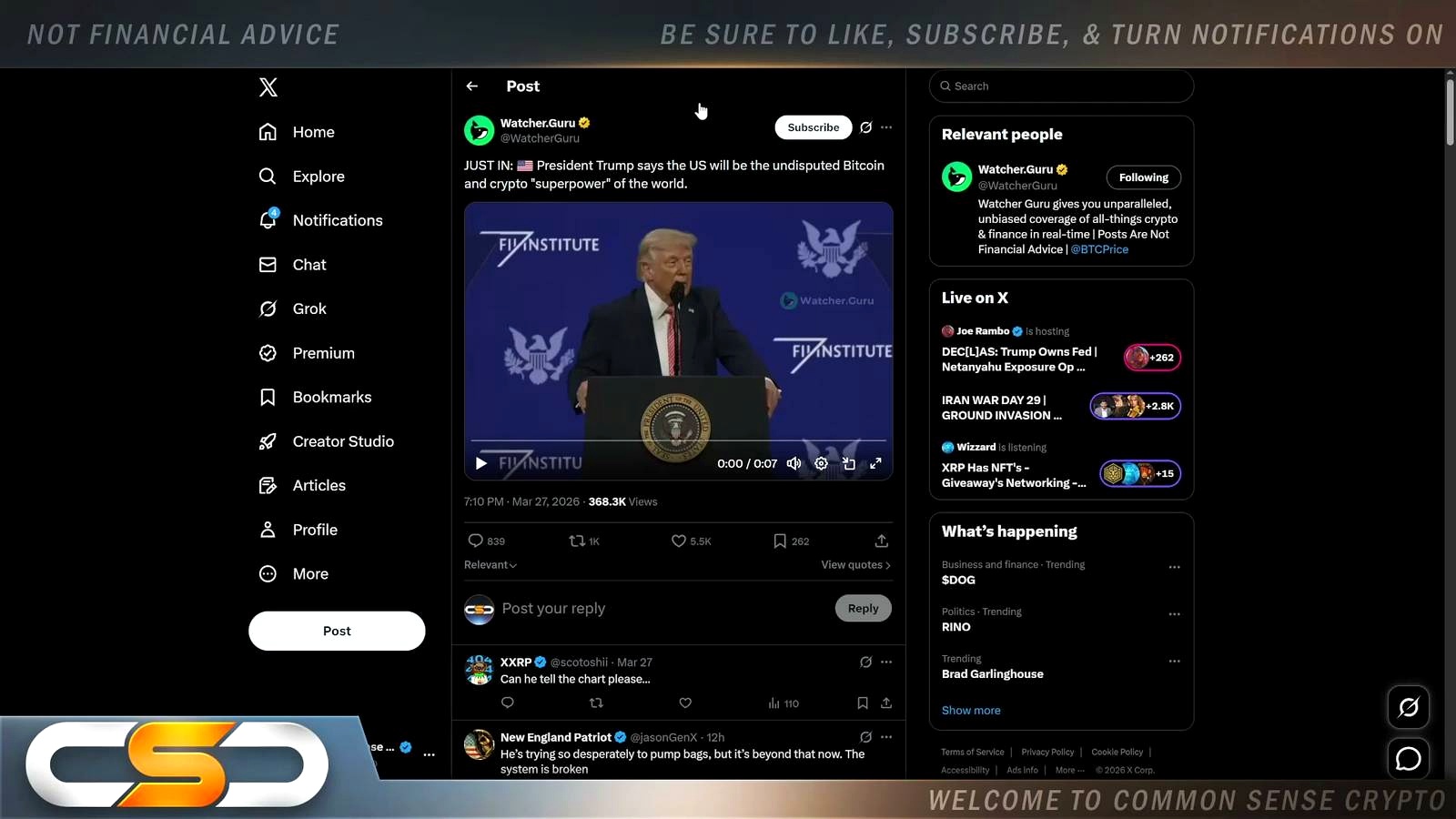
Common Sense Crypto also focused on US political messaging around crypto, especially comments from President Donald Trump and market participants around the current regulatory climate. Trump said the United States would become the world’s “undisputed crypto capital” and “Bitcoin superpower.”
The host pushed back on that rhetoric. His argument is that the US cannot claim crypto leadership while regulation keeps stalling. He said other jurisdictions are moving faster, while the US still faces repeated delays whenever major rules appear close to being finalized.
To sharpen that point, he contrasted broad pro-crypto language with friction around stablecoin yield and compliance. He referenced a comment from another speaker who said SEC leadership has shifted from a punitive posture under Gary Gensler to a more supportive one under Paul Atkins, including an ambition to put markets on-chain. But Common Sense Crypto said that enthusiasm tends to fade when financial incumbents face the prospect of losing revenue.
His takeaway is that official support for innovation is real, but conditional. Once crypto begins competing directly with existing profit pools, especially in payments and yield products, resistance rises quickly.
KYC, AML, and the bottleneck thesis
The analyst sees compliance, not market demand, as the next major choke point. He said KYC and AML requirements will become central as crypto scales, particularly because regulators and institutions want certainty about who is transacting on-chain.
He linked that problem to several potential outcomes:
- A compliance bottleneck for stablecoins
- A bottleneck for crypto exchanges
- A broader restructuring of the crypto market
- Pressure toward digital ID systems
His view is that once legislation finally passes, large parts of the current market structure could be disrupted at once. He described that as a potential “black swan” moment for crypto, not because the sector disappears, but because the rules of participation change suddenly.
That leads to one of his most important forward-looking claims: only a small group of cryptocurrencies, exchanges, and stablecoins are likely to emerge stronger after the regulatory transition.
Why he thinks a utility run could replace the usual boom-bust cycle
Common Sense Crypto’s biggest market call was not a short-term price target. It was a structural prediction. He said he does not see the kind of deep drawdowns that have defined prior crypto cycles, specifically questioning whether 80% to 90% pullbacks still make sense if the market enters what he called a “full-blown utility run.”
His reasoning is that real adoption changes the character of demand. If institutions onboard more value, if stablecoins and tokenized assets see more usage, and if lending and settlement migrate on-chain, then price support should come from utility rather than pure speculation. In that scenario, he said, select assets could move into repeated all-time highs and price discovery instead of returning to the old crash-recovery pattern.
He believes that process begins this year.
Secondary flashpoints: religion, online tribalism, and Charles Hoskinson
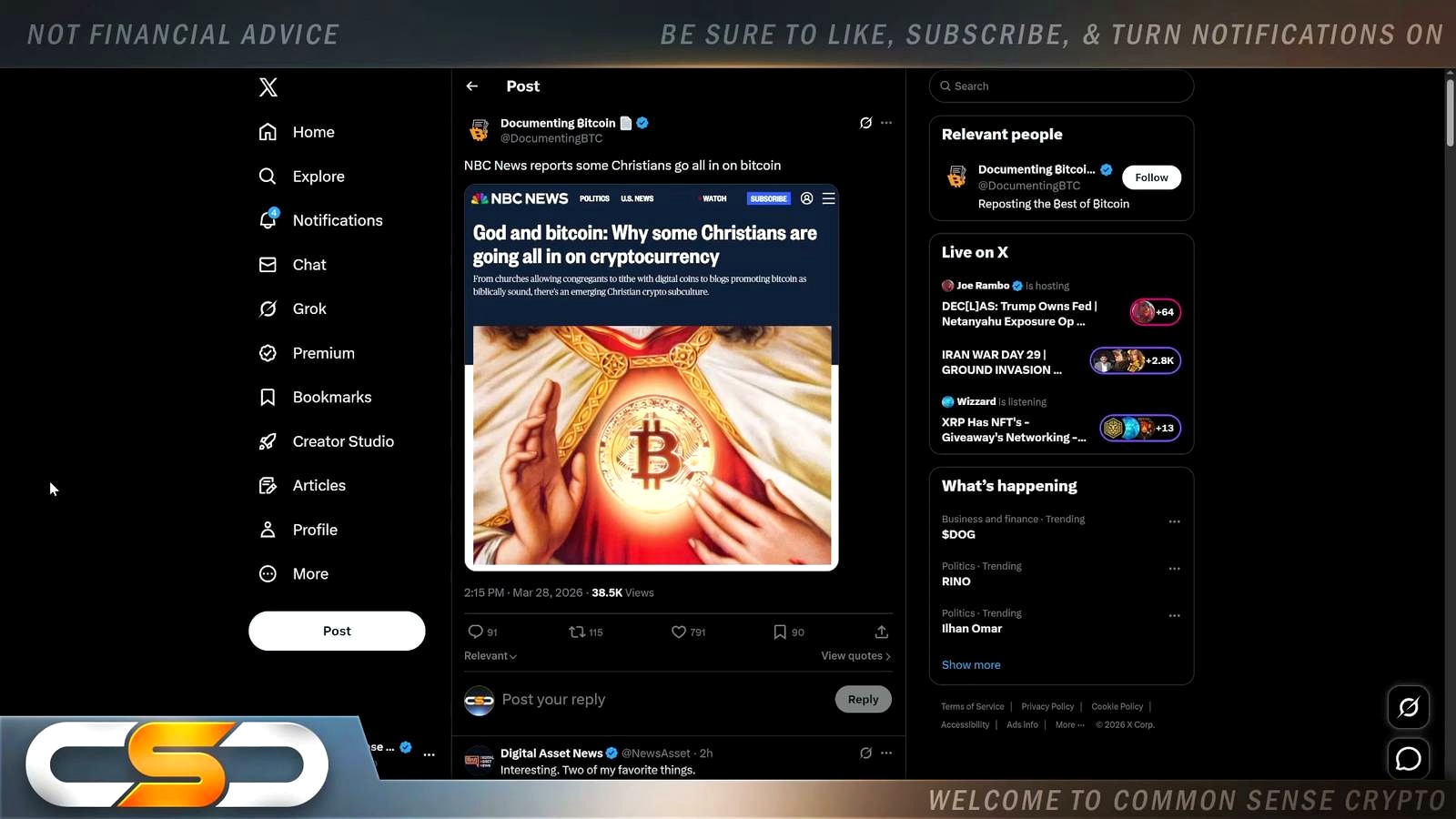
The video also veered into the culture wars around crypto. The host mentioned an article about Christians adopting Bitcoin and crypto, noting an emerging subculture that includes churches accepting tithes in digital assets and blogs describing Bitcoin as biblically sound. He was skeptical of a specifically Bitcoin-centered religious narrative, though he said people from all religions and backgrounds will continue entering crypto.
He also addressed a social media claim that many XRP investors are involved in Freemasonry. He rejected the idea as relevant to his own work, saying people can believe what they want and that holders come from many different backgrounds.
On inter-chain politics, he reacted to Charles Hoskinson’s criticism of the XRP community. Hoskinson said he supported Ripple during its SEC fight but did not contribute money because Ripple already had vast resources from its token holdings. He compared that to projects from 2017 and cited Ripple’s access to “tens of billions of dollars, ” while also saying he did not allocate himself 70% of ADA supply. Common Sense Crypto said Hoskinson was not wrong that Ripple had the funds to fight, but criticized him for spending too much time inserting himself into disputes involving other networks.
What to watch next
If Common Sense Crypto is right, the next phase of the market will be defined less by Bitcoin headlines and more by the plumbing of digital finance. The immediate watch points are clear: whether stablecoin legislation advances, whether tighter KYC and AML rules begin reshaping exchanges, and whether proposals like XLS-66 move XRP Ledger closer to native lending.
The broader question is whether institutional adoption shows up as real product usage rather than conference-stage optimism. If that happens, the market may start rewarding infrastructure that can settle, lend, verify, and comply at scale. If it does not, Bitcoin’s gravitational pull could reassert itself faster than utility narratives expect.
FAQ
Did Common Sense Crypto give a specific Bitcoin price forecast?
No new BTC target was given by the host. The only specific Bitcoin price figures mentioned were a contrast from Crypto Rover: above $150,000 was the promise, while below $100,000 was the reality described in the video.
What is the main bullish case for XRP in this segment?
It is not just price speculation. The host’s main XRP bull case is that the XRP Ledger is being positioned for institutional utility, especially through potential on-ledger lending, stablecoin-related use, and broader financial infrastructure.
Why does KYC and AML matter so much in this analysis?
Because the host believes mass on-chain finance cannot scale without stronger identity and compliance controls. In his framing, that is the tradeoff behind institutional adoption: more legitimacy and capital, but also more friction and fewer survivors.
What numbers were mentioned in the video?
Key figures included $150,000, $100,000, 24/7, 4, 3:00, XLS-66, 2017, $4 billion, 70%, 80%, and 90%.
What is the next concrete development to monitor on XRP Ledger?
The most tangible item is the proposed XLS-66 amendment and whether it advances native lending features such as fixed-rate loans, automated repayment, and zero-knowledge-proof-based privacy checks without wrapping or third-party custody.
Source Video

John Burnell focuses on Bitcoin infrastructure, wallet security and blockchain technology. He writes educational articles explaining how Bitcoin works and how the technology evolves.