Something feels off in the old safe-haven playbook. In the middle of war, panic, and market whiplash, the asset people were taught to trust most did the one thing it was never supposed to do.
That shock is forcing a bigger question into the open: if gold is losing its grip at the exact moment fear is everywhere, where does all that money go next?
Gold Was Supposed to Shine. Instead, It Broke Down.

The core case for gold has always been simple. When conflict breaks out, inflation rises, and governments look unstable, gold is supposed to hold value while everything else falls apart.
But that is not what happened here.
- Gold fell 17% since the US-Iran war started
- At its worst, it was down 22% from its all-time high
- That officially pushed it into a bear market
- Silver followed lower
This was described as an “extremely brutal flush” by JP Morgan, even while the bank kept a long-term bullish view on gold if the war continues.
That contradiction is the story. The traditional hedge did not behave like a hedge when stress actually arrived.
Why Gold May Be Falling Anyway
The explanation offered is less dramatic than the price action itself: a liquidity crunch.
When people cannot see clearly, they do not always run to gold. Some run to cash. They take profits, hold dollars, and wait. Last year’s gold bull run created gains, and many may simply be taking them off the table.
That may be the unglamorous answer. But it still leaves a giant open question.
Bitcoin Is Doing Something That’s Hard to Ignore

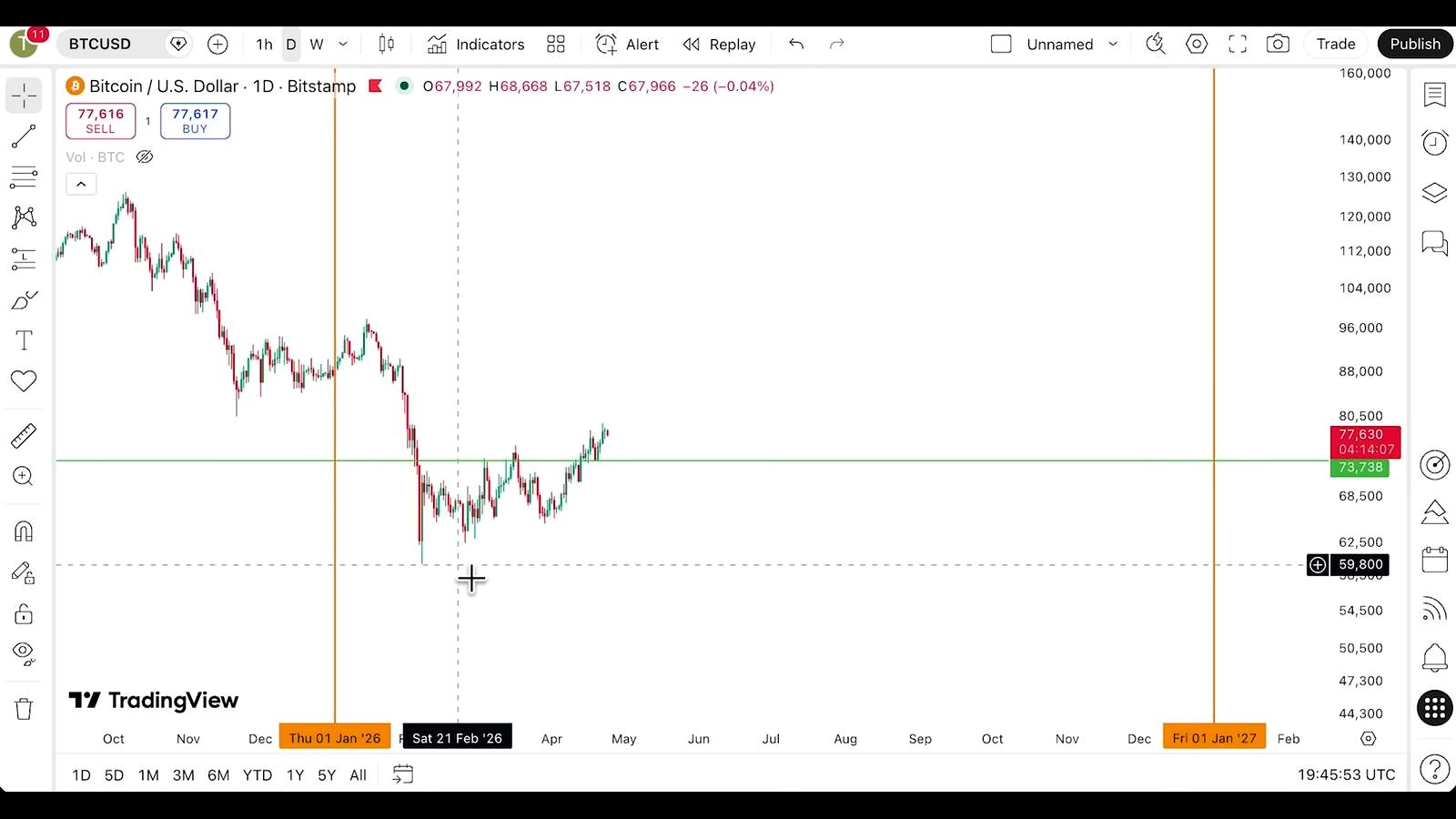
While gold dropped, stocks swung wildly, bonds got hit, and oil turned chaotic, Bitcoin moved the other way.
- Bitcoin rose nearly 8% over the same period
- It held around $70,000
- It did not “flinch” while other major assets behaved erratically
This is not being framed as some explosive breakout. The point is not that Bitcoin suddenly went vertical. The point is the context around that move.
When everything else is unstable, even relative strength starts to look like a message.
What “Decoupling” May Really Look Like
A macro analyst from Bitcoin Perception, Fernando, posed the key idea: maybe Bitcoin decoupling was misunderstood from the start.
Many expected decoupling to mean Bitcoin rises while everything else stays flat. But maybe the real version is uglier and more revealing than that. Maybe it means everything else falls hard, and Bitcoin simply does not fall the same way.
That is the pattern being pointed to now:
- Stocks down
- Gold down
- Bonds down
- Oil volatile
- Bitcoin steady to higher
That does not prove a full separation. But it makes the old “fragile speculative asset” narrative harder to defend.
The $7 Trillion Question

Since January, $7 trillion has left gold. That number hangs over everything.
Is it already flowing into Bitcoin? The answer given is blunt: probably not yet, at least not most of it.
The numbers shared around recent ETF activity are small beside that larger move:
- BlackRock and Fidelity were net buyers of Bitcoin last week
- Bitcoin ETFs saw about $400 million in inflows
- They also saw about $250 million in outflows
- That leaves a net $150 million inflow
Against $7 trillion leaving gold, that is tiny. A rounding error.
But the argument is that this may be the pause before redeployment, not the end of the story. People sitting in cash are still watching war, bond yields, and equity swings. They took gains. Now they are waiting.
The real issue is what looks credible when they decide to move again.
Why Bitcoin’s Case May Be Strengthening
The bullish argument is not based on hype. It is based on behavior under pressure.
Bitcoin held during a war while other supposed shelters did not. If institutions are studying that, the question starts to change.
It stops being:
Is Bitcoin just a speculative asset?
And starts becoming:
Is Bitcoin the new neutral reserve asset?
That shift matters because it points to a different kind of capital rotation entirely.
The Market Chaos Made the Contrast Louder

The sense of instability did not come from gold alone. It came from how quickly traditional markets were thrown around by headlines and political messaging.
One example stood out:
- President Trump posted on Truth Social that the US and Iran had “very good and productive conversations” about ending the war
- In six minutes, the S&P added $2 trillion in market cap
- Iran then denied it
- In the next hour, the S&P erased $3 trillion
That is trillions moving on a post, then reversing almost immediately.
At the same time:
- The 10-year bond yield broke 4.4%
- Bonds did not behave like a safe haven
- Oil surged as the Strait of Hormuz situation escalated, then shifted again after comments from Treasury
- Gold fell when it was expected to rally
The claim is not that Bitcoin is perfect or that its price cannot drop. It is that, relative to the rest of the board, it is acting with more consistency and integrity than the assets people were told would protect them.
A New Regulatory Signal for Bitcoin

Another development added weight to that argument. The SEC and CFTC issued a joint framework formally classifying Bitcoin as a digital commodity outside securities law.
The way this is described matters:
- No issuer
- No company behind it
- No fundraising
- Just an asset
From that perspective, Bitcoin is presented as the only truly neutral digital commodity.
In a world where governments print money, fight wars, and markets react violently to social posts, neutrality starts to look less abstract. It becomes part of the appeal.
Why Neutrality Is Suddenly a Bigger Deal
The argument here is straightforward. Bitcoin has no CEO to fire, no board to pressure, and no central bank to bend.
That feature may have been underappreciated until now. In a moment when trust in traditional protection is wobbling, the absence of a controlling center starts to stand out.
The Fight Over Self-Custody Is Getting More Serious

There is another layer to this story, and it is not about price.
The EU’s anti-money-laundering authority is preparing guidelines due by July 2027 that would require crypto exchanges to verify the identity of anyone using a self-custody Bitcoin wallet before sending funds.
That means exchanges may need to confirm that a user owns a self-custody address before sending Bitcoin to it. If they cannot verify that ownership, they could potentially be blocked from sending funds there.
The warning is sharp: this would attach government identity to private keys and remove one of the last remaining privacy layers in Bitcoin usage.
Why This Feels Bigger Than a Rule Change
Bitcoin is described here as the most transparent financial ledger ever created. Every transaction is visible. The only privacy layer left is that a wallet address is not automatically tied to a real-world identity.
The concern is that the EU wants to remove that by law, while also rolling out a digital ID system and pushing further into central bank digital currencies.
The implication being drawn is clear: these are not isolated developments. They point toward a full financial surveillance system, with Bitcoin being pulled inside it rather than left outside.
The “Exit” Idea Is What Ties This All Together

By the end of this argument, Bitcoin is not being framed as a get-rich-quick trade or a speculative thrill. It is being framed as an exit.
An exit from:
- A gold market that failed in a geopolitical crisis
- An S&P that can gain and lose trillions on conflicting posts
- A bond market that is not acting like shelter
- A regulatory direction that tightens surveillance around money
The conclusion is emotional, but it is also simple. This week did not create the signal. It exposed it.
Gold failed this week. The S&P failed this week. Bonds failed this week. Bitcoin, in this telling, did not.
That is why the $7 trillion leaving gold matters so much. Not because it has already fully arrived in Bitcoin, but because the search for a destination may be shifting.
FAQ
Why is the move in gold being treated as such a big deal?
Because gold is traditionally held as protection during inflation, conflict, and instability. In this case, it fell 17% since the war started and at one point was down 22% from its all-time high, entering a bear market.
Did the $7 trillion leaving gold already flow into Bitcoin?
The argument presented says probably not yet, or at least not most of it. Recent Bitcoin ETF net inflows of about $150 million are very small compared with $7 trillion.
What is the case for Bitcoin here?
The case is based on relative behavior. While gold, bonds, and stocks struggled, Bitcoin rose nearly 8% over the same period and held steady around $70,000.
What does “Bitcoin decoupling” mean in this context?
It means Bitcoin may not need to surge while everything else stays calm. Instead, decoupling could mean other assets fall sharply while Bitcoin holds up better.
What did the SEC and CFTC say about Bitcoin?
They issued a joint framework classifying Bitcoin as a digital commodity outside securities law, with no issuer, no company behind it, and no fundraising.
Why are the EU self-custody guidelines causing concern?
Because the proposed guidelines would require exchanges to verify the identity of people using self-custody wallets before sending them funds, potentially linking government identity to wallet ownership.
What is the broader claim of this article?
That recent market behavior has made Bitcoin look less like a speculative outlier and more like the only asset showing consistency while traditional safe havens and legacy markets behave unpredictably.
Reference Video

John Burnell focuses on Bitcoin infrastructure, wallet security and blockchain technology. He writes educational articles explaining how Bitcoin works and how the technology evolves.