A Bitcoin wallet does much more than display a balance or generate a receiving address. Behind the scenes, it turns 12 simple words into the foundation of a system that can control unlimited Bitcoin addresses and help keep Bitcoin as safe as possible.
Those 12 words are not just a backup phrase. They are the master key to an entire wallet structure built on randomness, mathematical checks, derivation paths, and digital signatures.
What Happens When You Set Up a Bitcoin Wallet
When a wallet is created, it does not simply pick 12 random words from a dictionary. A precise process happens behind the scenes.
True Randomness Comes First
Your wallet first generates pure randomness. A simple way to imagine this is flipping a coin 128 times and recording each result, although the wallet uses much more sophisticated randomness that is practically impossible to predict.
How Randomness Becomes 12 Words
That randomness is converted into a string of words using the BIP39 word list. This list contains exactly 2048 different words. Each word represents 11 bits of computer data because 2048 equals 2 to the power of 11.
With 12 words, the total becomes 132 bits of data:
- 128 bits of randomness
- 4 bits of error checking at the end
Why the 12th Word Matters
The final word is not completely random. It contains a mathematical checksum. If a typo is made later when entering the words, the wallet can detect that something is wrong instead of accidentally creating a new wallet with a zero balance.
This is why you cannot just pick 12 random words from the BIP39 word list. The math has to be exactly right, and the order of the words is critical. Changing the sequence creates a completely different Bitcoin wallet with different Bitcoin addresses.
What the 12 Words Really Are

Together, the 12 words are technically called a mnemonic phrase, though most people call it a seed phrase. They are essentially the master key to your entire Bitcoin universe.
A useful way to think about it is a magic phrase that can unlock thousands of different safety deposit boxes, each potentially containing some of your Bitcoin.
Not Your Keys, Not Your Coins
When people say, “not your keys, not your coins,” they are talking about control over this seed phrase. If you do not control these 12 words, you do not really own your Bitcoin.
Why Wallets Transform the Words
A wallet cannot use the 12 words directly to send Bitcoin. The words are a human-readable format of a giant number, so the wallet transforms them through a mathematical process into what is called a master extended key.
This master extended key is a long string of letters and numbers. It becomes the trunk of the wallet’s family tree, and everything else in the wallet branches out from it in an organized way.
The Master Fingerprint
Your wallet also creates a master fingerprint. This is a short eight-character identifier mathematically derived from the master extended key. It acts like an ID tag or a license plate for that specific wallet and helps ensure different parts of the wallet belong to the same master key.
How 12 Words Control Unlimited Bitcoin Addresses
Once the wallet has the seed phrase and the master extended key, it uses a derivation path system. This is the organizational structure that lets one wallet generate unlimited addresses.
The Wallet Tree Structure
The structure works like a family tree or an upside-down tree. The trunk is at the top, and the branches expand downward. The derivation path acts like directions for the wallet and is set up in a hierarchical fashion.
Seed Phrase to Master Key
The 12 or 24-word seed phrase generates a BIP39 seed using a BIP39 algorithm. Through PBKDF2 plus salt technology, which is a key derivation function, that seed is turned into a large number used to generate the master extended key.
This master key may begin with a unique prefix such as:
- XPRV
- ZPRV
- TPRV
The prefix depends on wallet settings and the derivation path in use.
Understanding the Derivation Path
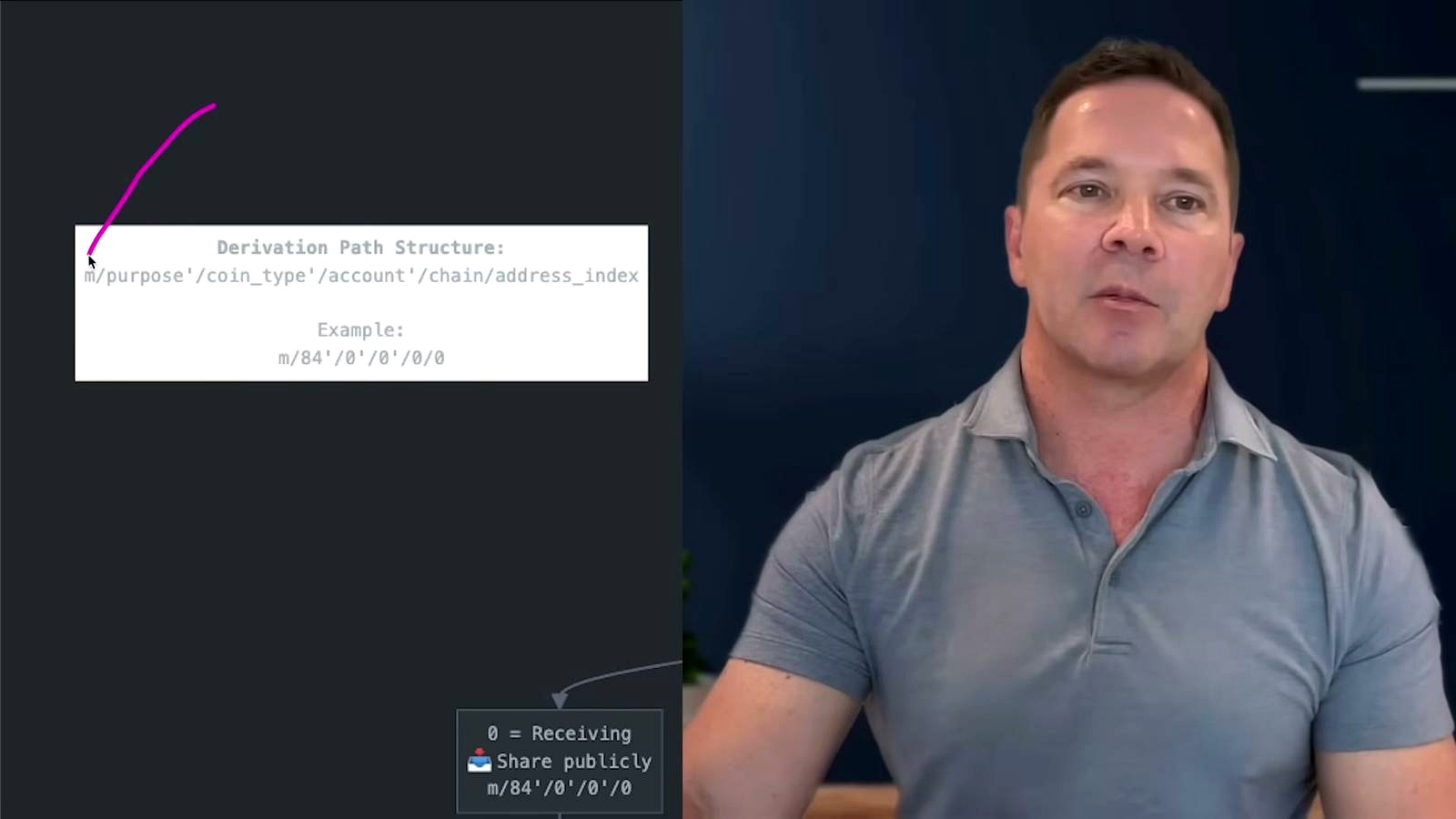
The derivation path is like a filing system with folders, subfolders, and more subfolders. Each level serves a distinct purpose.
Level 1: Master Level
This is the master extended key, the main key that controls everything. In a derivation path, it is often represented by the master fingerprint or simply by the letter M.
Level 2: Purpose
This level tells the wallet what type of Bitcoin addresses to create, such as native SegWit, Taproot, SegWit, or Legacy.
Examples mentioned include:
- 44 for Legacy
- 84 for native SegWit
Native SegWit has lower fees and is broadly accepted as the standard at the moment. Taproot is the most advanced version mentioned and has advanced privacy built into it, though some exchanges and wallets still do not offer Taproot support yet.
Level 3: Coin Type
For Bitcoin, this value is always set to zero. This allows the same wallet structure to support multiple cryptocurrencies while keeping them completely separate.
Level 4: Account
This level works like having different bank accounts within the same bank. You could have one Bitcoin account for personal spending, another for business activities, and another for long-term savings.
Each account is separate, but all of them can be restored from the same 12-word seed phrase.
Level 5: Chain
This level determines whether the wallet is creating receiving addresses or change addresses.
- 0 = receiving address
- 1 = change address
A receiving address is the one you give out publicly. A change address is used when you make a payment and receive change back from that payment.
Level 6: Address Index
This final level creates the actual Bitcoin address used to receive Bitcoin. The first address index is zero, then the sequence continues upward.
There is no mathematical limit to the number of addresses that can be created in a wallet.
Why Unlimited Addresses Are Useful
Privacy
Each transaction can and should use a completely different address. This makes it much harder for anyone to track spending or estimate how much Bitcoin you own.
Organization
You can keep completely separate financial identities within the same wallet. Business transactions can stay separate from personal spending while still being backed up by the same 12 words.
Security
Even if someone discovers one Bitcoin address, they cannot figure out your other addresses or work backwards to compromise the master key. The mathematical barriers prevent this.
The process is like mixing paint colors. You can mix blue and yellow to get green, but if someone sees green paint, they cannot work backward and determine exactly what was used to create it.
How a Wallet Signs a Bitcoin Transaction
When you send Bitcoin, the wallet must prove that you own the Bitcoin at a specific address.
Following the Path to the Right Key
The wallet starts with the master key and follows the exact derivation path needed to generate the private key for the address that contains the Bitcoin you want to spend.
Creating a Digital Signature
Once the wallet has the correct private key, it takes the transaction details and performs a mathematical calculation on that data. This produces a unique digital signature.
That signature proves you control the address without revealing the private key itself.
Private Keys on Demand
The wallet can generate the exact private key it needs on demand, even for addresses that have never been used before, all derived from the original 12 words.
Why the System Is So Secure
This system creates security that is almost impossible to break.
The Number of Possible Seed Phrases
Your 12 words come from the BIP39 word list of 2048 words. The number of possible combinations is so large that there are more combinations than atoms in the universe.
The odds of someone guessing your seed phrase are essentially zero.
Brute Force Is Not Practical
Even if someone had a computer that could check a billion different combinations of 12-word seed phrases per second, it would take approximately 5.4 sextillion years to have a reasonable chance of guessing one 12-word seed phrase.
That is over 390 billion times longer than the age of the universe.
24 Words Increase Security Even More
If you use a 24-word seed phrase, the security increases enormously. The increase described is the 12-word security multiplied by 340 undecillion, a number so large it defies comprehension.
Hierarchy Adds More Protection
The hierarchical structure means that even if someone gains access to one piece of information, like a single address or even an account-level key, they cannot work backwards to compromise other parts of the wallet or figure out the master key.
The cryptographic math behind the system has been tested by thousands of developers worldwide and has successfully secured billions, actually trillions of dollars for over a decade.
Why Seed Phrase Control Matters
Whoever controls the 12 words controls the Bitcoin.
Risks of Leaving Bitcoin on an Exchange
If Bitcoin is stored on an exchange, the exchange controls the keys or the seed phrase. That means the exchange actually controls the Bitcoin.
If the exchange gets hacked, goes bankrupt, or freezes an account, everything could be lost.
Sovereign Control With Your Own Wallet
When you have your own wallet with your own 12 or 24 words, you have complete sovereign control. Even if a phone breaks, a computer crashes, or a hardware wallet company goes out of business, everything can be restored with those words on compatible software.
How to Protect Your Seed Phrase
The seed phrase deserves serious protection because it is the root of the entire wallet.
Safer Storage Approaches
- Paper can work temporarily, but it can burn, get wet, or deteriorate over time.
- Metal backup plates are more durable and can survive fire, flood, corrosion, and time.
- If digital storage is used, it should be properly encrypted with a strong password of at least 24 characters including uppercase, lowercase, numbers, and symbols.
Using a Passphrase
Many wallets allow an optional passphrase, sometimes called the 13th or 25th word, on top of the seed phrase. This adds another layer of security because someone would need both the seed phrase and the passphrase to access the Bitcoin.
If the passphrase is forgotten or lost, access to the Bitcoin could be gone forever, so it should be stored securely but separately from the seed phrase.
Multiple Backup Copies
It can be wise to keep multiple copies of the seed phrase in different places. Examples mentioned include a home safe, a bank safety deposit box, and a desk drawer in a home office.
There is also a seed phrase splitting technology called Shamir backup that may be worth considering.
Important Safety Rules
- Never share your seed phrase with anyone.
- Do not type the seed phrase into a website.
- Do not take a picture of the seed phrase.
- Test your backup before putting serious money into the wallet.
Common Bitcoin Wallet Mistakes
Many beginner mistakes are simple oversights, but they can be catastrophic.
- Storing seed phrase words digitally without encryption in a notes app or on a computer
- Writing the words down in the wrong order
- Assuming the app on a phone is what controls the Bitcoin
- Keeping only one backup copy of the seed phrase
The app is only the interface to the Bitcoin blockchain. The 12 words are what actually control the Bitcoin.
Why Understanding Wallet Basics Matters
You do not need to become a cryptography expert, but understanding the fundamentals helps with better security decisions.
- It helps explain why hardware wallets are safer than smartphone applications because they keep the master key isolated from internet-connected devices.
- It shows why storing large amounts on exchanges is risky because you are trusting them with your keys.
- It highlights why backing up the 12 words is so crucial because they are literally your Bitcoin.
Bitcoin Wallets and Financial Sovereignty
Bitcoin wallets may seem like magic, but the process is built on mathematics and structure. Those 12 words are not just a backup. They are the root of a cryptographic tree that can generate unlimited addresses, maintain organization, and give complete financial sovereignty.
This system puts you in total control of your money, but that control comes with responsibility. Those 12 words should be treated with the respect and security they deserve.
FAQ
What is a Bitcoin seed phrase?
A Bitcoin seed phrase is a mnemonic phrase, usually 12 words, that acts as the master key to your wallet.
Can I choose any 12 words I want?
No. The words must come from the BIP39 word list and must match the required mathematics, including the checksum.
Why is the order of the seed phrase important?
The order is mathematically critical. Changing the sequence creates a completely different Bitcoin wallet.
How can 12 words create unlimited Bitcoin addresses?
The seed phrase is transformed into a master extended key, and the wallet uses hierarchical derivation paths to generate as many addresses as needed.
What is a derivation path?
A derivation path is the structured set of directions a wallet follows to generate accounts, chains, and individual Bitcoin addresses from the master key.
What is the difference between a receiving address and a change address?
A receiving address is shared publicly to accept Bitcoin. A change address is used by the wallet to receive change back when making a payment.
Can someone figure out my seed phrase from one Bitcoin address?
No. The mathematical barriers prevent anyone from working backward from a single address to the master key.
What happens if I lose my device?
If you still have your 12 or 24 words, you can restore your wallet on compatible software.
Is storing Bitcoin on an exchange the same as owning the keys?
No. If the exchange controls the keys or seed phrase, the exchange controls the Bitcoin.
What is the biggest security rule for a seed phrase?
Never share it, never type it into a website, and never take a picture of it.
Video Reference

Omar Al-Sharif lives and works in the UAE and is involved in the blockchain technology industry. He writes articles on Bitcoin and digital assets as a personal passion, explaining complex topics in simple and understandable language.