Bitcoin is moving deeper into mainstream finance as institutional adoption continues to expand. Matt Hougan, CIO of Bitwise, argues that the market is in the process of bottoming, that the crypto winter began at the start of 2025, and that major firms such as Morgan Stanley are accelerating Bitcoin’s normalization.
His outlook combines market structure, ETF demand, regulation, institutional behavior, and the growing role of Bitcoin in portfolios. The result is a view that current sentiment is disconnected from fundamentals that remain strong underneath the surface.
Bitcoin Market Outlook: Bottoming During a Deep Crypto Winter
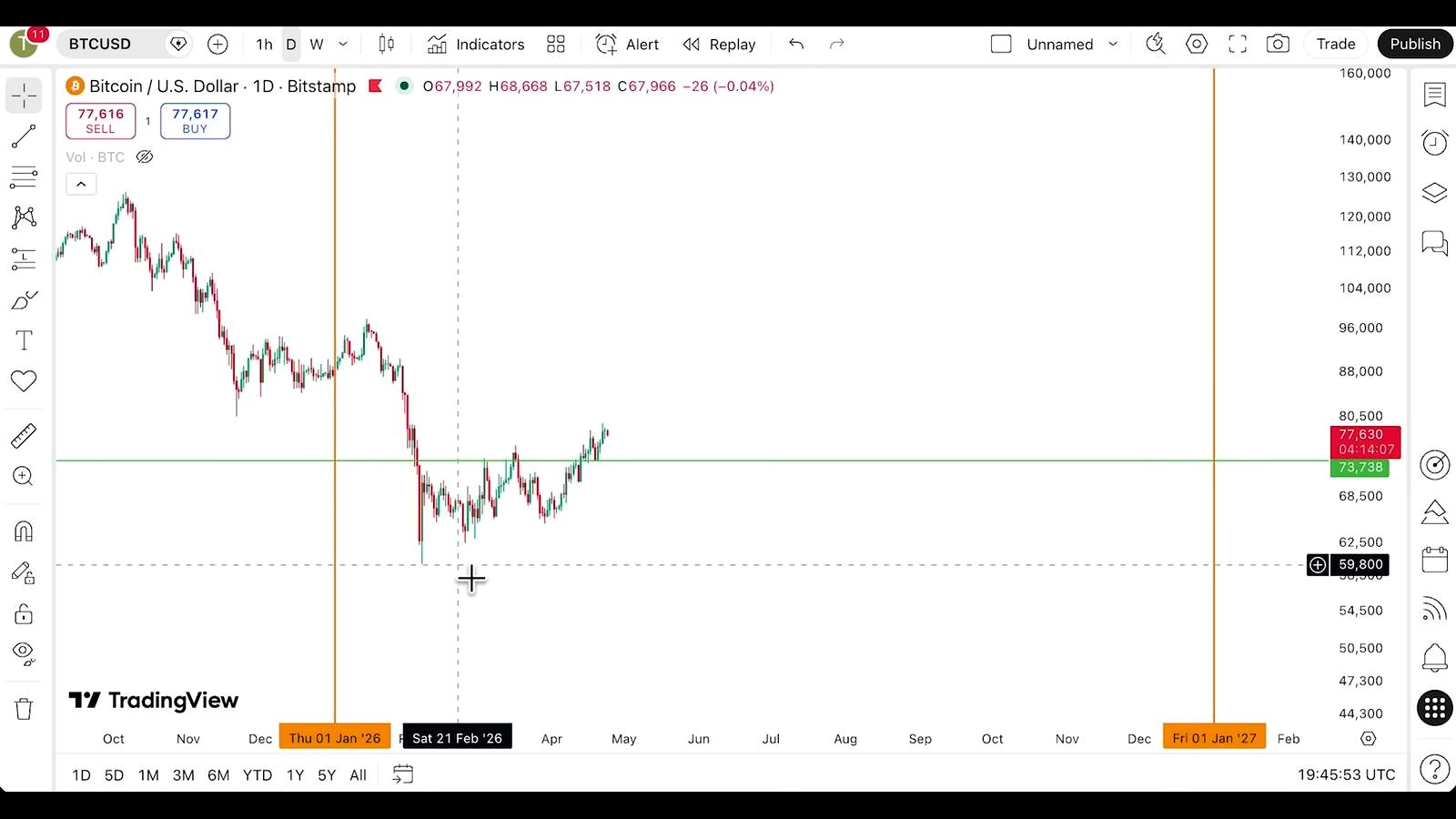
Matt Hougan says Bitcoin is already bouncing and appears to be in the process of bottoming. In his view, the market is deep into a crypto winter that may already be showing the first signs of spring.
He argues that this winter started at the beginning of 2025, but many participants did not notice because institutional capital kept flowing into Bitcoin through ETFs. That demand helped support prices even as retail selling was heavy and sentiment deteriorated sharply.
Why the 2025 Winter Looked Different
According to Hougan, this cycle was more about wearing investors out than scaring them out. Unlike 2022, the current downturn did not feature collapsing core infrastructure or a regulator trying to end the industry.
- Institutional investors continued coming in
- Regulation moved in a positive direction
- Other crypto use cases continued emerging
- Fundamentals stayed strong despite poor sentiment
He contrasts that with 2022, when FTX collapsed, core infrastructure was under pressure, and the regulatory environment was deeply hostile. In his view, comparing the current winter to 2022 or 2018 is an absurd comparison because the backdrop is much more constructive now.
Why Sentiment and Reality Have Diverged
Hougan believes the biggest gap in the market is between perception and reality. He says people are ignoring long-term good news and treating the present moment as though the underlying story has broken, when he sees the opposite.
He describes the current phase as a classic crypto winter, and says winters turn into spring. That framing matters because it shifts the market from fear of structural damage to recognition of a cyclical opportunity.
The Role of Institutional Capital in Supporting Bitcoin
One of the clearest themes in Hougan’s view is the importance of institutional capital. He says that without ETF demand and corporate buying, Bitcoin would be dramatically lower.
His estimate is direct: without that institutional support, Bitcoin would be down roughly 70% to 75%.
How ETFs Changed the Market
Hougan says ETFs and corporations bought about $75 billion worth of Bitcoin in 2025. He sees that as a major stabilizing force in the market.
- ETF and corporate demand supported prices during heavy retail selling
- Underlying financial advisers continued buying
- Recent flow patterns suggest attempts to pick the bottom
He agrees with the argument that older investors in brokerage accounts have played a major role in supporting Bitcoin. He also says these buyers tend to be long-term allocators because they had to overcome strong social and professional stigma before investing at all.
Why ETF Buyers May Be “Diamond Hands”
Hougan explains that buying Bitcoin is different from buying a normal stock. Because Bitcoin still carries stigma in traditional finance, many investors need to be highly convinced before allocating.
That creates a stronger holder base. In his view, ETF buyers were often 80% or 90% convinced before entering, which makes them less likely to be shaken out by volatility.
Morgan Stanley and the Normalization of Bitcoin
Hougan is emphatic about what Morgan Stanley’s moves mean for Bitcoin. He describes the firm as a $10 trillion financial giant going “500 miles an hour” into the Bitcoin ecosystem.
He says this is a major signal that Bitcoin is becoming normalized across mainstream finance.
What Morgan Stanley’s Move Signals
Hougan notes that Morgan Stanley is moving into Bitcoin trading, lending, custody, and ETF offerings. He sees that as a powerful sign that Bitcoin is no longer being treated as an outsider asset.
- Bitcoin is becoming part of what brokerages offer
- Bitcoin is becoming part of what macro hedge funds trade
- Bitcoin is being integrated further into the mainstream
- Bitcoin is expected to sit alongside other holdings in bank and brokerage accounts
He also highlights the importance of Morgan Stanley attaching its own name to a Bitcoin ETF. In his words, it is a big deal for the firm to place “Morgan Stanley” next to “Bitcoin,” and that naming decision acts as an enormous signal.
Why This Matters for the Long-Term Bitcoin Story
For Hougan, mainstream integration is not a side story. It is central to Bitcoin’s long-term thesis. If Bitcoin is to become digital gold, it needs to be part of the mainstream financial conversation.
He believes that process is well underway, and sees Morgan Stanley’s actions as one of the strongest recent confirmations of that trend.
Why Bitwise Sees Strong Fundamentals Under the Surface
Bitwise manages over $15 billion in assets and has positioned itself as a crypto specialist. Hougan says the firm’s niche is serving investors who want expertise, care about custody, and want a manager that deeply understands crypto markets.
How Bitwise Differentiates in the ETF Market
Hougan says competing with firms like BlackRock means accepting that major brands will capture large market share. At the same time, he notes that these firms also expand the total size of the market dramatically.
Bitwise has focused on several areas of differentiation:
- Launching with a lower-cost ETF
- Appealing to investors who care about Bitcoin itself
- Donating 10% of gross profits to Bitcoin core developers
- Emphasizing proof of reserves and specialist market knowledge
- Being first to in-kind creations and redemptions
Support for Open-Source Bitcoin Development
Bitwise has donated to Brink, Open Sats, and HRF, and recently donated $233,000. Hougan says the process is intentionally hands-off, with equal grants, no strings attached, and no attempt by an ETF issuer to direct Bitcoin development.
He says it is important not to free ride on the work of developers and that being a perpetual funding source for Bitcoin development is phenomenally good.
Institutional Adoption Takes Time
Hougan says institutions rarely allocate after one conversation. In his experience, it often takes eight meetings before an allocation is made.
The Typical Eight-Meeting Path
- Early meetings focus on basics such as how Bitcoin works and how mining works
- Middle meetings focus on specific fears, uncertainty, and doubt
- Later meetings shift toward allocation size, rebalancing, and exposure methods
He says meetings one and two are polite and educational. Meetings three through six are usually the “FUD meetings,” where institutions investigate concerns such as quantum risk, environmental concerns, or other issues they have heard about. Once the final meetings shift to portfolio construction, allocation is usually close.
Why Adoption Cascades Over Time
Hougan describes adoption as mechanical once it begins. A financial adviser may start with a personal allocation, then allocate 1% to 2% for a few accounts, then across all accounts, and later move to 5% allocations.
He extends the same framework to sovereign wealth funds and central banks. The pattern is the same, but the cadence is slower:
- Retail investors can go through the process in days
- Financial advisers may take two years
- Sovereign wealth funds may take four years
- Central banks may take much longer
Why Sovereign Wealth Funds Matter
Hougan confirms that Bitwise regularly speaks with sovereign wealth funds. He says these institutions find Bitcoin attractive and are not raising fundamentally different concerns than other allocators.
The main difference is pace. They simply move more slowly.
Nation-State Level Adoption as a Catalyst
Hougan believes sovereign wealth fund adoption will become one of the major sources of new capital for Bitcoin. He also says the process can accelerate after the first few adopters move.
In his view:
- One institution opening the door matters enormously
- Adoption tends to become exponential in scale
- Nation-state level adoption will be one of the big catalysts ahead
He adds that ETF adoption itself is still early and says there could eventually be around $1 trillion flowing into ETFs, not just the tens of billions seen so far.
Bitcoin, Portfolios, and the Case for Allocation
Hougan argues that Bitcoin has shown unusually strong portfolio characteristics. He says adding Bitcoin to a 60/40 portfolio improved returns in every three-year period and in 93% of two-year periods.
Why Bitcoin Fits in a Portfolio
He describes Bitcoin as a “sweet spot asset” with several qualities:
- High potential returns
- Low correlations to other assets
- Liquidity
- Volatility that can improve rebalancing outcomes
His analogy is simple: Bitcoin is like salt for food. A small amount in a portfolio, combined with rebalancing, can improve the overall result.
The Volatility Argument
Hougan says one of the worst arguments against Bitcoin is that it is too volatile. He does not deny that Bitcoin itself is volatile, but says that must be considered in the context of the total portfolio.
According to him, allocations up to about 5% do not significantly increase overall portfolio volatility, while they can improve risk-adjusted returns.
Paper Bitcoin, Futures, and Liquidity
Hougan does not believe fears around “paper Bitcoin” are the main explanation for market weakness. He explains that when investors buy cash-settled futures, the other side often hedges by buying spot Bitcoin, which transmits demand back into the physical market.
Why Most of It Still Comes Back to Spot
He says there may be a small element of truth in concerns around futures and cross-correlation trades, especially in the short term. But in his view, the bulk of the market still boils down to spot Bitcoin.
He also argues that more competition and participation make markets:
- More fair
- More transparent
- More efficient
- More liquid
That liquidity matters for larger institutions. Hougan says central banks and insurance companies want to see deeper liquidity before entering the space.
Regulation, Banks, and the Shift Toward Mainstream Access
Hougan sees regulation as a major part of Bitcoin’s improving long-term setup. He says legislation matters because it provides a concrete floor under crypto regulation and makes progress more resistant to political change.
Why Regulatory Progress Matters
He says if current legislative efforts pass, they will be a catalyst for crypto. If they fail, it would be a setback. The key issue is preserving a level regulatory playing field through legislation rather than leaving everything vulnerable to future reversals.
Kraken’s Master Account as a Signal
Hougan also says Kraken’s narrow master account at the Fed is a much bigger deal than short-term payment efficiency. He sees it as another step toward normalization, a crack in regulatory capture, and a sign that Bitcoin and crypto are increasingly moving into ordinary financial infrastructure.
AI, Deflation, and Why Asset Prices Could Benefit
Hougan believes AI will be deflationary and that governments do not like deflation. In his view, they respond to deflation by printing, and that tends to benefit asset price inflation.
How AI Could Support Bitcoin
He sees two important links between AI and Bitcoin:
- AI-driven deflation could push governments toward monetary responses that benefit asset prices
- AI agents are likely to use digital blockchain-based rails, including Bitcoin
He says Bitcoin is native to AI agents because it is global, liquid, and fungible across borders. He also says agents may use stablecoins, but expects Bitcoin to make sense to them as well.
A Repeat of Past Asset Inflation?
Hougan compares this dynamic to the deflationary shock of China entering the WTO. He says that instead of absorbing that through lower prices, the system responded through printing money and spending money, producing modest CPI growth but massive asset price inflation.
He expects a similar pattern to emerge again.
Long-Term Vision: Bitcoin by 2030
Looking ahead, Hougan says Bitcoin could be relatively well established by 2030 and beginning to influence the macroeconomy. He expects a world where Bitcoin starts constraining central banks and governments from their worst habits around damaging local currencies.
A Constraint on Fiat Abuse
Hougan says he is not hoping for hyperbitcoinization. Instead, he prefers a world with a strong Bitcoin that acts as a constraint on abuse of the fiat system.
In that scenario, Bitcoin provides an alternative that limits how far governments and central banks can go. He sees that as one of the most positive long-term outcomes Bitcoin could deliver.
How Hougan Thinks About Entry Points
For investors waiting for a perfect entry point, Hougan argues that the long-term perspective matters more than short-term precision. If Bitcoin is here to stay, he says it is easy to project it into a much higher long-term category.
His Preferred Approach
To reduce behavioral risk, he favors dollar-cost averaging.
- Take the amount you plan to invest
- Divide it by 12
- Invest monthly over 12 months
He says this approach may not perfectly time the bottom, but it also avoids the emotional damage of buying once, seeing a sharp drop, and getting shaken out of what he describes as a generational wealth opportunity.
FAQ
Why does Matt Hougan think Bitcoin is bottoming?
He says Bitcoin is already bouncing, the market is reacting positively to good news again, and the current setup looks like a deep crypto winter that may already be giving way to spring.
When does Hougan say the crypto winter began?
He says this crypto winter began at the beginning of 2025, but many people did not notice because institutional capital flowing through ETFs supported prices.
How much lower would Bitcoin be without ETFs and institutional buying?
Hougan says that without ETFs and corporate buying, Bitcoin would likely be down around 70% to 75%.
Why is Morgan Stanley’s Bitcoin push important?
He says Morgan Stanley is a $10 trillion financial firm moving “500 miles an hour” into Bitcoin through trading, lending, custody, and ETF activity. He sees that as a major signal that Bitcoin is being normalized in mainstream finance.
Will Bitcoin be available in normal bank and brokerage accounts?
Hougan’s answer is yes. He says Bitcoin is becoming integrated into the mainstream and is likely to sit alongside other assets in bank accounts, brokerage accounts, and related financial platforms.
What does Bitwise do to support Bitcoin development?
Bitwise donates 10% of gross profits to Bitcoin core developers through equal, unrestricted grants distributed across organizations including Brink, Open Sats, and HRF.
How long does institutional Bitcoin adoption usually take?
Hougan says it often takes about eight meetings before an institution allocates. Early meetings are educational, middle meetings address FUD, and later meetings focus on portfolio construction and allocation size.
Why does Hougan think Bitcoin belongs in portfolios?
He says adding Bitcoin to a 60/40 portfolio improved returns in every three-year period and in 93% of two-year periods. He argues that Bitcoin’s return potential, low correlations, liquidity, and volatility make it a useful portfolio ingredient.
What is Hougan’s response to the claim that Bitcoin is too volatile?
He says that argument ignores portfolio context. In his view, small allocations of up to about 5% do not significantly raise overall portfolio volatility and can improve risk-adjusted returns.
Does Hougan think AI will matter for Bitcoin?
Yes. He says AI is likely to be deflationary, governments tend to print into deflation, and AI agents are likely to use digital blockchain-based rails, including Bitcoin.
What investing approach does Hougan prefer for someone waiting for the perfect Bitcoin entry?
He favors dollar-cost averaging over 12 months to reduce behavioral risk and avoid missing what he sees as a long-term opportunity.
Original Source

John Burnell focuses on Bitcoin infrastructure, wallet security and blockchain technology. He writes educational articles explaining how Bitcoin works and how the technology evolves.