There’s a moment this market keeps hinting at, and it doesn’t look like what most people expect. It’s not a neat countdown to a higher price. It’s the far more unsettling idea that one day Bitcoin may not feel expensive first—it may simply feel out of reach.
That’s the tension building now. The real story isn’t just how many coins will ever exist, but how many are still actually available when more buyers show up at once.
The part most people are missing
For years, the familiar Bitcoin story has centered on one number: 21 million. That hard cap matters. But by itself, it doesn’t explain what is unfolding inside the market.
The sharper question is about liquid supply—the Bitcoin that is actually available to buy on the open market. That is the inventory sitting on exchange shelves. And according to the material here, those shelves are thinning fast.
This changes everything. A fixed total supply is one thing. A vanishing sellable supply is something else entirely.
Total supply vs. liquid supply
The distinction is simple, but it carries enormous weight:
- Total supply: the 21 million coins that will ever exist.
- Liquid supply: the much smaller pool of coins actually available for purchase.
That second number is where the pressure builds. If most coins are held tightly and not offered for sale, buyers are not really competing for all Bitcoin. They are competing for the fraction still circulating.
Why scarcity may arrive before people expect

The material makes a blunt point: Bitcoin does not become scarce only when 21 million coins are accounted for. It becomes scarce when the sellable supply disappears.
And that process is described as already underway.
The price seen on screen today is framed here as the clearing price of the last trade made from a shrinking pool. If that pool keeps getting shallower while demand keeps arriving, the market may not drift upward politely. It may reprice suddenly.
Think of it like rare art
The comparison is vivid. Imagine 50 authenticated masterpieces exist, but 49 are locked away by owners with no intention of selling. In practice, the market is not dealing with 50 pieces. It is dealing with one.
If multiple wealthy buyers suddenly decide they must own one, they are not bidding on the total number in existence. They are fighting over the only piece still available.
The argument here is that Bitcoin is moving toward that kind of market dynamic.
The four forces draining available Bitcoin

This supply squeeze is not pinned on a single cause. It is presented as a perfect storm of four forces, each reducing available inventory and reinforcing the others.
1. The ETF vacuum cleaner
Spot Bitcoin ETFs, approved in early 2024, are described as a direct bridge between massive pools of capital and Bitcoin’s finite supply. When money flows into these ETFs, the funds must buy real Bitcoin on the open market and lock it away.
That mechanism matters because new Bitcoin issuance is limited.
- After the April 2024 halving, new supply fell to 450 BTC per day.
- Throughout early 2026, net ETF inflows often absorbed multiples of that amount.
- The example given is stark: if ETFs buy 2,000 BTC a day while only 450 are newly created, the rest has to come from existing liquid supply.
That means the ETFs are not just participating in the market. They are draining it.
2. Long-term holders are not letting go
The second force is older and quieter: long-term holders. These are people who have held Bitcoin for more than 155 days and, according to the material, increasingly treat it not as a trade but as long-term savings technology.
On-chain data is cited as showing that, as of early 2026, this group still holds supply at historically high levels. More coins are aging into bands that suggest they have not moved in years.
The practical effect is simple: sellers keep disappearing.
This creates a feedback loop:
- Institutional adoption adds legitimacy.
- That legitimacy attracts more long-term believers.
- Those holders remove more Bitcoin from circulation.
- The market becomes even tighter.
3. Miners are no longer the reliable sellers they used to be
Miners have traditionally been a steady source of supply because they often needed to sell Bitcoin to cover operating costs. But that pattern is described as shifting.
The 2024 halving cut miner rewards in half, and the next halving in 2028 will tighten issuance again. At the same time, many publicly traded miners are said to have more flexibility to fund operations without immediately selling what they produce.
In early 2026, miner selling metrics reportedly fell to historically low readings. In other words, one of the market’s natural seller groups is no longer behaving like one.
The material calls this a standoff. It feels more like a strike.
4. Corporate and nation-state demand could change the scale entirely
The fourth force is presented as the endgame: Bitcoin being adopted as a treasury reserve asset by corporations and nations.
This trend is framed as having been pioneered by MicroStrategy and increasingly viewed as a hedge against inflation. The scale is what makes this piece so dramatic.
S&P 500 companies hold trillions on their balance sheets. If even 1% to 2% of that were allocated to Bitcoin, the demand shock for available supply would be enormous.
Then there is the nation-state angle. As global economic instability grows, the material argues that a neutral, decentralized reserve asset becomes more attractive.
These aren’t isolated forces. They feed each other.
Why this may not look like a normal bull market

The warning here is not about a routine climb from one price level to another. It is about a repricing event—a fast market realization that the old frame of reference was wrong.
That matters because repricing is different from gradual appreciation. It does not leave much room for hesitation. It does not reward “I’ll wait for a pullback” thinking if there is too little supply left to create one.
A market wake-up call
When large buyers decide they need exposure, the question may stop being “What is a fair price?” and become “At what price can we still get any?”
That is the shift this material keeps pointing toward. Not just more demand, but urgent demand colliding with an increasingly empty market.
What “impossible to buy” actually means
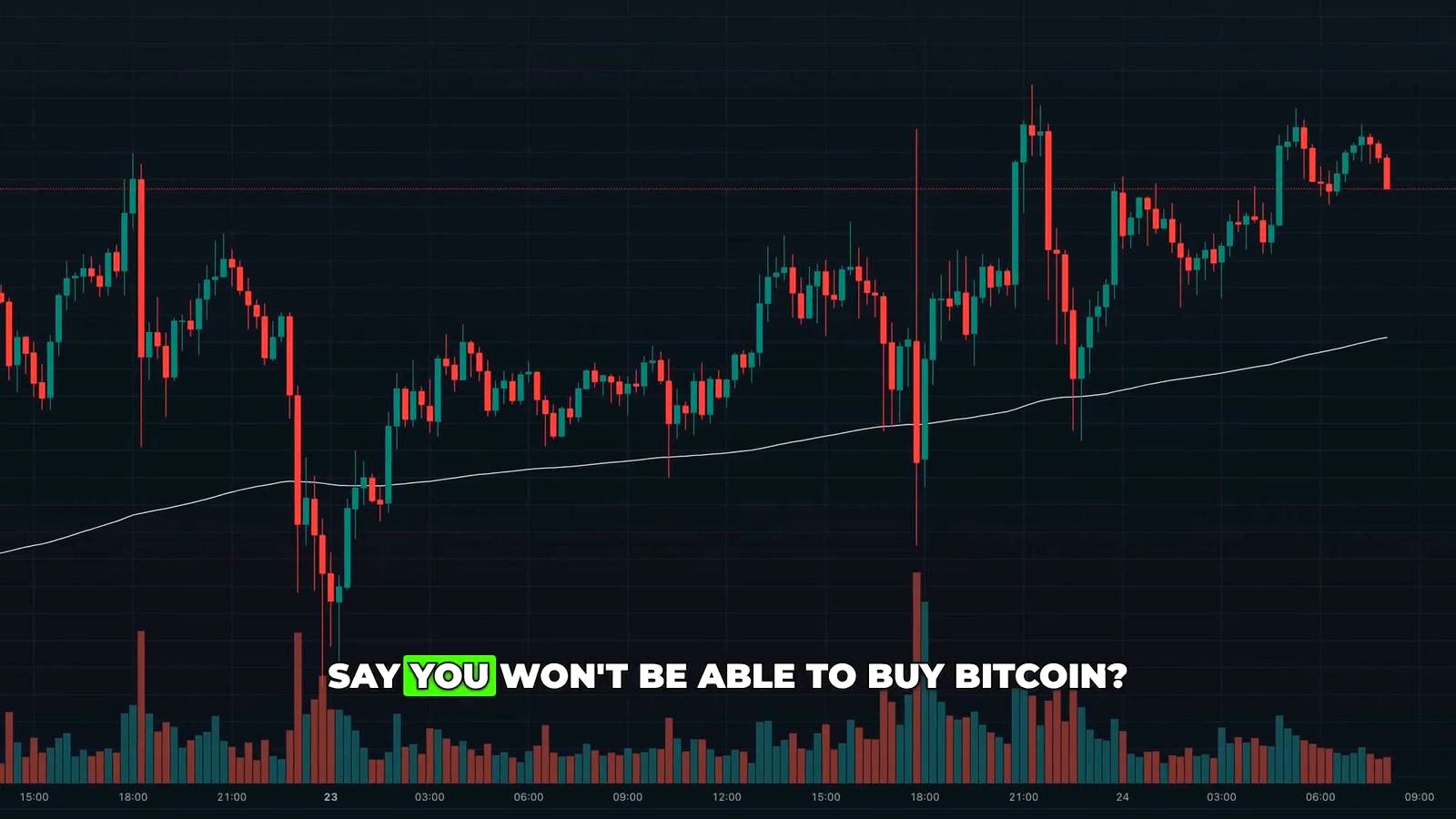
The phrase does not mean the buy button vanishes. It means access becomes unrealistic for the average person.
You are not locked out by technology. You are locked out because someone else got there first, and they are not selling.
That impossibility is practical and financial:
- The amount available on exchanges keeps shrinking.
- Institutions may absorb more supply through direct purchases and ETFs.
- More trading could move to private OTC deals.
- Retail buyers may be left competing over thin order books.
The article material is explicit here: even owning 0.1 BTC could become unrealistic if the market reprices into the millions per coin. At that level, buying a tenth of a Bitcoin would cost $100,000 or more.
In that world, a whole coin becomes less a goal and more a fantasy reserved for the ultra-wealthy.
The real countdown clock may not be price

One of the strongest ideas in the material is that the clock people watch is the wrong one. The visible countdown is usually price. The more important countdown is exchange supply.
As of early 2026, analyst estimates cited here said Bitcoin held on exchanges had already fallen to a record low. That is presented as the real signal.
The gap between watching price and watching liquid supply is where the tension lives. One tells you what the last buyer paid. The other hints at how many chances may be left.
Why timing may matter more than people think
The article’s final warning is emotional as much as analytical: understanding the mechanics does not guarantee being able to act when the move begins.
Because when this market moves, it may not pause for second thoughts.
The people best positioned are framed not as those reacting after the repricing, but those who understood the supply mechanics before it happened. That is the difference between seeing Bitcoin as a number on a screen and seeing it as inventory that may be disappearing in real time.
FAQ
Why does the article say Bitcoin could become unavailable instead of just more expensive?
Because the focus here is on liquid supply, not total supply. If the coins actually available for sale keep shrinking while demand rises, the issue becomes access and affordability, not just a higher quoted price.
What is liquid supply in simple terms?
It is the pool of Bitcoin that can actually be bought on the open market. The article compares it to inventory on exchange shelves.
What are the four forces behind the supply shock?
The four forces described are spot Bitcoin ETFs, long-term holders removing coins from circulation, miners selling less, and growing corporate and nation-state treasury demand.
Why are ETFs such a big part of this story?
Because when money flows into a spot Bitcoin ETF, the fund must buy real Bitcoin on the open market. That removes coins from already limited liquid supply.
How are long-term holders affecting the market?
According to the material, they continue to hold historically large amounts of Bitcoin and move coins into long-term storage, reducing the number of coins available for sale.
What changed with miners after the 2024 halving?
The halving reduced new Bitcoin issuance, and the material says many miners are now holding more of their coins instead of selling them immediately, which further tightens supply.
What does “impossible to buy” mean for average people?
It means Bitcoin may still be technically purchasable, but meaningful ownership could become financially unrealistic. The article gives the example that 0.1 BTC could cost $100,000 or more if repricing pushes the market into the millions per coin.
What is the real countdown clock mentioned here?
The article argues that the real countdown is the amount of Bitcoin left on exchanges, not the day-to-day price chart.
Video Source

An Indian crypto journalist covering the developments in the Bitcoin and blockchain industries. Her work helps readers understand key changes in the world of digital assets.