For years, crypto in the United States has lived in a strange gray zone. Projects launched first, regulators reacted later, and everyone else was left trying to guess what the rules actually were.
Now a huge proposal called the Digital Asset Market Clarity Act is pushing that uncertainty into the spotlight. For crypto holders and traders, this is not just another policy debate. It could reshape how tokens are classified, how exchanges operate, and whether some of crypto’s most attractive opportunities survive.
Why the CLARITY Act matters now

US crypto regulation has long been defined by confusion. Companies built products without clear guidance, only to face lawsuits later. Tokens could suddenly be labeled securities, and even basic questions stayed unresolved:
- Is a token a security or a commodity?
- Does the SEC control it, or the CFTC?
- What rules are exchanges supposed to follow?
That uncertainty has done real damage. It pushed innovation away from the US and kept major institutions on the sidelines. The CLARITY Act is an attempt to replace that uncertainty with an actual rulebook.
What the CLARITY Act is trying to do

The Digital Asset Market Clarity Act is described as the most comprehensive effort yet to create a proper legal framework for crypto in the United States. It passed the House in 2025 with strong bipartisan support, but it is still moving through the Senate.
At its core, the bill aims to turn vague regulatory guesses into written law. Instead of waiting to see how agencies might interpret crypto after the fact, the market would get a defined structure for how digital assets are treated.
The six big changes in the bill
- It classifies digital assets into three categories.
- It gives the CFTC exclusive jurisdiction over spot and cash markets for digital commodities.
- It creates a provisional registration regime.
- It includes protections for decentralized finance.
- It creates a new capital-raising pathway for digital asset projects.
- It prohibits the Federal Reserve from issuing a central bank digital currency to individuals directly or indirectly.
The biggest shift: who regulates crypto

One of the most important parts of the bill is simple but huge. It would move oversight of most crypto assets toward the CFTC, not the SEC.
That matters because the bill narrows the range of assets the SEC can claim as securities. Most blockchain-native tokens would be treated as digital commodities instead. In other words, the bill would push much of the crypto market closer to a commodity model than a securities model.
Where the SEC still stays involved
The SEC would still keep authority over primary fundraising, meaning when a project first sells tokens to raise capital. It would also retain oversight over any digital asset functioning as an investment contract.
But for secondary market trading of digital commodities, the CFTC would take over.
Clearer token classification could change the mood of the market

Right now, one of crypto’s biggest problems is that classification often comes after launch. That means a project can build, grow, and trade for a long time before suddenly being told it falls under a different rulebook.
The CLARITY Act tries to reduce that chaos by defining categories more clearly. For traders and holders, that could mean fewer shocks tied to sudden regulatory reinterpretations.
Crypto exchanges could finally get a real framework

The bill would also set clearer rules for exchanges. That includes how they register, what disclosures they must provide, and how trading platforms should operate.
For users, this could mean easier onboarding and a more structured market. For the industry, it could mean fewer gray areas and fewer situations where companies are forced to guess first and defend themselves later.
The stablecoin fight is where things get messy

This is the part causing the most tension. Proposals tied to the bill would ban or restrict yield on stablecoins, which could stop platforms from paying interest-like rewards.
That would hit several familiar crypto models, including:
- Earn programs
- Passive yield on USDC or USDT
- Some DeFi-style incentives
This is also where support for the bill starts to fracture.
Why banks are pushing back
The amendment is backed by the US banking industry. Their argument is that a stablecoin account paying yield looks too much like a savings account. Banks offering savings accounts face deposit insurance requirements, capital requirements, and full federal banking regulation.
From that perspective, a crypto platform offering yield without those same obligations is competing on an uneven field.
Why the crypto industry is resisting
The crypto side argues that stablecoin yield is not the same as a bank deposit product. The counterargument is that this yield comes from revenue sharing tied to interest earned on treasury bills held in reserve.
According to that view, restricting stablecoin yield would damage legitimate business models without delivering a matching consumer protection benefit.
The stakes are not small. Stablecoin-related revenue made up close to 20% of Coinbase’s total revenue in the third quarter of 2025. Coinbase’s Brian Armstrong described the yield restriction as a provision designed to protect bank profits rather than consumers.
Who supports the CLARITY Act

The White House has been the most vocal institutional supporter. In January 2025, Trump signed an executive order directing federal agencies to take a more favorable posture toward crypto and said his administration aimed to make the United States the crypto capital of the world.
Major voices in the industry have also reacted positively, including the Ripple CEO and JP Morgan analysts. At the same time, support is not unconditional. The stablecoin yield issue appears to be the main pressure point.
Coinbase withdrew its support in January, but later said it was in discussions and working toward a compromise. The Blockchain Association also sent 21 executives from 18 companies to meet with 24 Senate offices specifically on DeFi provisions.
Who opposes it — and why
The American Bankers Association has lobbied against the stablecoin yield provisions, arguing that yield-bearing stablecoins on unregulated platforms create regulatory arbitrage that disadvantages traditional banks.
Other criticism comes from different angles:
- The North American Securities Administrators Association said the bill could weaken state enforcement authority over digital asset fraud.
- Some Democrats argue the bill does not adequately protect retail investors.
- Some believe it shifts too much power from the SEC to the less-resourced CFTC.
One of the sharpest criticisms came from Cardano founder Charles Hoskinson, who called the current Senate form of the bill a “horrific trash bill” and warned that it could push future crypto founders offshore. His objection focused on DeFi provisions he said would harm decentralized protocol developers.
Why this is taking so long
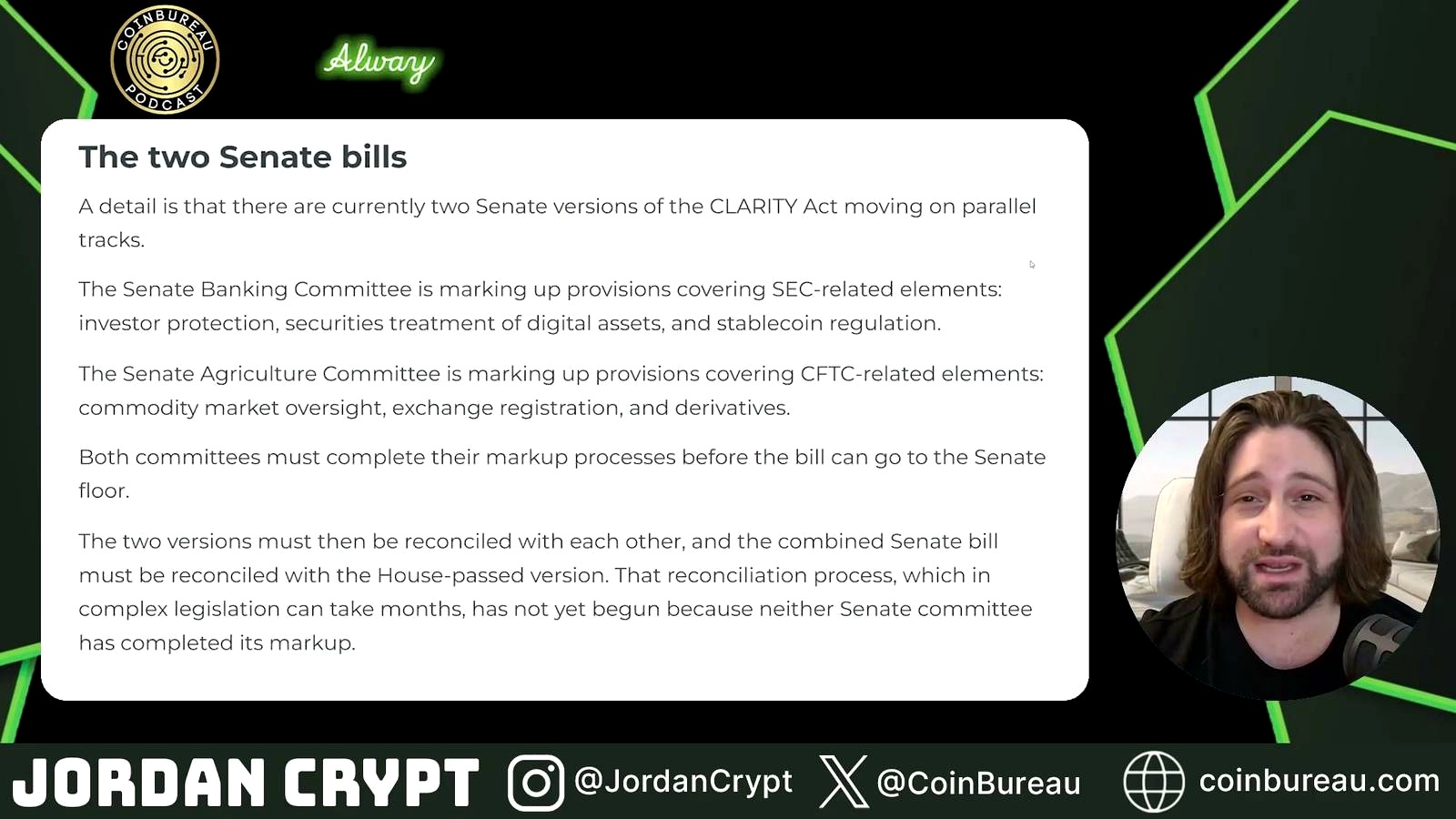
There are currently two Senate versions of the CLARITY Act moving on parallel tracks.
What each Senate committee is handling
- Senate Banking Committee: SEC-related elements, investor protection, securities treatment of digital assets, and stablecoin regulation
- Senate Agriculture Committee: CFTC-related elements, commodity market oversight, exchange registration, and derivatives
Both committees have to complete their markup processes before the bill can go to the Senate floor. After that, the two Senate versions must be reconciled with each other, and then the final Senate bill must be reconciled with the House-passed version.
That process has not even started yet because neither Senate committee has completed markup. In a bill this complex, reconciliation can take months.
What happens if it passes

If the bill becomes law, companies operating digital commodity exchanges would have 90 days to register with the CFTC. The CFTC would then have 180 days to expedite registration, and most rules would take effect 360 days after enactment.
That would mark the beginning of a very different crypto market in the US — one built less on interpretation and more on formal structure.
What happens if it fails

If the bill does not pass, the current system remains. That means more regulatory uncertainty, more guesswork, and more pressure on companies trying to operate without a clear line between what is allowed and what may trigger enforcement later.
How the CLARITY Act could affect crypto holders and traders

The upside
- More institutional money: Clearer rules mean less risk, which could attract more large investors.
- More adoption: The market could see more interest from banks, more pension fund exposure, and higher ETF inflows.
- Less regulatory fear: Fewer surprise lawsuits could make the market feel more stable.
- Easier access: Better-defined exchange rules could improve onboarding and bring in more users.
For long-term holders, that kind of structure could provide stronger price support over time.
The downside
- Less yield: If stablecoin rewards are restricted, passive income opportunities could shrink.
- More centralization: Heavier compliance could hurt smaller projects and benefit larger companies such as Coinbase.
- Volatility during rollout: Markets are already reacting to developments around the bill, and turbulence could continue before any real clarity arrives.
The bigger tension behind the bill

This is why the CLARITY Act feels so important. It is not just a legal update. It is a fight over what crypto becomes next.
Banks want tighter rules. Crypto companies want more freedom. Politicians are split. Stablecoins have become a major battleground because they sit right at the edge of old finance and the new system crypto is trying to build.
The result is a bill that could become one of the most bullish regulatory shifts crypto has ever seen — or a slower squeeze on some of the sector’s biggest advantages.
Either way, one thing is becoming harder to ignore: the wild-west era of crypto regulation in the US is nearing its end.
FAQ
What is the CLARITY Act?
The CLARITY Act, formally called the Digital Asset Market Clarity Act, is a US bill designed to create a clearer legal framework for crypto markets.
Has the CLARITY Act already passed?
It passed the House in 2025 with bipartisan support, but it is still working through the Senate.
Would the SEC or CFTC regulate crypto under the bill?
The bill largely gives oversight of most crypto assets to the CFTC, while the SEC keeps authority over primary fundraising and certain investment-contract digital assets.
Why is stablecoin yield so controversial?
Because proposals tied to the bill could ban or restrict platforms from paying yield on stablecoins, which would affect earn programs, passive rewards, and some DeFi incentives.
How could the CLARITY Act affect crypto holders?
It could bring clearer rules, more institutional participation, and less regulatory fear. But it could also reduce yield opportunities and increase compliance pressure across the industry.
Why are some people against the bill?
Critics say it could weaken state enforcement, reduce retail investor protection, shift too much power away from the SEC, or harm DeFi developers depending on how the final version is written.
What if the bill does not pass?
The current environment would continue, with crypto companies and investors still facing uncertainty over which rules apply and which regulator is in charge.
Source Video

Omar Al-Sharif lives and works in the UAE and is involved in the blockchain technology industry. He writes articles on Bitcoin and digital assets as a personal passion, explaining complex topics in simple and understandable language.