Wall Street’s growing grip on crypto has revived an old fear: if banks and asset managers dominate the rails, what happens to the decentralization that made Bitcoin matter in the first place? According to Tim Warren, that institutional wave is real, but it does not automatically mean crypto’s core gets absorbed. His argument matters because Bitcoin is again being framed less as a fringe trade and more as infrastructure for the next phase of finance.
Bitcoin’s setup, in Warren’s view, is bigger than price alone

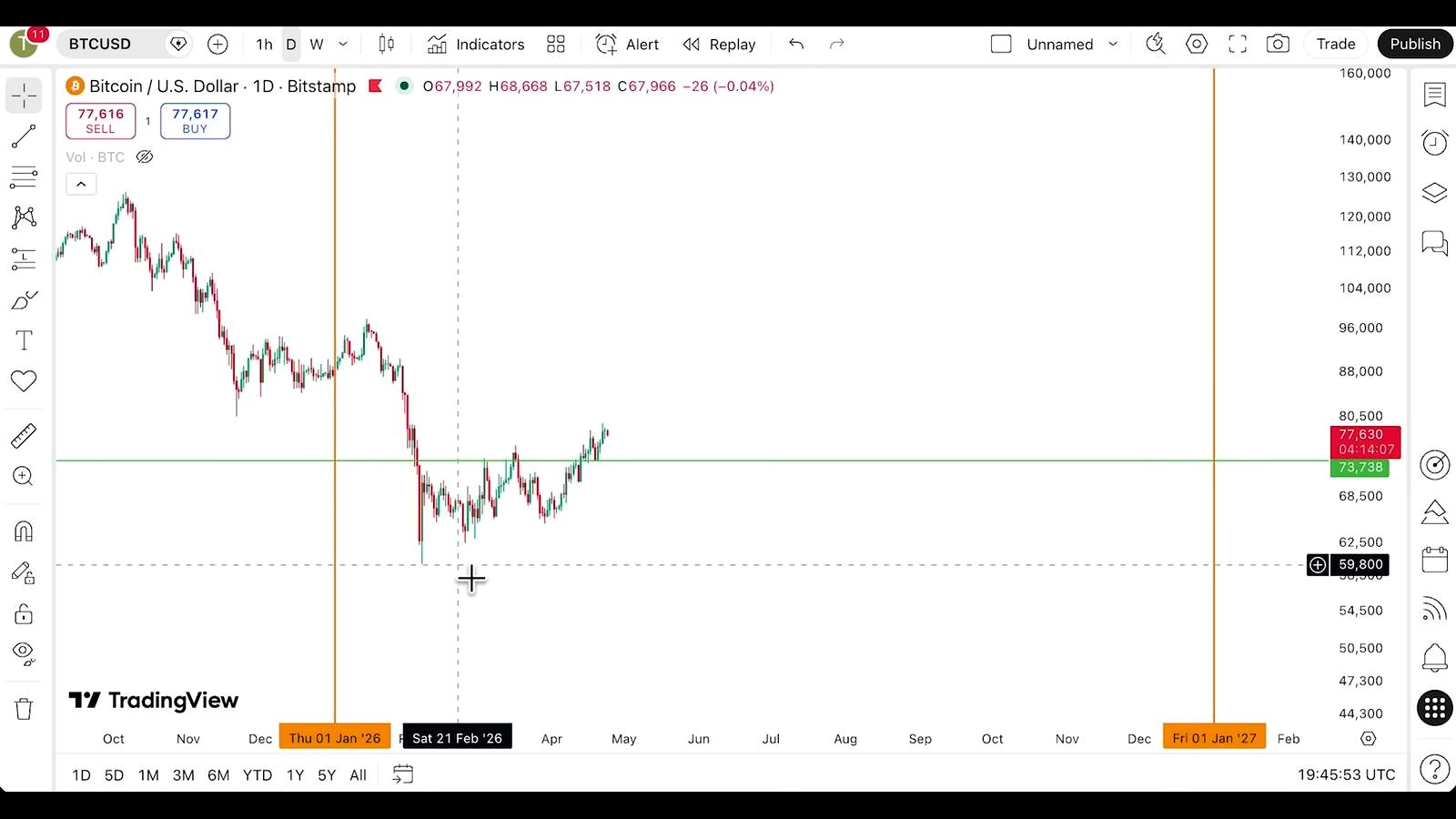
According to Tim Warren, the central thesis is twofold: first, Bitcoin is either at or near a bottom and could move “significantly higher” over the next 8 to 12 months; second, institutions are not merely buying exposure, but actively building financial products and market structure on crypto rails.
He ties that view to a cluster of adoption signals. In the transcript, Warren says U.S. spot Bitcoin ETFs now hold $96.5 billion in assets after peaking near $165 billion late last year, with BlackRock’s iShares Bitcoin Trust alone at roughly $54 billion. He also cites projections that ETF assets could rise to $180 billion to $220 billion by year-end if Bitcoin keeps making higher lows. On the institutional side, he points to a Coinbase survey in which more than 75% of investors said they plan to increase crypto allocations and 59% expect to put more than 5% of assets under management into digital assets.
That is broadly aligned with the market’s current medium-term bullish case, though not all of it is consensus. The mainstream view today is that ETF demand, post-halving supply dynamics, and improving regulatory clarity have structurally changed Bitcoin’s demand profile. The more aggressive part of Warren’s thesis is the idea that this is the start of a much larger redesign of financial plumbing, not just another cyclical BTC rally.
There is some broader context supporting that. ETF access has made Bitcoin easier for registered investment advisers, family offices, and institutions to hold inside familiar wrappers. At the same time, tokenization has become one of the few crypto-adjacent themes that major financial firms discuss without apology. Still, Bitcoin’s path is rarely linear. Macro conditions, real yields, dollar strength, and policy shocks can interrupt even strong structural demand stories.
Why the institutional case does not automatically mean decentralization loses

According to Tim Warren, the market is misreading the nature of institutional adoption. His claim is not that banks will fail to capture value. In fact, he argues they likely capture 75% or more of financial-services activity that migrates to crypto rails in the coming years. But he also says fully decentralized systems will retain a “meaningful, untouchable share” that traditional institutions cannot replicate or control.
He supports that argument with examples across both traditional finance and DeFi. Warren says Goldman Sachs filed in April for a Bitcoin premium income ETF and already holds about $1.1 billion in Bitcoin and $1 billion in Ethereum through ETFs, plus $153 million in XRP and $108 million in Solana. He says BlackRock’s BUIDL fund has surpassed $2.8 billion in assets and is live on eight blockchains, while BlackRock manages over $10 trillion overall. He also says JPMorgan launched a tokenized money market fund on Ethereum seeded with $100 million of its own capital and is now accepting Bitcoin and Ether as collateral for loans.
On the decentralized side, Warren points to Aave, which he says has more than $42 billion in total value locked and nearly 60% share of DeFi lending, with cumulative borrows above $775 billion. He adds that total DeFi TVL is around $130 billion to $140 billion, and that DeFi lending captured roughly two-thirds of the broader $73 billion crypto-collateralized lending market by late 2025.
The underlying idea is credible even if some of the rhetoric is stronger than the evidence. Institutions tend to adopt the parts of crypto that reduce costs, improve settlement, and create new packaged products for clients. That does not mean they can replace open-source networks, self-custody, or permissionless lending altogether. More likely, the market is moving toward a split structure: regulated access layers on top, open protocols underneath.
Regulation and positioning are the real catalysts in this framework

According to Tim Warren, regulation is no longer just a headwind but a potential catalyst. He points to the Genius Act, which he says was signed into law in July 2025 as the first federal framework for stablecoins in the U.S. He also says the Clarity Act passed the House by 294 votes to 134 and is now moving through the Senate, while Europe’s MiCA regime has been live since 2024. He adds that the SEC rescinded SAB 121 in January 2025, removing a major obstacle that had kept banks from engaging more directly with crypto custody and related services.
Warren’s trading framework is built around those legislative milestones. He argues Senate progress on the Clarity Act could become a macro catalyst, especially if passage starts to look likely in the second half of 2026. He also highlights what he calls a convergence trade: BlackRock bringing BUIDL to Uniswap, Goldman filing income ETFs, and JPMorgan building deposit-token products. In his view, the biggest opportunity sits at the intersection of traditional finance and DeFi infrastructure.
He also flags a more tactical signal: K33 Research noted that funding rates on Binance perpetuals have been negative for more than one month despite rising open interest. Warren interprets that as a setup for an overcrowded short squeeze. In practice, traders often do read persistent negative funding alongside rising positioning as evidence that too many participants are leaning bearish into a market that refuses to break down decisively.
That said, this is where his thesis gets more speculative. Legislative timelines are notoriously messy, and negative funding alone does not guarantee upside. It simply signals positioning imbalances that can resolve in multiple ways.
What could go wrong

The cleanest way Warren’s thesis fails is if institutional adoption proves real but not especially bullish for Bitcoin itself. A great deal of Wall Street interest today is focused on tokenized money funds, stablecoins, collateral efficiency, and blockchain-based settlement. That can be positive for the broader digital-asset sector without translating into an immediate BTC breakout.
There is also the concentration problem. If ETF products continue to absorb large amounts of supply, Bitcoin may become more accessible but also more dependent on a smaller set of custodians, market makers, and regulated wrappers. That would not “break” Bitcoin at the protocol level, but it could shift price discovery and ownership toward institutions in a way many early users would see as a loss.
Another risk is macro. If inflation re-accelerates, rate-cut expectations get pushed out, or risk assets broadly weaken, Bitcoin can trade like a high-beta macro asset regardless of tokenization headlines. Regulatory optimism can also reverse. A House vote is not a Senate win, and even passed legislation can be watered down, delayed, or implemented in ways the market dislikes.
Finally, Warren emphasizes self-custody protections and DeFi resilience, but he spends less time on operational and security risks. Open protocols may be censorship-resistant, yet users still face smart-contract exploits, governance capture, oracle failures, and liquidity fragmentation across chains.
What to watch next

The most important trigger in Warren’s framework is Senate movement on the Clarity Act, particularly committee markups and any signs that passage in the second half of 2026 is becoming politically realistic. Markets will also watch whether U.S. spot Bitcoin ETF assets can recover from $96.5 billion back toward the prior $165 billion peak and then press toward Warren’s cited $180 billion to $220 billion range.
On the trading side, keep an eye on whether negative perpetual funding persists while open interest climbs. If that setup remains in place and Bitcoin holds higher lows, the short-squeeze argument gets stronger. Beyond BTC, further expansion of tokenized treasury products, deposit tokens, and BlackRock-style on-chain fund distribution would reinforce the convergence theme Warren sees driving the next cycle.
FAQ
What is a Bitcoin premium income ETF?
A Bitcoin premium income ETF is typically a fund that seeks Bitcoin-linked exposure while generating yield by selling call options. The tradeoff is that option income can reduce some upside if Bitcoin rallies sharply, since covered-call strategies often cap part of the gains.
What does negative funding on perpetual futures mean?
Negative funding generally means short traders are paying long traders to keep positions open. It often signals bearish positioning in perpetual futures markets. If price holds up despite that, traders may see the market as vulnerable to a short squeeze.
How is tokenization different from buying Bitcoin?
Buying Bitcoin means owning or gaining exposure to BTC itself. Tokenization refers to putting traditional assets such as Treasurys, money market funds, or deposits onto blockchain rails so they can settle faster, trade more efficiently, or integrate with programmable finance.
Why does self-custody matter if institutions are entering crypto?
Self-custody lets users hold assets directly without relying on a bank, broker, or ETF issuer. That matters because it preserves one of crypto’s original value propositions: ownership without an intermediary. Institutional products expand access, but they do not replace that feature.
How does this compare with previous Bitcoin cycles?
Earlier cycles were driven more by retail speculation, offshore leverage, and crypto-native capital. The current cycle is different because regulated ETF access, tokenization efforts, and legislative developments are bringing in slower but potentially more durable forms of demand.
Reference Video

Omar Al-Sharif lives and works in the UAE and is involved in the blockchain technology industry. He writes articles on Bitcoin and digital assets as a personal passion, explaining complex topics in simple and understandable language.