Markets are trying to answer a familiar question: was the latest geopolitical scare just another dip to buy, or the start of a broader risk-off turn? With BTC climbing back toward a recent high, CryptosRUs argues the macro backdrop has shifted back in bulls’ favor, and that a move through $78,000 could quickly open the way to the $80,000s and even the $90,000s.
Why the bull case is getting louder
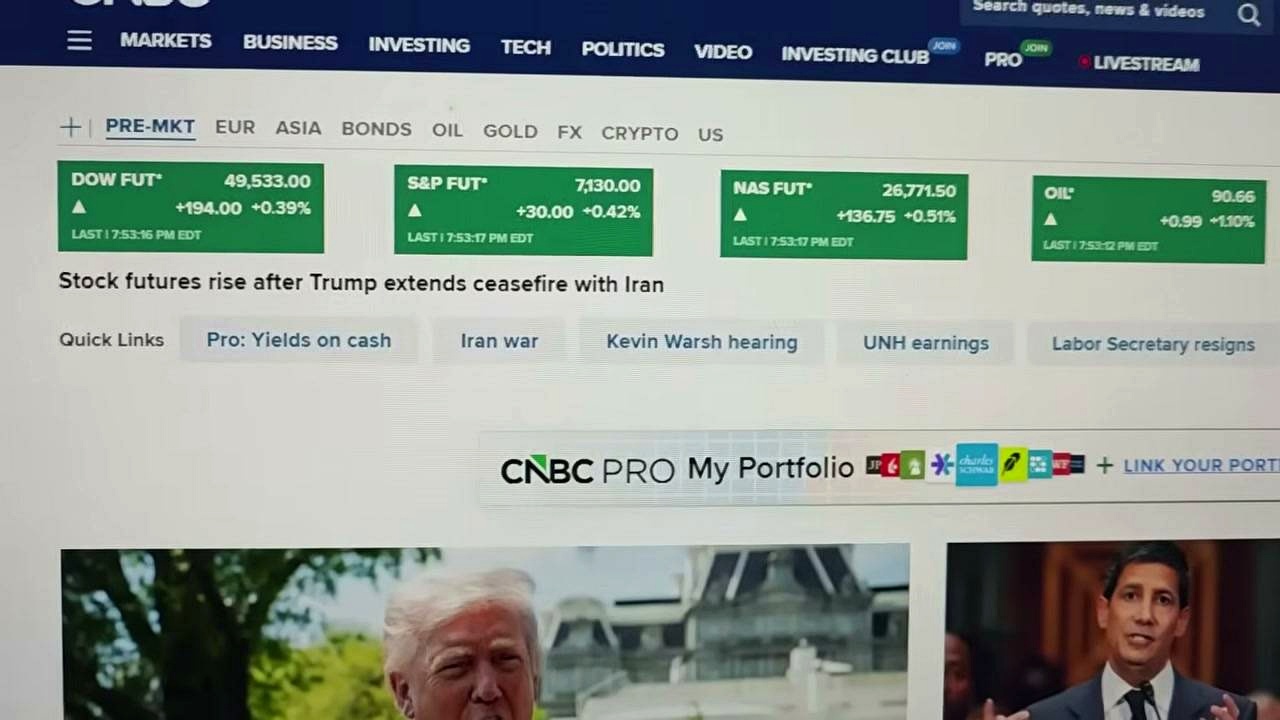
According to CryptosRUs, the main setup is straightforward: easing Middle East tensions, greener futures markets, and renewed large-scale Bitcoin accumulation are combining to push capital back into risk assets. In the host’s telling, Bitcoin was trading around $76.4K and “creeping up” toward a recent high near $78K, with the implication that Wall Street, whales, and institutions are becoming more comfortable that a ceasefire will hold.
The analyst tied that move directly to geopolitics. He argued that the U.S. decision to extend a ceasefire and rely on economic pressure rather than immediate renewed military action reduces uncertainty for markets. In risk markets, that matters because Bitcoin often trades less like an isolated macro hedge and more like a high-beta expression of improving liquidity and investor confidence. When traders see war risk fading rather than escalating, capital tends to rotate back into equities, crypto, and other speculative assets.
That framing is broadly in line with how markets usually react to de-escalation. But it is not a Bitcoin-only thesis. It is a classic risk-on thesis. If bond yields stabilize, oil avoids another spike, and equities remain firm, BTC often benefits from the same tailwind. On the other hand, the crypto market has a habit of overpricing “all clear” moments. Geopolitical relief rallies can be real, but they can also fade quickly if the underlying conflict is unresolved.
The host added a second macro point: tariff-related cash flows. He said $1.66 billion collected through tariffs would be pushed back to businesses, even if new tariffs are later enacted under different rules. His argument is that any near-term redistribution of capital could provide another liquidity tailwind for assets. That is more speculative than the ceasefire point, but it fits a common crypto narrative: when money is put back into the private sector, some portion can end up in markets.
Corporate buying and whale accumulation are central to the thesis

According to CryptosRUs, the more durable bullish driver is not geopolitics but demand. He pointed to Michael Saylor’s latest buy of 34,000 BTC as “enormous, ” then cited estimates that Saylor could be holding as much as 1 million BTC by the end of 2026. He also emphasized that “this is the end of this year” before correcting the timeline in his own remarks to the stated 2026 target, the relevant takeaway is the scale of the estimate, not the slip.
The analyst’s broader point is that Strategy’s model creates a feedback loop: raise capital, buy Bitcoin, strengthen the Bitcoin treasury narrative, then raise more capital. As long as BTC does not suffer a sustained crash, he argued, that cycle can continue. In the current market, that matters because corporate treasury accumulation has become one of the few clearly identifiable structural demand sources outside spot ETFs.
He paired that with a whale-accumulation claim, saying about 45,000 were added by whales over the last week. The transcript does not specify whether that means 45,000 BTC or whale-address growth, but the intended message is clear: large buyers are returning at the same time as Saylor and ETFs. For traders, this is the kind of supply-demand framing that can justify upside continuation even when price has not yet cleanly broken resistance.
That part of the thesis has some intuitive support in broader market structure. Bitcoin’s circulating supply is finite, long-term holders tend to be sticky, and concentrated institutional demand can have an outsized effect during periods of tight liquid supply. This is one reason corporate treasury buying and ETF inflows get so much attention: they can compress available float faster than retail sentiment alone would suggest.
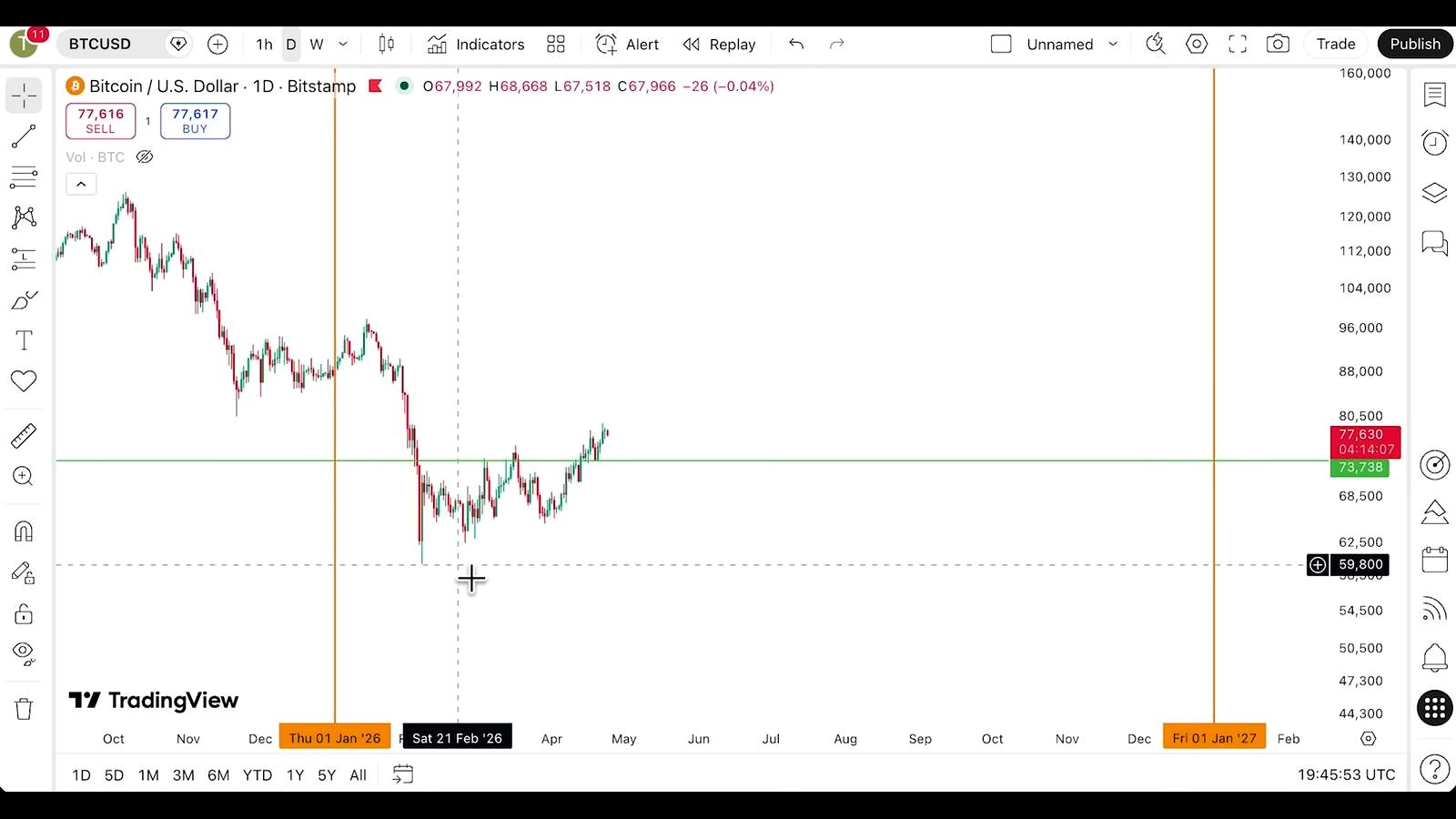
Technically, the setup is also easy to understand. The host said Bitcoin has not yet broken its recent high around $78K, but appears to be trending upward in a slow grind rather than a vertical move. He compared the current market to prior post-bottom periods where crypto trades sideways for a while and then breaks out. His trading implication is simple: clear $78K, and momentum could carry Bitcoin into the $80,000s, with the $90,000s following “in no time.” That is an aggressive framing, but it captures how traders think about breakout markets: once overhead supply is cleared, momentum strategies can quickly pile in.
What could go wrong

The obvious weak point in this thesis is that it depends on several moving parts staying favorable at once. If Middle East tensions re-escalate, oil spikes, or U.S. policy rhetoric turns more hawkish, the market could move back into risk-off mode quickly. Bitcoin’s recent history shows that even strong structural narratives can be overwhelmed by macro shocks in the short term.
There is also execution risk around the demand story. Corporate buying can support sentiment, but it can also become reflexive. Strategy’s approach works best when capital markets remain open and Bitcoin keeps appreciating or at least holds up. A sharp drawdown could challenge that financing model and sour investor appetite for similar treasury trades. That would not invalidate Bitcoin long term, but it would weaken one of the market’s strongest current demand narratives.
The host also did not spend much time on valuation or leverage risk. If BTC is approaching a key breakout level while derivatives positioning becomes crowded, the market can still deliver a violent rejection before any sustained move higher. That is the other side of the trade: a failure at $78K could trap late longs and send price back into the prior consolidation range. In bull markets, the most painful move is often the one that flushes momentum traders just before a larger advance.
What to watch next

The first trigger is simple: whether Bitcoin can decisively break and hold above $78,000. A clean move through that level would support the analyst’s view that the market is transitioning from sideways grind to breakout. If that happens alongside continued ETF demand and further evidence of corporate accumulation, the path into the $80,000s becomes easier to argue.
Beyond price, traders should watch three things: whether ceasefire headlines continue to signal de-escalation, whether broader futures markets stay green, and whether large-buyer demand remains visible. If macro calm fades or BTC gets rejected at resistance despite bullish headlines, that would be an early sign the market is not ready to price in the optimistic scenario just yet.
FAQ
What does a Bitcoin breakout above resistance usually mean?
A breakout above resistance means price has moved through a level where sellers previously capped rallies. If the move holds, traders often interpret it as evidence that demand has absorbed overhead supply, which can invite momentum buying and short covering.
Why do traders care so much about corporate Bitcoin buying?
Large corporate buyers can reduce liquid supply, especially when they buy consistently and hold long term. That matters more in Bitcoin than in many other assets because the freely tradable float can tighten quickly when ETFs, treasury companies, and long-term holders all accumulate at the same time.
How is Bitcoin affected by geopolitics like Middle East tensions?
Bitcoin can react in different ways depending on the market regime. In acute stress, it often trades like a risk asset and falls with stocks. When tensions ease, it can rebound as investors rotate back into higher-volatility assets. Over longer periods, some investors still view it as a hedge against monetary and geopolitical instability.
What happened in past Bitcoin cycles after long sideways periods?
Historically, Bitcoin has often spent weeks or months consolidating after major moves before breaking into a new trend. Those breakouts can be powerful, but they are frequently preceded by false starts, failed breakouts, and sharp pullbacks that shake out overleveraged traders.
What would invalidate a bullish BTC setup near $78,000?
A failed breakout is the clearest warning sign. If Bitcoin pushes above $78,000 and quickly falls back below it, traders would likely treat that as a rejection. Broader invalidation would come from weakening risk sentiment, deteriorating macro conditions, or visible slowing in institutional and ETF demand.
Reference Video

Omar Al-Sharif lives and works in the UAE and is involved in the blockchain technology industry. He writes articles on Bitcoin and digital assets as a personal passion, explaining complex topics in simple and understandable language.