Why do so many people manage to lose money in an asset that has risen dramatically over the long run? The tension, according to one Bitcoin analyst, is not the asset itself but the way people approach it.
According to Rajat Soni, CFA, most people lose money buying Bitcoin because they behave like short-term speculators in a market that he believes rewards patience. His core argument is simple: many buyers enter near euphoric highs, panic during drawdowns, and sell precisely when a long-term holder would be accumulating.
The central mistake: buying emotion, selling fear
Soni draws a hard line between two groups using the same asset for very different purposes. In his framing, short-term speculators want more fiat currency and try to profit from moves over the next 1 month, 2 months, or 3 months. Long-term investors, by contrast, buy Bitcoin for its longer-run potential and are willing to sit through volatility.
That distinction matters because, in his view, short-term thinking creates the classic losing pattern. People tend to buy when optimism is loudest and price is near a top. Then, when the market falls and fear takes over, they sell to protect what is left. Soni says that cycle, buying near highs and selling near lows, is the main reason many retail participants end up losing money on Bitcoin.
He also argues that social pressure worsens the problem. At market tops, bullish predictions make buying feel easy. At market bottoms, bearish commentary makes selling feel safe. In both cases, he says, investors are pushed toward emotionally satisfying decisions rather than disciplined ones.
Why a falling BTC price looks different to a long-term holder
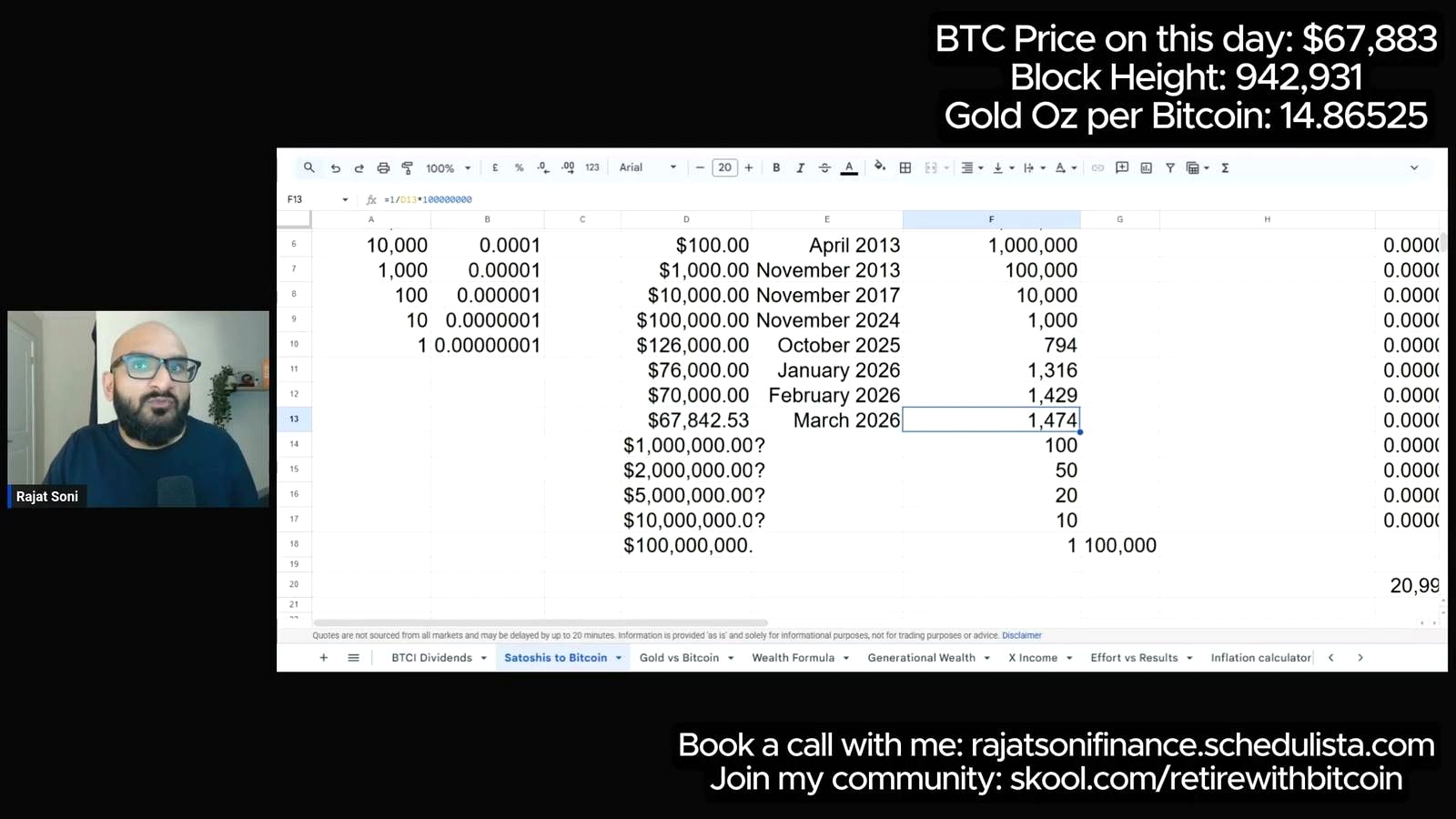
Soni’s most actionable point is that a declining Bitcoin price is not automatically bad news for someone with a long time horizon. He says he views lower prices as an advantage because each dollar buys more Bitcoin, or more precisely, more satoshis.
He gives a recent example from the market:
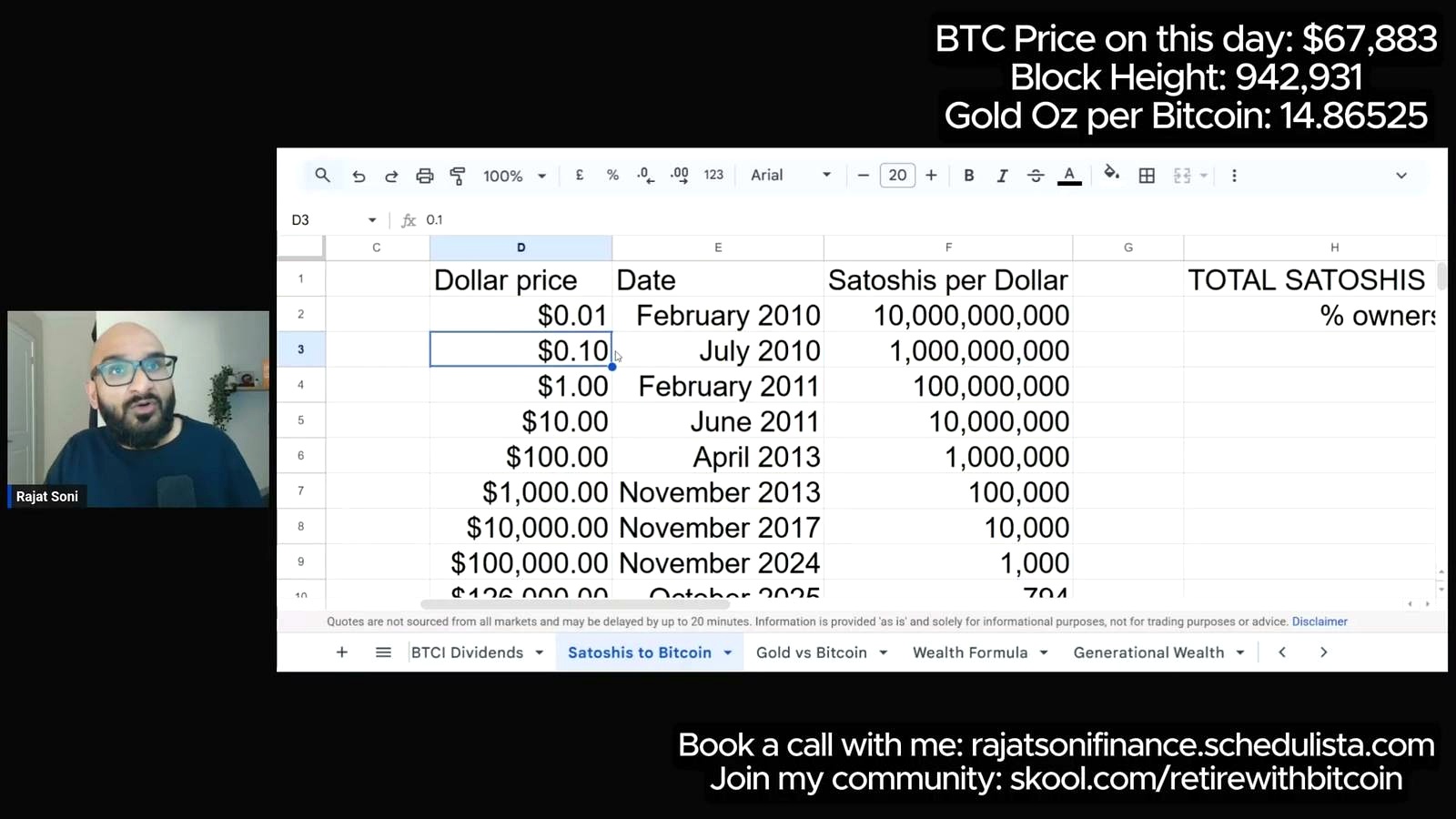
- October 2025 BTC all-time high:$126,000
- Current BTC price in the video: about $68,000
- Drawdown from the high: about 45% to 46%
- $1 at the October 2025 high bought:794 satoshis
He says that at roughly $68,000, a dollar buys almost twice as many satoshis as it did at the peak. That is why he does not treat the drop as a reason to exit. Instead, he frames it as an opportunity for accumulation, provided the money being invested is not needed soon.
Soni says his own approach is to buy Bitcoin only with money he does not expect to need for 4 years, 5 years, 10 years, or even 15 years. He links that to retirement and financial freedom rather than near-term trading gains.
The numbers behind his time-horizon argument
Soni leans on a probability-style framework to argue that Bitcoin becomes less speculative as the holding period lengthens. His claim is not that losses become impossible, but that the odds improve meaningfully over time.
The specific figures he cites are:
- 1 day:55% chance of profit, 45% chance of loss
- 1 week:60% chance of profit
- 1 month:60% chance of profit
- 6 months:65% chance of profit
- 1 year:75% chance of profit
- 3 years:98% chance of profit, about 2% chance of loss
- 5 years: about 99% chance of profit
- 10 years: about 100% chance of profit
He adds one caveat: Bitcoin has only existed for about 17 years, so the longest-duration numbers have a limited history behind them. Even so, he argues that the trend in those figures supports a long-term strategy over short-term speculation.
That is also why he compares very short-term Bitcoin holding to casino-like odds. A 45% chance of losing money after just one day, he says, is barely better than gambling. Stretch the horizon to several years, and the risk profile, in his telling, changes completely.
Why he thinks supply keeps forcing the long-term trend higher
Soni’s broader thesis rests on Bitcoin’s fixed supply. He repeatedly argues that “Bitcoin runs out at every price, ” meaning sellers willing to part with coins at lower prices are eventually exhausted, forcing buyers to bid higher.
He ties that to Bitcoin’s unit structure:
- Total Bitcoin supply: just under 21 million
- 1 Bitcoin:100 million satoshis
- Total satoshi supply: just under 2.1 quadrillion
In his view, long-term holders continuously remove supply from the market by accumulating and not selling. Speculators may dominate short-term price action, but they do not change the larger scarcity dynamic. Over time, he says, that shrinking liquid supply forces repricing.
Soni uses Bitcoin’s early trading history to illustrate the point. He says that from February 2010 to July 2010, the price had to 10x because there was not enough supply available for everyone to buy at 1 cent. He extends that logic through price levels like 10 cents, $1, $10, $100, and $1,000, arguing that more people get priced out of whole-coin ownership as Bitcoin rises.
That leads to his satoshi-focused view of the market. He suggests that over time the average person may only be able to buy smaller fractions such as 1 million satoshis, then 500,000, then 300,000, then 100,000.
Short-term charts look bad. The long-term chart tells a different story

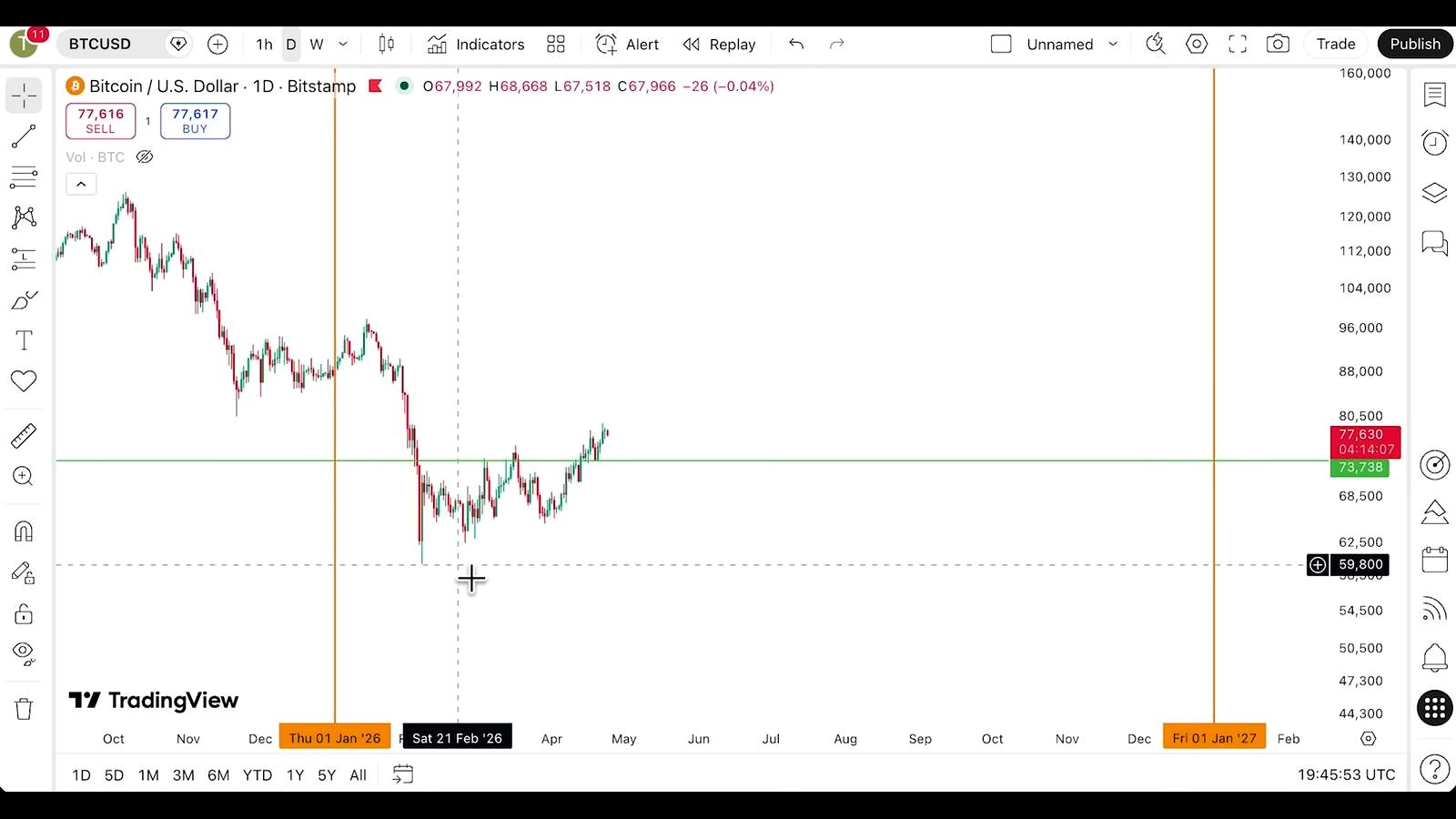
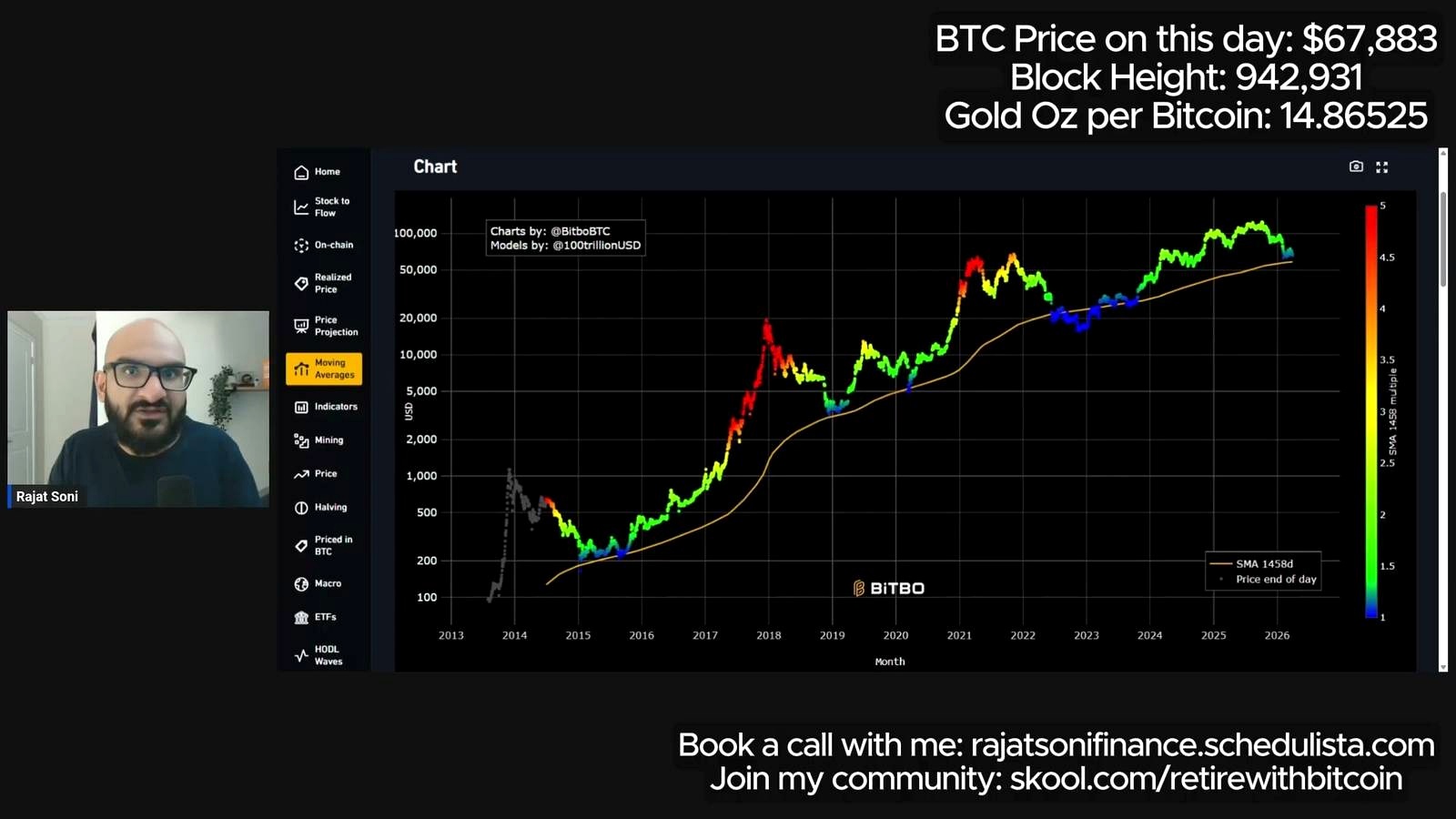
Soni argues that investors get trapped by the timeframe they choose. On shorter windows, Bitcoin can look broken. On longer windows, he says, the same asset tells a very different story.
He cites the following performance snapshots:
- Year to date: down 22.42%
- 6 months: down 40%
- 1 year: down 18%
- 5 years: up slightly
- 10 years: up 15,000%
For Soni, that contrast is the entire point. A person staring at day-to-day moves sees volatility and danger. A person looking at a 4-year moving average sees a market that, in his interpretation, steadily reprices upward as supply tightens and demand persists.
He also says the day-to-day price will keep swinging forever. That does not invalidate the long-term trend in his view; it is simply the cost of owning a scarce asset in a volatile market.
What to watch next
The practical takeaway from Soni’s argument is not a near-term price target. He gives none. Instead, the key variables to watch are whether long-term holders continue absorbing supply, whether short-term fear keeps shaking out newer buyers, and whether investors judge Bitcoin on a multi-year rather than multi-week basis.
He says he would remain comfortable buying even if Bitcoin dropped to $30,000 “tonight, ” because his thesis does not depend on the next few days or months. His expectation is that Bitcoin will do “very well” over the next 10 years, but he also warns that the path will be volatile and emotionally difficult.
For readers following this framework, the real signal is not whether BTC is red on the week. It is whether the market keeps transferring coins from fearful hands to patient ones.
FAQ
Why does Rajat Soni, CFA think most Bitcoin buyers lose money?
He says the typical mistake is behavioral, not technical. Buyers enter when optimism is strongest, then sell when drawdowns trigger fear. In his view, that turns volatility into realized losses.
Did he give a specific BTC price target?
No specific upside price target was given. The only explicit price reference about a possible future move was his comment that he would still be comfortable buying if Bitcoin fell to $30,000.
What is the difference between a speculator and a long-term investor in his framework?
Soni defines speculators as people focused on short-term fiat gains, sometimes using borrowed money to amplify returns. He frames long-term investors as people buying with capital they do not need for several years and measuring success over much longer periods.
What numbers does he use to support long-term holding?
His most important figures are the rising profit odds with longer holding periods: 55% after 1 day, 75% after 1 year, 98% after 3 years, about 99% after 5 years, and about 100% after 10 years.
How does he explain Bitcoin scarcity in practical terms?
He reduces it to satoshis. Because there are fewer than 21 million BTC and each coin has 100 million satoshis, he argues that rising demand eventually means each dollar buys fewer sats. That is why he focuses on accumulation rather than trying to trade every swing.
Source Video

An Indian crypto journalist covering the developments in the Bitcoin and blockchain industries. Her work helps readers understand key changes in the world of digital assets.