Can BTC rally even as global markets wobble, sovereign sellers unload coins, and a fresh quantum-computing scare ripples through crypto? According to Money Talks, the entire near-term setup may come down to one level: $62,750.
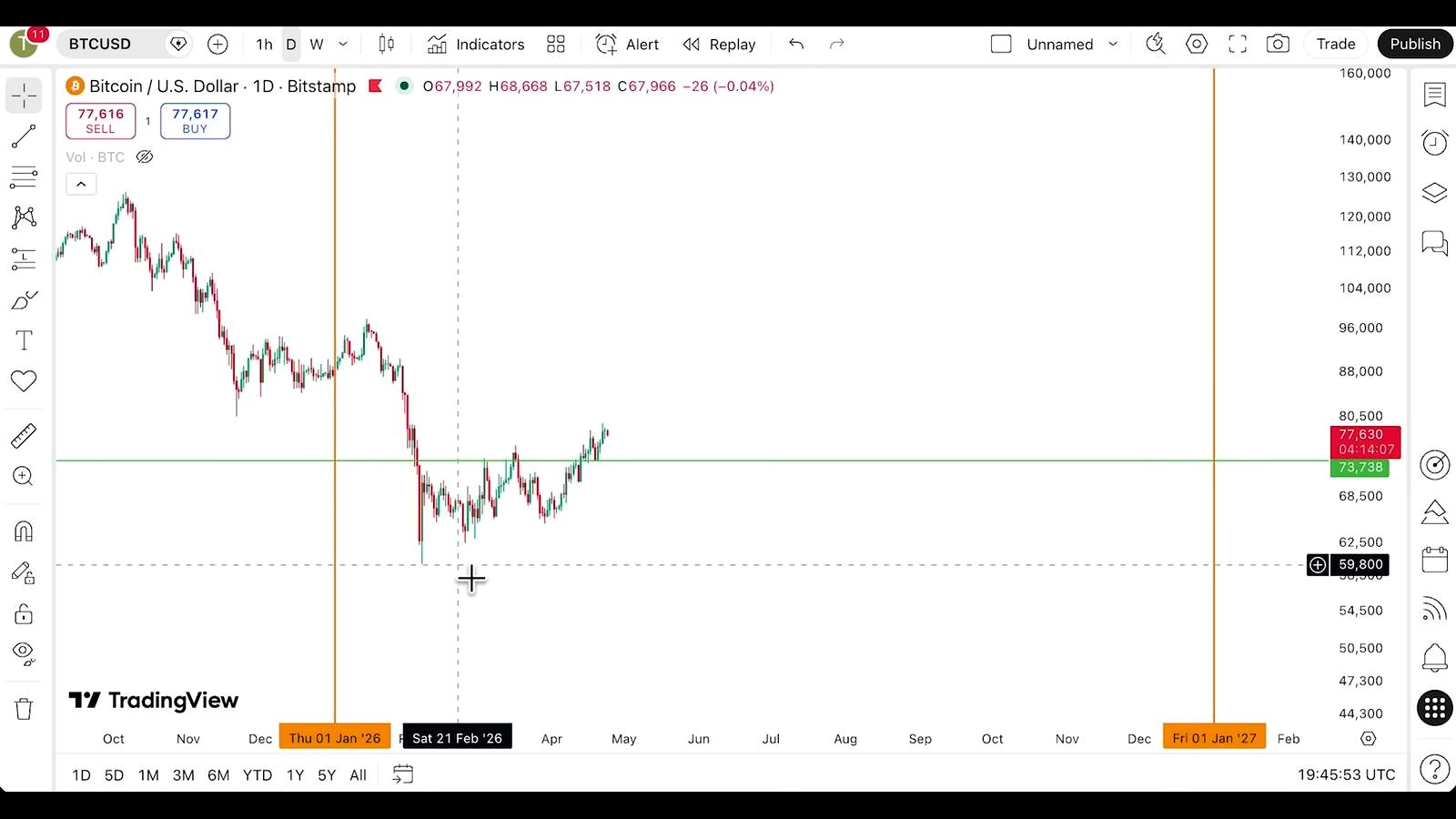
Money Talks argues that Bitcoin is still technically bullish as long as it does not post a daily close below $62,750, even after falling from roughly $100,000 to $60,000. With BTC sitting around $66,700, the channel frames Q2 2026 as a high-tension moment: a relatively narrow downside buffer against a potential push toward $80,000 to $85,000.
The level that matters most for Bitcoin right now
Money Talks says the current market structure hinges on the bottom of a February 6 bullish reversal candle. That level sits at $62,750, and the host treats it as the dividing line between a still-valid recovery and a deeper bear phase.
Gareth Soloway, speaking in the segment, said he has turned bullish in the near term after previously being bearish. His view is tactical rather than structural. He said Bitcoin could climb to $80,000 or even $85,000 over the next weeks to a month or so, but he still expects a broader bearish cycle to resume later if US stock markets roll over again.
The chart levels highlighted in the video were specific:
- $66,700: Bitcoin’s quoted spot level in the episode
- $62,750: key daily-close support and “line that decides everything”
- $68,400: breakout level that Money Talks says would target $71,500
- $75,000: full bull trigger cited by the channel and Soloway
- $80,000,$85,000: near-term upside target zone
- $34,000: bearish head-and-shoulders target if $62,750 fails
Money Talks also quantifies the setup as a 6% downside buffer from $66,700 to $62,750, versus roughly 25% upside to $85,000 if the bullish case develops.
Why the channel thinks BTC has held up better than many expect
One of the more notable points in the video is relative performance. Soloway said Bitcoin has been the best-performing asset since February when compared with gold, silver, and the stock market. Money Talks extends that point by arguing BTC is down less than gold from its peak and has held its structural floor during what it calls the worst quarter for global markets in 18 years.
The macro backdrop in the segment is bleak. Money Talks says Q1 2026 was the worst quarter for the stock market since 2008. It also cites the MSCI Asia Pacific index heading for its worst month since 2008, the S&P 500 logging its longest losing streak since 2022, and US gasoline crossing $4 per gallon for the first time since 2022.
Against that environment, the host argues Bitcoin’s resilience matters more than any single intraday move. The point is less that BTC is surging already, and more that it has not broken down despite pressure from risk markets, rising real yields, and heavy negative headlines.
FTX creditor cash could become a short-term tailwind
Money Talks says $2.2 billion is being distributed to former FTX creditors in the fourth payout round, bringing total repayments to nearly $10 billion since the process began. The channel’s core point is psychological: many creditors lost Bitcoin in the collapse and are now receiving cash based on November 2022 valuations rather than current crypto prices.
The comparison in the video is stark. Bitcoin was at $16,871 when FTX collapsed, versus $66,700 now. Money Talks says that means creditors are being repaid in cash at a level far below the current market value of the BTC they once held, after missing nearly 300% of Bitcoin’s appreciation. The host expects a significant portion of that cash to flow back into Bitcoin and Ethereum within days, though he stops short of calling it a guaranteed pump.
The channel adds some nuance here. It says previous FTX distributions during fearful markets saw weak reinvestment, while distributions during the May 2025 bull market saw much stronger crypto re-entry. The fear and greed index, according to the video, is now at 11. In other words, this is a potentially supportive flow, but one that still depends on market mood.
The quantum threat is real, but not immediate
Money Talks also spotlights two new research papers on quantum computing and Bitcoin cryptography. One, described as coming from Caltech in collaboration with a startup called Atomic, claims a quantum computer with 26,000 qubits could break the encryption standard securing Bitcoin and Ethereum. A second paper, attributed to Google, suggests fewer than 500,000 physical qubits may be enough, down from estimates in the millions.
The host is careful to distinguish between acceleration and imminence. Today’s most advanced systems, he says, operate in the range of hundreds to low thousands of qubits. Researchers cited in the segment estimate a meaningful threat may arrive around 2029, not tomorrow.
Money Talks further says the risk is not uniform across the network:
- 25% to 30% of Bitcoin supply, or more than 5 million coins, is described as potentially vulnerable if public keys have been exposed on-chain
- The other 70% of Bitcoin, particularly coins that have never moved, is described as not vulnerable to that same attack path
- BIP 360 is cited as a proposal for quantum-safe address formats
- Google is said to have set a 2029 internal deadline to migrate its own cryptography
The channel’s bottom line is that this is a long-term issue moving faster than many expected, but not a reason to assume an immediate collapse in Bitcoin’s security model.
Short-term sellers are visible, but the bigger demand story is larger
Money Talks contrasts two opposing supply-demand forces. On the supply side, Bhutan’s sovereign wealth fund is said to have transferred another 375 BTC to exchanges, taking weekly sales above 1,000 BTC. The country has reduced its Bitcoin holdings by about 66% to 70% from a peak of more than 13,000 BTC in late 2024, according to the video. Year to date, the host says Bhutan has sold more than $150 million in Bitcoin, including $70 million in the latest week, and has 3,954 BTC left.
On the demand side, the host points to a US proposal to expand crypto access in 401(k) retirement plans. If passed, he says it could open a $7 trillion market to Bitcoin exposure. Even a 1% allocation would equal $70 billion, which Money Talks says would be larger than the current Bitcoin ETF market.
The implication is straightforward: Bhutan’s selling is real but finite. Retirement-plan demand, if approved and adopted, would be much larger and structurally more important.
What macro signal could unlock the next move
Money Talks says the main macro force suppressing Bitcoin right now is high real interest rates. In the host’s framing, as long as investors can earn a meaningful inflation-adjusted return in US government bonds, the case for taking Bitcoin’s volatility is weaker.
The specific reversal scenario revolves around oil. The host says if an Iran deal materializes and oil drops from $115 to $80, inflation expectations could fall, giving the Federal Reserve more room to cut rates. Lower rates would likely pull down real yields, reducing the opportunity cost of holding Bitcoin.
That matters because the channel sees several pieces of infrastructure already in place: ETF access, longer institutional holding periods, FTX creditor cash that may re-enter crypto, and a broad retirement-market proposal that could expand future access.
Money Talks also says institutional ETF holders now represent 67% of total Bitcoin ETF assets under management, and their average holding period rose 43% in March, from 89 days to 127 days. The channel interprets that as a sign that “real money” is staying put while weaker speculative capital has already exited.
What to watch next
For Q2, the checklist in the video is clear. First, watch whether Bitcoin can protect $62,750 on a daily closing basis. Second, watch for volume: Money Talks says strong volume without a price collapse would point to accumulation. Third, watch the next upside thresholds at $68,400, $71,500, and especially $75,000.
If BTC holds support and breaks higher, the channel sees a path toward $80,000 and $85,000. If it loses $62,750, the tone changes sharply, with $34,000 entering the discussion as a downside target.
FAQ
Why is $62,750 so important for Bitcoin?
Money Talks says that level marks the low of the February 6 bullish reversal candle. As long as BTC stays above it on a daily close, the current recovery structure remains intact.
Did Money Talks turn fully bullish on Bitcoin?
No. The channel presents a short-term bullish case and a longer-term bearish one. Soloway says he is bullish for a move toward $80,000,$85,000 in the near term, but still expects lower prices later if the stock market weakens again.
How big is the FTX repayment story for crypto markets?
The video cites $2.2 billion in the current round and nearly $10 billion in total repayments. The argument is that creditors receiving cash at old crypto prices may be motivated to buy back into Bitcoin and Ethereum quickly.
Is quantum computing an immediate threat to BTC?
According to Money Talks, no. The risk is progressing faster than expected, with some estimates dropping to 26,000 qubits, but the segment says a meaningful threat is more likely around 2029 than in the immediate future.
What is the biggest bullish macro trigger mentioned in the video?
The host points to a fall in oil from $115 to $80. In his framework, that could cool inflation, enable rate cuts, lower real yields, and make Bitcoin more attractive to institutional capital.
Video Reference

An Indian crypto journalist covering the developments in the Bitcoin and blockchain industries. Her work helps readers understand key changes in the world of digital assets.