Crypto traders are weighing two very different clocks at once: a near-term bearish chart structure and a potentially market-changing shift in Washington. The immediate question is whether regulatory clarity can arrive fast enough to alter sentiment before Bitcoin retests lower levels. According to Altcoin Daily, that policy backdrop is becoming more urgent as the White House and top US regulators push to move the Clarity Act forward this spring.
The Core Thesis: Washington May Be Turning Into a Bitcoin Catalyst

According to Altcoin Daily, the central bullish macro argument for crypto is no longer just ETF demand, halving cycles, or rate-cut speculation. It is the idea that the US government is moving toward a more coherent digital-asset framework after what Treasury Secretary Scott Bessant described as years of delay. The host highlights Bessant’s call for Congress to pass the Clarity Act “this spring, ” framing the bill as urgent and tying the issue to national security.
The host says Bessant argued that a “growing share” of crypto development has moved to jurisdictions with clearer rules, naming Abu Dhabi and Singapore, and that the US now risks losing financial innovation abroad. He also emphasizes that the heads of the SEC and CFTC are supportive, and says this is the first time “every single major US regulator and lawmaker” is signaling that the Clarity Act should move now.
That matters because regulatory clarity has been one of crypto’s longest-running valuation overhangs. In broad market terms, digital assets tend to reprice when uncertainty around market structure, exchange oversight, and token classification starts to ease. For Bitcoin specifically, cleaner US rules would likely be viewed as supportive even if the legislation is aimed at the wider digital-asset market. A friendlier regulatory regime can improve capital formation, custody confidence, product development, and institutional participation.
Still, this is not yet a consensus “price goes up immediately” trade. Markets often discount legislative optimism too early. Even when the direction of policy looks constructive, timelines can slip, implementation can soften the impact, and traders may continue to prioritize liquidity conditions, Treasury yields, the dollar, and risk appetite over headline progress in Congress. That makes Altcoin Daily’s thesis credible as a medium-term structural argument, but less certain as a short-term trigger for BTC.
Why the Bill Matters Now, and Why the Chart Still Matters More in the Short Run

According to Altcoin Daily, the legislation has already passed the House, which the host places in “mid last year, ” and still needs to move through the Senate before reaching President Trump’s desk. He then adds a more current update: part of the bill dealing with the CFTC has passed out of a Senate committee, while the next sticking point sits with the Senate Banking Committee.
The specific obstacle, he says, is stablecoin rewards and yield, particularly whether digital-asset intermediaries should be able to offer rewards and yield on stablecoins to customers. The host says White House officials have held meetings over the past month to broker a compromise and described this issue as the “domino” that could allow the rest to fall into place.
That is a more actionable detail than the broader “clarity is good” narrative. If stablecoin treatment is the bottleneck, then traders and policy watchers should focus less on sweeping crypto rhetoric and more on whether that narrower dispute is resolved. Stablecoin policy has outsized market importance because stablecoins underpin exchange liquidity, collateral mobility, and much of crypto’s dollar-based plumbing.
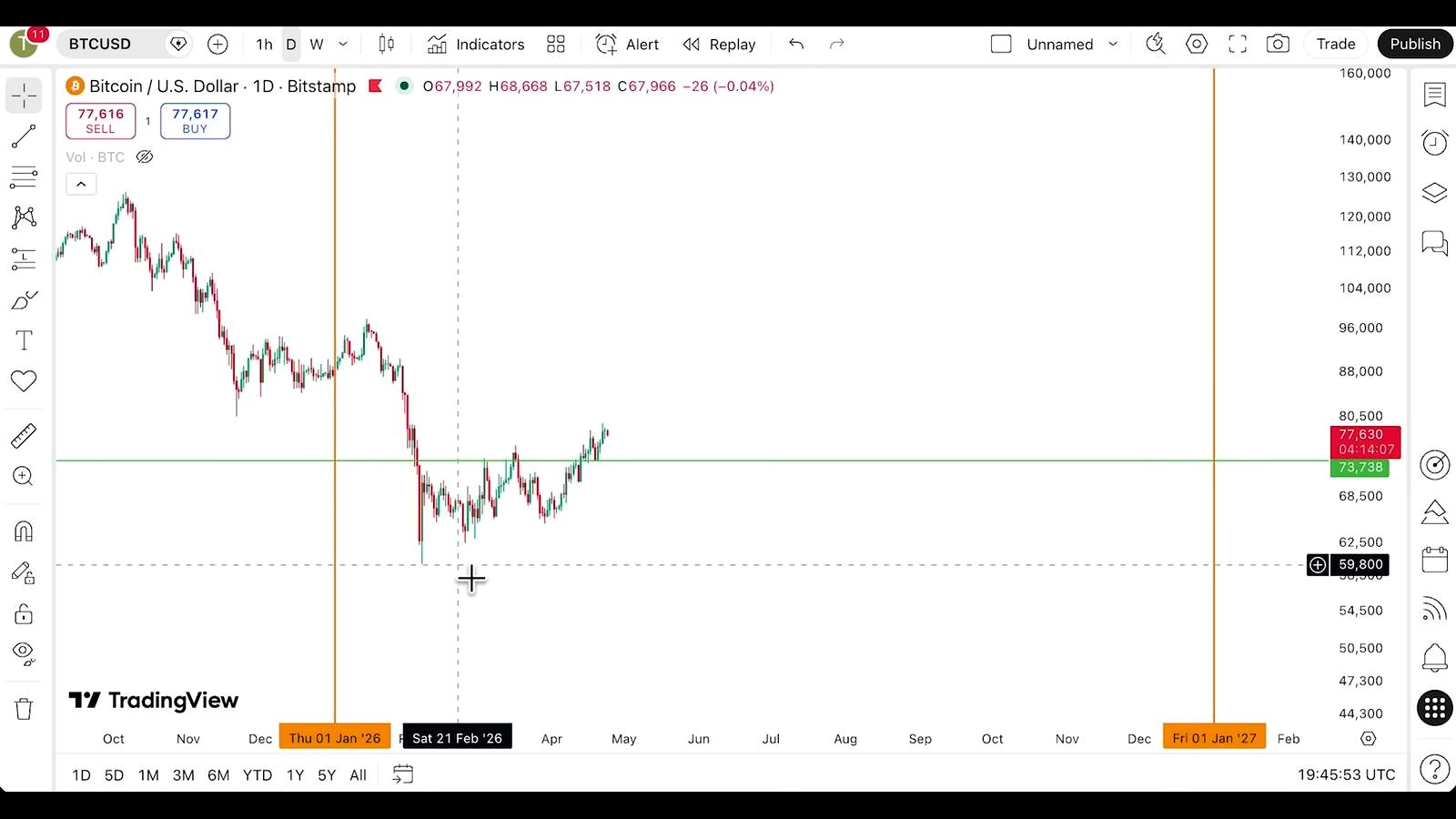
But Altcoin Daily does not turn this into an immediate technical breakout call. In fact, the host explicitly says passage would not happen for “several weeks, ” and argues Bitcoin remains in its “second bear flag.” He points to a zone as high as roughly $79,000 to $81,000 where the bear flag would still remain intact. In his view, if traders accept the pattern, the higher-probability outcome is at least a retest of the lows.
That framing is notable because it mixes medium-term policy optimism with near-term technical caution. In the current market, that is a fairly balanced view. Bitcoin can rally on headlines and still remain below key resistance, especially if spot demand is not strong enough to force short covering through overhead supply. A move into the low $80,000s without follow-through would fit that script.
Supporting Analysis: Policy Progress, BTC Levels, and the Side Story Around CZ
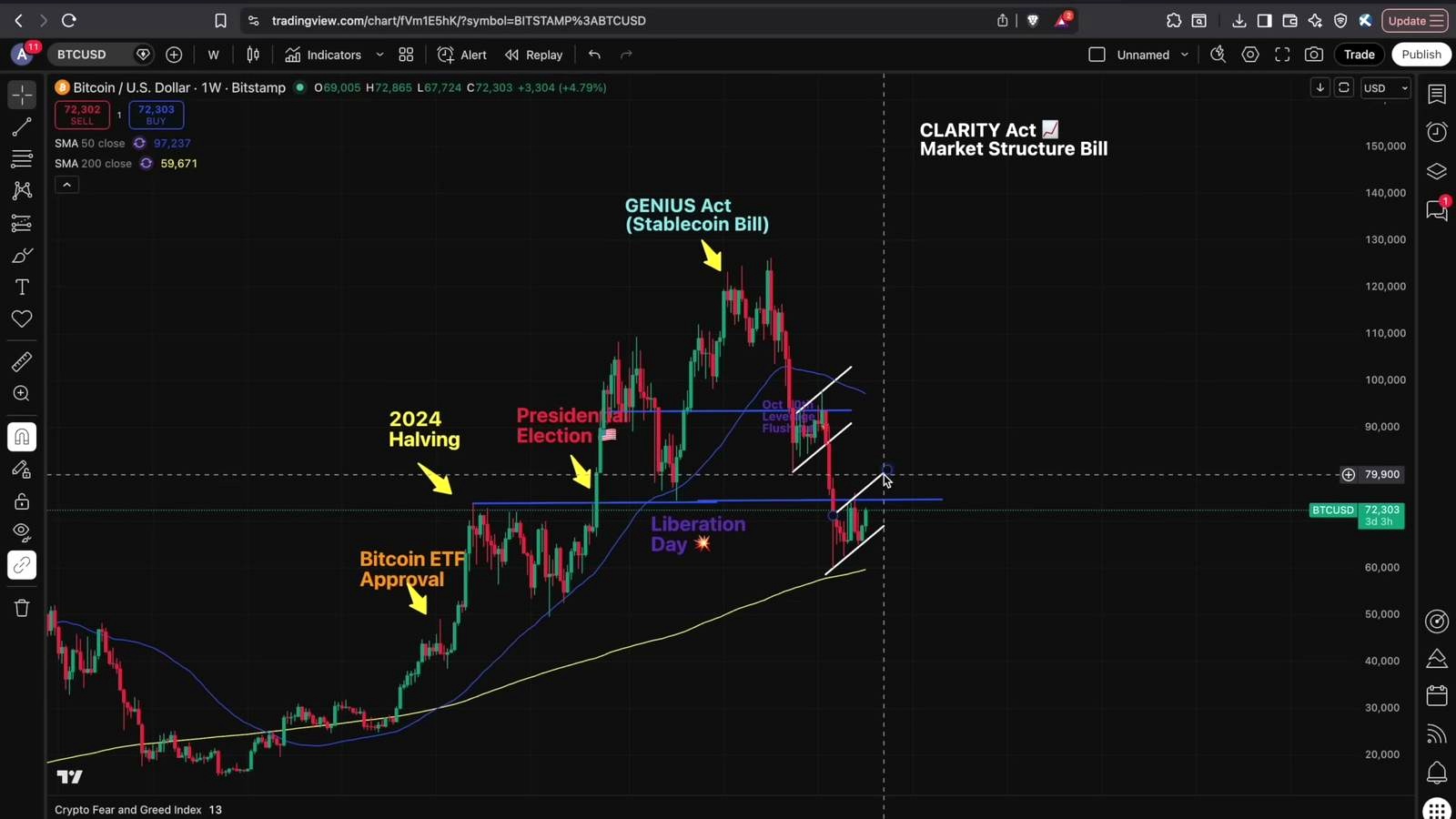
According to Altcoin Daily, the big-picture trade setup is straightforward: constructive regulation may improve the long-term environment for Bitcoin and crypto in the US, but traders should not ignore the chart while Congress works through the details. The host’s key technical point is that Bitcoin can climb into the $79,000 to $81,000 area and still preserve a bearish continuation structure. For directional traders, that implies strength into resistance may not automatically mean trend reversal.
In practical market terms, that kind of setup usually creates a fork in the road. Bulls need a decisive reclaim above the upper end of the flag and sustained acceptance there. Bears only need price to fail in that zone and rotate back toward prior lows. The host leans toward the latter on a probability basis, while acknowledging “anything is possible.”
The transcript also spends substantial time on a separate industry story: a public dispute involving Binance founder Changpeng “CZ” Zhao, his ex-wife and Binance co-founder Yi He, and OKX founder Star Xu. That section is more crypto gossip than direct Bitcoin market analysis, but it still matters as a read on exchange-industry optics.
The host recounts claims and counterclaims over whether CZ is officially divorced and whether his Binance stake was legally separated. He quotes CZ saying he is “officially divorced” and offering a bet of $1 billion or any amount chosen to prove it confidentially through lawyers, with a 24-hour response window. He also quotes Star criticizing the public bet as unprofessional for leaders of regulated firms and pressing the question of whether the Binance stake had been legally separated.
None of that changes Bitcoin’s near-term market structure. But it does underscore a recurring truth about crypto: narratives around exchanges and industry leadership can still shape sentiment at the margins, especially in periods when markets are searching for confidence and institutional legitimacy.
What Could Go Wrong
The clearest threat to Altcoin Daily’s thesis is that regulatory optimism proves real but non-immediate, while Bitcoin continues to trade as a macro risk asset. If the Clarity Act stalls in the Senate Banking Committee, or if the stablecoin-yield dispute becomes a larger political fight than expected, the market may conclude that “clarity” is still months away rather than weeks away.
Even if the bill advances, there is a second risk: Bitcoin may simply not care in the short term. A stronger dollar, sticky inflation, higher real yields, or broad risk-off conditions in equities could overwhelm a positive policy narrative. Crypto often trades on liquidity first and legislation second.
There is also a chart-based invalidation risk for both sides. If BTC cleanly breaks above the host’s $79,000 to $81,000 bear-flag zone and holds, the bearish retest thesis weakens. But if price rejects that area and loses momentum, the market may focus on downside continuation before any Washington catalyst can arrive.
One more blind spot in the transcript is implementation risk. Passing a law is not the same as creating immediate certainty. Agencies still need to interpret, coordinate, and enforce the framework. Markets may celebrate the headline, then spend weeks repricing the fine print.
What to Watch Next
First, watch the Senate Banking Committee. According to Altcoin Daily, that is where the key markup process still needs to happen, with stablecoin rewards and yield as the main sticking point. If that issue is resolved, the odds of broader legislative progress improve materially.
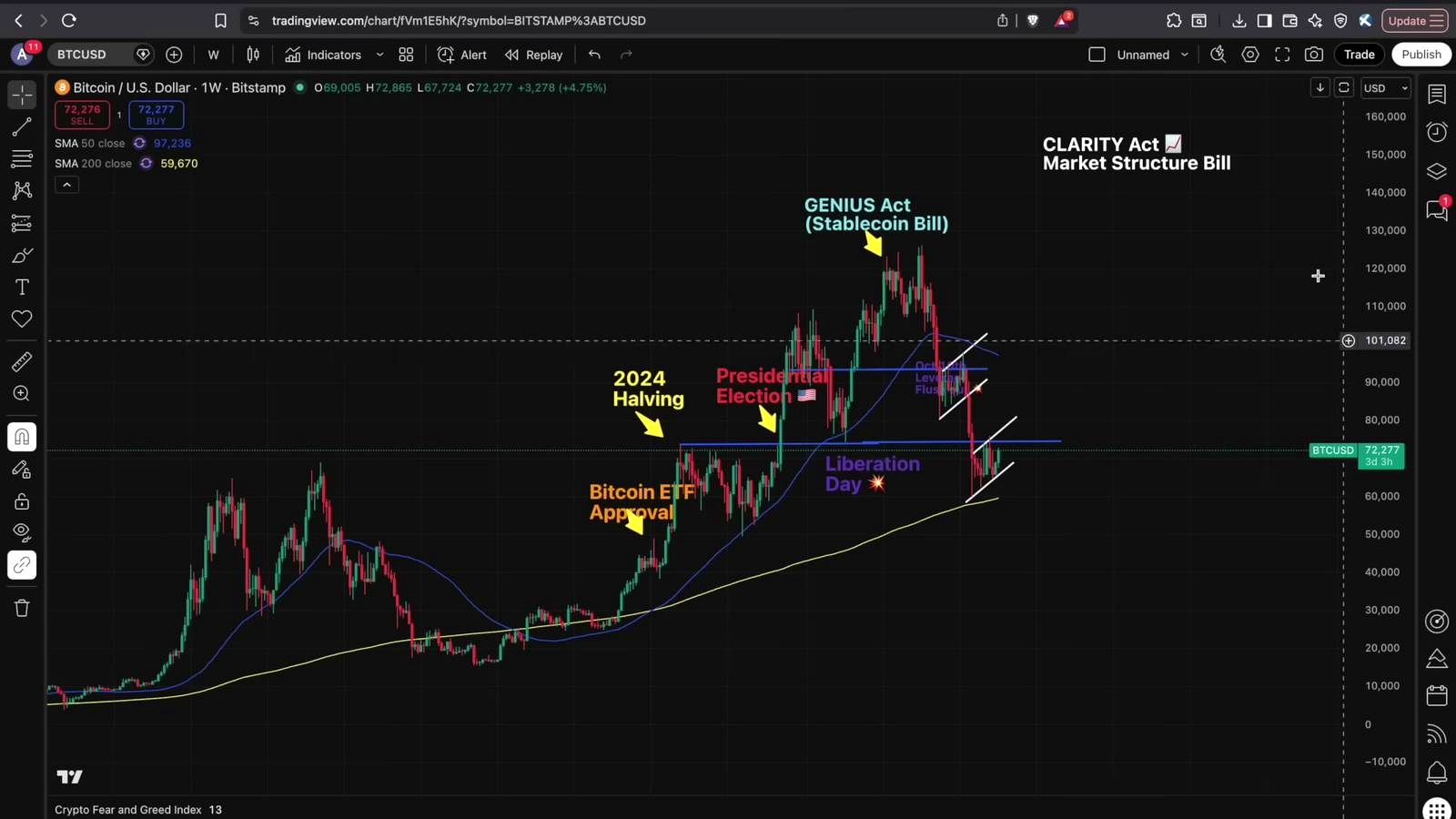
Second, watch Bitcoin’s behavior around $79,000 to $81,000. If price pushes into that zone and gets rejected, the host’s bear-flag thesis stays alive. If BTC breaks above it and finds support there, the market may start treating Washington’s policy shift as a more immediate tailwind.
Third, monitor whether crypto policy headlines are translating into spot demand rather than just social-media excitement. That is the difference between a narrative and a trend.
FAQ
What is a bear flag in Bitcoin trading?
A bear flag is a continuation pattern that typically forms after a sharp drop, followed by an upward or sideways consolidation channel. Traders view it as bearish because the bounce is seen as temporary unless price breaks above resistance and holds there.
Why do stablecoin rules matter for Bitcoin if the bill is about digital assets broadly?
Stablecoins are core market infrastructure for crypto trading. They support exchange liquidity, collateral flows, and dollar settlement across the ecosystem. Clearer stablecoin rules can improve confidence in the plumbing that supports Bitcoin markets, even if Bitcoin itself is not a stablecoin.
How would traders interpret the $79,000 to $81,000 zone mentioned in the article?
In the host’s framework, that area is resistance within a bearish structure. A failed rally there could attract sellers looking for a retest of prior lows. A breakout above that zone, followed by support holding, would weaken the bearish setup.
What happened when CZ first bought Bitcoin?
According to the transcript, CZ said on the All-In podcast that he sold an apartment for roughly $900,000, then bought Bitcoin in tranches, with purchases starting around $800 and continuing as the price fell toward $600 and $400, averaging about $600.
How is this regulatory moment different from earlier crypto policy debates in the US?
The key difference, as framed by Altcoin Daily, is alignment. The host argues that major regulators and lawmakers are now more openly supportive of moving a market-structure bill forward, rather than relying on enforcement-first ambiguity. Whether that alignment produces fast legislation is the real test.
Source Video

John Burnell focuses on Bitcoin infrastructure, wallet security and blockchain technology. He writes educational articles explaining how Bitcoin works and how the technology evolves.