Home Bitcoin mining keeps running into the same wall: industrial ASICs are cheap on the secondary market, but most were built for 240V power, warehouse noise levels and multi-kilowatt draw. The question is whether repurposed hardware can cross over into a normal house without losing the economics that make it attractive. According to Altered Component, a modified Antminer S19j Pro gets part of the way there, but not yet far enough.
The Core Thesis: A Used Industrial BTC Miner Can Be Adapted for the Home
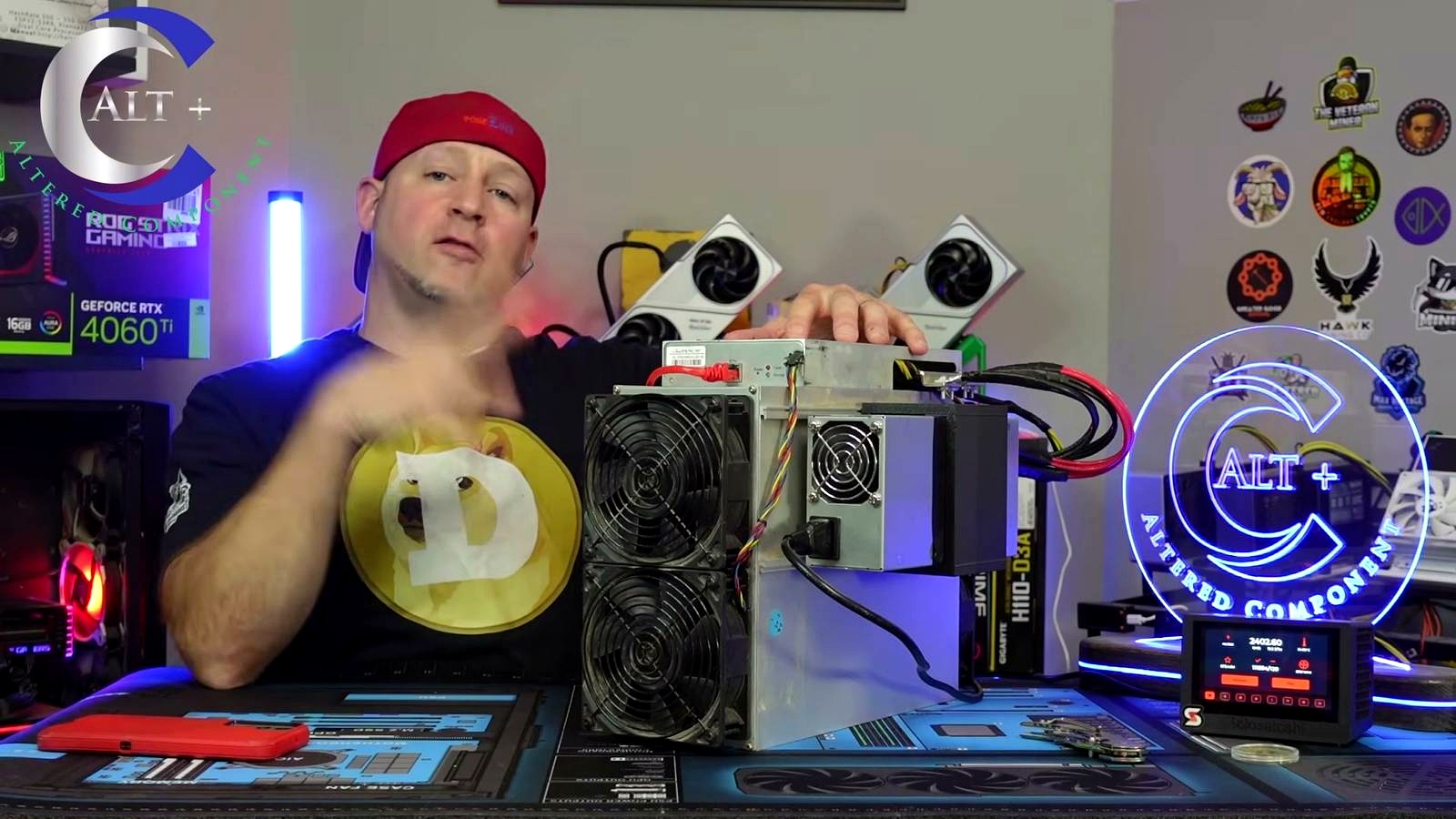
According to Altered Component, the appeal of this setup is straightforward: take a used Bitmain Antminer S19j Pro bought for $250 with free shipping, or roughly $260-plus after tax, strip it down for a 120V U.S. household outlet, and see whether it can deliver meaningful Bitcoin hashpower at a price hobbyist miners can justify.
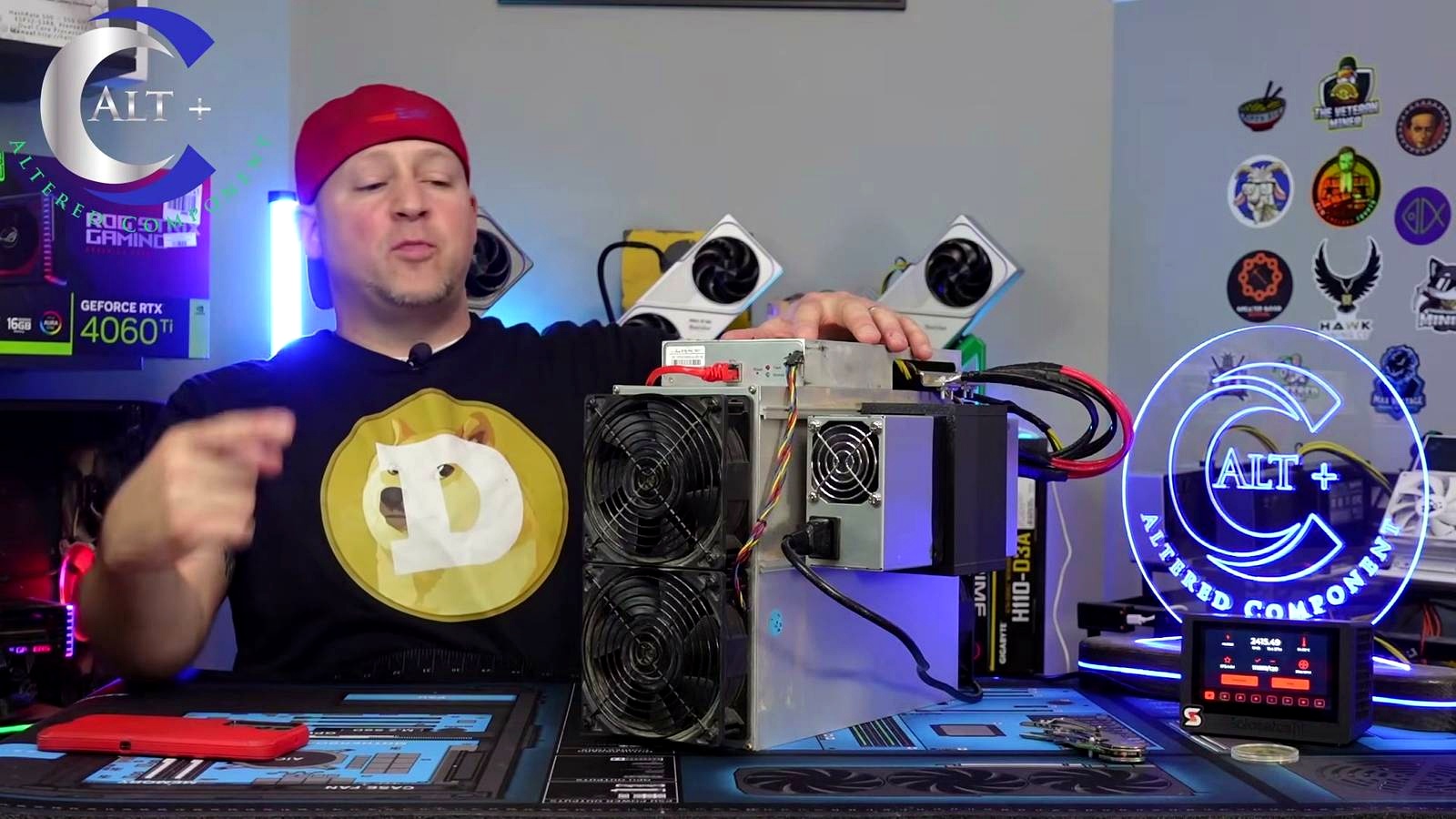
The unit in the video is a repurposed “Loki mining rig, ” which the host describes as a standard S19j Pro adapted from a machine that normally wants to draw near 3,000W on 240V power. In this version, one of the miner’s three hash boards has been removed and custom firmware is used to tune power, fan speeds and frequency. The promise is obvious: older ASICs are flooding the used market as industrial miners rotate into more efficient fleets, and that creates an opening for home miners willing to accept lower absolute performance in exchange for lower upfront cost.
That broad thesis fits a real market trend. The secondary market for older ASICs often becomes attractive after major hardware upgrade cycles, especially when BTC price strength supports renewed mining interest but new-gen rigs remain expensive. For home miners, the trade-off is rarely about maximizing pure efficiency. It is about whether used hardware can produce enough terahash per dollar while staying within the electrical, thermal and acoustic limits of a house or apartment.
Where Altered Component’s test becomes more useful is that it avoids the usual marketing trap. The host does not present the modified miner as plug-and-play. Instead, he shows that the economics may be attractive on purchase price, while the real bottlenecks are wall-power draw, fan noise and the gap between software-reported and actual power use.
What the Test Actually Showed
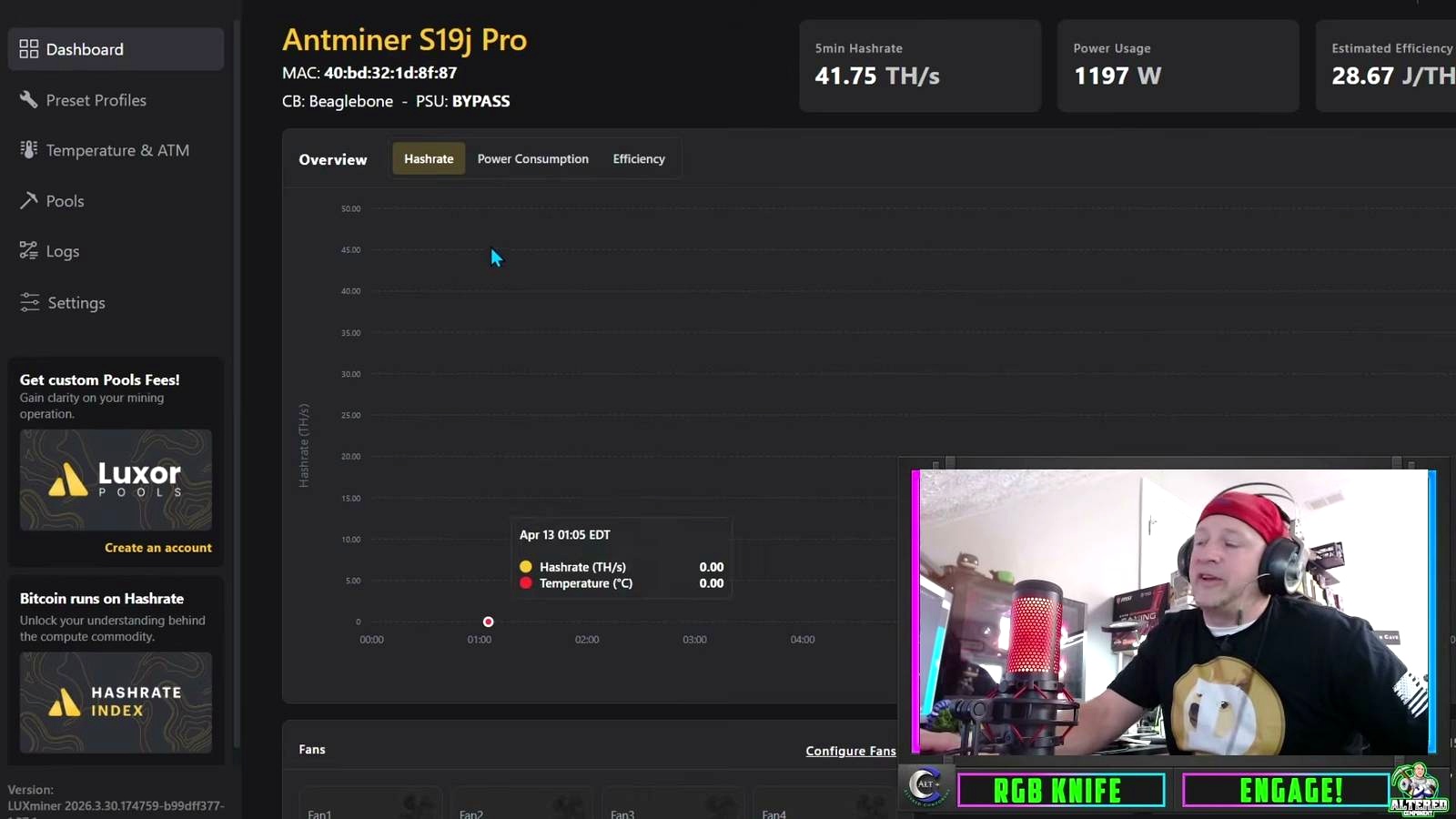
According to Altered Component, the first boot immediately exposed the main problem: the machine was still far too loud for normal indoor use, and power draw was higher than expected. On startup, the miner showed around 1,400W at the wall, then 1,450W, then 1,500W before dropping back to roughly 1,200W. That is already well below the near-3,000W draw of a stock industrial configuration, but it is still a heavy load for a home setup.
Once the host accessed the firmware dashboard, the machine initially showed 18 TH at 856W, then climbed to 21 TH at 934W. He called that “terrible efficiency” at that stage, while noting the system was still ramping. Fan speeds were around 6,000 RPM, far above what most home users would tolerate. For comparison, the host framed 2,000 RPM to 2,500 RPM as more normal fan territory, with noise becoming severe above 3,000 RPM.
After settling and pointing the machine to a ViaBTC pool, the miner reached roughly 42.14993 terahash at 23.61 joules per terahash in software. That put it in a more respectable efficiency range for a repurposed older ASIC, even if it still lagged more specialized home-focused devices. Altered Component compared it unfavorably with a tuned NerdQaxe-style setup at around 15 to 16 J/TH, but favorably enough to keep testing.
The more revealing detail was the discrepancy between software and real consumption. The host repeatedly found that the dashboard understated actual wall draw. A software reading around 1,200W appeared closer to 1,400W to 1,500W at the wall. Later, in a single-board configuration, the miner showed 530W in software but actually consumed 670W at the wall, which he estimated as about a 21% difference.
That matters because home miners do not pay power bills in software numbers. They pay for what comes out of the wall, and profitability models can break quickly if the real number is consistently 20%-plus higher than reported.
Why the One-Board Setup May Be the More Realistic Path
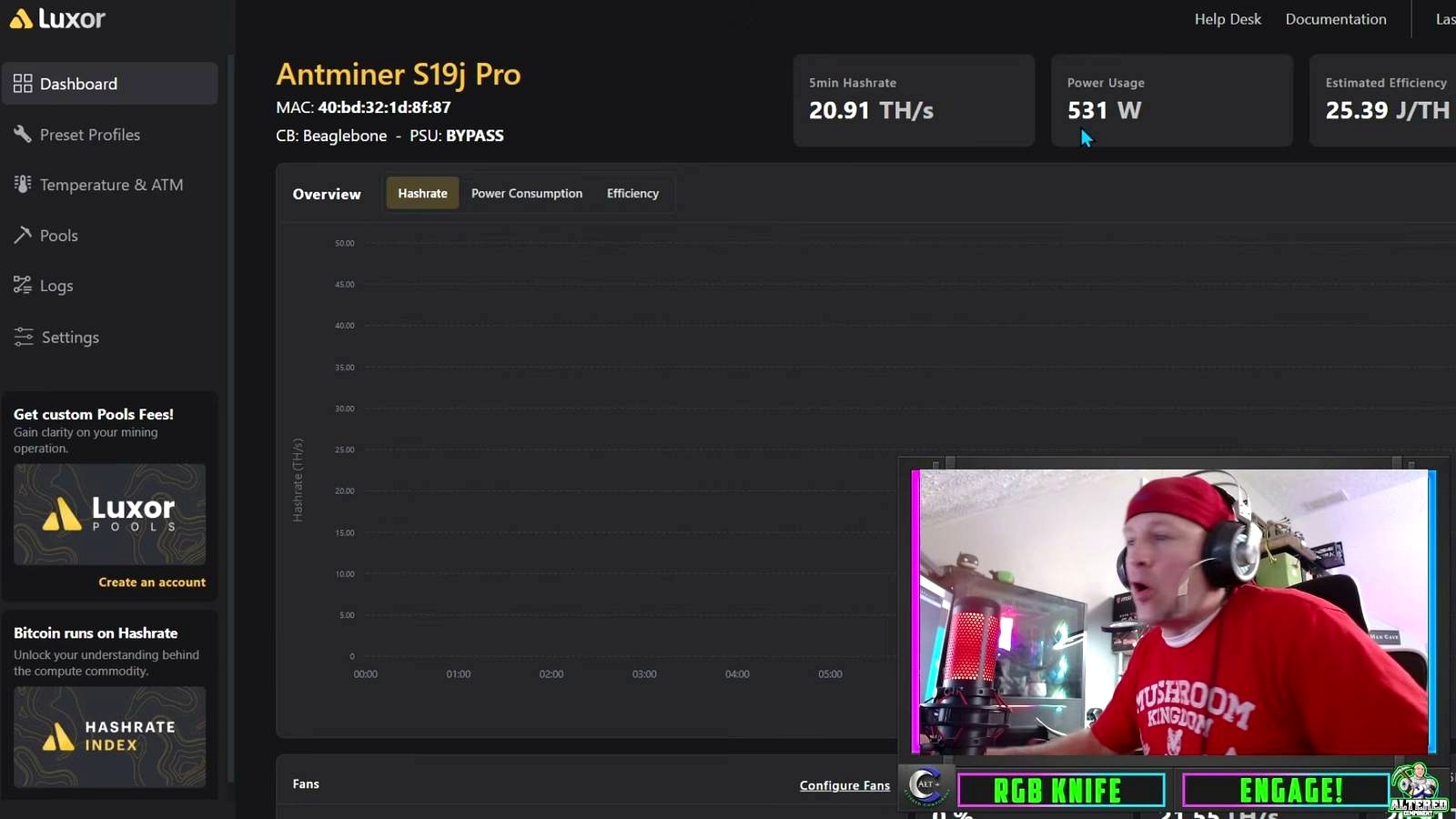
According to Altered Component, the more workable configuration may be a heavily down-tuned machine running only a single active board. In that mode, the host said the miner produced 20.77 TH at 25.5 J/TH, with real wall usage around 665W to 670W. That is a dramatic drop from the 1,200W-plus to 1,500W territory seen in more aggressive configurations.
The trade-off is obvious. A one-board setup sacrifices total hash rate, but it gets much closer to something a household circuit can support more comfortably. The host also suggested that if two boards could be run efficiently, the machine should be able to produce around 42 TH, with the dashboard showing around 950W and a more realistic wall figure near 1,200W. His conclusion, though, was that this was still probably too much for “normal home mining.”
He also experimented with fan settings, including changing the temperature target to 60, which briefly dropped fan speeds into the 1,100 to 1,400 RPM range. At that point, he said the unit became quiet enough that he could not hear it over his desk fan. But temperatures then began rising, with intake around 53 and exhaust around 55, and the fans started ramping up again. He later reduced frequency to 200 from the prior 325 setting, continuing to search for a workable balance between heat, noise and efficiency.
The practical takeaway is that this type of repurposed miner may be best understood as a modding platform, not a finished consumer product. For hobbyists who care about upfront cost and are comfortable changing fans, adjusting firmware and validating wall-power draw independently, the experiment is promising. For buyers expecting a quiet, turnkey Bitcoin heater, this version is not there yet.
What Could Go Wrong
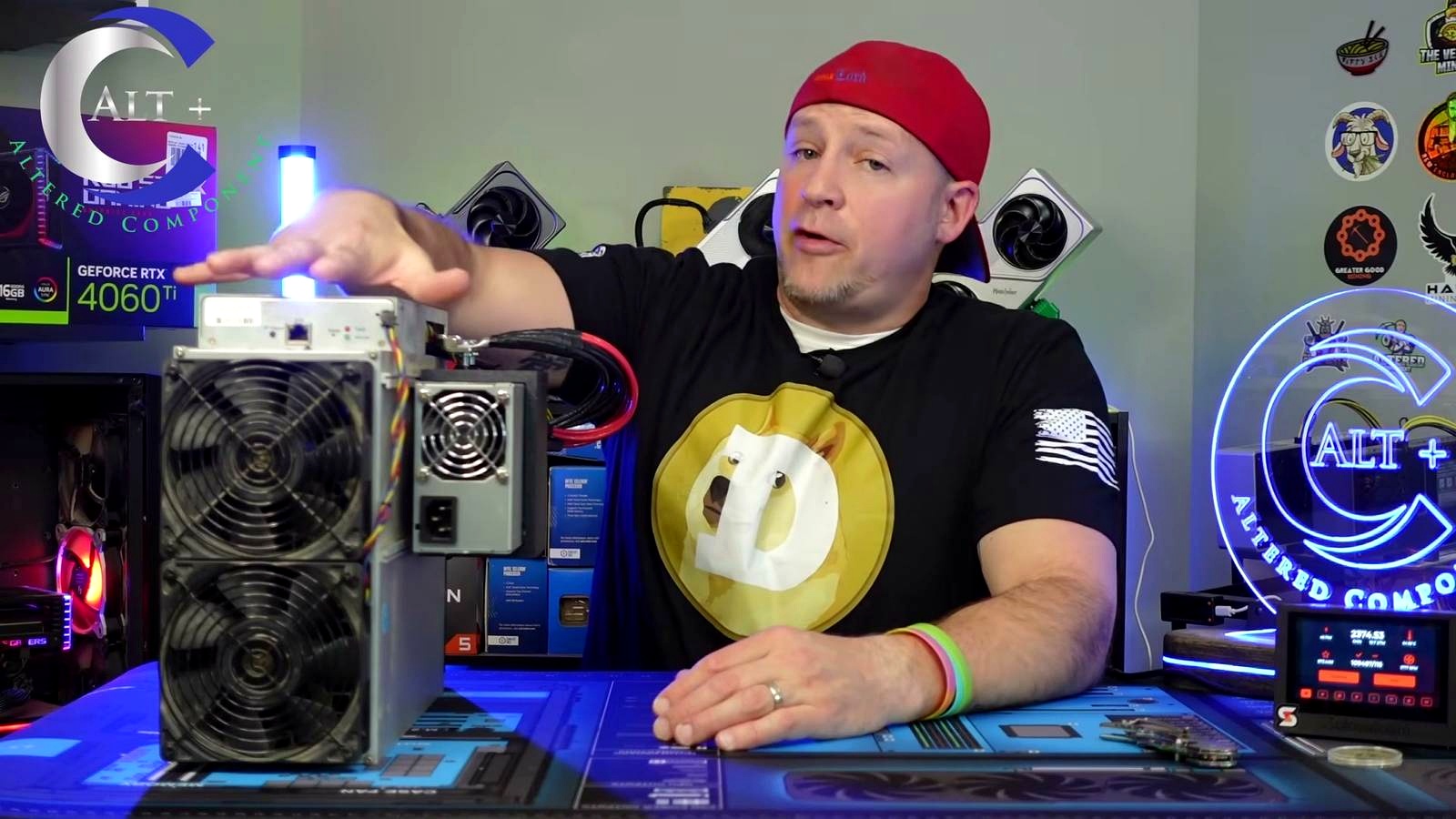
The biggest risk to this thesis is that the economics look better on paper than they do in a house. A used miner priced under $300 sounds compelling, but that is only the chassis-level entry cost. Once buyers factor in replacement fans, possible power-supply changes, cleaning, noise mitigation, spare parts and time spent tuning, the all-in cost can move much closer to purpose-built home mining hardware.
There is also a structural efficiency problem. The S19j Pro is an older platform, and while underclocking often improves efficiency, it does not erase the limits of previous-generation silicon. If newer low-power ASICs or home-specific products keep falling in price, the advantage of repurposing old industrial gear narrows.
Another issue the host surfaced indirectly is reliability. This machine arrived loosely packed, visibly dirty and heavily used. That is common in the secondary ASIC market. Hash boards, fans and power components degrade under industrial duty cycles, and a cheap used miner can quickly become expensive if one failure leads to replacement parts or prolonged downtime.
The final counterargument is environmental fit. Even if the machine can be pushed toward 22 J/TH, the thesis still fails if fan noise remains unacceptable or if the wall draw stays too high for a normal living setup. In other words, this is not just a hash rate question. It is a heat, sound and electrical integration question.
What to Watch Next
The key trigger from here is whether the mod can get meaningfully closer to the host’s stated goal of roughly 22 J/TH while keeping fan noise in a “normal” range and wall power comfortably below the current levels. Based on the test, readers should watch three things in any follow-up:
- whether a one-board setup can stay near 20 TH to 21 TH at roughly 665W to 670W without acoustic issues,
- whether a two-board setup can actually hold around 42 TH without drifting toward 1,200W-plus wall draw,
- and whether fan modifications, not just firmware tuning, are needed to make the machine genuinely home-usable.
If a future build closes the gap between dashboard numbers and wall numbers, that would strengthen the case that repurposed industrial ASICs can become a credible home-mining category rather than a niche tinkering project.
FAQ
What is joules per terahash in Bitcoin mining?
Joules per terahash, or J/TH, measures mining efficiency: how much energy a machine uses to produce one terahash of hashpower. Lower is better. A miner at 15 J/TH is more efficient than one at 25 J/TH.
Why would someone remove a hash board from an Antminer?
In this case, the modification is meant to reduce power demand so the miner can run on 120V household power instead of its original 240V setup. Fewer active boards mean lower total hash rate, but also lower electrical load.
Why does wall power matter more than software power readings?
Wall power is what your outlet actually supplies and what your utility bill reflects. Software readings may not capture losses from fans, power conversion or other components, so they can understate real consumption.
How does this compare with purpose-built home Bitcoin miners?
Repurposed ASICs can offer more hash rate per dollar upfront, especially when bought used. Purpose-built home miners usually win on noise, ease of setup and predictable power behavior, but often cost more relative to their raw hash rate.
What happened the last time older ASICs flooded the resale market?
Historically, older mining rigs become cheap after major hardware refresh cycles or periods of margin pressure. That often creates a short-lived opportunity for hobbyists, but the winners are usually the buyers who can repair, tune and operate them cheaply rather than those looking for a turnkey experience.
Original Source

Omar Al-Sharif lives and works in the UAE and is involved in the blockchain technology industry. He writes articles on Bitcoin and digital assets as a personal passion, explaining complex topics in simple and understandable language.