Bitcoin has been moving higher over the past couple of days, reaching around 75,000 earlier and then fluctuating around 74,000. At the same time, attention is turning to Bitcoin network hash rate, an upcoming difficulty drop in about three days, and changes in Litecoin and Scrypt mining.
Mining remains highly competitive, especially for home miners. While rising Bitcoin price makes conditions look a little better, power costs and miner efficiency still play a major role in whether mining makes sense.
Bitcoin Price Movement and Mining Conditions
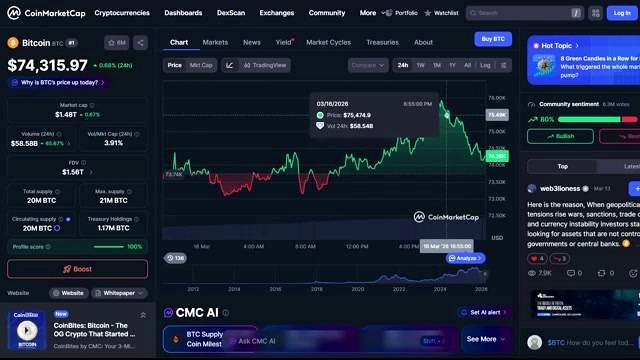
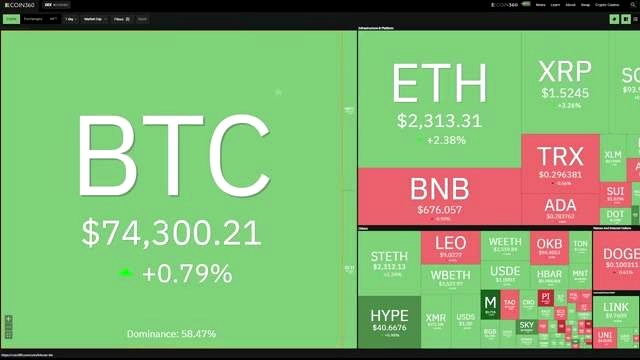
Bitcoin has been pumping a little bit over the past couple of days and going up. Earlier it hit around 75,000, and then moved to about 74,000, fluctuating around that level.
That price action looks good, but whether it will sustain is still uncertain. For miners, especially those at home, a higher Bitcoin price helps, even if profitability is still rough for many setups.
- Mining at home is still not profitable at all for anyone above about 8 cents per kilowatt hour
- Older hardware without the latest efficiency is still in a difficult position
- Higher Bitcoin price is making conditions look a little better
Bitcoin Network Hash Rate Growth
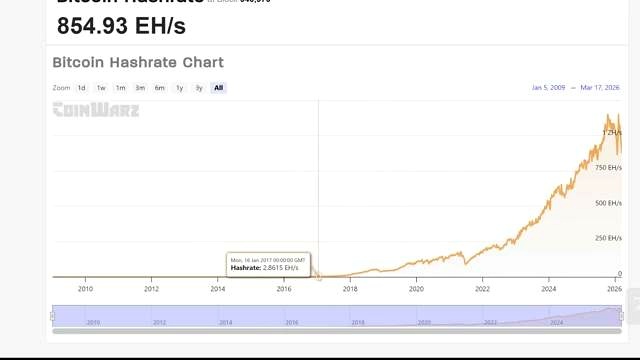
Bitcoin’s hash rate growth over the past five to ten years has been enormous. Back in 2017, the network was at just a few exahashes, and by 2025 it moved to over one zetahash.
That represents an almost millionfold increase in computational power securing the Bitcoin network. The rise reflects both growing participation in Bitcoin mining and the constant release of newer and more efficient hardware.
Why the Hash Rate Has Climbed So Much
One major reason for the increase is the steady arrival of more efficient Bitcoin miners. New models have continued to appear every month or every couple of months, improving performance over time.
Electrical cost is also a major factor. At very low power prices, even older and less efficient Bitcoin miners can still remain decently profitable. As electricity prices rise, efficiency becomes much more important.
- Newer hardware has been getting better and better over time
- Very low electricity costs can keep older miners running
- Efficiency and cost per kilowatt hour are now paramount
Large Mining Farms and Industry Expansion
Large-scale mining farms have continued appearing over the years, especially after Bitcoin moved up to 65K in 2020. That period brought more institutional investment, more adoption, and bigger players with the capital to expand infrastructure.
Over the past five years especially, mining operations have scaled aggressively. The network moved from around 100 exahash in 2020 all the way toward a zetahash, showing just how much mining capacity has been added.
At the same time, hobby miners still contribute from home setups and garages. That helps keep mining more decentralized, even though most miners are still motivated by financial incentive.
Home Bitcoin Mining and Power Cost Reality
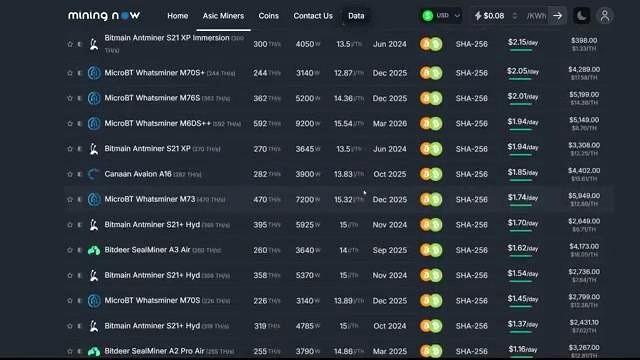
Home mining has become increasingly difficult. For anyone paying 9 cents per kilowatt hour and above, mining at home is pretty much losing money in many cases.
Smaller devices are a different story. A BitAx gamma, for example, does not use much power, which is one reason these devices are so popular. Many users run them more for the chance to hit a Bitcoin block or mine other SHA-256 coins than for strong daily profitability.
Why Small Miners Remain Popular
- They do not take much power
- They are easier to keep running at home
- Many users are trying their luck at solo mining Bitcoin
Solo mining Bitcoin is very popular right now, although it has also become oversaturated.
Bitcoin Hash Rate and Difficulty Update
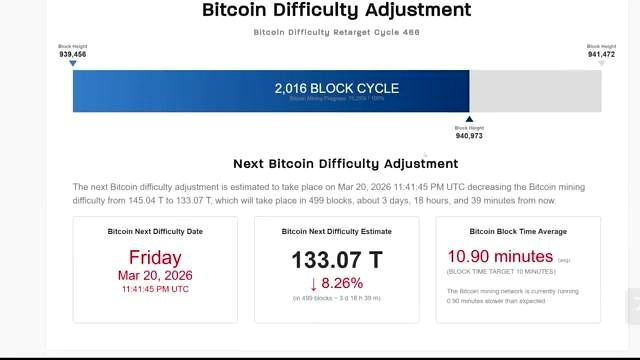
Bitcoin’s network hash rate is around 854 exahash, while difficulty is at 145T as of recording. Hash rate has been dropping over the past couple of months, especially after Bitcoin moved down from 125K to 60.
There were also winter curtailments that caused a lot of companies to go down. In addition, some larger mining entities are reportedly shutting down and moving into AI, which may also be contributing to lower mining activity.
Upcoming Difficulty Drop
The next Bitcoin difficulty adjustment is expected in about three days. The projected change is a drop of 8.26%, which would bring difficulty down to 133T.
That is expected to help miners who continue operating, especially those with cheaper electricity. They may see a small bump in profitability.
What Could Happen After the Adjustment
Once difficulty drops, there may be an influx of miners turning machines back on because mining could become profitable again. That could push hash rate back up, creating the usual back-and-forth between profitability and network participation.
This pattern is not new, but it remains important as miners react quickly to changes in revenue and power cost conditions.
Litecoin Hash Rate and Scrypt Mining Pressure
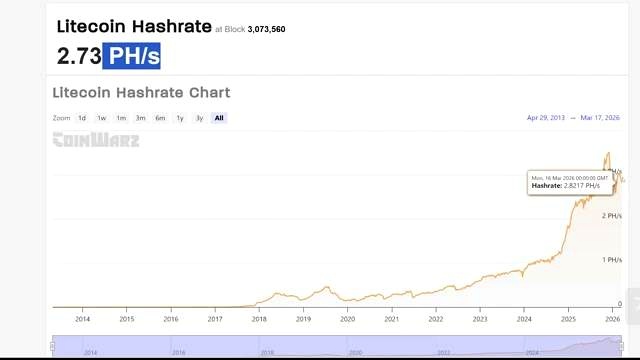
Litecoin is also becoming highly competitive, along with Dogecoin. Most of the profits are connected to merge mining, where Litecoin is mined first and then merged with Dogecoin and other auxiliary merge-mineable coins when the pool supports it.
Litecoin’s network hash rate is around 2.73 petahash, and it has been coming down. A big reason appears to be pressure on older Scrypt miners, including L7 units.
Why Litecoin Hash Rate Has Been Falling
Even with Dogecoin moving up a little, an L7 is still pretty much losing money or breaking even at around 7 cents power. That suggests many L7s, along with older inefficient Scrypt miners, may be turning off.
The next less efficient models are also likely to face pressure. Machines around 0.31 joules per megahash may be next as profitability tightens further, while L7s are around 0.36.
- Litecoin hash rate is around 2.73 petahash
- L7 miners are near break-even or losing money at around 7 cents
- Older inefficient Scrypt miners are likely turning off
Dogecoin’s Role in Scrypt Mining
Dogecoin remains very popular and Scrypt mining has already become industrialized. Hash rate has climbed significantly as more miners entered the space.
If Dogecoin moves higher, profitability can shift quickly. If Dogecoin were at 20 cents, L7 miners would be profitable again, showing how strongly price affects network participation.
Seal Miner DL1 Announcement
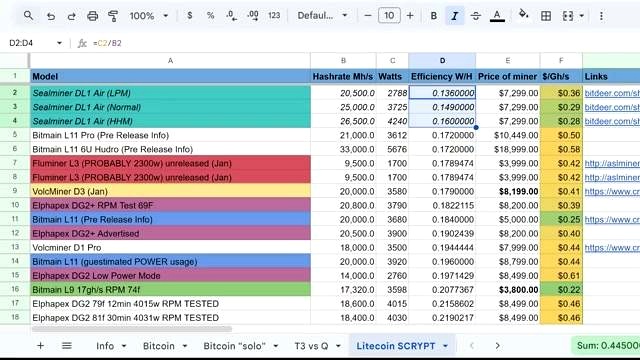
BitDeer has announced the new Seal Miner DL1. It is already listed on Crypto Miner Bros for 7,299, although it cannot be pre-ordered and currently only offers a wait list.
The announced specifications are 25 gigahash and 149 joules per gigahash. Based on the announced numbers, it would be the most efficient Scrypt miner currently announced, although it is still unreleased.
Seal Miner DL1 Key Specs
- Price listed: 7,299
- Pre-order status: no pre-order, wait list only
- Hash rate: 25 gigahash
- Efficiency: 149 joules per gigahash
Low Power Mode
The Seal Miner DL1 Air also includes a low power mode. In that mode, it runs at 20.5 gigahash and 2,788 watts, which comes out to about 0.13 efficiency.
That low power mode stands out as very efficient and is one of the more interesting parts of the announcement.
Operating Environment and Dimensions
The DL1 Air is described as engineered for reliable Scrypt mining across diverse environments. Its stated operating range includes minus 20 degrees C up to 50 degrees C, humidity from 10 to 90%, and altitude up to 2,000 meters.
- Temperature: -20°C to 50°C
- Humidity: 10% to 90%
- Altitude: up to 2,000 m
- Dimensions: 197 x 365 x 292 mm
- Net weight: 15.5 kg
Competition With L9 and Other Scrypt Miners
Although the Seal Miner DL1 looks strong on paper, the current leader among available machines is still considered the L9 17 gigahash model. There are also L11 units in the wild, though apparently not many.
L9 miners have been especially popular, and their impact on Scrypt hash rate has been significant. Since late 2024, Scrypt mining has seen a meteoric rise, with L9s playing a dominant role.
Current Scrypt Market Dynamics
There is likely a large amount of L9 hash rate already online, along with Alphaex and VolcMiner units. Older hardware, including L7s and machines older than that, still makes up a substantial amount of the network as well.
As more efficient hardware keeps coming out, older units are pushed out unless coin prices rise enough to make them profitable again.
Efficiency Is Driving the Market
Across both Bitcoin mining and Scrypt mining, efficiency now matters more than ever. When crypto prices are not extremely high, the miners with the cheapest power and the best efficiency have the advantage.
The market has become an arms race for hash power and the lowest possible electricity cost. Anyone with cheap power is in the strongest position to reach ROI on new hardware.
Concerns About Announced Specs
There is also skepticism around manufacturer efficiency claims. Some announced numbers do not always match real power draw at the wall, and this has become part of the broader competition between manufacturers releasing new models.
That makes pricing and real-world efficiency especially important when evaluating new machines like the Seal Miner DL1.
FAQ
What is happening with Bitcoin hash rate right now?
Bitcoin hash rate is around 854 exahash, and it has been trending down over the past couple of months after a previous peak above one zetahash.
What is the expected Bitcoin difficulty change?
The expected Bitcoin difficulty adjustment is a drop of 8.26%, which would bring difficulty from 145T down to 133T.
Why is the Bitcoin difficulty drop important?
A lower difficulty can improve profitability for miners who stay online, especially those with cheaper electricity. It may also bring some miners back online.
Why is home Bitcoin mining difficult now?
Home mining is difficult because power costs and efficiency are now critical. For anyone above about 8 to 9 cents per kilowatt hour, many setups are not profitable.
What is Litecoin’s current network hash rate?
Litecoin’s network hash rate is around 2.73 petahash, and it has been coming down.
Why are some Scrypt miners turning off?
Many Scrypt miners, including L7 units, are near break-even or losing money at around 7 cents electricity, so older and less efficient units are likely shutting down.
What are the announced specs of the Seal Miner DL1?
The announced Seal Miner DL1 specs are 25 gigahash at 149 joules per gigahash, with a listed price of 7,299 and wait list availability.
Does the Seal Miner DL1 have a low power mode?
Yes. The low power mode is listed at 20.5 gigahash and 2,788 watts, with about 0.13 efficiency.
Why does efficiency matter so much right now?
Efficiency matters because current crypto prices make electricity cost a major factor. The most efficient miners with the cheapest power have the best chance to stay profitable.
Video Source

An Indian crypto journalist covering the developments in the Bitcoin and blockchain industries. Her work helps readers understand key changes in the world of digital assets.