As Bitcoin-linked yield products spread across social media, the core question for retail users is the same as ever: are these mining-based passive income pitches a legitimate shortcut to BTC exposure, or a risk dressed up as simplicity? According to Earn Online, a platform called Uni Mine offers retail users a way to buy cloud-mining-style packages starting at $100, with returns tied to Bitcoin mining output and recent daily percentages near 0.93%.
Core thesis: a retail mining pitch built around daily yield and a two-year lockup
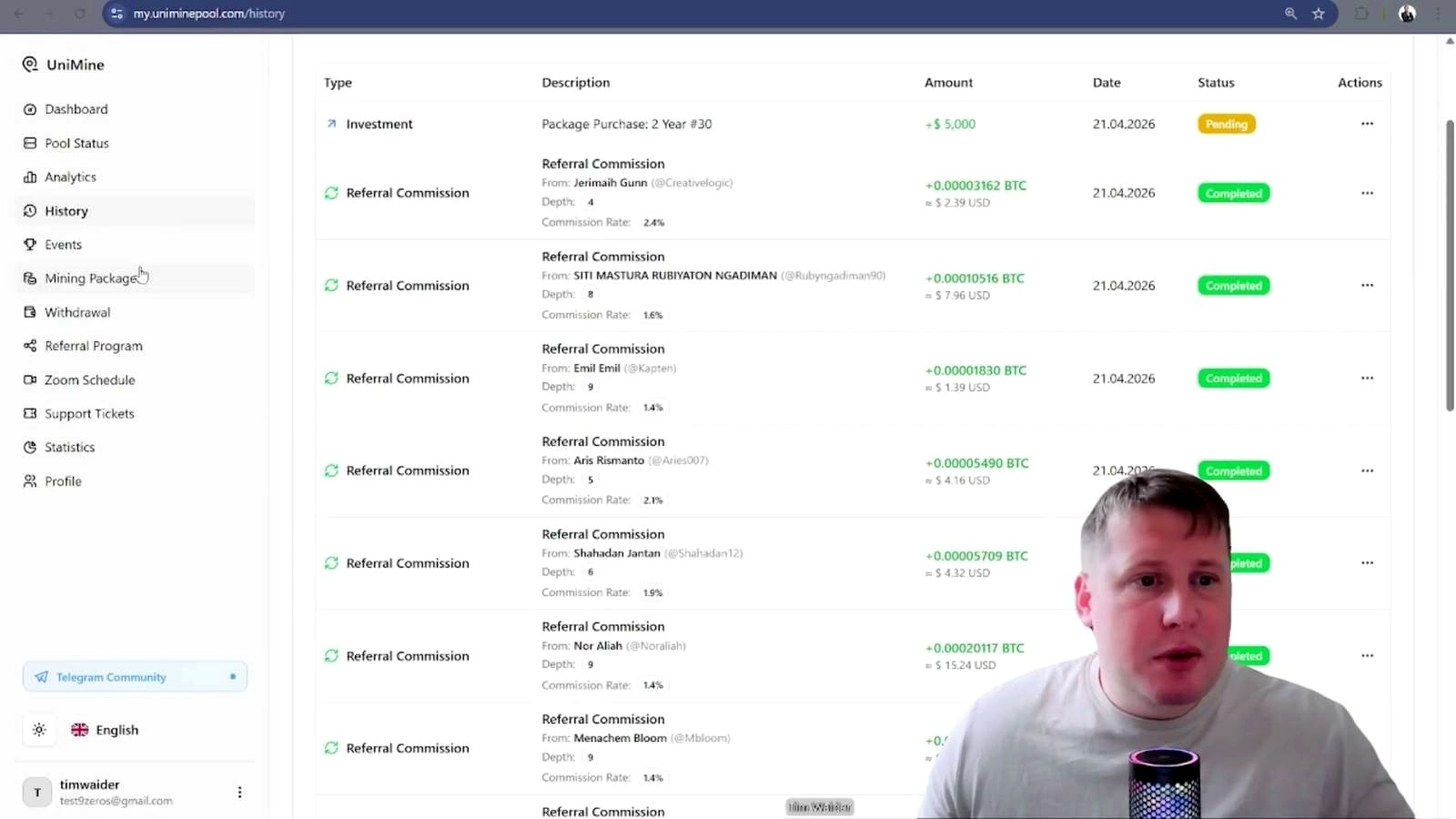
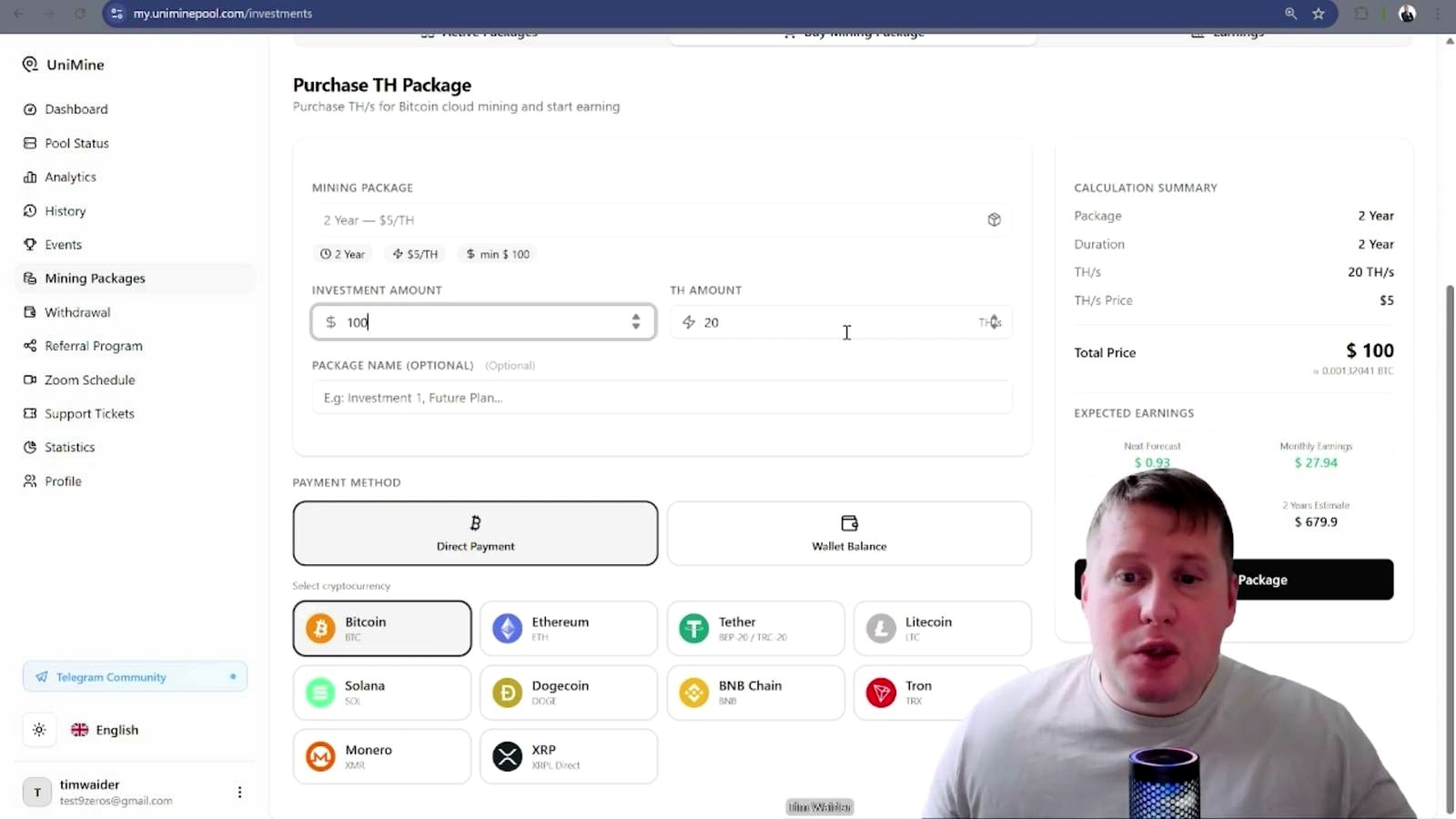
According to Earn Online, the appeal of Uni Mine is straightforward: users can purchase mining packages in crypto, receive exposure to rented hashpower, and collect passive income over a fixed term of two years. The host says he recently added another $5,000 to the platform and claims his total capital deployed now stands at roughly $21,850. He also says participants have been “making up to 1% a day, ” while citing an average return for that day of 0.93%.
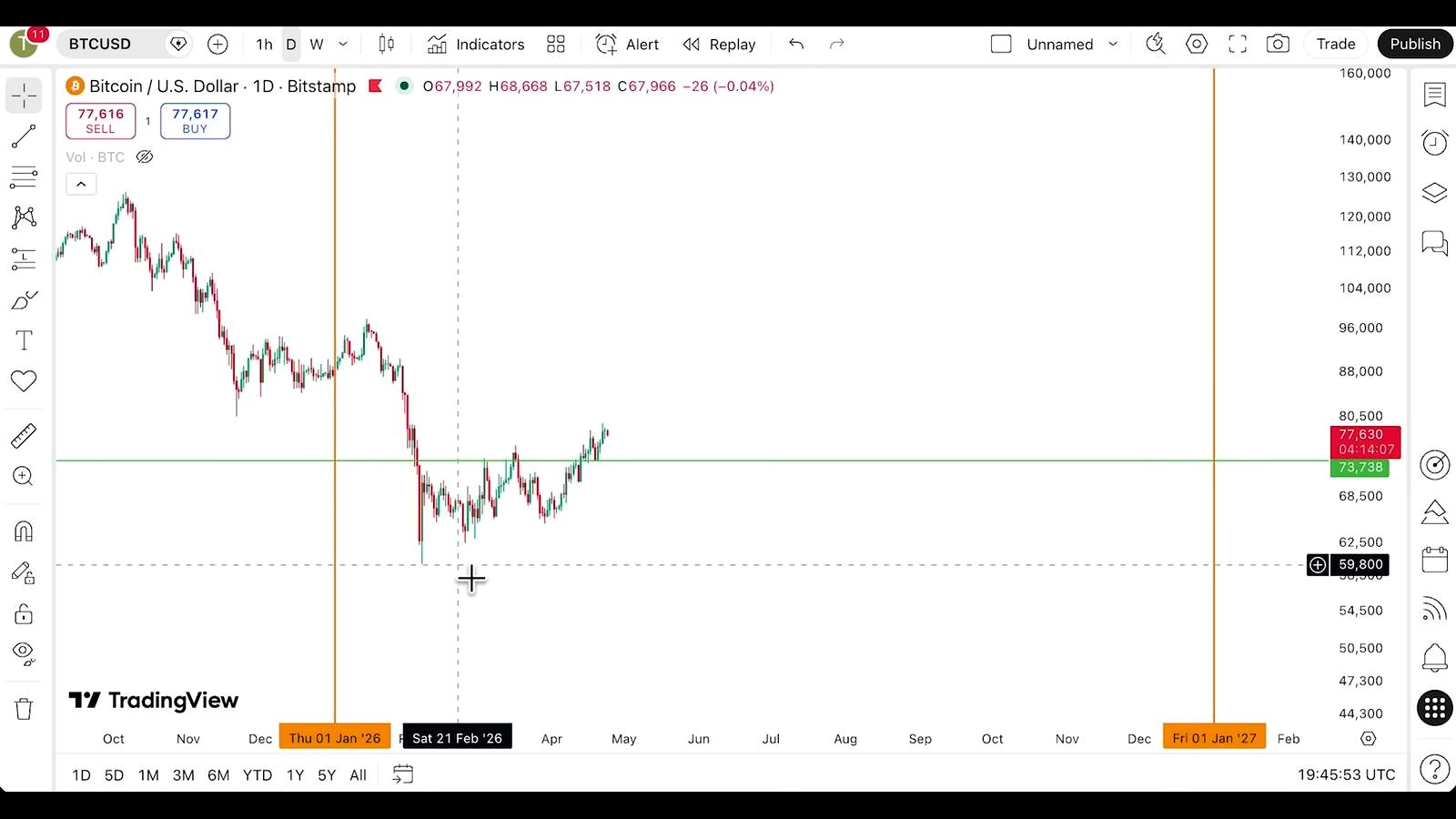
The host frames those payouts as a function of Bitcoin price. When BTC rises, he says, mining profits and participant returns increase; when Bitcoin falls, the daily profit declines. He adds that when he joined around three months earlier, returns were closer to 0.82% to 0.85% per day, and says percentages have risen alongside Bitcoin’s price.
That pitch sits in a familiar part of the crypto market: retail investors seeking “passive income” without directly trading BTC or buying and running mining hardware themselves. In broad market terms, there is a plausible logic behind mining-linked revenues moving with Bitcoin’s price. Higher BTC prices can improve miner margins if energy and hardware costs stay relatively stable. But there is also a major gap between that general principle and the much stronger implication that retail users can reliably earn near-1% daily through a third-party package.
In public Bitcoin mining markets, profitability is usually constrained by network difficulty, hardware efficiency, hosting costs, treasury strategy, and capital structure. Those variables can shift quickly. A high advertised daily percentage may look attractive in a bull market, but the durability of such payouts depends less on marketing language and more on whether the economics, custody, and corporate structure can withstand lower BTC prices or rising difficulty.
Supporting analysis: the package structure, reported performance, and growth claims
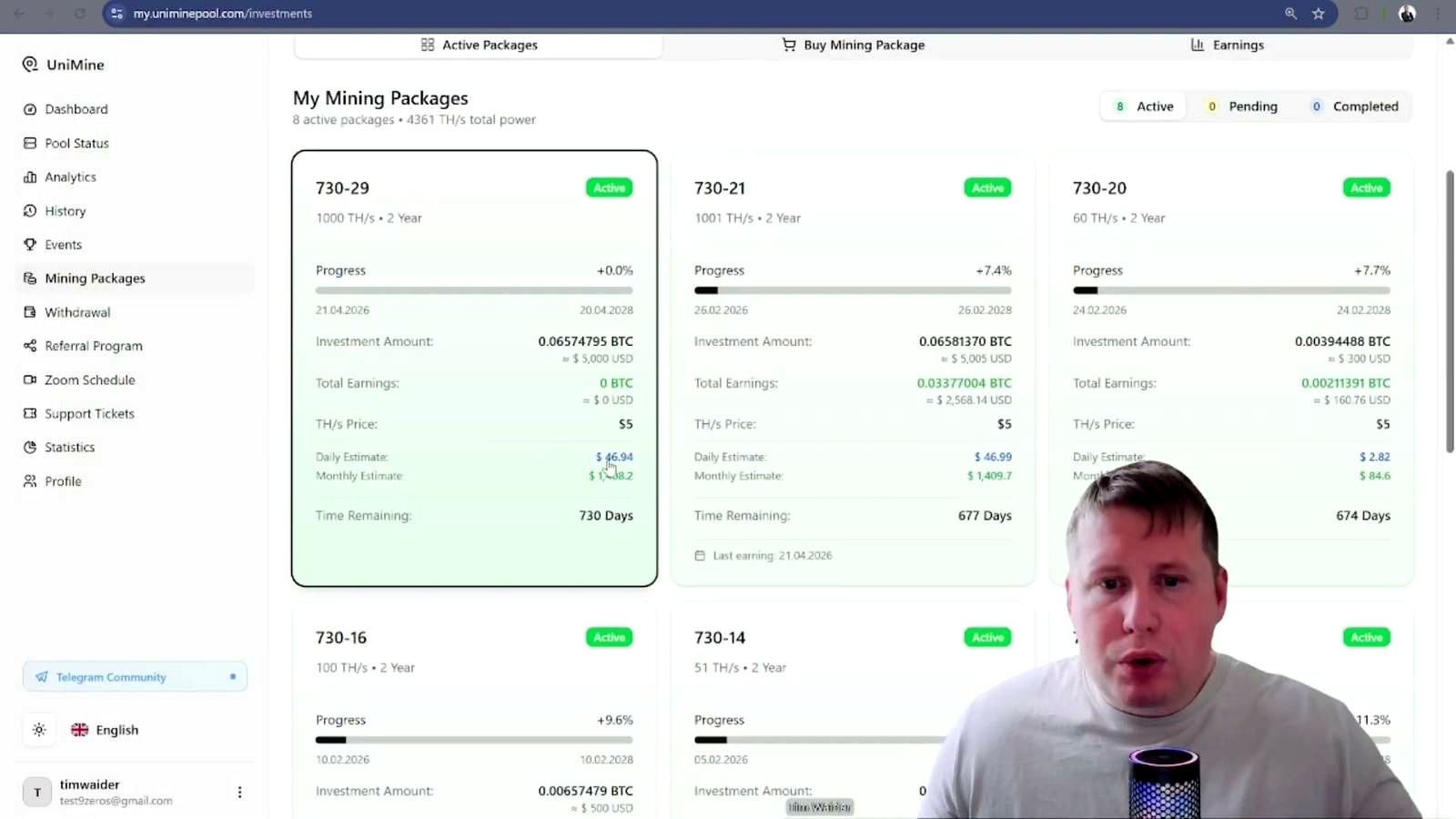
According to Earn Online, Uni Mine offers eight different mining packages, all with a two-year duration. The host says one of his earliest packages began on January 19, 2026 and runs until January 19, 2028. He says that package started at $10,000 and had already returned about $8,520, leaving about $1,500 to break even. He says he expects that to happen within “a few weeks.”
He then runs through several other examples from his account: a package of around $100 that had returned roughly $170; a $575 package that had returned about $449; a $255 package that had returned about $183; a $500 package that had returned about $337; and a $300 package that had returned about $160. He also references one of his more recent packages of roughly $5,500, saying more than 50% of that had already been returned.
The host says users can fund packages with multiple cryptocurrencies including Bitcoin, Ethereum, USDT on different networks, Litecoin, Tron, BNB, Dogecoin, Solana, Monero, and XRP. He adds that a $5,000 package corresponds to 1,000 terahash of mining power. He also says payment confirmations usually take about 5 minutes to 10 minutes.
One of the more consequential claims is operational rather than promotional. The host says Uni Mine benefits from discounted electricity from the government of Georgia, which he argues allows the company to mine Bitcoin cheaply. He also says the company is raising funds to buy more miners ahead of the 2028 halving and aims to become a leading Bitcoin mining platform by then. He further claims that once the miner acquisition target is reached, new participants may no longer be accepted, presenting today’s offer as limited.
Those details matter because they are the closest thing in the video to an underlying business case: cheap power, expanding mining fleet, and BTC-linked payouts. But none of those claims, on their own, establish whether users hold a direct claim on mining output, whether the contracts are legally enforceable, or how much of the payout is operational income versus a product structure dependent on continued inflows.
What could go wrong
The most obvious risk to the thesis is simple: Bitcoin mining economics are cyclical, but fixed-return-style marketing often implies a consistency the sector rarely delivers. If BTC stalls or drops sharply while network difficulty rises, margins can compress fast. In that scenario, a daily return near 0.93% would be much harder to sustain.
There are also platform-specific risks the host does not meaningfully address. The video does not provide audited mining data, proof of reserves, legal documentation for user claims on hashpower, or independently verified financials. That is a critical omission. In crypto, “passive income” products tied to mining, arbitrage, or bots have repeatedly failed when users relied on dashboards rather than verifiable operations.
The affiliate component is another point of caution. According to Earn Online, the platform includes an affiliate system and allows users to make additional money by promoting it. That does not prove anything improper on its own, but it does raise the standard of proof investors should demand. A real mining business can still be risky; a real mining business paired with aggressive retail distribution deserves even more scrutiny.
The other side of the trade is straightforward: if an investor is bullish on Bitcoin, simply holding BTC avoids counterparty risk tied to a platform. If the investor wants mining exposure, public miners and spot BTC each offer more transparent alternatives, even if they come with different volatility and operational tradeoffs.
What to watch next
The first trigger is whether reported payouts stay near the host’s cited 0.93% average as Bitcoin price conditions change. If returns decline materially while marketing expectations remain high, that would weaken the core pitch quickly. The second is evidence of operations: miner fleet growth, transparent reporting, and verifiable proof that user packages are tied to real hashpower rather than internal accounting.
Investors should also watch the broader Bitcoin mining environment into the 2028 halving cycle. If mining difficulty keeps climbing faster than BTC price, retail mining products will face pressure. Finally, any change in withdrawals, settlement delays beyond the cited 5 to 10 minutes, or revised package terms would be an immediate red flag.
FAQ
What is hashpower, and what does 1,000 terahash mean?
Hashpower is the computing power used to mine Bitcoin. A terahash measures trillions of guesses per second made by mining equipment. In the video, the host says a $5,000 package corresponds to 1,000 terahash, meaning the buyer is effectively renting a stated amount of mining capacity rather than buying a machine directly.
How does cloud mining differ from owning Bitcoin outright?
Buying Bitcoin gives direct exposure to BTC’s price with no mining operational risk. Cloud or package-based mining adds counterparty risk, payout uncertainty, and dependence on the provider’s hardware, energy costs, uptime, and accounting. The tradeoff is that users avoid setting up and running mining machines themselves.
Why do Bitcoin mining returns change with BTC price?
Miners earn revenue in Bitcoin, so a higher BTC price can improve the value of mined coins. But profitability also depends on network difficulty, block rewards, fees, machine efficiency, and electricity costs. That is why mining returns do not move in a straight line with price alone.
What happened to Bitcoin miners after previous halvings?
Halvings cut the block subsidy in half, which usually pressures miner revenue unless a rising BTC price or higher transaction fees offset the reduction. Historically, weaker or high-cost miners tend to come under stress after halvings, while low-cost, efficient operators are better positioned to survive.
What would a cautious investor check before using a mining platform?
A cautious investor would want audited financials, proof of mining operations, legal terms for package ownership, transparent withdrawal history, jurisdictional details, and evidence that returns come from mining rather than new deposits. Without that, a dashboard showing daily earnings is not enough to assess risk.
Source Video

John Burnell focuses on Bitcoin infrastructure, wallet security and blockchain technology. He writes educational articles explaining how Bitcoin works and how the technology evolves.