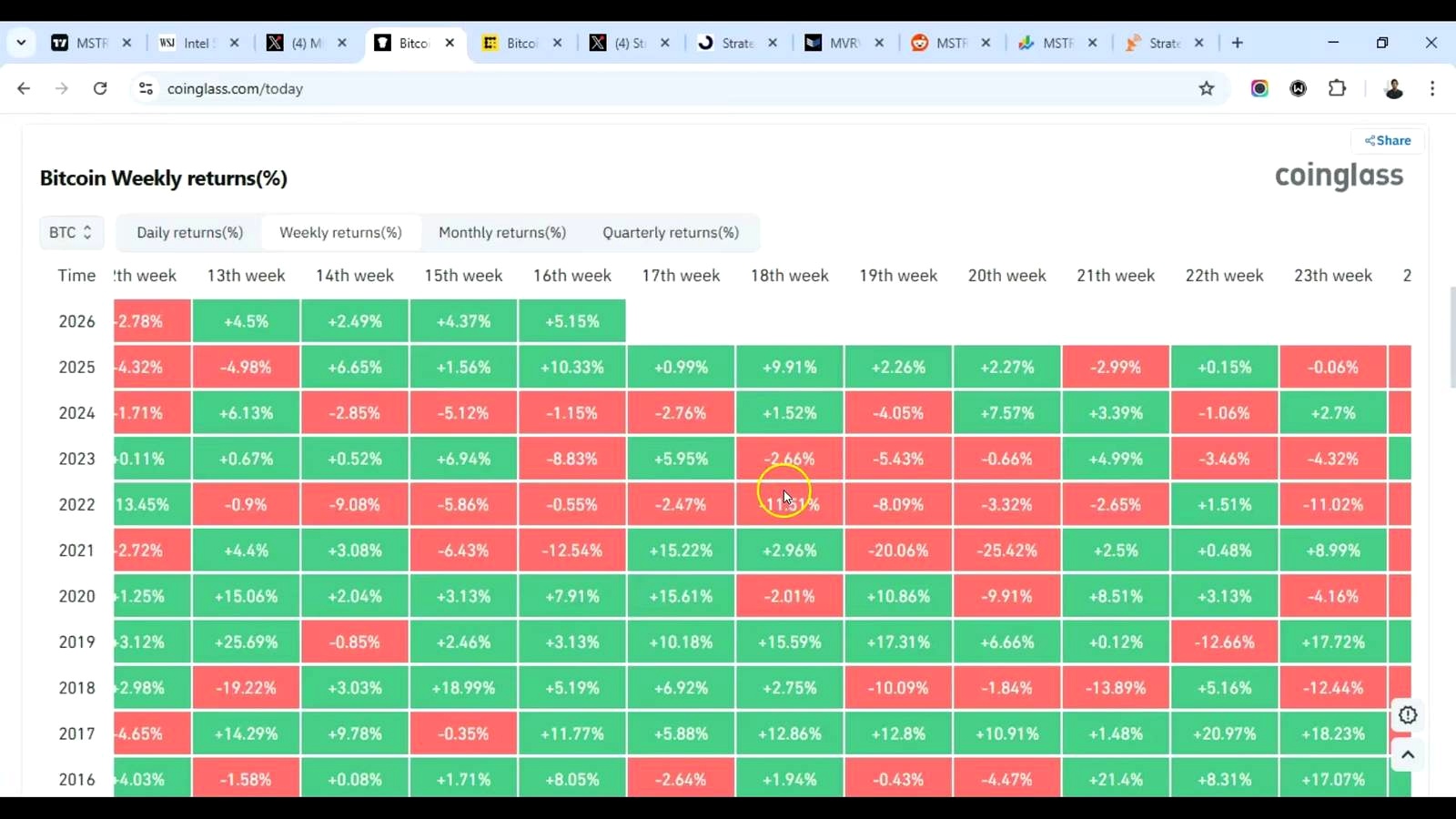
Bitcoin is moving through a period of volatility, fear, and market uncertainty, yet the deeper structural picture continues to strengthen. As sentiment turns negative, long-term adoption, institutional access, and new Bitcoin-based financial instruments are reshaping how investors, companies, and governments view digital capital.
Bitcoin in a Volatile Market Environment
Bitcoin enters this moment with volatility surging and fear dominating headlines. The sharp downswing has shaken traders, ETF flows have thinned, and global markets are flashing uncertainty.
Despite that surface-level chaos, the structural story has not cracked. The long-term forces reshaping Bitcoin’s role in the global economy are continuing to accelerate, creating a contrast between weak sentiment and strengthening fundamentals.
Why the Fundamentals Look Stronger
Michael Saylor argues that the fundamentals of the industry are much better today than they were 12 months ago. In his view, this creates an extraordinary risk-reward opportunity, especially for investors willing to make decisions based on fundamentals rather than short-term sentiment.
Key improvements over the last year
- A hundred companies added Bitcoin to their balance sheet.
- The derivatives market and IBIT surged.
- Flows into ETFs surged.
- Major banks announced support.
- Accounting improved dramatically.
- The tax regime improved.
- Support at the SEC, CFTC, and treasury level improved.
- Technology improved.
- Companies like Block rolled out Bitcoin support on Square and Cash App.
At the same time, across the US, Europe, and Asia, major banks are rolling out Bitcoin access. Corporations are rethinking how they store value, while governments facing inflation and mounting debt are beginning to see digital assets as insulation rather than speculation.
Negative Sentiment and Opportunity

Saylor describes the current environment as a teaching moment. He believes that all the developments many market participants wanted to see have already happened, while sentiment remains negative.
That disconnect matters. In his view, negative sentiment can become an opportunity for the equity investor who makes independent decisions and uses a time horizon of four years or longer. He also notes that equity markets may lead, lag, or only occasionally reflect reality in a rational way.
His core view on timing
- The fundamentals are better than they were a year ago.
- Market sentiment is negative.
- This creates what he calls a much better time to invest.
Bitcoin as Digital Capital

Saylor frames Bitcoin as digital capital and as an index reflecting the global digital economy. He says Bitcoin has no employees, no corporate headquarters, and no tariffs.
He also describes owning one Bitcoin as owning 1/21 millionth of the global free market and 1/21 millionth of all the money in the world forever. As more people understand that idea, he believes more individuals will shift from vulnerable forms of wealth into digital capital.
How Bitcoin is positioned in this view
- No nation can tax it at the border.
- No corporation can mismanage it.
- No crisis can dilute it.
- It does not inherit the risks of governments, companies, or monetary systems.
As confidence weakens in currencies, governments, companies, and banking systems, Bitcoin is presented as an alternative that does not suffer from war, famine, political mistakes, monetary corruption, fire, flood, or other external risk factors in the same way.
Global Instability and the Shift Away From Fragile Fiat Trust

Across global markets, confidence in traditional money is cracking. Inflation is dismantling purchasing power in Argentina and Turkey, austerity battles are destabilizing Europe, and governments across Africa and Asia are watching their currencies erode under pressure.
In this setting, the shift from fragile fiat trust to durable digital capital becomes more visible. As capital flight, currency failures, banking stress, and geopolitical uncertainty expand, Bitcoin is increasingly seen as a borderless, leaderless asset that avoids the political, corporate, and monetary risks that often destabilize fiat systems.
Scarcity, Supply, and the 2035 Milestone

Bitcoin’s engineered scarcity is central to this market evolution. Saylor points to 2035 as a decisive year, when 99% of all Bitcoin will have been mined.
He argues that this fixed and predictable scarcity cannot be replicated or reversed by any central bank. He also emphasizes that the last 1% of Bitcoin comes out over 100 years, making the supply curve increasingly tight over time.
Why 2035 matters
- 99% of all Bitcoin will have been mined by 2035.
- The level of scarcity becomes locked in.
- That scarcity is fixed, predictable, and immune to policy mistakes.
As global liquidity becomes more unstable and ETF adoption grows, this scarcity is colliding with rising debt and broader adoption. That combination is changing how institutions think about safety, yield, and long-term capital preservation.
Different Ways to Access the Bitcoin Economy

Saylor argues that investors now have a wider range of instruments to ride the digital wave. Different choices fit different risk tolerances, pools of capital, and time horizons.
Bitcoin
For those who do not want to trust anybody and want no counterparty risk, he points to Bitcoin itself. He describes it as straightforward and says it has been up 50% a year over five years.
ETF access
For those who simply want the asset in a brokerage account, he points to ETFs like IBIT. He says this route is easy to use and easy to borrow against.
Amplified equity exposure
For those seeking maximum performance and willing to accept maximum volatility, he points to amplified equity exposure such as MSTR. He says that if an investor wants to outperform Bitcoin and is ready for the roller coaster, equity may be the path.
Convertible preferred exposure
For those who want a mix of dividend, principal protection, and some upside of common equity, he points to instruments such as STRK.
Low-volatility digital credit
For investors with a shorter time horizon or lower tolerance for volatility, he points to credit instruments such as STRC. He describes STRC as designed to be very stable around $100 plus or minus a few pennies and to offer a 10% to 10.5% tax-deferred dividend.
Time Horizon and Risk Tolerance

A major part of Saylor’s framework is that investors should match the instrument to their risk tolerance and time horizon.
His distinction between investor types
- If you are an equity investor, think for yourself and use a time horizon of four years or longer.
- If you want stable yield from a stable instrument, be a credit investor rather than an equity investor.
- If your time horizon is less than four years and you cannot stomach much volatility, avoid equity and equity hybrids.
- If you want principal protection and low volatility, consider credit instruments such as STRC.
He also compares volatility levels directly, saying Bitcoin’s volatility is around 45, Strategy’s is around 65, and STRC is designed to get volatility down to 7.
The Rise of Digital Credit
One of the broadest transformations described in this market evolution is the emergence of digital credit. Saylor says digital credit did not exist 12 months ago, and nearly $8 billion of digital credit has already been issued.
He contrasts this with traditional bank credit, saying digital credit has a tax equivalent yield four times higher than bank credit. He uses the example of a bank account in New York City paying 4% and taxable, versus STRC paying 10.5% tax deferred.
How digital credit is presented
- It is part of the evolving Bitcoin economy.
- It can offer low volatility.
- It can provide tax-deferred yield.
- It is designed for those who want exposure without the volatility roller coaster.
Saylor describes Strategy’s mission as giving a billion people a bank account that pays 10% tax deferred. In that framework, Bitcoin becomes the foundation of a financial ecosystem built on digital capital and digital credit rather than on traditional banks.
From Volatility Narratives to Structural Adoption

The broader shift is moving away from weekly price narratives and toward structural adoption. Spot ETFs continue to pull in long-duration capital even in choppy conditions, and Bitcoin-powered credit products are expanding the range of ways investors can participate.
What emerges is a financial ecosystem built on Bitcoin rather than protected by banks. In this system:
- Spot ETFs offer simplicity.
- Self-custody offers sovereignty and zero counterparty risk.
- Bitcoin-powered credit offers yield with reduced volatility.
- Equity offers amplified exposure for those seeking higher performance.
Together, these options reflect a transition toward scarcity rather than dilution, transparency rather than trust, and global access rather than borders.
Institutional and Market Pressure Points
Several pressure points are driving this evolution in how institutions and markets think about Bitcoin:
- Growing bank support across major regions.
- Surging derivatives and ETF activity.
- Improved accounting and tax treatment.
- Government-level support improvements.
- Tightening scarcity as 2035 approaches.
- Global instability and weaker confidence in traditional money.
These factors are pushing Bitcoin further into discussions about long-term value storage, capital preservation, and the future of the global digital economy.
FAQ
Why does Michael Saylor say now is a better time to invest in Bitcoin?
He says the fundamentals of the industry are much better than they were 12 months ago, while market sentiment is negative. In his view, that creates an extraordinary risk-reward opportunity.
What does he mean by digital capital?
He describes digital capital as a fixed share of all the money that will ever exist and presents Bitcoin as an index of the global digital economy.
Why is 2035 important for Bitcoin?
He points to 2035 as the year when 99% of all Bitcoin will have been mined, locking in a level of scarcity that no central bank can replicate or reverse.
What is the difference between buying Bitcoin, an ETF, equity, and credit products?
Bitcoin is presented as the choice for those who want no counterparty risk. ETFs like IBIT offer simple brokerage access. Equity such as MSTR offers amplified exposure with higher volatility. Credit products such as STRC are presented as lower-volatility instruments with tax-deferred yield.
Who are credit instruments like STRC meant for?
They are meant for investors with shorter time horizons or lower tolerance for volatility who want principal protection, low volatility, and yield without the roller coaster of equity exposure.
What is happening with digital credit?
Saylor says digital credit did not exist 12 months ago and that nearly $8 billion has already been issued. He presents it as a major part of the market’s evolution.
How does Bitcoin fit into global instability?
As confidence weakens in currencies, governments, banking systems, and traditional money, Bitcoin is framed as a borderless asset that does not carry the same political, corporate, or monetary risks.
What is the long-term shift described here?
The shift is from volatility-driven narratives to structural adoption, with growing institutional access, ETF participation, self-custody, and Bitcoin-powered credit all contributing to a broader financial ecosystem built on Bitcoin.
Video Source
https://www.youtube.com/watch?v=5cVsGnUllmQ

Omar Al-Sharif lives and works in the UAE and is involved in the blockchain technology industry. He writes articles on Bitcoin and digital assets as a personal passion, explaining complex topics in simple and understandable language.