How much Bitcoin is actually available to buy right now? That question sits at the center of an increasingly aggressive bullish case: that BTC’s price may be constrained less by demand growth than by a market with fewer coins for sale than most people assume.
According to Bitcoin News Alerts, the key issue is not Bitcoin’s hard cap of 21 million coins but the much smaller pool of BTC that is actually liquid and available for immediate purchase. The host argues that this shrinking tradable supply is the mechanism that could push Bitcoin toward $2 million faster than investors expect.
The core claim: only a small slice of Bitcoin is truly for sale

The host’s central argument is simple: most Bitcoin is not actively circulating, and that changes how investors should think about price. He says the market still frames scarcity around the eventual cap of 21 million BTC, when the more relevant figure is the amount that can realistically be bought today.
Bitcoin News Alerts cites several supply figures to support that case:
- 14.8 million BTC is described as illiquid as of 2026
- That equals roughly 75% of supply
- Leaving about 22% to 25% as liquid supply
- Just 2.7 million to 3 million BTC is said to be available on exchanges for immediate trading
- An estimated 3 million to 4 million BTC is described as permanently lost
The host later adds a more current exchange figure from market commentary he cites: total exchange balances at about 2.4 million BTC, near 7-year lows. In his telling, that is the number that matters in a supply squeeze, because price is set at the margin by coins people are willing to sell now, not by the theoretical total that will ever exist.
Why the analyst says this matters for price
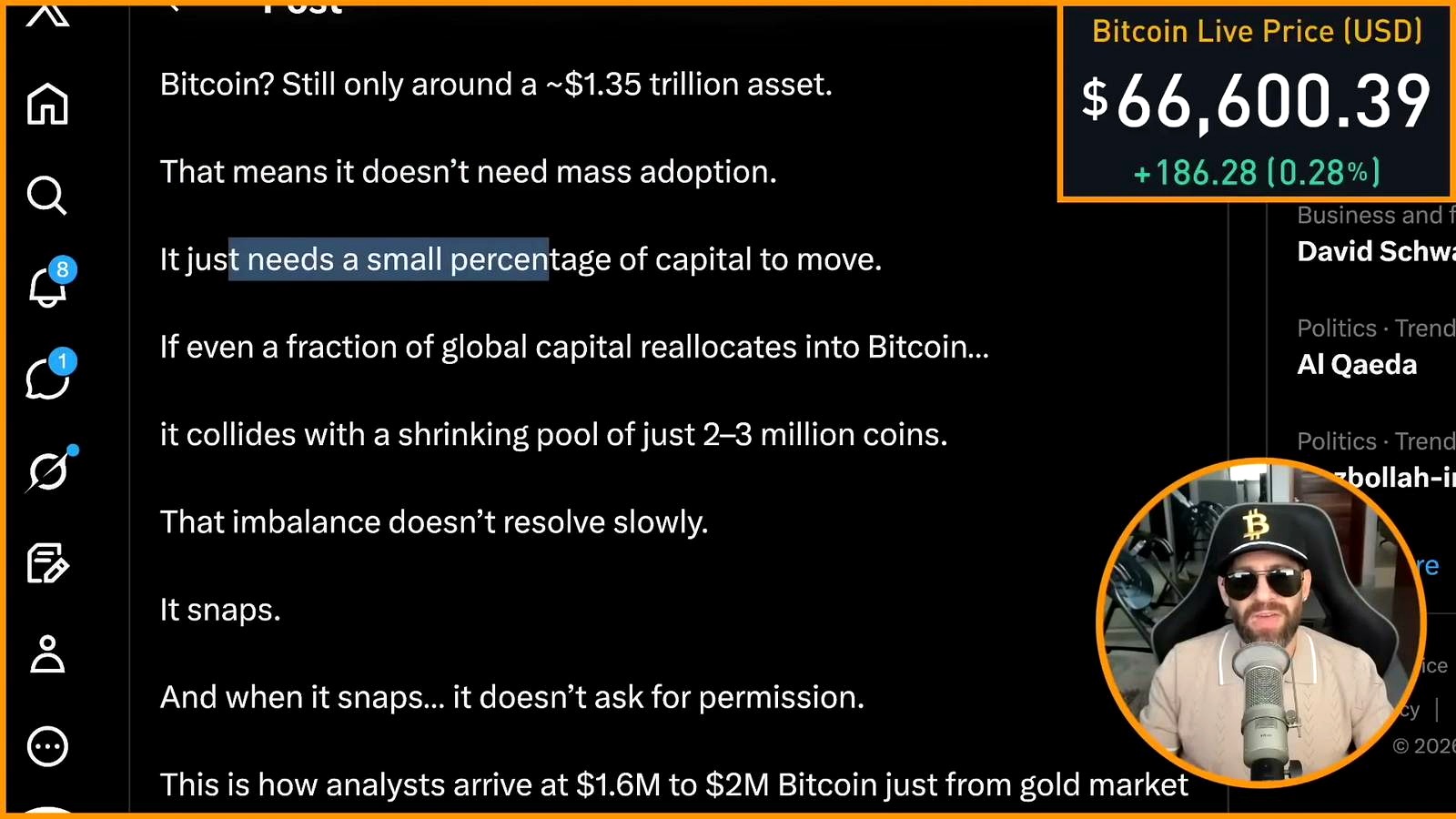
Bitcoin News Alerts argues that once a scarce asset collides with even modest capital inflows, repricing can happen quickly. The host says Bitcoin does not need universal adoption to move dramatically higher. It only needs a small share of global capital to compete for a thin pool of liquid coins.
He frames Bitcoin as a relatively small asset in a much larger financial world:
- Bitcoin market value today: roughly $1.35 trillion or $1.3 trillion
- Gold market cap today: roughly $36 trillion
- Global capital: described as in the hundreds of trillions
From there, the analyst links price targets to gold parity. He says this is how some market observers arrive at a Bitcoin valuation of $1.6 million to $2 million per coin if BTC eventually matches gold’s network value. He also argues that institutional adoption, sovereign allocation, retirement plans, inflation pressure and debt stress could push demand beyond a simple gold-comparison model.
Who is absorbing supply?
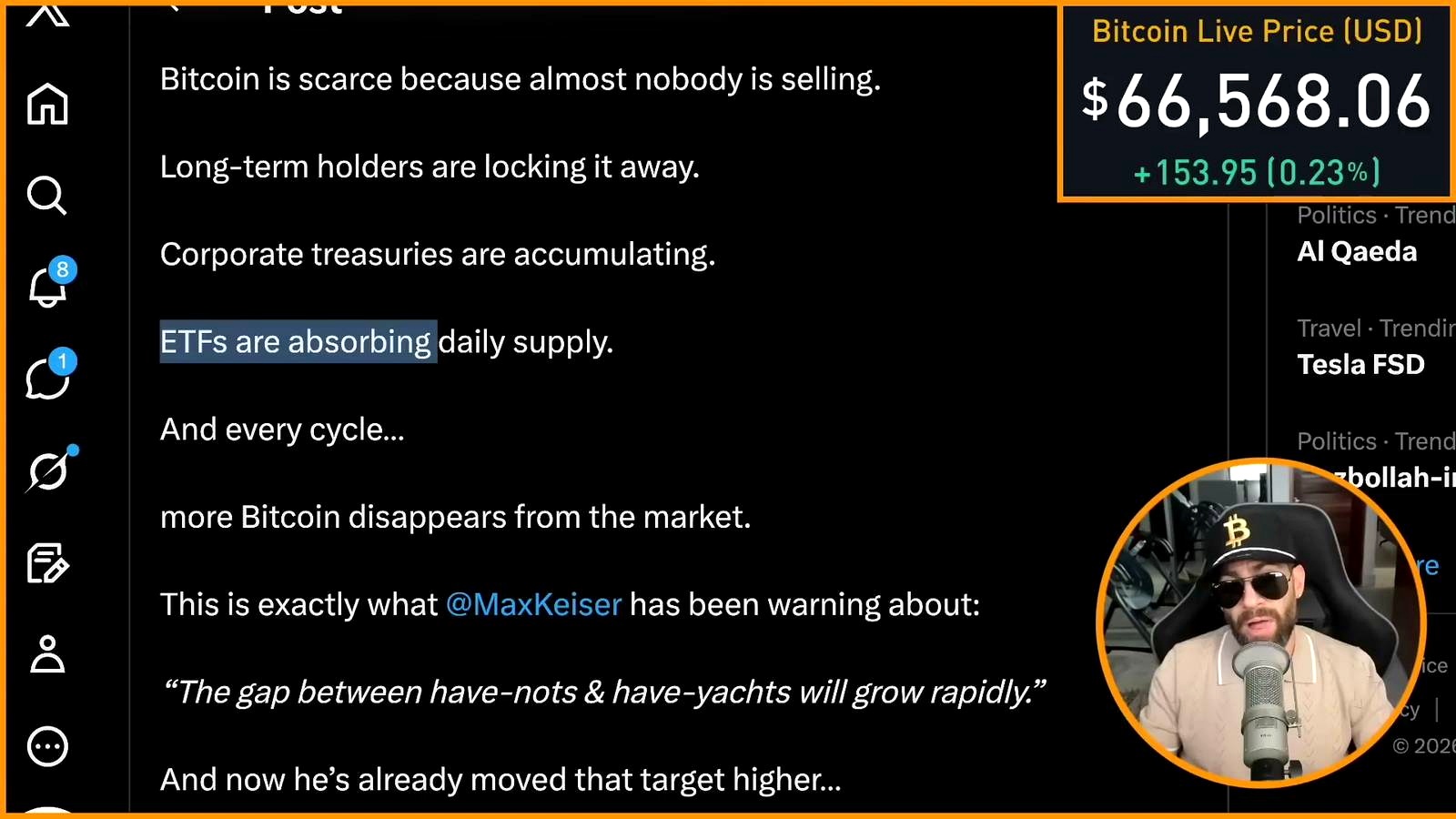
The host points to long-term holders, corporate treasuries and exchange-traded funds as the main groups removing Bitcoin from the liquid market.
Among the examples cited:
- Strategy holds 762,000 BTC
- BlackRock’s IBIT is said to hold close to 800,000 BTC within 2 years
- An Abu Dhabi sovereign wealth fund bought $436 million in Bitcoin ETFs in the first quarter
He also highlights near-term flow data as evidence that the squeeze is still intensifying:
- 23,700 BTC left exchanges during the week referenced
- 57,000 BTC left exchanges over 4 weeks
- New mining supply is only 3,150 BTC per week
- That breaks down to roughly 450 BTC per day
- And 3.125 BTC per block every 10 minutes
That imbalance is the heart of the thesis. The analyst argues that if tens of thousands of coins are leaving exchanges while miners add only a few thousand a week, fresh supply cannot easily meet new demand.
The big price targets on the table
Bitcoin News Alerts leans heavily on outside bullish forecasts, especially from Max Keiser, Cathie Wood and Tom Lee.
Max Keiser: from $2 million to $10 million
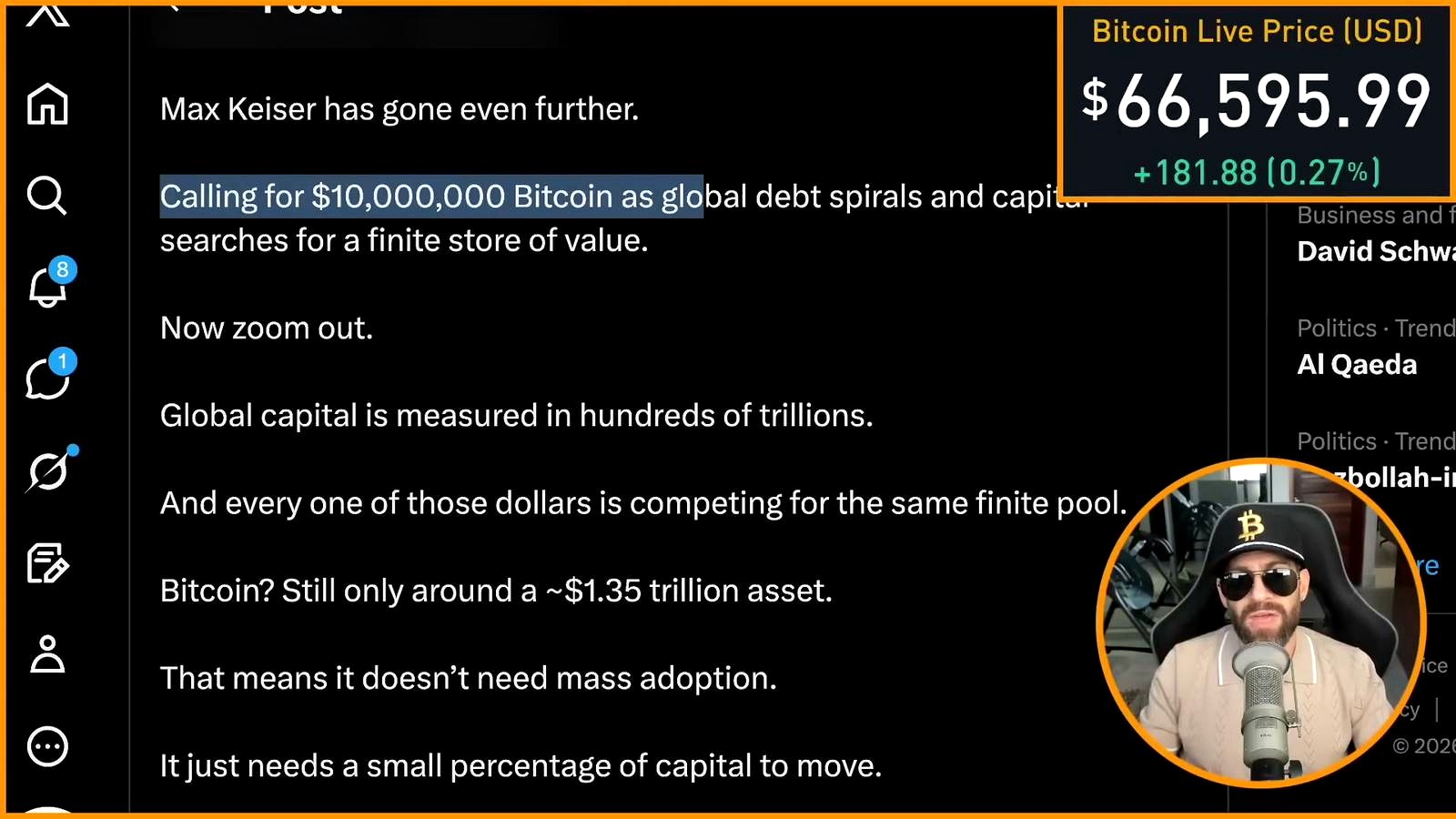
The host says Max Keiser has raised his Bitcoin target to $2.2 million and in a separate interview discussed a path to $10 million per coin. Keiser’s case, as quoted by the host, ties Bitcoin upside to rising debt burdens, monetary instability and capital searching for a finite store of value.
The host also links Keiser’s view to gold’s rise, noting that gold surged to $4,200 per ounce for the first time and later reached roughly $5,600 before a major correction. He says Bitcoin hit an all-time high of 126 around October 15, though the transcript does not specify the unit.
ARK Invest: 2030 targets up to $2.4 million
The analyst also references ARK Invest’s April 24, 2025 report. He says ARK’s updated 2030 targets include:
- Bear case: $300,000
- Base case: $710,000
- Bull case: $1.5 million
He then says ARK has also raised its bullish scenario to as high as $2.4 million by 2030. The CAGR figures he cites are:
- Bear case CAGR: 21%
- Base case CAGR: 40%
- Bull case CAGR: 58%
- Latest higher target assumption: 72% CAGR
The report, as summarized by the host, assumes Bitcoin’s supply will approach 20.5 million units by 2030. He also notes that Bitcoin has already crossed the 20 million coin milestone, leaving less than 1 million BTC to be mined by 2140.
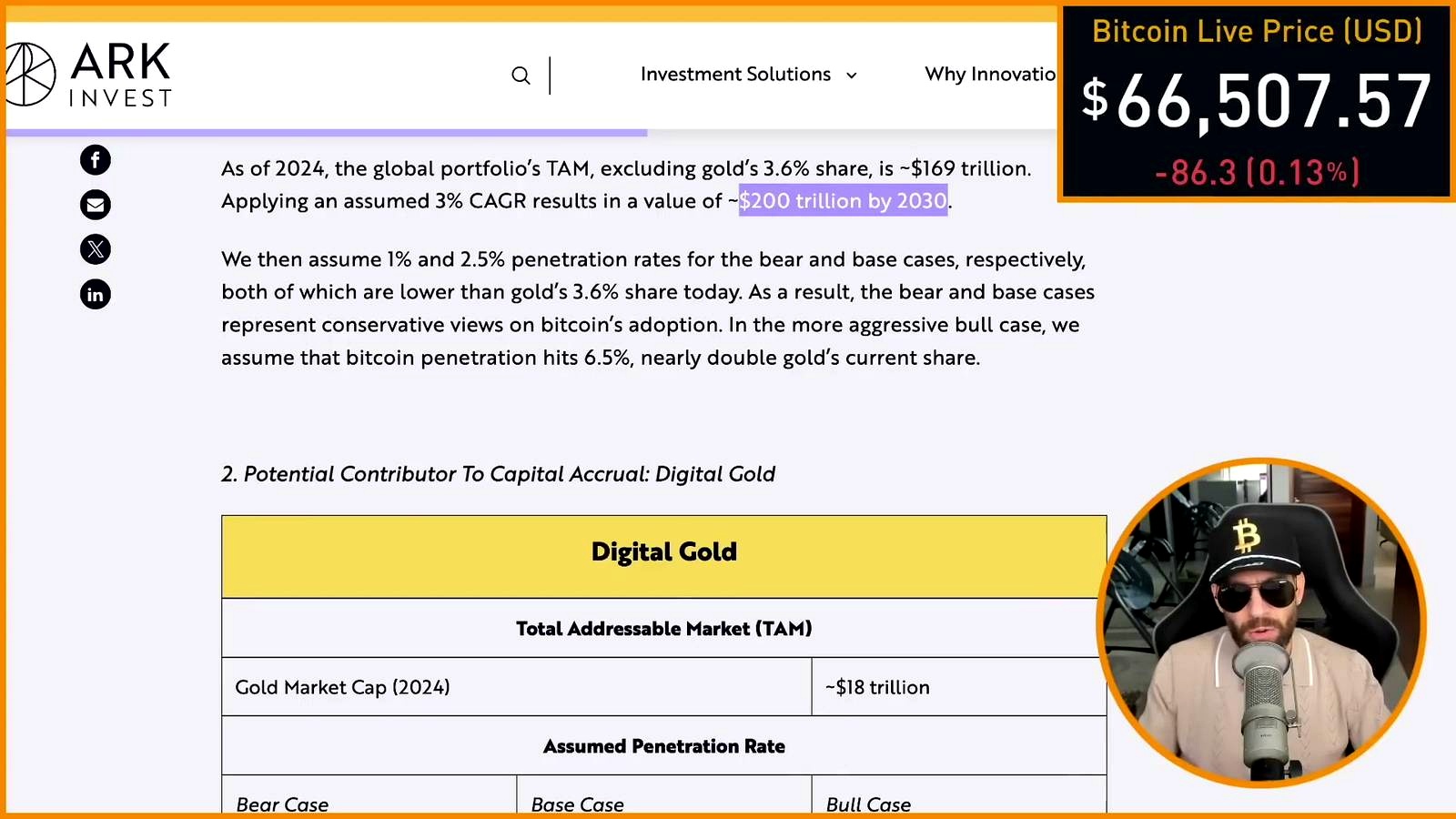
On market share, he cites ARK’s view that global portfolio value excluding gold’s 3.6% share is $169 trillion today and could reach $200 trillion by 2030 with assumed growth of 3%. He says ARK models penetration rates of 1% and 2.5% for the bear and base cases, and 6.5% for the bull case.
Tom Lee: gold could pull Bitcoin higher
The host also spotlights Tom Lee’s argument that if gold settles at $5,000, Bitcoin’s fair value could land around $1.6 million to $2 million if it matches gold’s network value. Lee’s timeframe, as quoted, is five years.
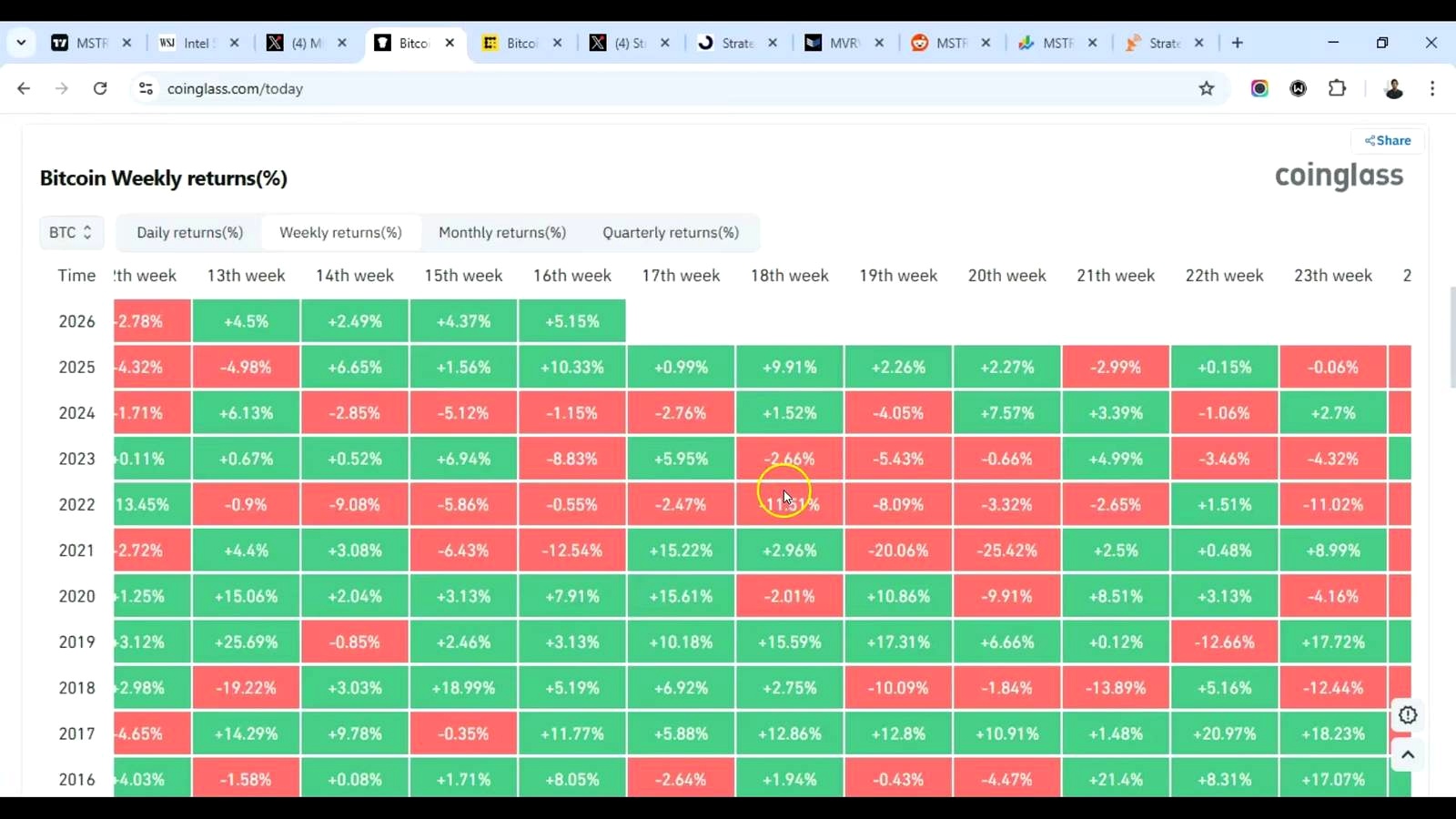
One other point from Lee stood out to the analyst: Bitcoin makes much of its move in just 10 days a year, with the fourth quarter often carrying outsized importance. The implication is that major repricing may be compressed into short windows rather than unfold gradually.
Why self-custody is part of the thesis
Bitcoin News Alerts goes beyond price and makes a political-custody argument. The host says Bitcoin held in self-custody is fundamentally different from BTC held through ETFs, exchanges or custodians because, in his view, properly self-custodied Bitcoin is much harder to seize.
He contrasts that with “paper Bitcoin, ” arguing that assets held through intermediaries could be vulnerable to government orders. To illustrate the historical risk of confiscation, he cites the Gold Seizure Act of 1933. His takeaway is blunt: exchange balances may be liquid, but they are also exposed in ways self-custodied coins are not.
What to watch next
The host’s thesis can be reduced to a few pressure points. First, exchange balances: if they keep falling from the current range of 2.4 million to 3 million BTC, the supply side gets tighter. Second, ETF and corporate accumulation: if large buyers continue to absorb coins faster than miners produce them, the market’s float shrinks further. Third, gold: the analyst repeatedly links rising gold prices to higher implied Bitcoin valuations.
For now, the key tension is straightforward. Bitcoin still trades as if a deep supply reservoir exists. Bitcoin News Alerts argues that reservoir is mostly unavailable already, and that once larger pools of capital fully grasp that point, price may have to do the rationing.
FAQ
How much Bitcoin does the host say is actually available to buy?
Bitcoin News Alerts puts the immediately tradable pool at roughly 2.7 million to 3 million BTC, and later cites exchange balances closer to 2.4 million BTC. His point is that this is far more relevant than the headline 21 million cap.
What does “75% illiquid” mean in this context?
The host says the figure comes from Glassnode-style wallet behavior analysis, not just lost coins. It includes long-term holders and entities that historically do not sell, meaning the coins may exist but are unlikely to return to the market quickly.
What are the clearest bullish price targets mentioned?
The transcript cites $1.6 million to $2 million from gold-parity logic, $2.2 million from Max Keiser, $2.4 million from ARK Invest’s bullish scenario, $3 million from Tom Lee, and $10 million from Keiser’s more extreme macro case.
Why does mining supply matter so much here?
Because new issuance is small compared with exchange outflows. The host says miners add about 3,150 BTC per week, while exchange balances fell by 57,000 BTC over 4 weeks. That gap is why he describes the setup as a supply crisis rather than a normal bull market.
What is the main risk the host raises around ETFs and exchanges?
Custody. He argues that Bitcoin held through third parties could be seized or restricted more easily than self-custodied BTC. That does not change Bitcoin’s supply, but in his view it changes who truly controls it.
Video Reference

An Indian crypto journalist covering the developments in the Bitcoin and blockchain industries. Her work helps readers understand key changes in the world of digital assets.