It looks calm on the surface, but the pressure under Bitcoin is building fast. The strange part is that some of the biggest signals around it just turned stronger at the exact moment fear is taking over.
That tension is what makes this moment so hard to ignore. A sharp drop is still on the table, yet the groundwork for something much bigger may already be in motion.
Why this week feels different for Bitcoin
One event stood above everything else: $14.16 billion in Bitcoin options expired at 8:00 a.m. UTC on Deribit, the largest crypto options exchange. That represented nearly 40% of all open interest on the platform.
This mattered because the options market had been helping keep Bitcoin pinned in a narrow range. The sideways move between $68,000 and $72,000 was not just random drift. It reflected dealer hedging and market mechanics that were absorbing pressure into expiry.
Now that buffer is gone.
According to the reporting cited, volatility is more likely to rise after the expiry, not fall. With the contracts settled, Bitcoin is now more exposed to geopolitics and macro data, with no structural cushion left to soften the impact.
The level that stood out
The max pain level sat at $75,000, while Bitcoin was around $68,000. That left price roughly $7,000 below the point where the most option buyers would have felt the least damage.
The message was hard to miss: the market had been held in place, and once that pressure disappeared, the next move became much more uncertain.
- Bitcoin options expired: $14.16 billion
- Share of open interest affected: nearly 40%
- Max pain level: $75,000
- Bitcoin price around the event: about $68,000
Tom Lee’s warning: the crash may come before the rebound
The setup described here is not a simple bullish call. It is a warning wrapped around a bigger thesis. Bitcoin may still crash before it does what Tom Lee believes it can eventually do.
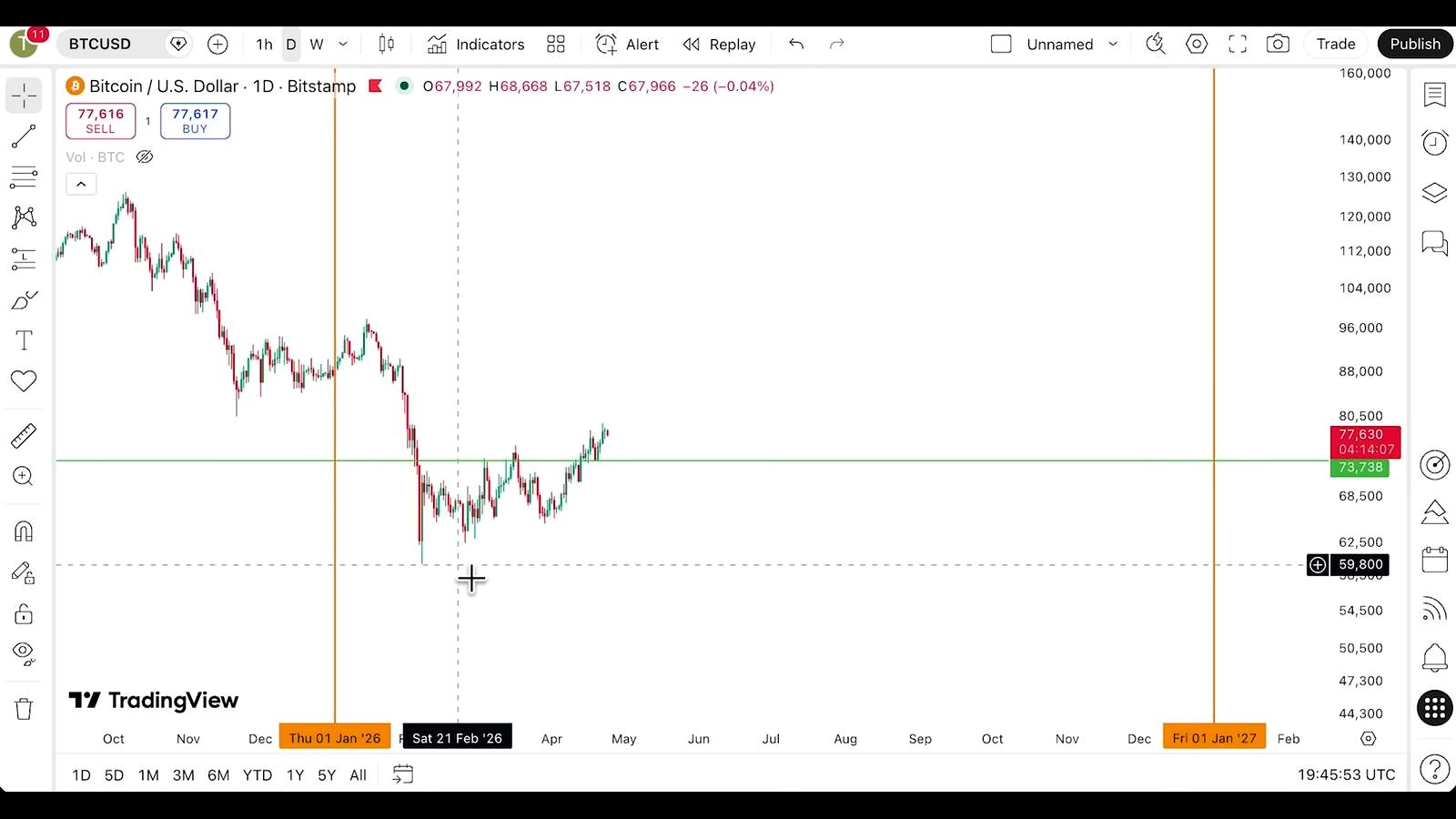
The numbers show a market under pressure. Bitcoin was cited at $67,896. The fear and greed index was at 13, its lowest reading in five months. The 20-day moving average stood at $67,200, and Bitcoin was testing it. Out of 33 technical indicators mentioned, 29 were bearish and only four were bullish.
That is not the picture of a comfortable market. It is the picture of a market stretched to the downside.
What Tom Lee appears to be watching
Rather than reacting to panic, the focus is on where stress may create the next opportunity. The argument is that wartime markets often move from crisis to opportunity, and that extreme fear can appear right before a turning point.
The halving-cycle analysis added another layer. Bitcoin was described as 73 days past the April 2024 halving, while past cycle bottoms were said to begin forming around day 777 of the halving cycle. That points to a possible cycle low roughly 74 days away, in late May or early June 2026.
In other words, the bottom window may be opening, but not necessarily today.
The institutional twist that changed the conversation
While Bitcoin slipped below $70,000, one of the biggest institutional developments in its history arrived almost quietly.
Fannie Mae announced it would accept Bitcoin and USDC as collateral for standard conforming mortgages. That means, for the first time in American history, a buyer can pledge Bitcoin as collateral for a Fannie Mae-backed mortgage without selling the Bitcoin position.
That changes the emotional math around ownership. The old choice between keeping Bitcoin and buying a home suddenly looks different.
Why this hit so hard
The implications were presented as massive:
- Bitcoin can now be used as mortgage collateral
- Borrowers do not have to sell their Bitcoin
- They do not trigger a capital gains tax event by selling
- If Bitcoin drops, mortgage terms do not change
- There are no margin calls or liquidations in the structure described
The product was built with Better Home and Finance for origination and Coinbase Prime for institutional custody.
The broader point is simple: when Bitcoin gets a new permanent use case, its addressable market expands. That is the core logic behind why this may matter far beyond one headline.
JP Morgan’s shift may be the biggest signal of all
Another moment stood out for its symbolism. JP Morgan, described here as one of the most conservative investment banks in the world, published research saying Bitcoin showed safe haven-like demand during the Iran war.
That came with a sharp comparison. Gold and silver weakened, while Bitcoin saw inflows and stronger network activity.
The contrast in fund flows was even more dramatic. Nearly $11 billion exited gold ETFs in March, which was described as the largest single-month gold ETF outflow in years. At the same time, Bitcoin ETFs kept attracting institutional flows despite the war, fear, and falling price.
What this says about who is buying
The explanation given was that speculative gold buyers moved fast and sold first, while Bitcoin ETF holders were more often institutions with longer time horizons and allocation mandates.
That distinction matters because it changes the character of the market. It suggests weakness in price does not necessarily mean weakness in conviction.
The selloff that scared traders — and why it may have been misread
Bitcoin’s dip below $70,000 was also tied to a large sale from Mara Holdings, the biggest publicly traded Bitcoin miner. Between March 4 and March 25, Mara sold 15,133 Bitcoin for about $1.1 billion.
That sale added pressure. But the reason behind it was framed very differently from panic.
Mara used the proceeds to buy back $1 billion in convertible senior notes, cutting total debt by 30%, from $3.3 billion to $2.3 billion. It also captured an estimated $88 million discount because the debt was trading below par.
Not capitulation, but restructuring
The argument here is that this was financial engineering, not surrender. Mara sold Bitcoin to clean up its balance sheet and support a pivot into digital energy and AI data center infrastructure.
That makes the sale look less like a vote against Bitcoin and more like a move to build a stronger company for the next phase.
The policy backdrop is still moving
David Sacks completed his 130-day term in his crypto and AI role, and the initial market reaction was described as negative. But the interpretation here was the opposite.
Rather than disappearing, his influence was said to be expanding through the president’s council of advisers on science and technology. More importantly, the policy groundwork was already in place.
- Groundwork for the strategic Bitcoin reserve
- Support for the Clarity Act framework
- Stablecoin legislation via the Genius Act
- A regulatory sandbox for tokenized securities
The framing was clear: the framework phase is over, and implementation has begun.
At the same time, the FHFA was said to have ordered Fannie Mae and Freddie Mac to accept crypto as mortgage collateral. That tied the policy story directly to rising real-world Bitcoin demand.
War, oil, and the path to a tradable bottom
The macro backdrop remains uncomfortable. Investors are described as risk-averse, facing misinformation and uncertainty tied to war.
But the signals inside that fog are shifting.
Prediction markets showed at least a 50% chance of a ceasefire by the end of April, with 53% cited as the highest odds since early March. The probability of oil being above $100 by June was 70%, still high, but lower than the more than 90% seen for much of March.
The interpretation was that if oil probabilities keep falling and ceasefire odds keep rising, markets may be getting close to a tradable bottom.
Why that matters for Bitcoin
The argument connected several markets at once:
- Falling oil could support assets with negative correlation
- The S&P 500, Ethereum, crypto, and the MAG 7 were highlighted
- Technology valuations were described as back to levels seen 10 years ago
- A relief rally in stocks could pull Bitcoin higher too
Tom Lee’s broader view was that the S&P 500 reaches 7,700 and Bitcoin outperforms. The war, in this telling, is a detour, not the final destination.
The market is terrified — and that may be the point
The data paints a bleak short-term picture. Extreme fear. Bearish technicals. A market suddenly stripped of options-related support. And the possibility that Bitcoin still tests lower levels before any real recovery begins.
But right beside that fear sit a series of developments that are difficult to dismiss:
- Fannie Mae accepted Bitcoin as mortgage collateral
- JP Morgan called Bitcoin a safe haven-like asset during war
- Bitcoin ETFs kept attracting institutional flows
- Gold ETFs lost nearly $11 billion in a month
- Policy support for crypto kept advancing
That is why this moment feels so unusual. The market looks weak, but the infrastructure around Bitcoin keeps getting stronger.
FAQ
What did Tom Lee warn about Bitcoin?
The warning was that Bitcoin may still crash or fall further before a larger move higher takes shape. The short-term setup remains fragile even as longer-term signals strengthen.
Why was the Bitcoin options expiry so important?
$14.16 billion in Bitcoin options expired, representing nearly 40% of open interest on Deribit. That expiry had been helping suppress volatility, and once it ended, Bitcoin became more exposed to sharp moves.
What is the max pain level mentioned here?
The max pain level was $75,000, while Bitcoin was trading around $68,000. That gap highlighted how far price sat below the level where options buyers would have felt the least pain.
Why is Fannie Mae’s mortgage decision such a big deal?
Because it allows Bitcoin and USDC to be used as collateral for standard conforming mortgages. That means buyers can keep their Bitcoin instead of selling it to help buy a home.
Did JP Morgan really describe Bitcoin as a safe haven?
Yes. The research cited said Bitcoin showed safe haven-like demand during the Iran war, with inflows and stronger network activity while gold and silver weakened.
Why did Mara Holdings sell so much Bitcoin?
Mara sold 15,133 Bitcoin for about $1.1 billion to buy back debt, reduce its total debt load by 30%, and improve its balance sheet as it pivots toward digital energy and AI data center infrastructure.
What does the fear and greed index reading of 13 mean?
It signals extreme fear. In the material provided, it was the lowest reading in five months and part of the case that the market is deeply oversold.
Could Bitcoin still fall before recovering?
Yes. The material explicitly raises that possibility, including the question of whether Bitcoin bottoms near $68,000 or tests $60,000 before a real recovery begins.
Reference Video

Omar Al-Sharif lives and works in the UAE and is involved in the blockchain technology industry. He writes articles on Bitcoin and digital assets as a personal passion, explaining complex topics in simple and understandable language.