Markets are wrestling with an awkward question: if geopolitics, inflation fears and growth fears are all hitting at once, where exactly are investors supposed to hide? According to The Bitcoin Macro, that confusion is precisely why Bitcoin matters now, not as a momentum trade, but as a response to a financial system the host says is growing more unstable and politically constrained.
Bitcoin’s core bull case is shifting from speculation to system stress

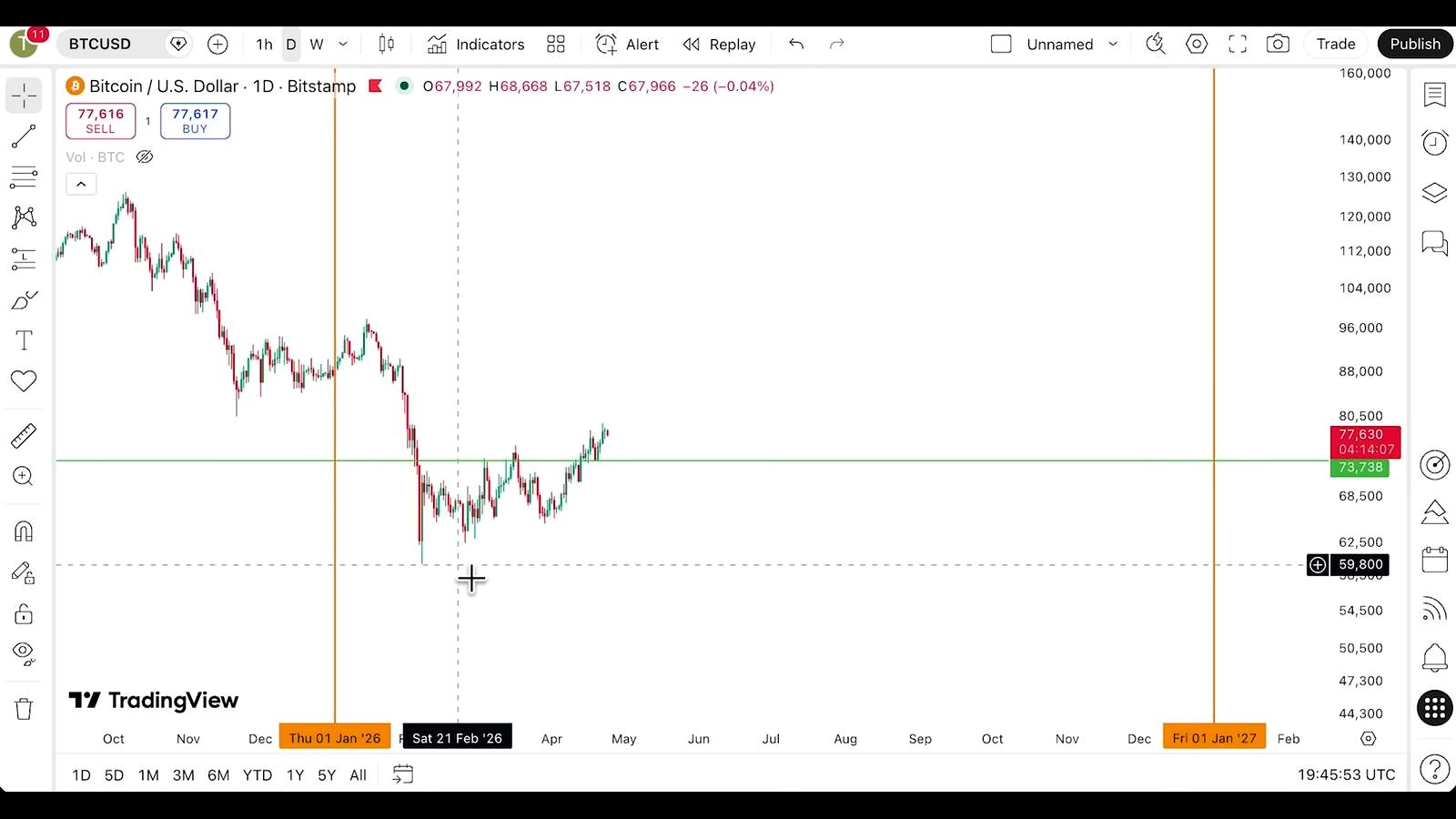
According to The Bitcoin Macro, the central argument is that Bitcoin is being misread by much of the market as “just the oldest cryptocurrency” when it should be understood as a distinct monetary asset. The host frames the backdrop in stark terms: traditional refuges are no longer behaving cleanly, with gold described as roughly 25% to 30% off its highs, Bitcoin having fallen about 50% before recovering, and equities still vulnerable to another 20% to 30% drawdown if a single macro shock cascades through correlated markets.
That framing lands at a time when Bitcoin’s identity is still contested. In broader market debate, the asset sits somewhere between digital gold, high-beta tech proxy and liquidity sponge. Bulls have leaned on the ETF era, sovereign debt concerns and long-run fiat debasement narratives. Skeptics still point out that during acute risk-off episodes, Bitcoin often trades more like a volatile growth asset than a defensive store of value. That tension matters because the safe-haven thesis is strongest over a multi-year horizon, but much weaker in the first stage of a macro panic when dollar liquidity tends to dominate.
The host’s view is contrarian in emphasis, though not in direction. Plenty of Bitcoin investors agree on the long-term monetary thesis. What is less consensus is the claim that there is now “nowhere to hide” outside very short-term Treasury bills and that this vacuum mechanically strengthens Bitcoin’s role. In practice, Bitcoin still must prove it can absorb macro stress without simply joining the selloff. That said, the broader context does support part of the case: persistent sovereign debt expansion, political pressure on central banks and rising distrust in legacy institutions have all helped keep the Bitcoin-as-alternative-money narrative alive.
The analyst’s secondary thesis: retail is chasing 100x stories while missing Bitcoin

According to The Bitcoin Macro, a major reason Bitcoin remains misunderstood is behavioral rather than technical. The host argues that a K-shaped economy and the Cantillon effect have split the market between asset owners doing well and younger or lower-income participants feeling permanently behind. In that environment, investors are not looking for preservation first; they are looking for escape velocity.
That leads, in his telling, to the search for “the next big lick”, not a 10x return, but 100x. He contrasts Bitcoin with the kinds of narratives attracting retail speculation: smaller altcoins, meme stocks, prediction markets such as Polymarket, and even legacy commodities like silver, which he says some buyers treat as a lottery ticket after seeing it at around $20 and imagining a move to $500. He also says many retail investors dismiss Bitcoin because it already trades around $60,000 to $70,000, leading them to assume the upside is capped.
That observation fits a recurring pattern in late-cycle risk appetite. Retail traders often prefer lower unit-price assets or stories with a private-market mystique, even when market cap math makes the upside less compelling than advertised. The host extends that argument to likely future IPOs, saying firms such as Anthropic, OpenAI and SpaceX could come public in the next couple of months and attract intense retail demand at valuations that may not be cheap.
He also uses that same valuation discipline to discuss Bitcoin treasury companies. The host says euphoria around some of these names ran ahead of fundamentals, citing Nakamoto trading in the $20 range and claiming some treasury-company mNAV multiples reached 3, 4, 5, 6 and even 7 times. He says his preferred framework is to buy near 1x mNAV or below, and he highlights newer perpetual preferred structures from Strategy and Strive that, in his account, have been issued at roughly 11% to 12% yields, with dividend coverage supported by cash buffers of 6, 12 or 18 months.
The bigger point is not just security selection. It is that Bitcoin-related leverage and Bitcoin-related equities are becoming their own mini-capital market. That can deepen Bitcoin adoption, but it also adds reflexivity. If those structures work, they can accelerate balance-sheet accumulation. If they break, they can amplify downside and drag sentiment with them.
What could go wrong

The cleanest way to break this thesis is simple: Bitcoin fails the next real macro stress test again. If oil shocks, recession fears or geopolitical escalation push investors toward cash and short-duration government paper, Bitcoin could remain a source of liquidity rather than a destination for it. That would undermine the host’s argument that traditional havens are failing in a way that naturally elevates Bitcoin.
There are also risks the discussion only partly touches. One is political contamination. The host argues Bitcoin has become more politicized after Trump and his family embraced it rhetorically, and that this has hardened public misconceptions. That risk cuts both ways. Political sponsorship may expand visibility, but it can also narrow Bitcoin’s coalition and make regulation more partisan.
Another risk is the treasury-company complex itself. The analyst acknowledges that some public vehicles were bought at valuations that “didn’t make sense.” If Bitcoin stalls or falls, equity premiums can compress much faster than spot BTC, especially for vehicles dependent on capital markets access. Preferred structures yielding 11% to 12% may look attractive in bullish conditions, but they also imply meaningful financing costs. If issuance windows close, the model gets tougher.
The other side of the trade, then, is not just “Bitcoin bad.” It is that plain Bitcoin could still outperform the more engineered wrappers around it, and that cash or short-duration instruments may outperform both during periods of severe market stress.
What to watch next

For this thesis to strengthen, investors would need to see Bitcoin hold up better than equities and other speculative assets during the next bout of macro volatility. Just as important, watch whether flows continue to favor Bitcoin itself over lower-quality proxies and overhyped treasury stocks.
On the macro side, the key signals are oil-driven inflation scares versus growth scares, shifts in bond-market pricing, and fresh noise around the Fed’s independence and leadership. On the industry side, monitor whether new Bitcoin treasury securities keep finding buyers near par, and whether future IPO mania pulls capital away from BTC or simply reinforces the host’s point that investors are still chasing narratives over monetary assets.
FAQ
What is mNAV in the context of Bitcoin treasury companies?
mNAV usually refers to market capitalization relative to net asset value, often used to judge whether a Bitcoin-holding company is trading at a premium or discount to the value of the BTC on its balance sheet. A higher multiple implies investors are paying extra for management, strategy, leverage or expected future accumulation.
Why do some investors choose altcoins over Bitcoin when BTC is more established?
Many retail traders focus on unit price rather than market cap. A token priced at a fraction of a dollar can look “cheaper” than Bitcoin near $60,000 to $70,000, even if the smaller token would need unrealistic valuation growth to deliver the returns buyers expect.
How are Bitcoin treasury companies different from buying BTC directly?
Buying BTC gives direct exposure to the asset. Treasury companies add corporate management, financing decisions, equity dilution risk and stock-market volatility on top of Bitcoin exposure. In bull markets, they can outperform spot BTC. In down markets, they can underperform sharply.
What are perpetual preferred securities?
They are preferred shares with no fixed maturity date. In the framework discussed by the host, these instruments pay ongoing dividends and can be used by companies to raise capital for additional Bitcoin purchases without creating a traditional debt maturity wall.
Has Bitcoin historically acted like a safe haven?
It depends on the timeframe. Over longer periods, many investors see it as a hedge against monetary debasement. During sudden liquidity crunches, though, Bitcoin has often traded like a risk asset first. That split is why the safe-haven debate remains unresolved.
Video Source

John Burnell focuses on Bitcoin infrastructure, wallet security and blockchain technology. He writes educational articles explaining how Bitcoin works and how the technology evolves.