Was the market betting on a geopolitical cooldown that never really arrived? A new move lower in BTC has reopened that question after Donald Trump’s latest White House remarks, with traders now watching whether risk assets extend the retreat.
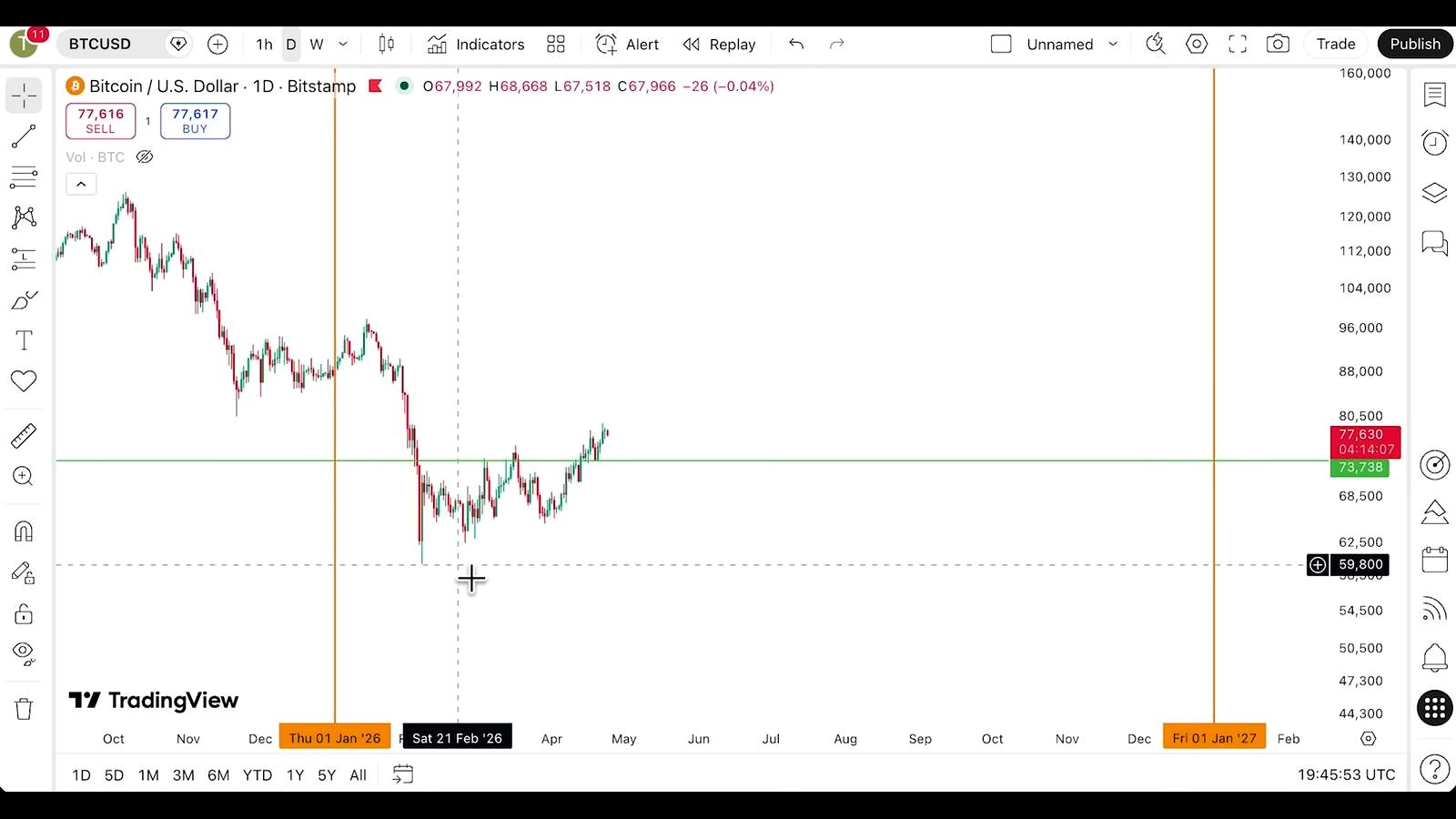
According to Tim Warren, Bitcoin sold off during and after Trump’s update on Iran because the speech projected strength without delivering the one thing markets may have wanted most: a clear declaration that the conflict was over. Warren said BTC fell from $68,600 when Trump began speaking to around $67,300 by the time he recorded his video, framing the drop as part geopolitical reaction and part confirmation of a bearish technical setup that had already been building.
Why Warren thinks the market reacted negatively
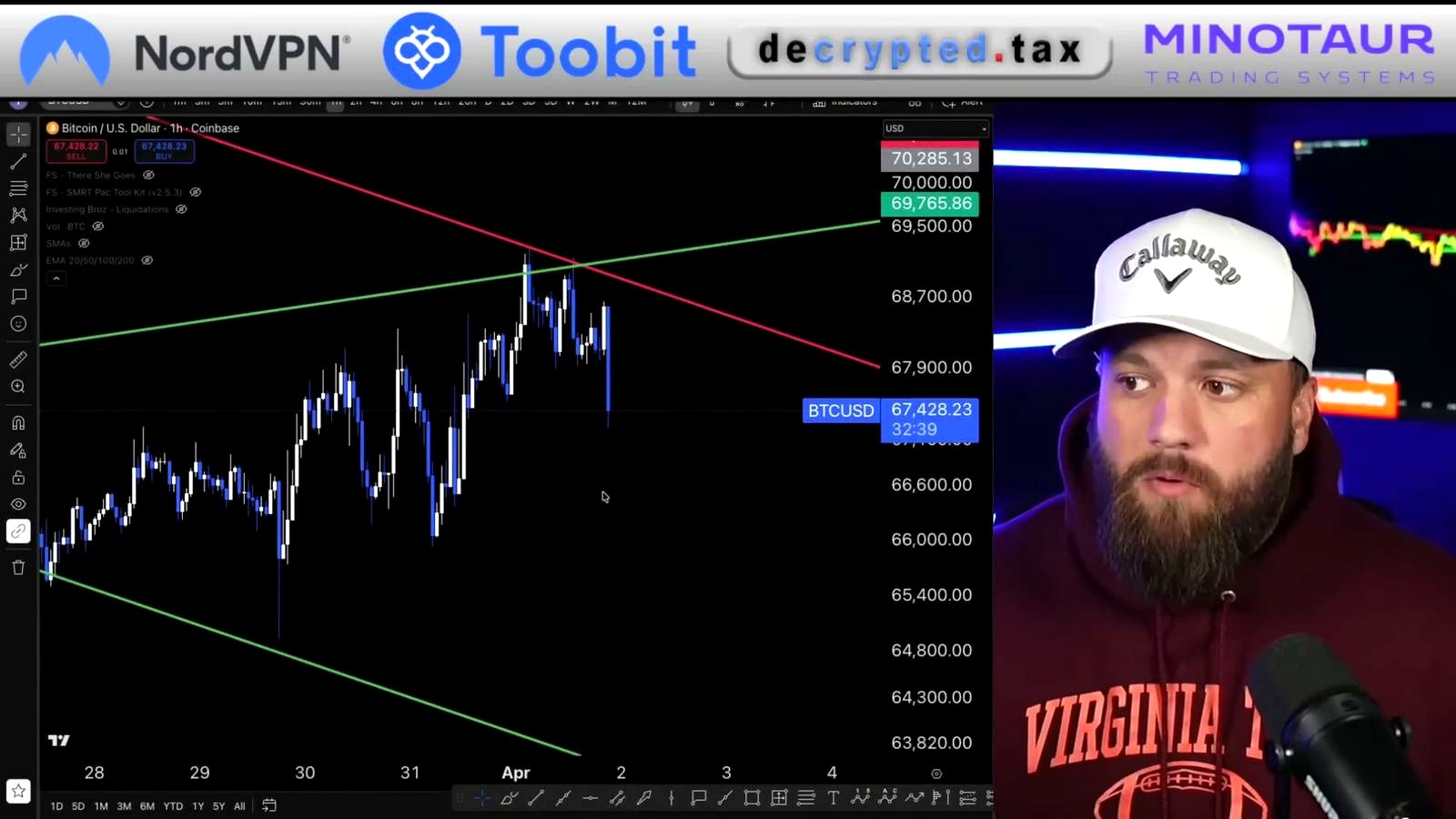
Warren’s core argument is straightforward. Trump, in his telling, said the US was on track to complete its military objectives “very shortly, ” but did not announce that the war was over, did not present a peace deal, and did not clarify whether troops on the ground were or were not part of the next step. For Warren, that left traders with less certainty than the headline tone might initially suggest.
He described the speech as a forceful show of confidence, including remarks that Iran’s capabilities had been heavily degraded and that America does not need Middle East oil. But the host argued that this was not the same as de-escalation. In his view, the absence of a formal end to hostilities undercut optimism that had started to build around a near-term resolution.
That matters for crypto because Warren sees Bitcoin and the broader market as highly sensitive to geopolitical risk when key macro headlines hit outside normal market hours. He also said he would not be surprised to see stocks open lower the following day after stronger sessions earlier.
The technical case: sell signals, a broken wedge, and lower support

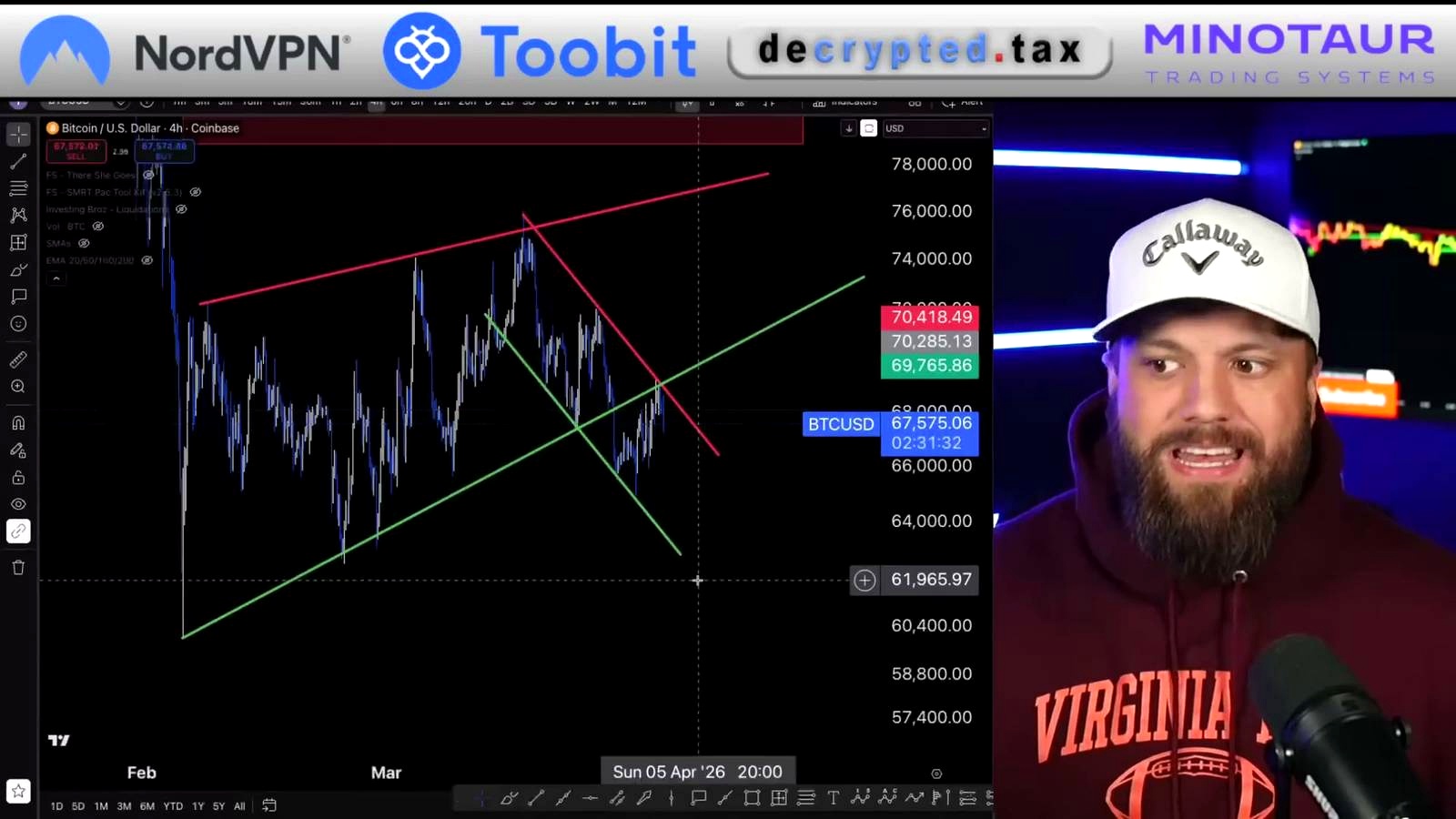
Warren did not base his warning only on the Iran headline. He argued that Bitcoin’s chart was already leaning bearish before Trump spoke, and that the news simply accelerated a move he had been expecting.
His main technical points were:
- A 4-hour sell signal had appeared, which he said does not occur often.
- The last comparable signal came on the 16th.
- His indicators were showing bearish conditions, including a red z-core dot, a red momentum dot, and negative MACD histogram readings.
- Bitcoin had recently fallen below a rising wedge pattern on the 27th.
- A retest of that former support level appeared to turn it into resistance.
In Warren’s reading, that combination raises the odds of a deeper pullback. He explicitly said he was not calling for an immediate collapse to $60,000 “tonight, ” but he did say the move looked like it wanted to revisit a trending support area below $64,000.
That distinction is important. His message was not that Bitcoin was about to break down in a single dramatic flush. It was that a failed recovery attempt, combined with renewed geopolitical uncertainty, made the market’s earlier optimism look premature.
The numbers from the video
Warren gave several specific levels and time markers that define his view:
- $68,600: Bitcoin price when Trump began speaking
- $67,300: Bitcoin price during Warren’s recording
- $60,000: A level he said he was not predicting Bitcoin would hit that night
- Below $64,000: His stated area for a possible move toward support
- 102: Oil level he said prices had risen back to
- 16th: Date of the prior sell signal he referenced
- 27th: Date he said Bitcoin fell below the rising wedge
- 3 PM: Time of the live show he mentioned for a future update
- $100 or more: Deposit threshold he cited for access to live trading sessions through TUBIT
- 30 days: His rough timeframe for when he believes the war could be over
Warren says the “relief” narrative may have been a trap

One of the sharper claims in the video is Warren’s view that recent optimism around the Iran conflict may have been misleading. He argued that markets were being given moments of hope that suggested the bottom might be in, only for those moves to reverse.
He characterized that pattern as “misdirection, ” tying it to a broader claim that manipulation remains a major force in crypto and financial markets. In practical terms, he believes traders were too quick to interpret strong rhetoric from Washington as a signal that the conflict was close to ending.
That is why he maintained short positions, he said, and why he viewed the post-speech decline as validation rather than surprise. He added that he had been in shorts for a couple of days and said the latest drop had pushed those positions back into profit.
For readers, the key takeaway is not the promotional aspect of the trade commentary but the directional bias behind it: Warren is still bearish on Bitcoin near term, and he does not think the market has found its final bottom yet.
His broader Bitcoin outlook is still cautious

Warren went beyond the immediate headline reaction and reiterated a bigger-picture view he says he has held for months: the bottom is not in. He pointed back to a prior painful move to $60,000 and said that level was “probably not the bottom.”
That leaves his thesis in two layers. First, the Iran update may have removed some of the market’s short-term confidence. Second, the chart structure already looked vulnerable enough that any disappointing macro headline could reinforce the downside.
He also connected the Bitcoin move with strength in oil, saying prices were moving higher again. If energy rises while geopolitical risk stays elevated, Warren expects pressure could spread more broadly across risk assets, including the S&P 500 ETF he referenced as “the spy.”
What to watch next for BTC
The next test is whether Bitcoin stabilizes after this initial drop or continues drifting toward the support region Warren identified below $64,000. Just as important, traders will likely watch whether traditional markets echo the same concern once they reopen, and whether oil continues climbing from the 102 level he cited.
On the geopolitical side, Warren’s framework is clear: he does not think this is permanent doom for markets, and he said he still believes the war could be over within 30 days. But his point was that it is not over now, and that gap between expectation and reality may be enough to keep Bitcoin under pressure in the near term.
FAQ
Why did Tim Warren say Bitcoin fell after Trump’s Iran speech?
Warren said the speech sounded forceful but stopped short of declaring the conflict over. In his view, markets had been hoping for de-escalation, and the lack of a peace announcement triggered a risk-off reaction.
What Bitcoin levels did he highlight?
He cited a drop from $68,600 to $67,300 during the speech window, said he was not calling for $60,000 that same night, and pointed to a possible move toward support below $64,000.
Is Warren bearish only because of geopolitics?
No. He said the chart was already showing weakness through a 4-hour sell signal, negative MACD readings, and a failed retest after a break below a rising wedge on the 27th. The Iran headline, in his telling, added fuel to an existing setup.
Did he say this is the end of the bull case for Bitcoin?
No. Warren said this is not “doom and gloom” forever. He still thinks the war may end within 30 days, but he does not believe the market has reached a durable bottom yet.
What other market signal did he connect to Bitcoin’s weakness?
He pointed to oil moving back up to 102 and said that, alongside geopolitical uncertainty, could pressure stocks as well as crypto when broader markets reopen.
Source Video

Omar Al-Sharif lives and works in the UAE and is involved in the blockchain technology industry. He writes articles on Bitcoin and digital assets as a personal passion, explaining complex topics in simple and understandable language.