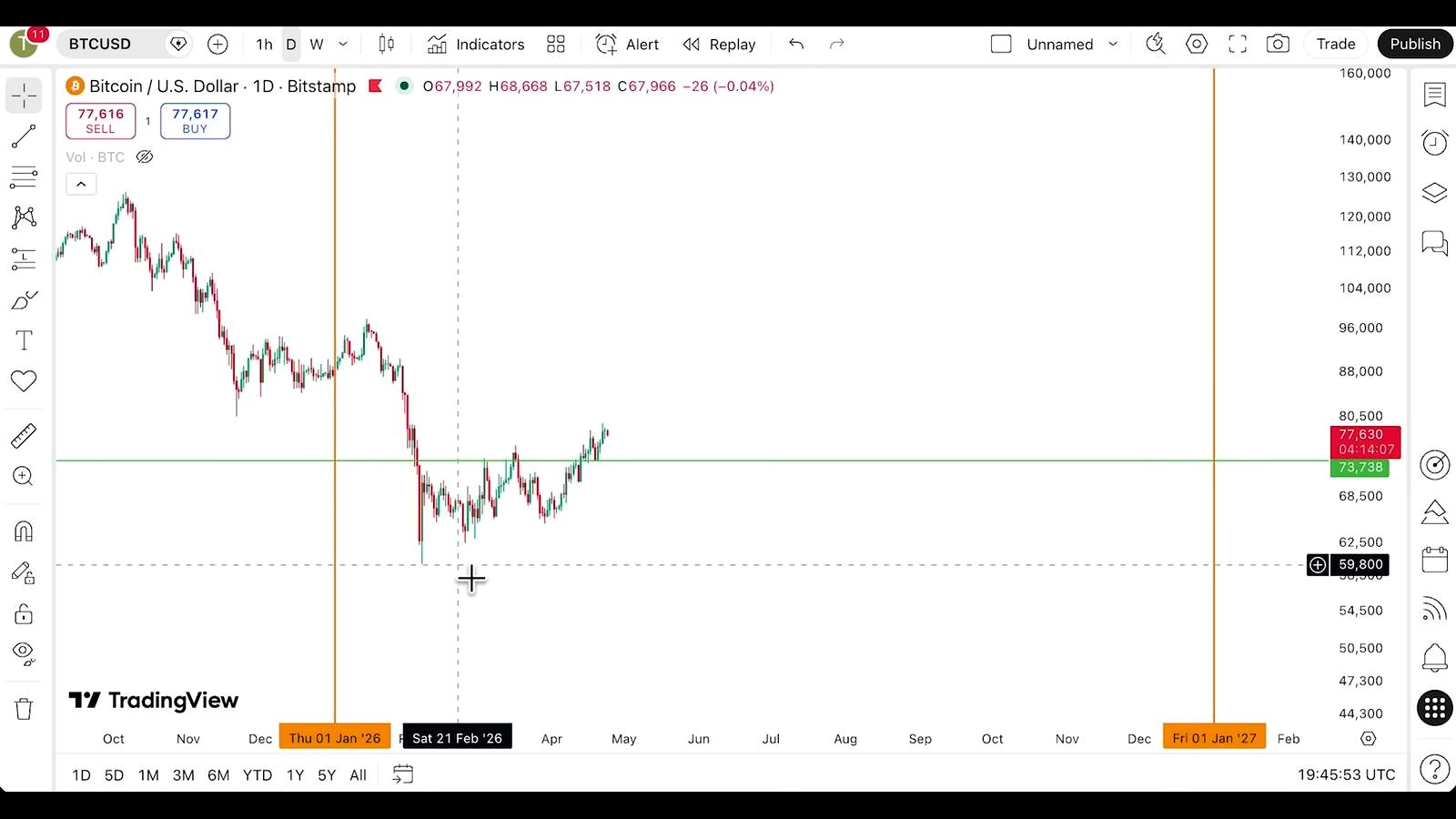
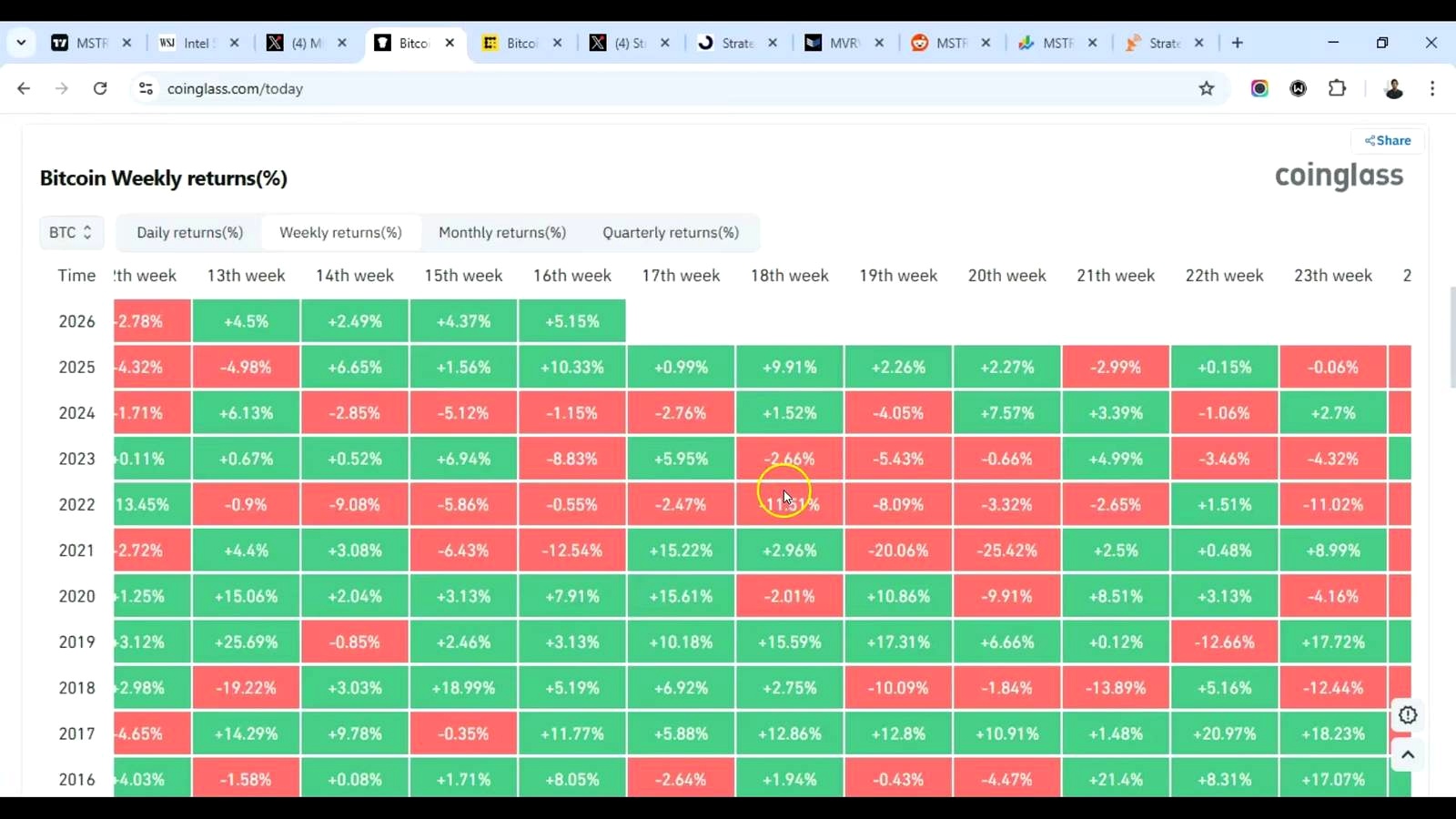
After a sharp squeeze through short positioning, the immediate question for traders is whether Bitcoin’s push toward the upper $77,000s marks the start of a broader reversal or just another trap near resistance. According to The Crypto Report, the rally can extend in the near term, but the levels that would truly flip the market structure bullish are still far above current price.
The Core Thesis: Relief Rally First, Full Reversal Later
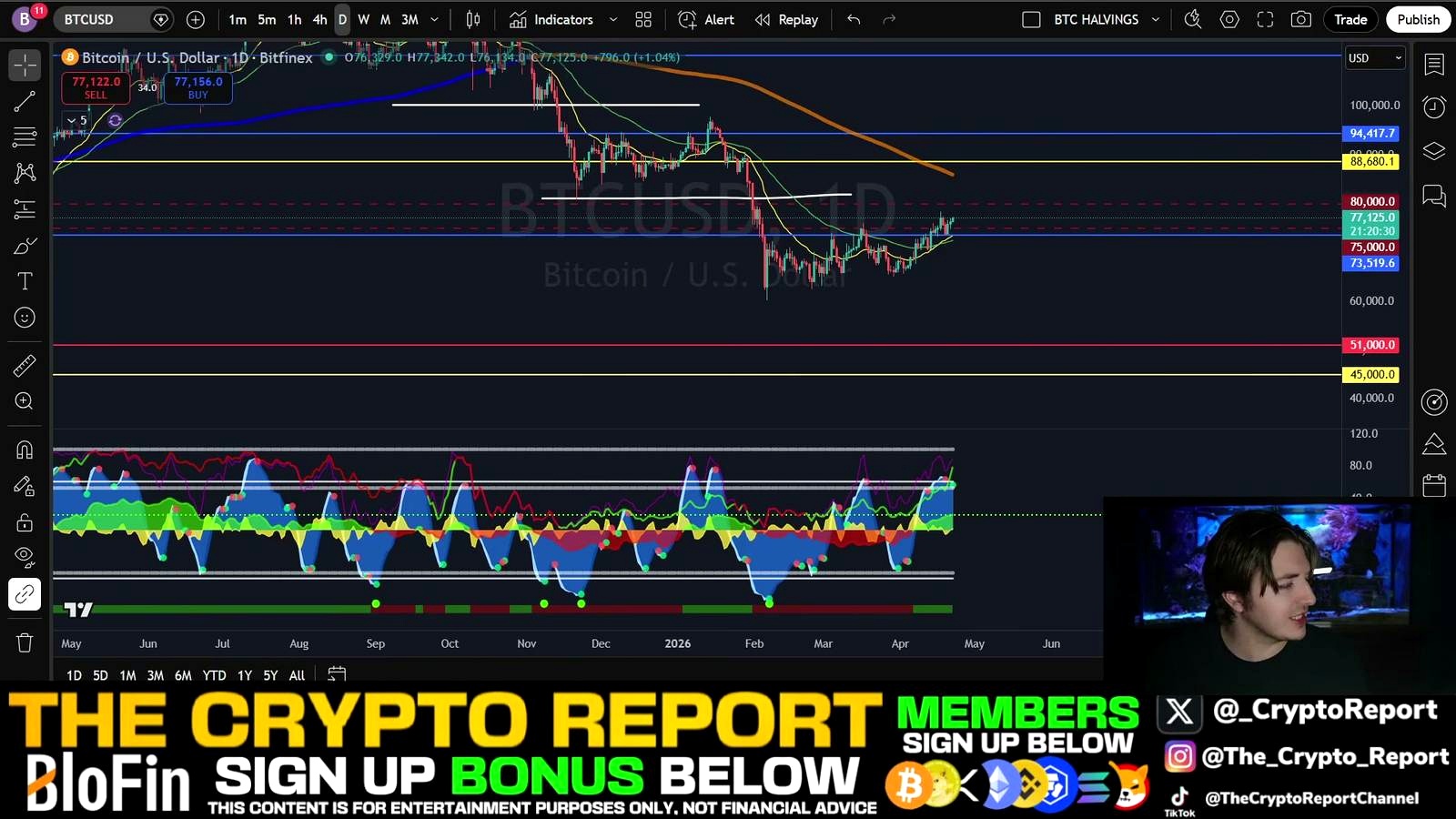
According to The Crypto Report, Bitcoin’s latest upside move looks more like continuation within a broader relief rally than the start of an unambiguous new bull leg. In the video, the host said BTC was trading around $77,000, after wicking into roughly the $77,300 to $77,400 area, but had still not reclaimed the prior wick near $78,000. That distinction matters because, in his framework, clearing $78,000 would open the way toward $80,000 and potentially $88,000, yet even that would not be enough to confirm a “full-on reversal.”
The analyst’s higher bar for a structural trend change is explicit: he said Bitcoin would need to close above $88,000 and, more importantly, above $94,000 before he would treat the move as something more durable than a multi-week bear market rally. He also pointed to Bitcoin still trading below the 200-week simple moving average as a reason for caution.
That stance sits somewhere between bearish and conditional-neutral relative to broader crypto sentiment. In periods of aggressive short liquidation, traders often extrapolate too quickly from one squeeze into a full trend reversal. The analyst is arguing against that instinct. In general market terms, that is a defensible position: Bitcoin has repeatedly produced violent countertrend rallies during uncertain macro phases, especially when positioning gets overcrowded on the short side. At the same time, the counterargument is straightforward. Once BTC starts reclaiming major resistance clusters, market structure can improve quickly, and waiting for confirmation above much higher levels can mean missing a large part of the move.
Why He Thinks This Area Is Dangerous
According to The Crypto Report, the most important near-term zones sit around $80,000, $82,000, and $88.6K. His concern is not that Bitcoin cannot rally into those levels. It is that this kind of breakout sequence can resemble a classic bull trap: repeated taps of resistance, a breakout above it, a retest, renewed momentum, and then a sharp reversal lower once late longs are fully committed.
That pattern is central to his argument. He compared the current setup to a prior episode in which price repeatedly tested resistance, finally broke above it, trapped bulls, and then fell hard. In his telling, the market is now at risk of replaying something similar unless Bitcoin can cleanly push through $78,000 and sustain the move.
The practical trading implication is nuanced. The analyst is not ruling out upside from here. He explicitly said a resumption that clears $78,000 could support continuation to at least $80,000 and potentially $88,000. But he is also warning that traders should not confuse that move with a completed regime change.
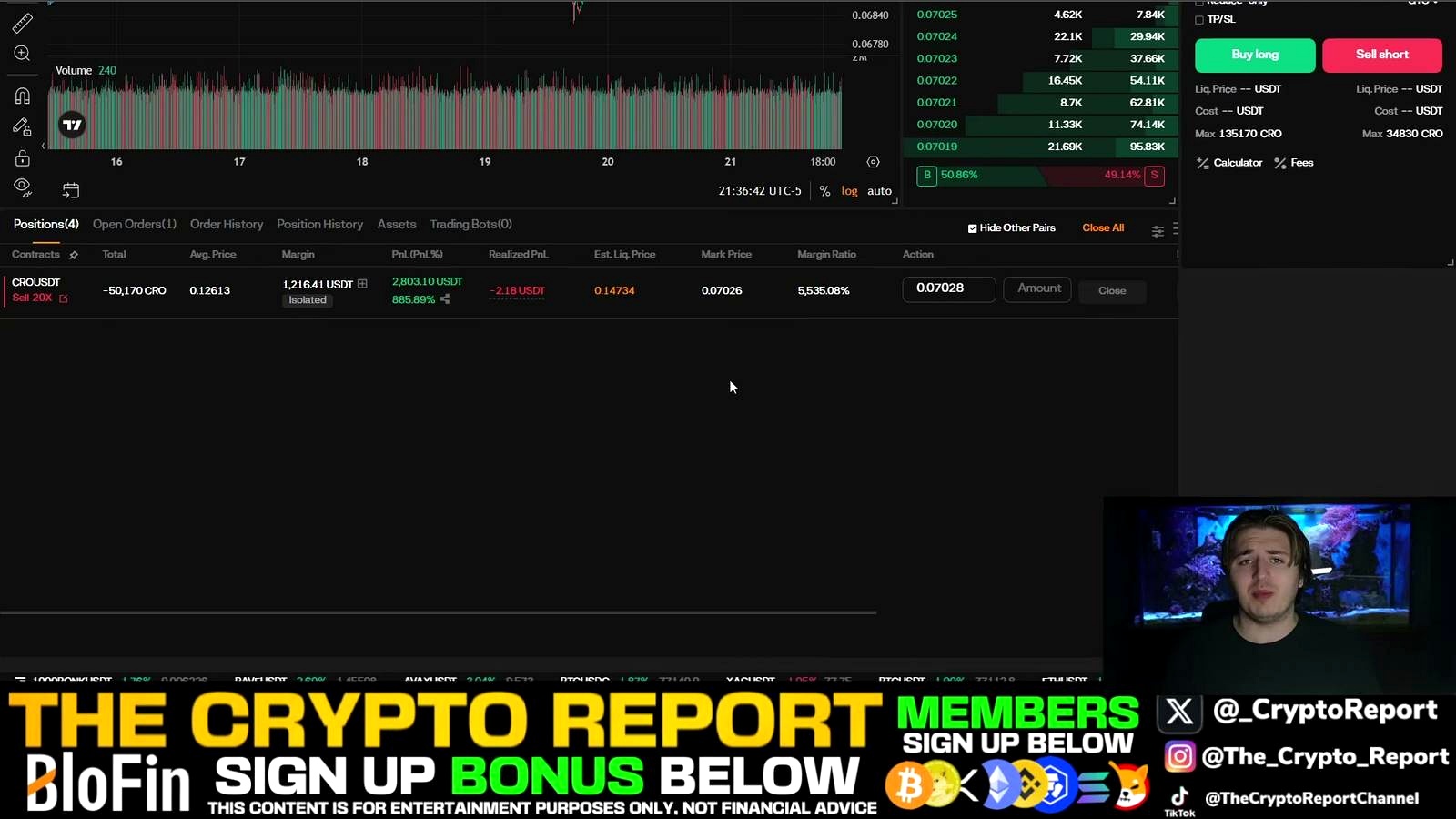
He extended that caution even more aggressively to the altcoin market. The host said he remains short altcoins and expects they will not bottom until at least the end of 2026, even if Bitcoin itself bottoms earlier. He said he is short CRO and about 17 other altcoins, adding that his CRO short was up around $2,800 and roughly 85%, though he said the gain fluctuates between about 50% and 80% depending on Bitcoin’s movement.
That is a far more contrarian call than his Bitcoin view. While Bitcoin dominance has often risen during uncertain market phases and altcoins do tend to underperform in risk-off conditions, calling for altcoin bottoms only by late 2026 implies a much deeper and longer washout than many market participants currently expect.
Macro Context: Why the S&P 500 Matters Here
According to The Crypto Report, one reason Bitcoin may still have room for additional relief is the resilience in equities. The host highlighted the S&P 500’s rebound after dipping below its 200-day simple moving average, describing the move as a V-shaped recovery that has brought the index close to new all-time highs. He also referenced a “golden cross” forming with the 21 and 55 moving averages and said he does not currently expect a drawdown in the index.
That matters because Bitcoin does not trade in a vacuum. In broad risk-on periods, BTC often benefits from easier financial conditions, stronger equity sentiment, and renewed appetite for speculative assets. The analyst was careful not to claim that Bitcoin must rally just because stocks are rallying. But he argued that when traditional markets are firm, Bitcoin usually gets at least some relief.
That general relationship has held often enough to matter, though not consistently enough to be treated as a rule. Bitcoin can decouple from equities, especially when crypto-specific flows dominate, whether through ETF demand, exchange liquidations, regulatory headlines, or sudden shifts in leverage. Still, as a framing tool, the analyst’s point is sensible: traders relying only on Bitcoin’s four-year cycle while ignoring broader market conditions can miss important signals.
What Could Go Wrong
The biggest risk to this thesis is that Bitcoin does exactly what skeptics least expect: reclaim resistance quickly, hold above it, and force a much larger repositioning move. If BTC decisively breaks $78,000, powers through $80,000 and $82,000, and then starts accepting price above $88,000, the “bear market rally” framing gets much harder to defend. A close above $94,000 would, by the analyst’s own definition, invalidate his broader caution.
There are also risks the video did not explore in much depth. One is the role of spot demand. In crypto, structural buying can overwhelm otherwise clean-looking technical resistance, especially if leveraged shorts are already offside. Another is that altcoin weakness does not always map neatly onto Bitcoin weakness. BTC can outperform sharply while the rest of the market lags, which would complicate any broad bearish thesis built from alt underperformance.
The other side of this trade is simple: what looks like a trap can also be accumulation resolving upward. Markets often look most suspicious right before they break higher, because prior failed breakouts train traders to fade strength. If this rally is being underwritten by improving macro sentiment and cleaner positioning after heavy liquidations, standing too firmly in front of it could be costly.
What to Watch Next

The first trigger is obvious: whether Bitcoin can reclaim and hold above $78,000. If it does, the next upside checkpoints are $80,000, $82,000, and then the broader $88,000 area highlighted in the video. Above that, $94,000 becomes the line that would shift this analyst’s view from relief rally to reversal.
On the downside, traders will be watching for signs that the move through the upper $77,000s was just a squeeze that failed at resistance. Beyond crypto, the S&P 500’s ability to stay firm near record levels could remain a useful barometer for whether risk assets, including Bitcoin, continue to receive macro support.
FAQ
What is a bear market rally in Bitcoin?
A bear market rally is a sharp upward move that happens within a broader downtrend. It can last days or weeks and often looks convincing, but it does not necessarily mean the larger trend has reversed.
Why does the 200-week moving average matter for BTC?
The 200-week moving average is a long-term trend gauge many traders use to separate bullish from bearish market structure. When Bitcoin is below it, some analysts view rallies with more skepticism because price has not yet reclaimed a key long-term support area.
What is a bull trap in crypto trading?
A bull trap happens when price breaks above a resistance level, draws in buyers expecting continuation, and then reverses lower. In volatile crypto markets, these false breakouts can trigger fast liquidations and sharp downside moves.
How does Bitcoin usually behave when the S&P 500 is rallying?
Bitcoin often benefits when equities are strong because both can respond positively to improving risk appetite. But the correlation is imperfect. Crypto-specific factors such as ETF flows, exchange positioning, and regulation can cause Bitcoin to diverge from stocks.
Why might altcoins underperform even if Bitcoin rises?
In uncertain market conditions, capital often rotates into Bitcoin first because it is viewed as the most liquid and established crypto asset. That can push BTC dominance higher while smaller tokens lag or continue falling, even during a Bitcoin rebound.
Video Reference

An Indian crypto journalist covering the developments in the Bitcoin and blockchain industries. Her work helps readers understand key changes in the world of digital assets.