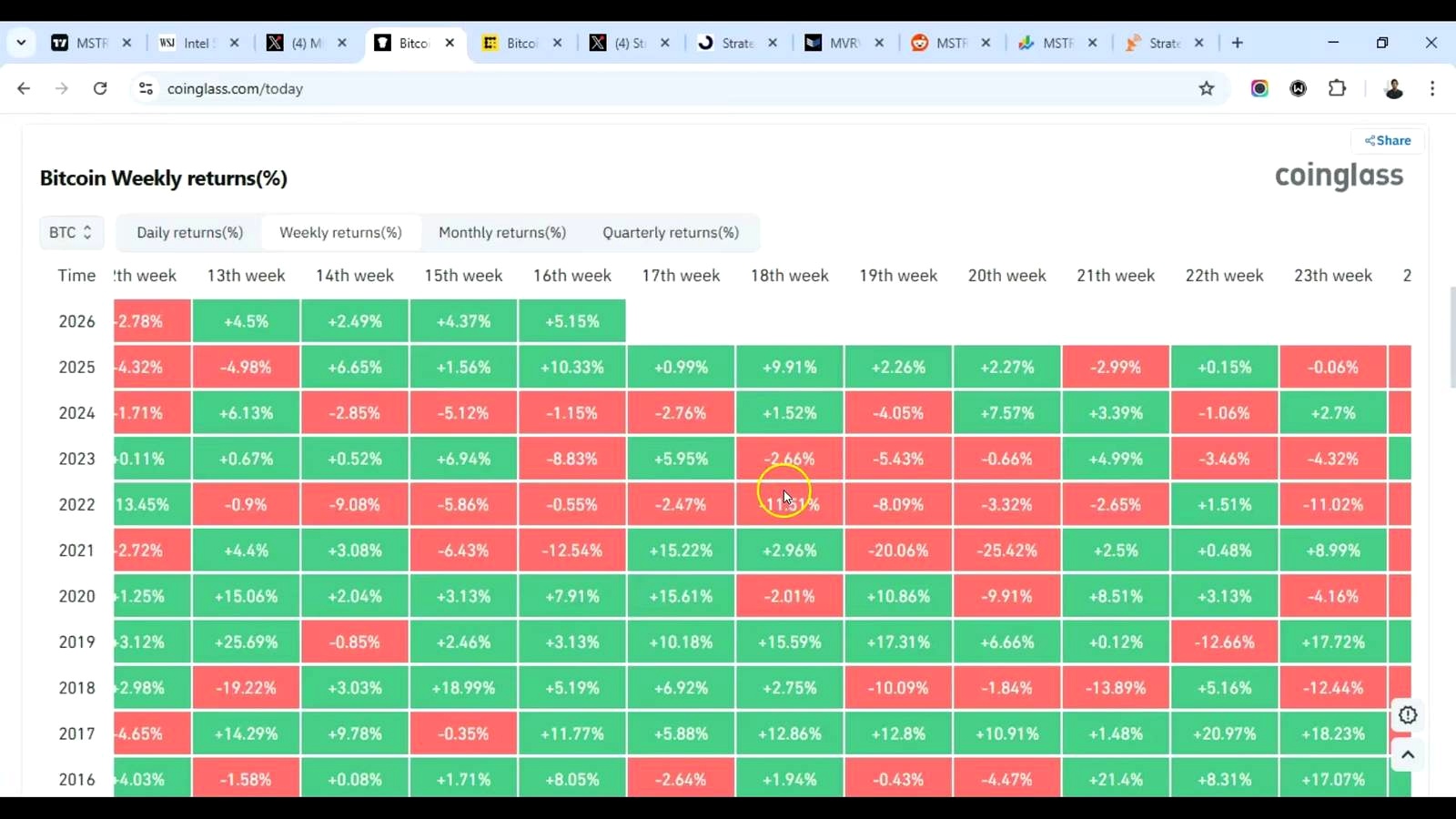
Momentum has turned higher again, but the bigger question is whether this is the start of a real breakout or just another bear-market rally. According to VisionPulsed, Bitcoin is approaching a technical zone where bulls need to prove themselves quickly, or risk setting up the next major leg down.
Bitcoin’s rally is testing the bearish case
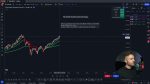
According to VisionPulsed, the core setup is simple: Bitcoin’s 5-day stock RSI is nearing an overbought reading again, and the market is at a point where the next reaction should reveal whether this is true accumulation or just a temporary squeeze higher. The host said he had shifted away from an earlier expectation of an April crash when price action around $67,000 stopped behaving bearishly, but he still believes the broader structure looks like a market that is only “halfway into the bear market.”
That is a contrarian stance in the current cycle. Broader crypto sentiment has leaned toward the idea that dips are being bought within a larger uptrend, especially after spot ETF demand and recurring institutional flows changed the structure of Bitcoin markets. In that context, calling for another major downside move is not the consensus trade. Still, the analyst’s framework will sound familiar to technically minded traders: overbought conditions in strong uptrends often lead to continuation, while overbought conditions in weaker markets can become ideal rejection zones.
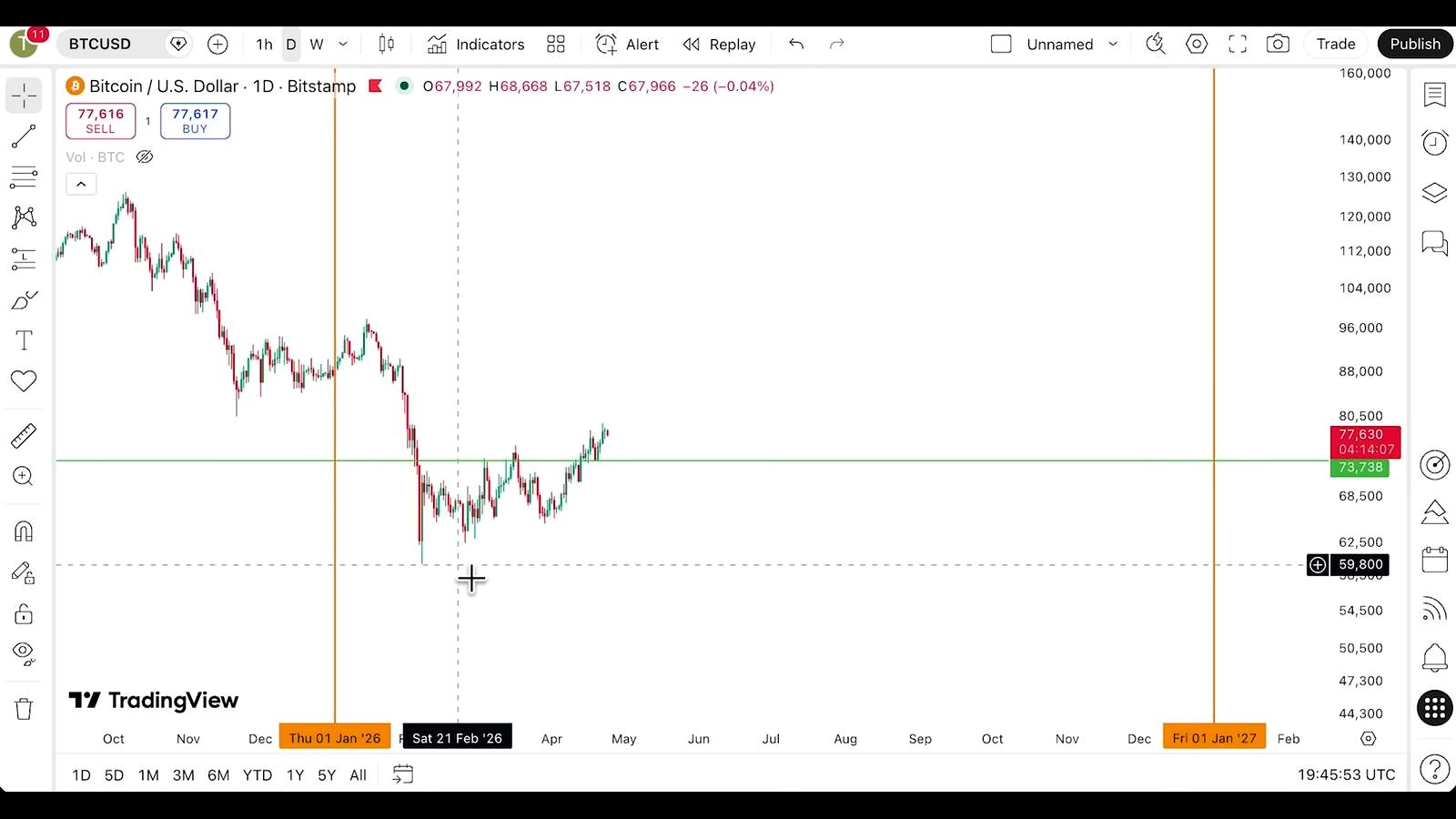
VisionPulsed argues that if Bitcoin is genuinely bullish, then after this overbought trigger the market should print “big green candles” rather than stall. If, instead, overbought conditions are followed by “big red candles, ” he sees that as confirmation the market remains bearish. He also noted Bitcoin recently tagged around $73,000, while citing a prior close around 74,79 749 on one chart feed, and stressed that Coinbase’s chart was still “nowhere near the high, ” which he views as a possible warning sign.
That matters because market tops and failed rallies often show up first in related equities and proxies. Traders regularly monitor Coinbase, MicroStrategy and crypto-linked retail names for divergence. But the counterpoint is straightforward: Bitcoin can decouple from those proxies, especially when ETF flows, macro liquidity expectations, or large treasury buying dominate shorter-term trading.
The supporting case: lower highs, weak proxies, and a ceiling near $79,000
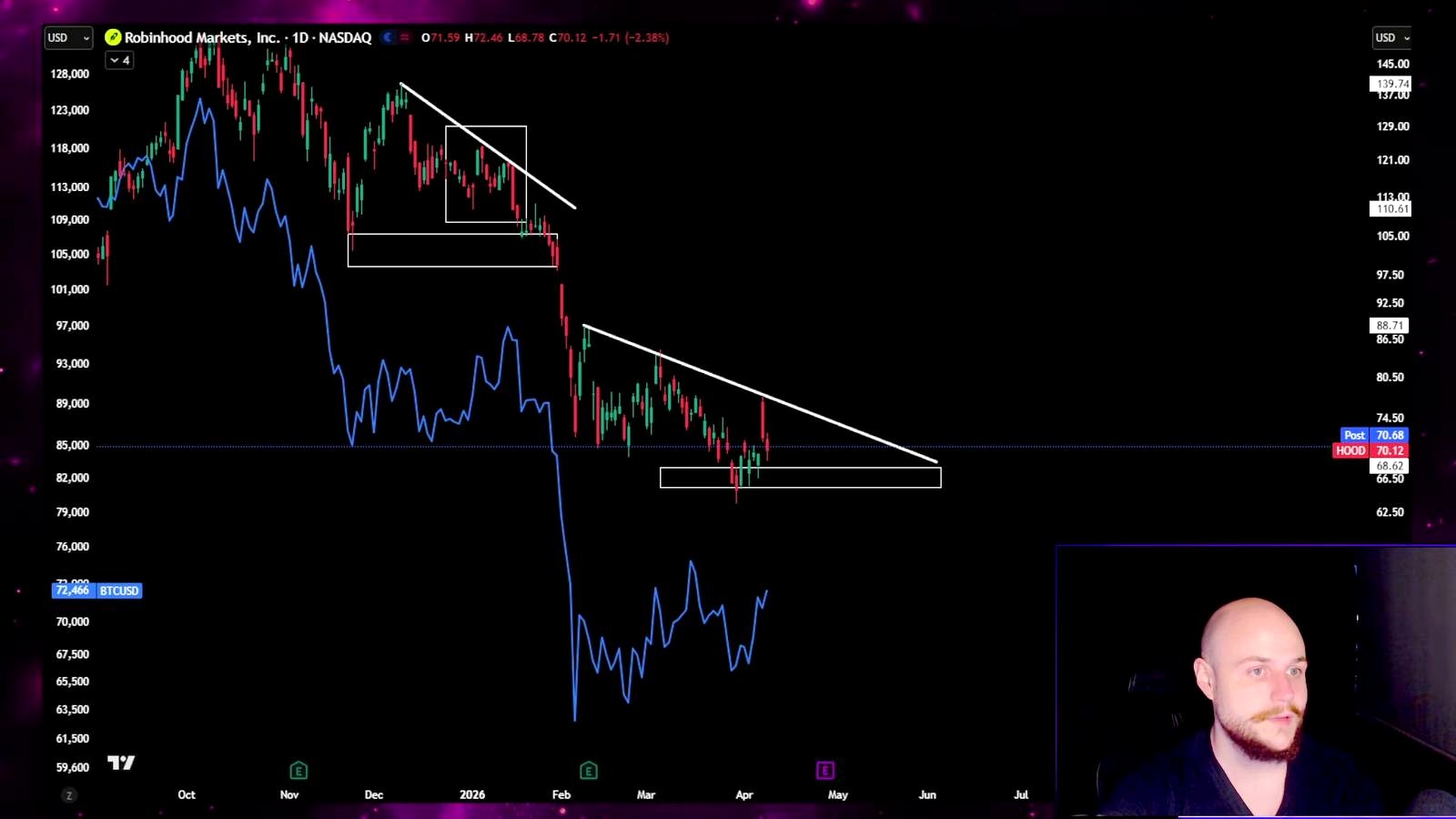
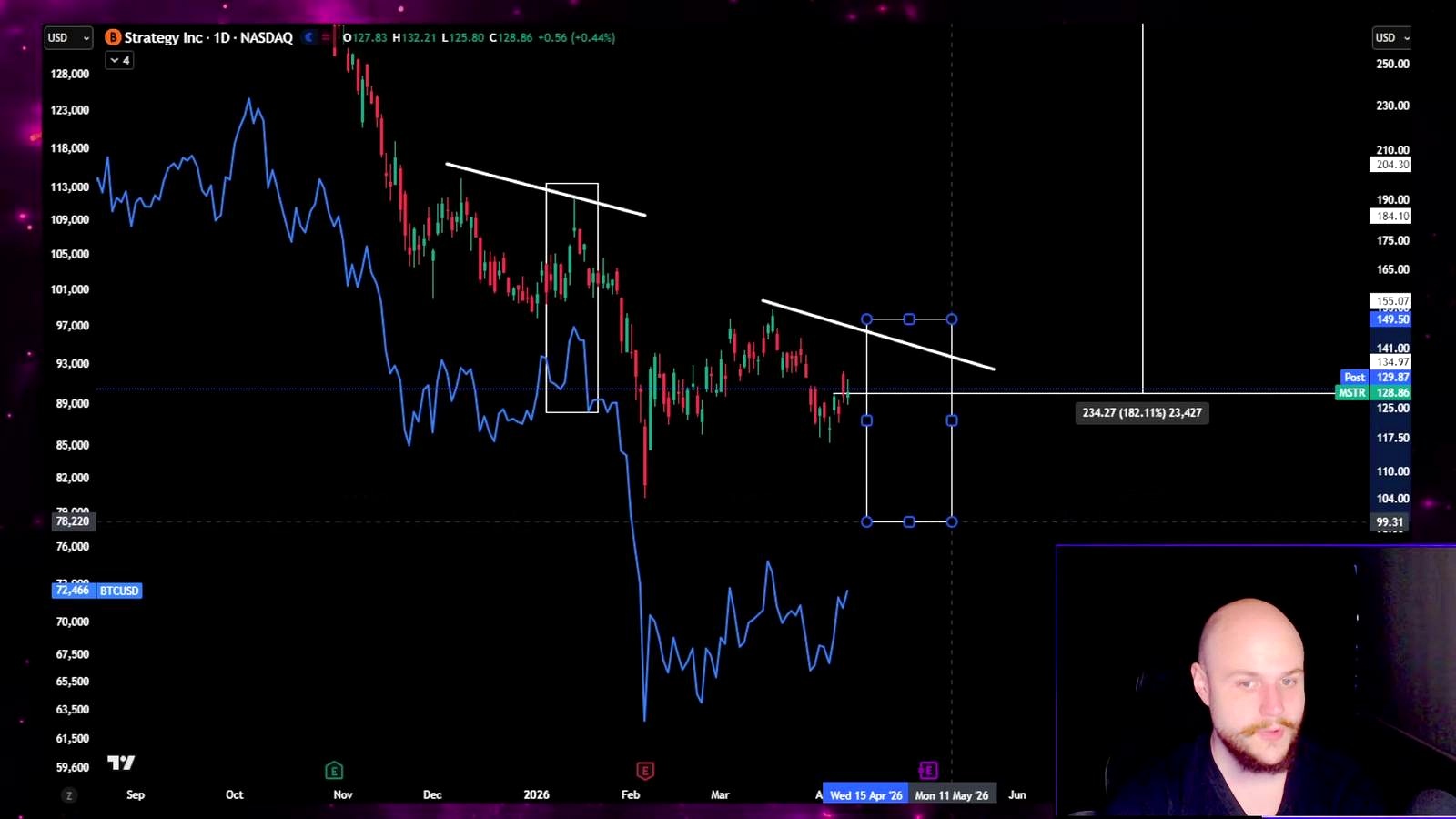
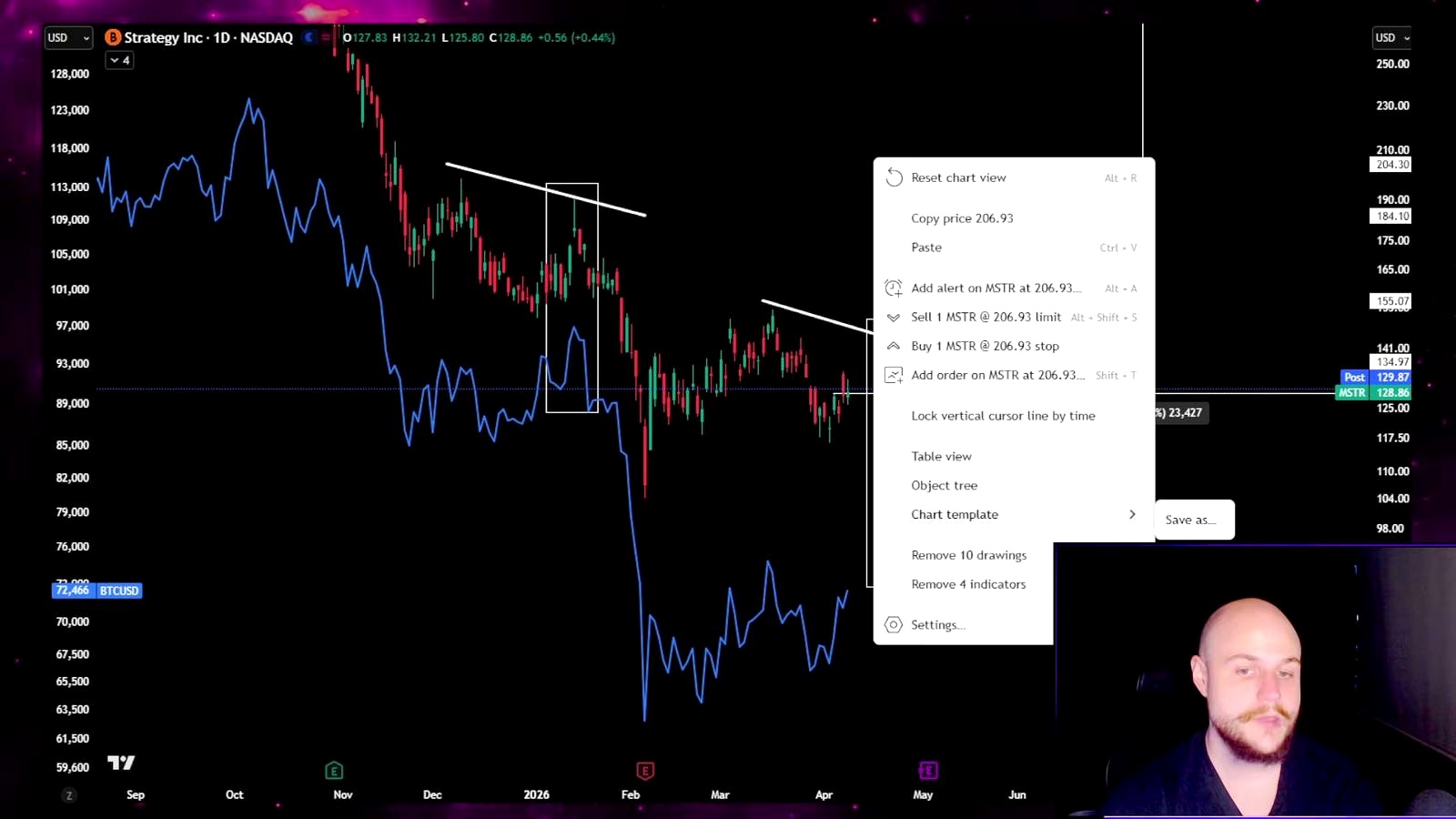
VisionPulsed’s supporting thesis leans on two ideas: proxy weakness and a technical ceiling defined by on-chain cost basis. First, he said crypto-linked stocks such as Robinhood, Coinbase and MicroStrategy are worth monitoring for lower highs even as Bitcoin pushes upward. In his reading, Robinhood is already acting more like a Bitcoin proxy than an S&P 500 stock. The host noted that while the S&P had returned to roughly where it traded over the last 3 to 4 months, Robinhood remained weak and had already hit downtrend resistance and been rejected.
That relative weakness is one reason he remains skeptical of the rally. He made a similar point on macro context, arguing that the S&P 500 is back near prior highs from March, February, January, December and November, while Bitcoin is still lagging. To him, that suggests Bitcoin is not participating like a healthy risk asset should. He compared the setup to prior equity cycles in 2014, 2015, 2018, 2020 and 2022, though he also conceded that the S&P has often shrugged off short bearish phases and resumed climbing.
The more actionable level in his framework is the short-term holder realized price. VisionPulsed described this as an on-chain indicator that has historically acted like a ceiling during bear markets. His conclusion: if Bitcoin is to remain bearish, it should stay below or around $79,000. He added that $78,000 no longer looks unreasonable, and even $77,000 could be enough to complete the move, especially because a falling resistance line sits near $71,000 while spot is around $73,000. In other words, he is not arguing that Bitcoin cannot rally further; he is arguing that a move into the high $70,000s could still fit a bearish structure.
That nuance matters. Bear-market rallies can be violent, and in crypto they often erase the conviction of traders who positioned too early. Even the analyst acknowledged that “the momentum is bullish” and warned bears not to stand in front of it while it is still running.
What could go wrong with this thesis
The cleanest invalidation is also the most obvious one: Bitcoin keeps rallying, clears the high-$70,000 area decisively, and does so without the rejection VisionPulsed expects. He explicitly said that if price “blow[s] through this” and starts flying toward $80,000 to $90,000, then “something is broken, ” meaning his bear-market model would no longer fit.
There are other risks to the thesis that the host touched on only indirectly. One is structural demand. Bitcoin now trades in a market shaped by spot ETF flows, corporate treasury demand, and a more developed derivatives complex than in 2014, 2018 or even 2022. Historical analogs can still be useful, but they are less reliable when the buyer base changes. Another is macro. If rate-cut expectations improve, the dollar softens, and equities remain firm, Bitcoin may not need crypto equities like Robinhood or Coinbase to lead; it may simply respond to global liquidity and institutional inflows.
There is also a timing problem. VisionPulsed repeatedly said the expected downside is taking “much longer” than anticipated. That matters because being directionally right but early can still be a losing trade. A market can remain range-bound or grind higher long enough to invalidate an otherwise reasonable technical setup from a trading perspective.
Finally, the thesis depends heavily on interpreting overbought conditions as a trap rather than strength. In persistent bull phases, overbought RSI readings often mark trend acceleration, not exhaustion. If that dynamic returns, bears waiting for a perfect rejection may simply miss continuation higher.
Dogecoin’s setup: a rally first, then a deeper drop?
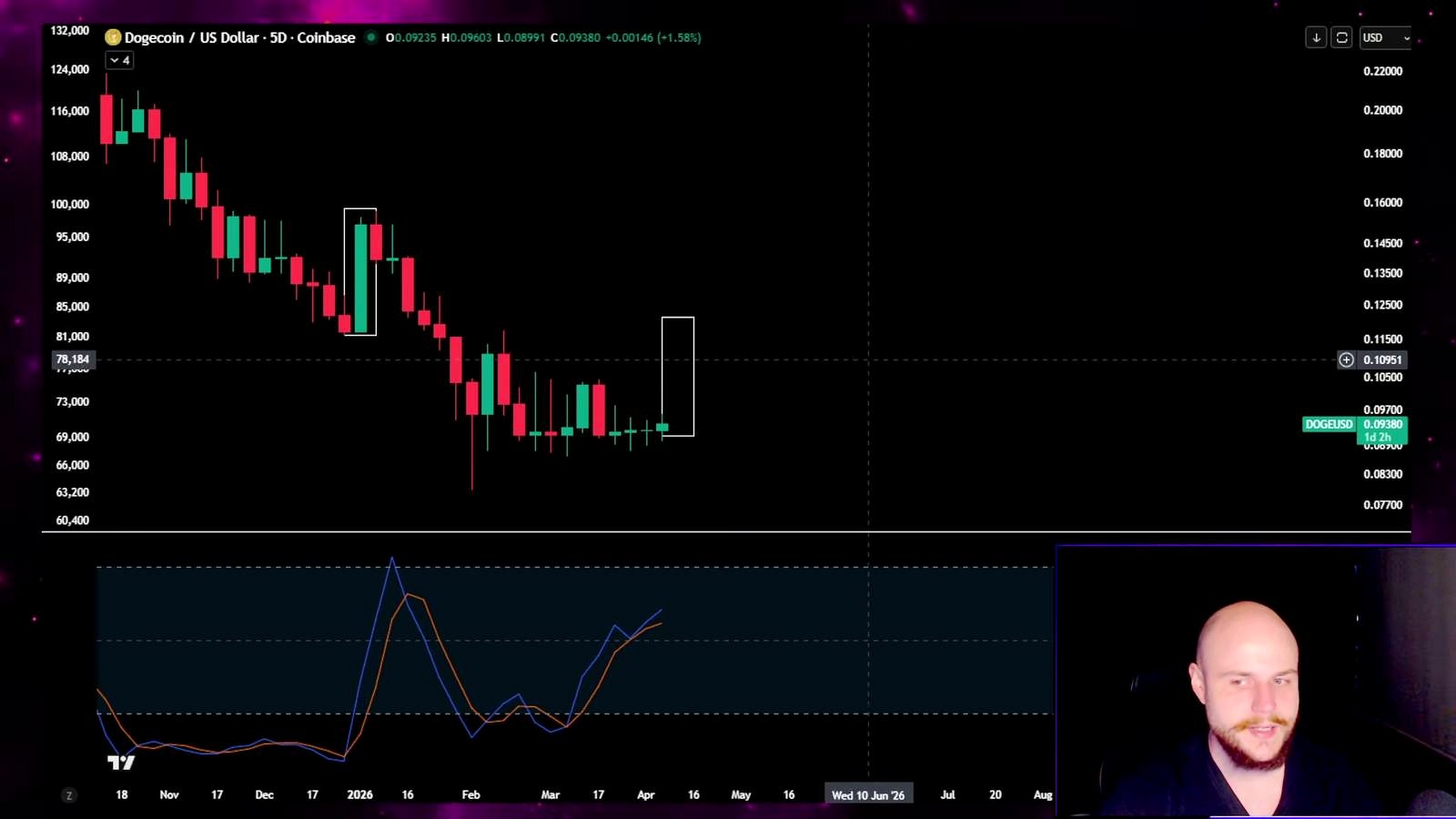
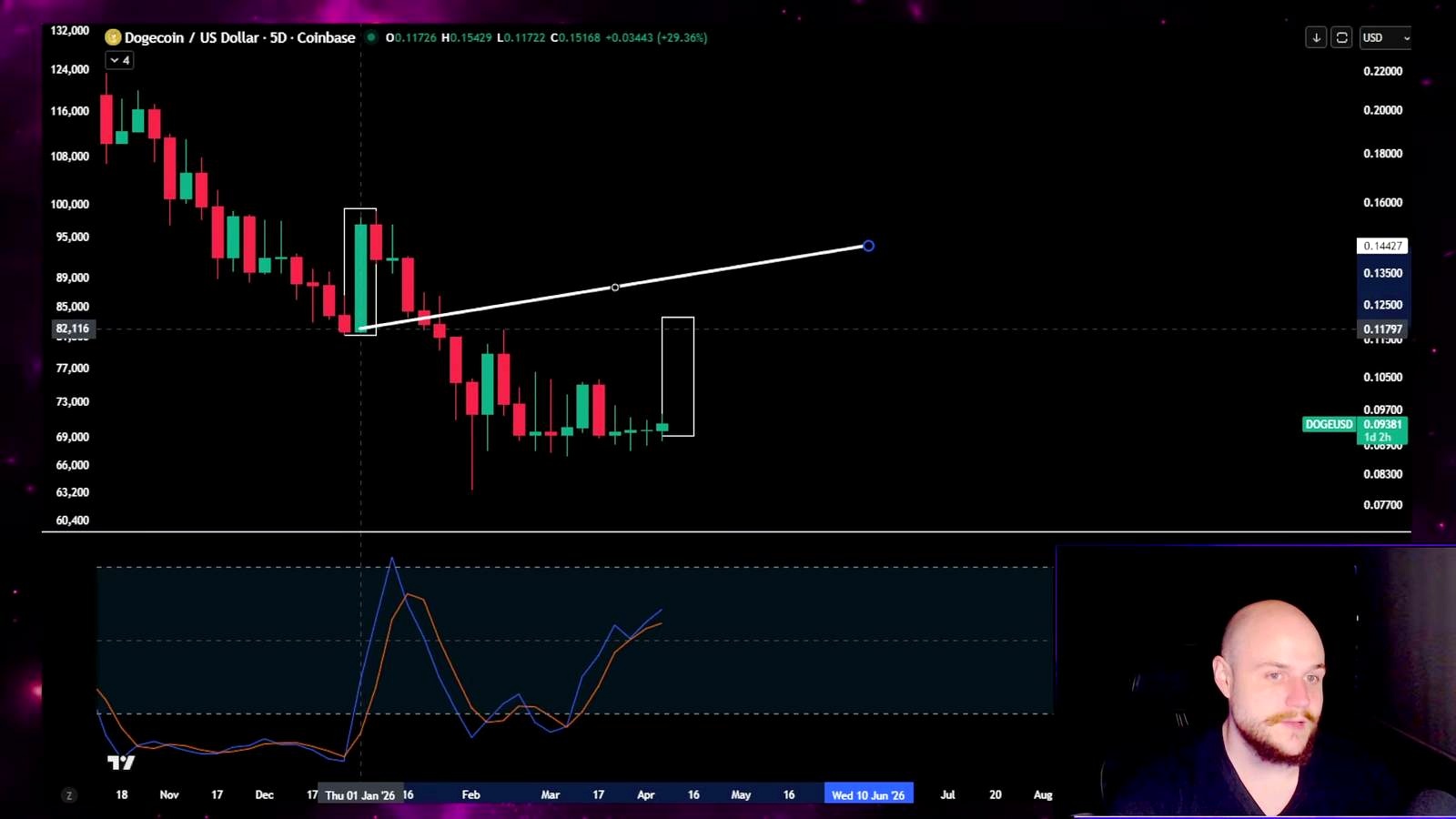
VisionPulsed extended the same logic to Dogecoin, with an even more cautious conclusion. He said Dogecoin’s momentum is “extremely bullish right now, ” but price still is not moving decisively. If Bitcoin pushes high enough, he expects Dogecoin could print a sharp green candle, potentially reaching 12 cents. But he framed that move as a likely “scam pump” rather than the start of a durable uptrend.
The host’s base case is that traders who chase that kind of move risk getting trapped if they fail to exit. He also floated a slower bearish scenario in which Dogecoin does not reach 5 cents until roughly a year from now. At the same time, he acknowledged an alternate path: if an anomaly-style spike occurs, then the recent low around 7.9 cents could end up being the bottom. Even then, he argued, Dogecoin would probably offer another entry later because prior relief rallies in 2018 and around the FTX collapse still retraced before the final washout.
That framing captures the broader altcoin tension right now. Memecoins can outperform sharply when Bitcoin rallies, but they also tend to exaggerate reversals. If the analyst is right about Bitcoin nearing a late-stage rally within a bearish structure, Dogecoin would likely amplify both the upside teaser and the downside reset.
What to watch next
The first trigger is the 5-day stock RSI. VisionPulsed said it could hit overbought as soon as “tomorrow, ” and that the market’s reaction after that matters more than the signal itself. If Bitcoin reaches overbought and keeps printing strong upside candles, the bullish case gains credibility fast.
The second trigger is price in the $77,000 to $79,000 zone. That is the area the analyst sees as compatible with a final rally before rejection. A decisive move above $80,000 would seriously weaken his thesis, while a sharp rejection from the high $70,000s would strengthen it.
Third, watch Coinbase, MicroStrategy and Robinhood for lower highs or renewed selling. In VisionPulsed’s framework, those divergences could act as early warnings that Bitcoin’s rally is losing sponsorship before spot price fully rolls over.
FAQ
What is the short-term holder realized price in Bitcoin?
It is an on-chain metric that estimates the average acquisition price of coins held by short-term investors. Traders use it to gauge whether newer market participants are in profit or loss. In weaker market phases, Bitcoin often struggles to stay well above this level for long.
What does an overbought RSI actually mean?
RSI, or Relative Strength Index, measures momentum. An overbought reading usually means price has risen quickly over a given period. That does not automatically mean a crash is coming. In strong uptrends, overbought conditions can persist and even signal trend strength rather than reversal.
Why do traders watch Coinbase, Robinhood, and MicroStrategy when analyzing BTC?
These stocks often act as sentiment proxies for crypto markets. Coinbase reflects trading and retail activity, MicroStrategy is heavily tied to its Bitcoin treasury strategy, and Robinhood can reflect speculative appetite. If Bitcoin rises while these proxies weaken, some traders read that as a divergence.
What is a bullish divergence in market analysis?
A bullish divergence happens when price makes a lower low but an indicator such as RSI, MACD, or a selling-pressure gauge makes a higher low. It can suggest downside momentum is fading even before price fully turns. VisionPulsed argues that past Bitcoin bear-market bottoms showed this feature, while the current setup does not yet.
How is this Bitcoin setup different from a normal bull-market breakout?
In a classic breakout, Bitcoin clears resistance and related assets usually confirm the move with stronger highs, broader participation, and follow-through buying. In the setup described here, the concern is that Bitcoin may rally into resistance while crypto-linked equities lag and momentum becomes overstretched, creating the conditions for a reversal instead of expansion.
Original Source

John Burnell focuses on Bitcoin infrastructure, wallet security and blockchain technology. He writes educational articles explaining how Bitcoin works and how the technology evolves.