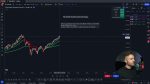
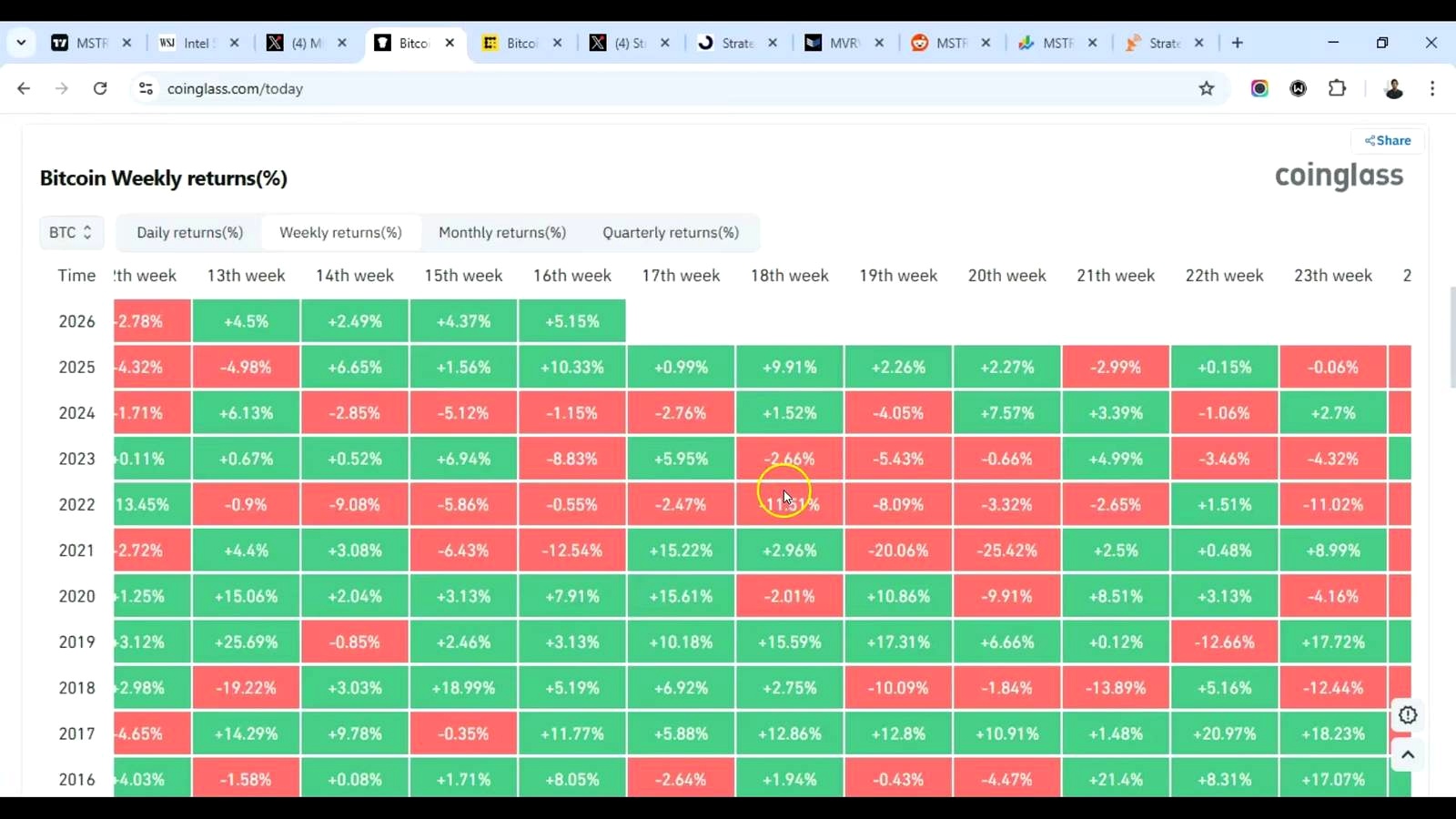
Crypto markets are stuck in an uncomfortable spot: bearish signals have piled up, yet the decisive flush many traders expected still has not arrived. According to VisionPulsed, that delay matters because every extra day Bitcoin holds up increases the odds that the market sees another relief rally before any deeper move lower.
Core Thesis: the bearish setup is aging, and timing now matters
According to VisionPulsed, the central question is no longer whether Bitcoin looked vulnerable weeks ago, but whether a breakdown can still happen quickly enough to preserve that thesis. The analyst said he had expected the market to be “going down by now, ” and argued that the longer Bitcoin stays elevated, the “less probable” an immediate April-style washout becomes.
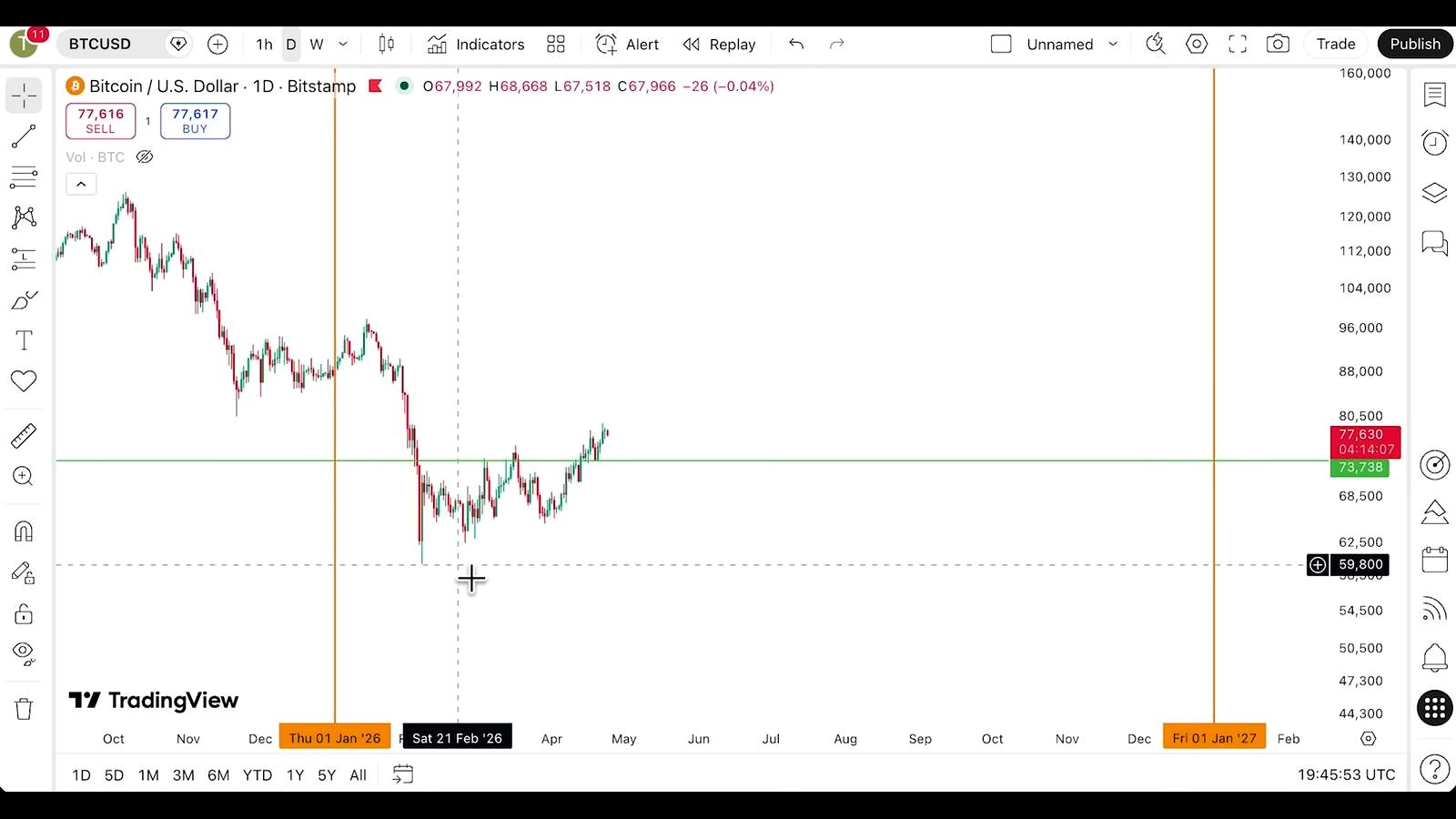
His base case remains bearish in the medium term. VisionPulsed repeatedly argued there is a 0% chance the bear market bottom is already in and also a 0% chance Bitcoin is about to return to prior highs from here. He described the current period as the sixth month of the bear market and said the market is roughly as far from the bottom as it is from the top, framing this as a mid-cycle bearish phase rather than a new bull leg.
But the notable shift in the video is tactical, not directional. The analyst is now openly allowing for a scenario where Bitcoin rallies first and only then breaks lower. He tied that possibility to the 5-day stochastic RSI, arguing that if price does not start moving down soon, momentum could instead reset upward, produce another rally, push the oscillator into overbought territory, and only then set up the next crash.
That puts VisionPulsed somewhat between consensus camps. Broader market sentiment often splits into two extremes during prolonged consolidations: one side sees every delay as bullish resilience, while the other treats sideways chop as merely a pause before capitulation. Historically, both can be true at different moments. In crypto, late bear-market structure often includes sharp reflex rallies before the final low, especially when leveraged shorts pile in too early. On the other hand, if macro liquidity improves or ETF-related flows stabilize risk appetite, a market that “should have” broken down but didn’t can transition from weak-looking to structurally stronger surprisingly fast.
What the analyst is watching across altcoins and momentum gauges
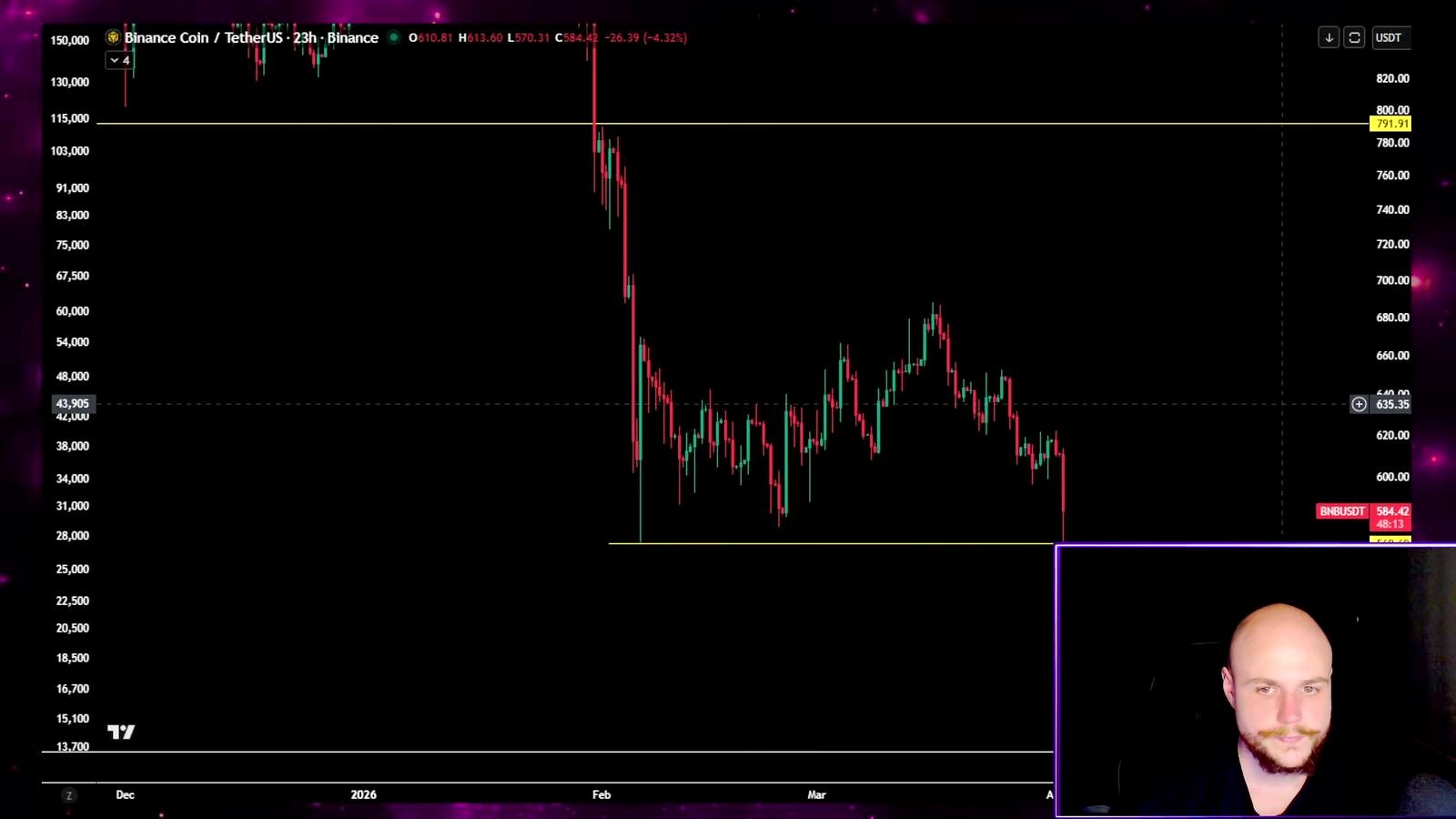
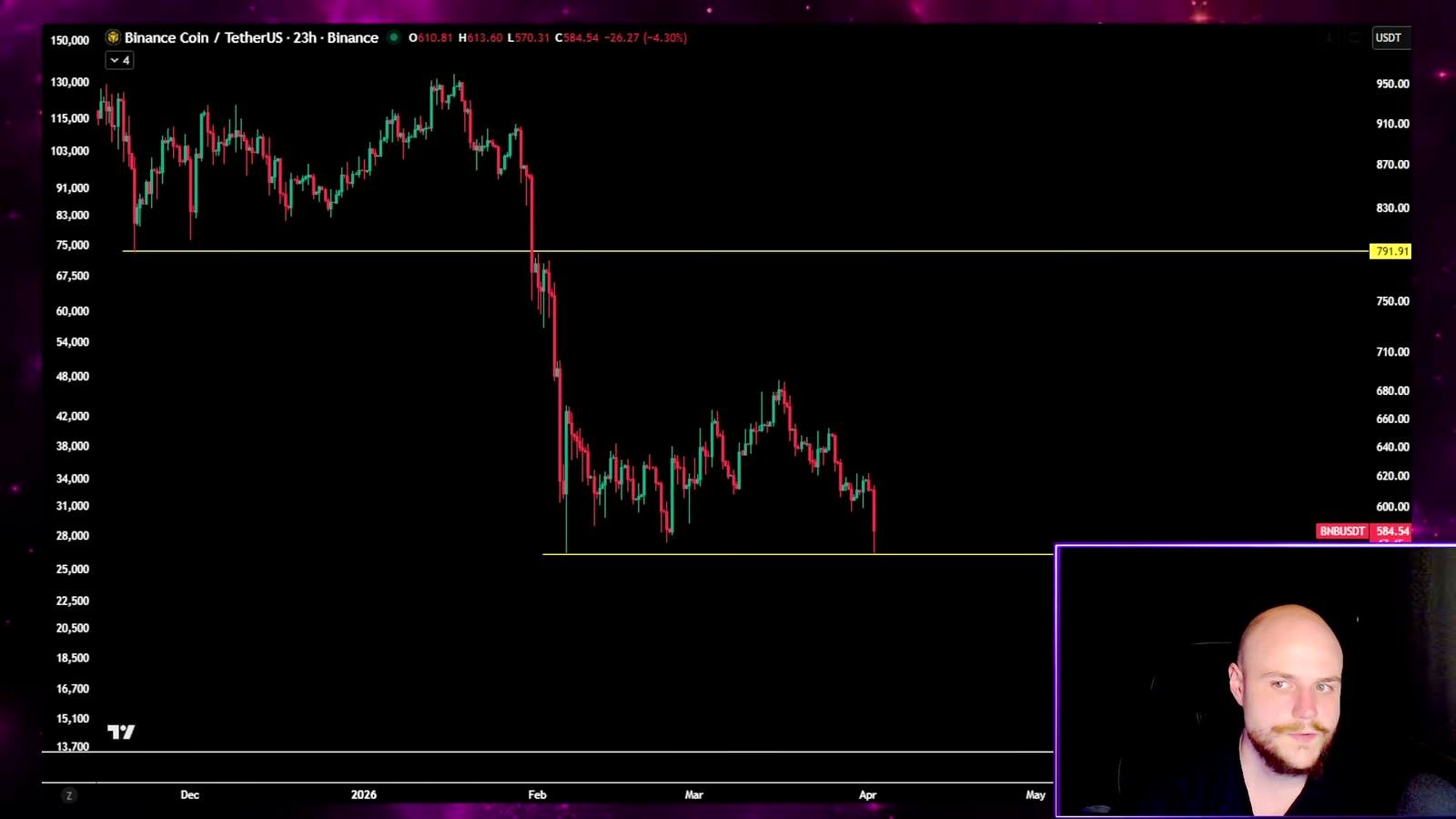
VisionPulsed’s supporting evidence comes less from a single Bitcoin price level than from a cluster of altcoin stress signals. He highlighted BNB as the “biggest” coin to watch, noting that it returned to its prior low but did not break it. In his framework, a fresh downside break in BNB would be “extremely bearish” and could act as a warning that Bitcoin is about to follow.
He also cited a group of smaller and mid-cap names that either have broken prior lows already or are testing them: MOG, VeChain, Telcoin, Aptos, Injective, Ethereum Classic, Uniswap, Solana and others. His broader point is that if “almost every coin” starts doing the same thing, losing local support or confirming breakdowns, then traders can infer rising odds of a Bitcoin move lower.
Some of the examples are highly speculative tokens, so they should not be treated as clean macro proxies. Still, the underlying observation is familiar: altcoins often weaken before Bitcoin in risk-off phases. When market breadth deteriorates and lower-quality assets break first, Bitcoin can hold up briefly before catching down. That sequence has shown up repeatedly in prior drawdowns.
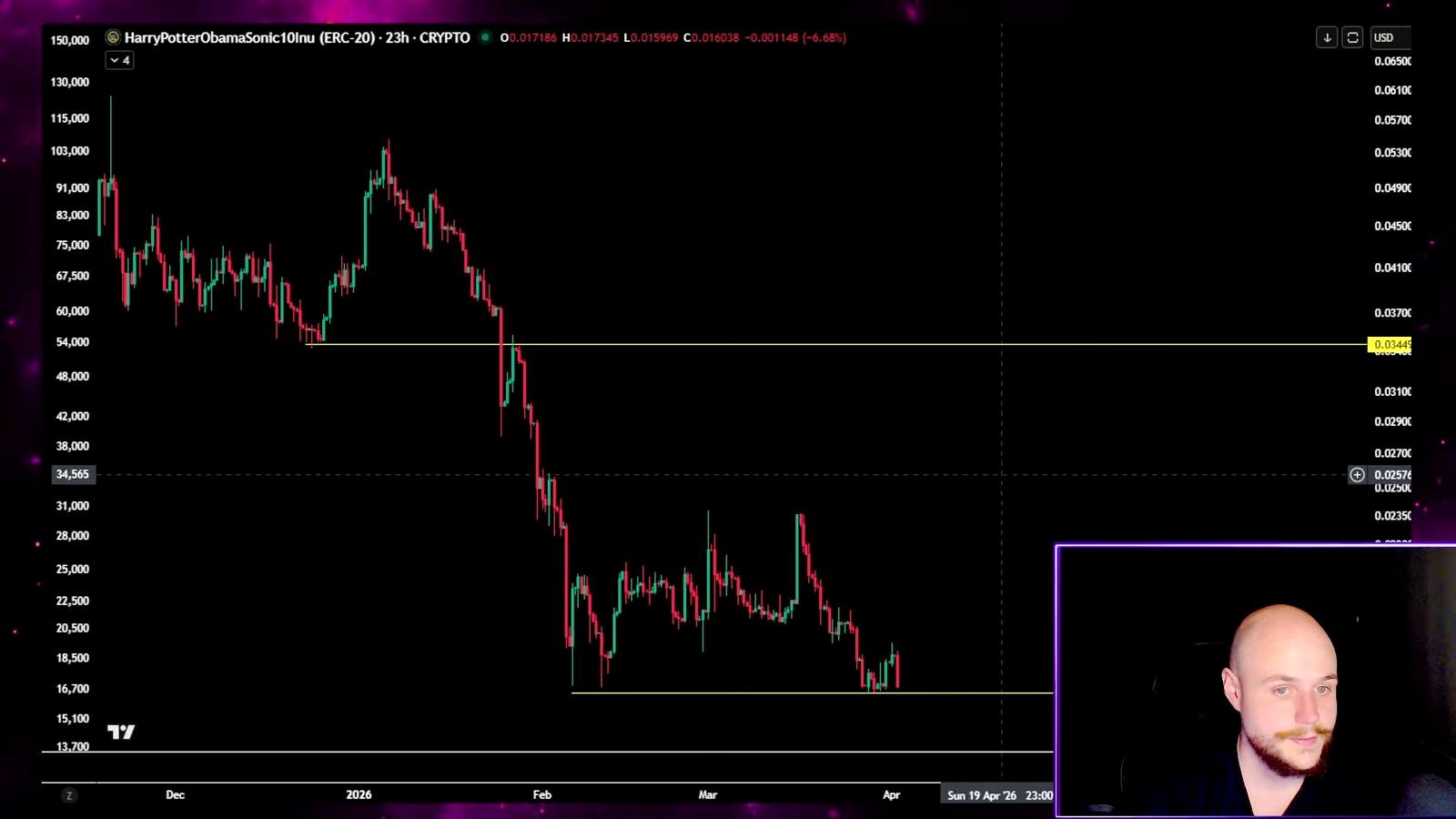
Dogecoin gets special attention in the video. According to VisionPulsed, DOGE is becoming “extremely compressed, ” with volatility narrowing enough that a large move looks close. He pointed to a 10-day BBWP bar as evidence a volatility expansion is likely soon and said the coin is unlikely to keep consolidating much longer. In his estimate, that leaves two main paths: either Dogecoin breaks down toward 5 to 6 cents within roughly the next 3 weeks, or the bottom is already in and a strong upside expansion follows.
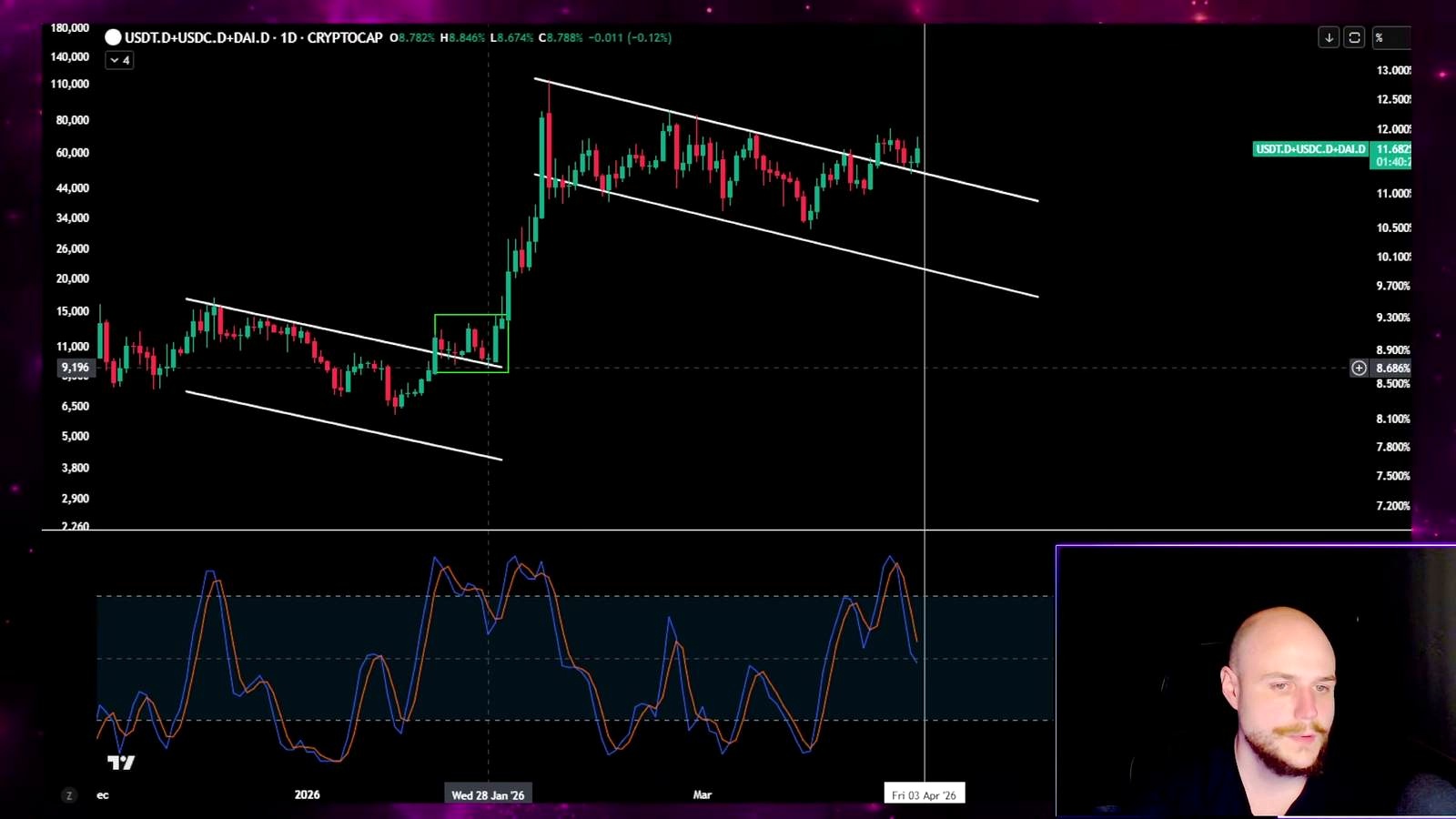
The host also connected Bitcoin’s outlook to stablecoin dominance, specifically USDT, USDC and DAI. He said stablecoin dominance is holding a resistance-turned-support area, which is technically bullish for stablecoin market share and therefore bearish for Bitcoin. That relationship is not perfect, but traders often use rising stablecoin dominance as a shorthand for defensive positioning inside crypto.
One more timing signal he flagged: the market is roughly 16 days past the last FOMC meeting. He said previous post-FOMC declines sometimes happened immediately, while in at least one case the crash came around 15 days later. In other words, he is not ruling out an imminent breakdown, but he is no longer comfortable acting as if it is guaranteed.
What Could Go Wrong
The biggest risk to VisionPulsed’s thesis is straightforward: Bitcoin may simply be showing strength, not delay. Markets that absorb bearish setups without breaking often trap shorts, especially when a widely watched capitulation window passes without capitulation. If that is what is happening now, then the analyst’s “another rally first” fallback could still underestimate how durable that rally becomes.
His own invalidation is also clear. According to VisionPulsed, a move back above the total crypto market cap trend line would remove his reason to stay bearish in the near term. If that breakout happens and breadth improves rather than narrows, then the bearish interpretation of altcoin weakness loses force.
There are other risks he touched only lightly. First, altcoin breakdowns do not always lead Bitcoin lower; sometimes they simply reflect rotation into BTC. That is especially true when traders de-risk from speculative tokens but keep capital inside large-cap crypto. Second, macro conditions can change faster than chart structures. A softer inflation print, a dovish shift in rate expectations, or renewed institutional demand can overpower a technical setup that looked ready to fail.
The other side of the trade, then, is a market that squeezes higher because too many participants positioned for a flush that never came. In that scenario, the final bearish move may be delayed into a later quarter, or may arrive from a much higher level.
What to Watch Next
The immediate trigger is time. VisionPulsed said that if Bitcoin does not start moving down soon, he has to prepare for another rally. He also said that if the market sits sideways for another 8 days, taking out the April low becomes much less likely.
Beyond timing, traders should watch three things. First, whether the total crypto market cap reclaims the trend line the analyst uses as his invalidation point. Second, whether BNB and Solana lose nearby support and whether broader altcoin weakness becomes synchronized. Third, whether the 5-day stochastic RSI pushes into overbought territory even if price remains mostly rangebound; in his framework, that would support the idea of one more upside push before a larger decline.
The next FOMC window also matters. VisionPulsed noted that one Fed meeting already feels distant enough that another is approaching, and that prior post-FOMC selloffs did not always happen immediately. If weakness still fails to appear as that calendar rolls forward, the bearish case weakens further.
FAQ
What is the 5-day stochastic RSI?
The stochastic RSI is a momentum indicator that measures RSI relative to its own recent range. Traders use it to spot overbought and oversold conditions faster than standard RSI. A 5-day setting makes it more sensitive to short-term swings, which is why analysts often use it to time relief rallies and local reversals.
What is BBWP and why does it matter for Dogecoin?
BBWP stands for Bollinger Band Width Percentile. It tracks how compressed or expanded volatility is relative to prior periods. When BBWP gets very low, traders often expect a large move soon because price has spent too long in a tight range. That move can break in either direction.
Why would stablecoin dominance be bearish for Bitcoin?
If stablecoin dominance rises, it usually means a larger share of crypto market value is sitting in defensive assets like USDT or USDC rather than in BTC or altcoins. Traders read that as caution or reduced risk appetite. It is not a perfect inverse signal, but it often aligns with weaker crypto price action.
How does altcoin weakness sometimes lead Bitcoin lower?
In many drawdowns, speculative tokens lose support first because they carry more risk and less liquidity. If that weakness spreads broadly across majors and mid-caps, it can signal deteriorating market breadth before Bitcoin itself breaks down. Still, the relationship is not automatic; sometimes capital rotates from altcoins into BTC instead.
What would invalidate a near-term Bitcoin breakdown thesis?
In the framework laid out by VisionPulsed, the key invalidation is a reclaim of the total crypto market cap trend line. More broadly, a sustained move higher in Bitcoin accompanied by improving altcoin breadth, falling stablecoin dominance, and momentum turning up would all challenge the idea that a breakdown is imminent.
Source Video

An Indian crypto journalist covering the developments in the Bitcoin and blockchain industries. Her work helps readers understand key changes in the world of digital assets.