Markets are trying to decide whether Bitcoin’s latest government-related headlines are real adoption milestones or just narrative fuel in a still-fragile trend. According to Discover Crypto, the more actionable takeaway is on the chart: BTC may be nearing a technical signal that has historically marked the end of deep bear-market weakness.
Bitcoin’s thesis now hinges on a macro chart level, not just the headlines

According to Discover Crypto, the key development is a combination of geopolitical adoption signals and a long-watched technical threshold. On the fundamental side, the host points to two developments from the last 24 hours: Russia approving crypto use for foreign trade amid sanctions, and testimony indicating the U.S. military is running a Bitcoin node for monitoring and operational testing.
The analyst argues that those events matter because they suggest Bitcoin is moving beyond retail speculation and into state-level utility. He draws a sharp distinction between consumer adoption, which he says failed to gain traction in El Salvador’s day-to-day economy, and sovereign or institutional use cases. In his framing, Russia’s move is geared toward large entities settling international trade, not “mom-and-pop” investors, while the U.S. military’s use of a node is presented as validation of Bitcoin’s relevance as infrastructure.
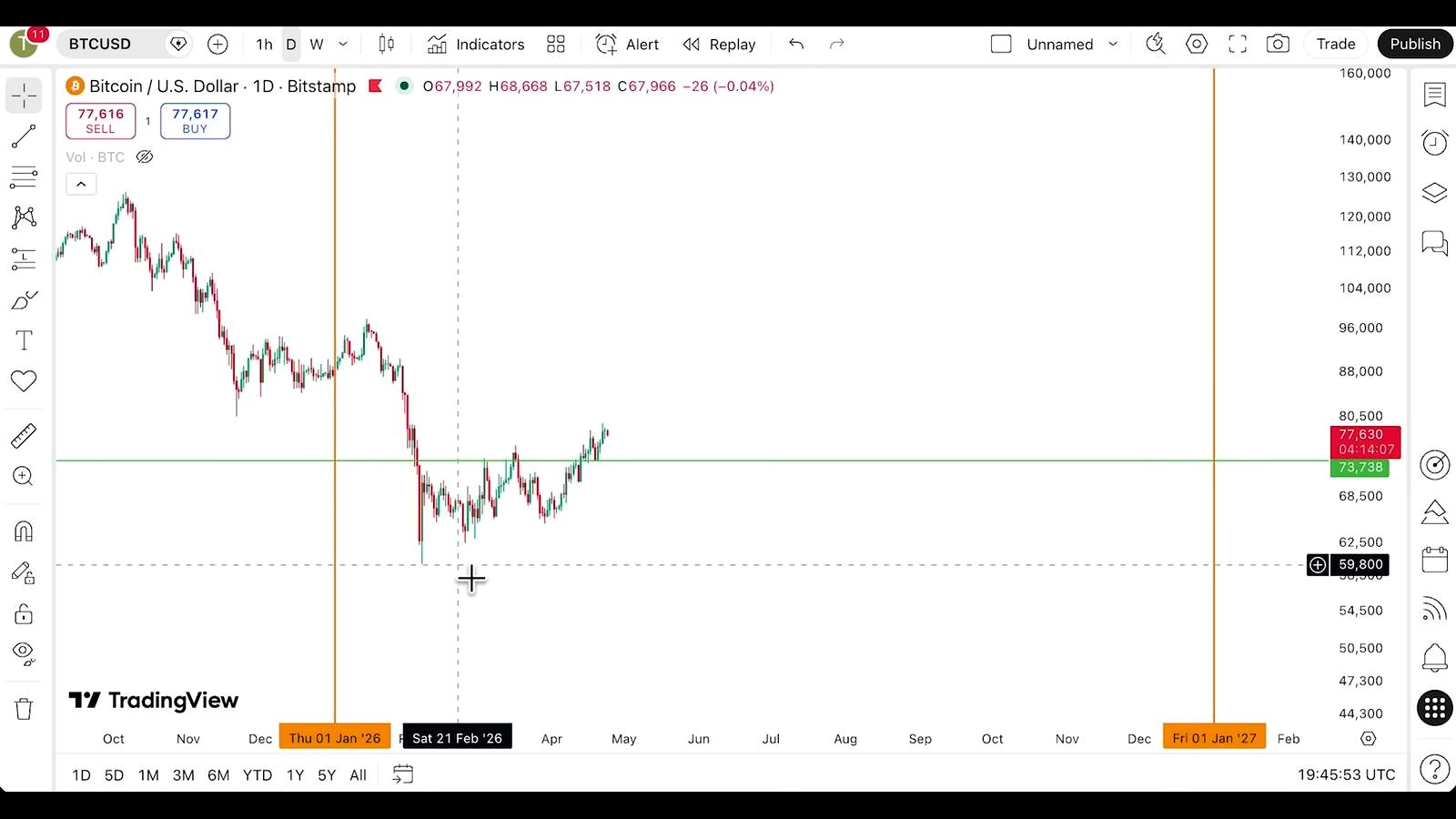
But the core thesis is technical. Discover Crypto argues that Bitcoin is trying to reclaim the 20-week exponential moving average after slipping below the 200-week moving average. In the host’s reading, prior cycles showed that once BTC fell under the 200-week average and then recovered the 20-week average, the market often transitioned into a sustained bullish phase.
That framing lands at a time when broader market sentiment remains split. Some traders see any reclaim of medium-term trend levels as evidence that Bitcoin’s post-capitulation structure is improving. Others argue that macro conditions still dominate: liquidity, rate expectations, dollar strength, ETF flows, and risk appetite have often mattered more than isolated bullish news. Historically, the 200-week moving average has been one of Bitcoin’s most watched long-term support zones, but reclaiming the 20-week average is usually more meaningful when accompanied by rising spot demand, stronger volume, and improving momentum across the broader crypto market.
The pattern Discover Crypto is watching
According to Discover Crypto, the warning sign is that Bitcoin has already fallen below the 200-week moving average, a level many long-term investors treat as a deep-value floor. The host says that in the last bear market, Bitcoin dropped an additional 40% after losing that level. In the prior bear market, he says the decline extended another 25%. In the current instance discussed in the video, he says Bitcoin only moved about 12% below it.
That relative shallowness is part of the bullish case. The analyst’s point is not that every breach of the 200-week average immediately marks a bottom, but that the deeper signal comes later: when price reclaims the 20-week moving average and begins turning it into support. He says that in the historical cases he reviewed, that reclaim tended to coincide with the point where Bitcoin stopped making materially lower lows and began moving “up and to the right.”
He cites only three historical instances, which is both the strength and weakness of the setup. Bitcoin’s limited history means long-cycle pattern recognition can be compelling, but also statistically thin. The host also calls out two exceptions that complicate a clean read: the COVID crash and what he describes as a 2015 “flash crash” around August 15, tied to exchange-related disruption affecting New York residents. In his view, those were idiosyncratic shocks rather than failures of the broader trend signal.
For traders, the practical takeaway is straightforward. Discover Crypto says the bear market is “not yet” over until Bitcoin flips the 20-week moving average into support. The analyst adds that current price action looks like the beginning stages of that process. In other words, he is not calling for a confirmed breakout yet; he is calling attention to a setup that would become much more significant if weekly closes hold above that level.
What could go wrong

The most obvious risk to this thesis is that state-related Bitcoin headlines do not translate into immediate price demand. Russia allowing crypto in foreign trade may be important geopolitically, but that does not necessarily mean direct spot BTC buying at scale. Depending on implementation, settlement could involve intermediaries, other crypto assets, or tightly controlled channels that have little near-term effect on open-market demand.
The U.S. military node story also has limits as a price catalyst. Running a node is operationally meaningful, but it is not the same as holding Bitcoin on a sovereign balance sheet, mining it, or mandating settlement in BTC. Traders could easily overread the symbolic significance.
On the technical side, the setup can fail if Bitcoin briefly moves above the 20-week average and then loses it on a weekly close. False reclaim signals are common in choppy macro environments. A stronger dollar, hotter-than-expected inflation, rising yields, risk-off equity moves, or large ETF outflows could all pressure BTC even if the chart appears to be improving.
There is also a structural counterargument the host does not fully explore: prior cycles unfolded in a market with less institutional participation and different liquidity conditions. As Bitcoin matures, older bear-market analogs may become less predictive. A pattern observed across just three instances is useful context, but not a law of market behavior.
What to watch next
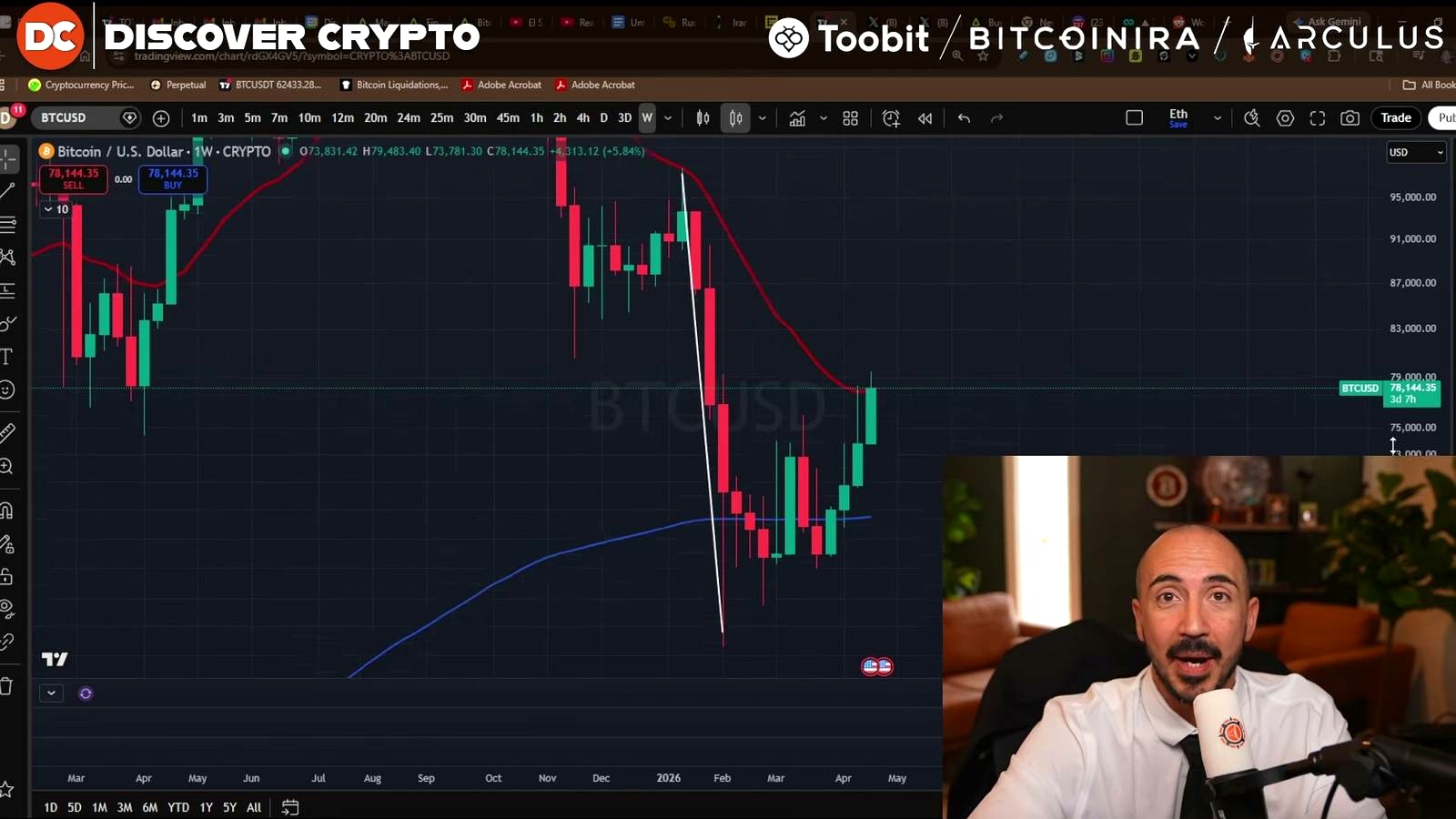
The clearest confirmation would be a clean weekly reclaim of the 20-week EMA followed by that level holding as support rather than resistance. Traders will also want to see whether Bitcoin can avoid revisiting the zone below the 200-week moving average, where the host notes prior bear markets extended another 25% to 40%.
Beyond the chart, watch whether the Russia policy shift leads to identifiable trade-settlement use cases and whether U.S. government engagement with Bitcoin expands beyond node operation and testing. If those headlines evolve from symbolic to operational, the narrative gets stronger. If not, BTC may still trade primarily on macro liquidity and technical structure.
FAQ
What is the 20-week EMA in Bitcoin trading?
The 20-week EMA is a trend indicator that gives more weight to recent price action than a simple moving average. Traders use it to judge whether Bitcoin is regaining medium-term momentum after a downturn. A reclaim and hold above it can signal improving market structure.
Why does the 200-week moving average matter for BTC?
The 200-week moving average is widely viewed as a long-term valuation floor in Bitcoin bear markets. Historically, BTC has often found support near or around it during deep drawdowns, which is why breaks below it attract outsized attention from long-term investors.
Is running a Bitcoin node the same as buying Bitcoin?
No. Running a node means participating in the network by validating and relaying data according to Bitcoin’s rules. It can signal technical or strategic interest, but it does not necessarily imply direct BTC purchases or balance-sheet exposure.
How is Russia’s crypto-for-trade move different from El Salvador’s Bitcoin policy?
They address different use cases. El Salvador’s experiment focused on Bitcoin in everyday commerce and legal-tender adoption. Russia’s move, as described in the video, is centered on foreign trade settlement by larger entities, which is closer to institutional or sovereign utility than retail payments.
What would invalidate a bullish reclaim setup?
A failed weekly breakout above the 20-week EMA, followed by rejection and renewed weakness below the 200-week moving average, would weaken the case. Traders would also treat deteriorating macro conditions or heavy spot-selling pressure as signs that the reclaim was not durable.
Reference Video

Omar Al-Sharif lives and works in the UAE and is involved in the blockchain technology industry. He writes articles on Bitcoin and digital assets as a personal passion, explaining complex topics in simple and understandable language.