Crypto’s biggest ideological fight is no longer just Bitcoin versus fiat. It is increasingly about which blockchain networks actually get picked when regulated financial firms build payment rails. A new integration out of Abu Dhabi is feeding that debate, and DHN CRYPTO argues it strengthens the case that stablecoin infrastructure is moving beyond Bitcoin and even beyond Ethereum for day-to-day financial use.
The Core Thesis
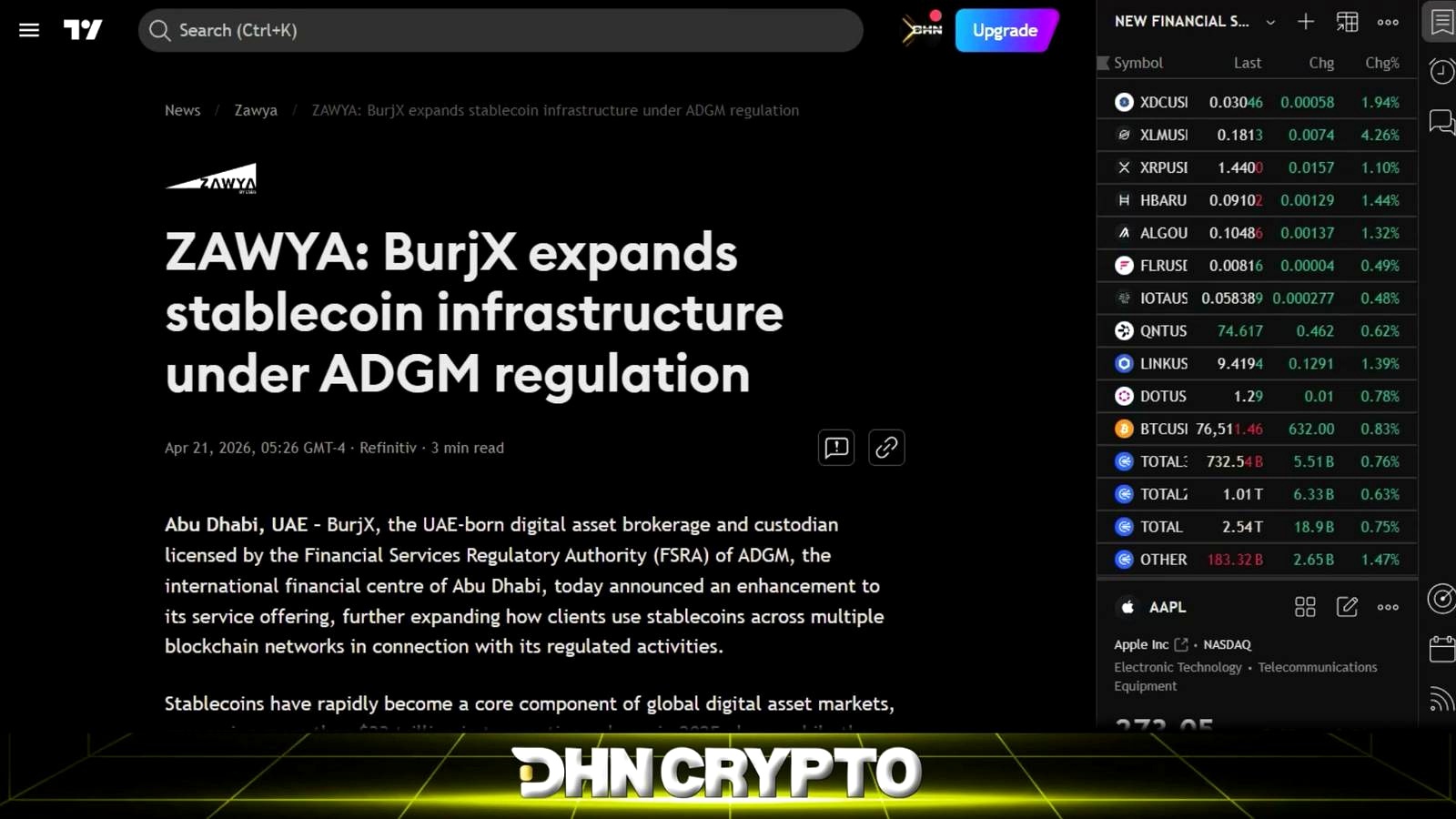
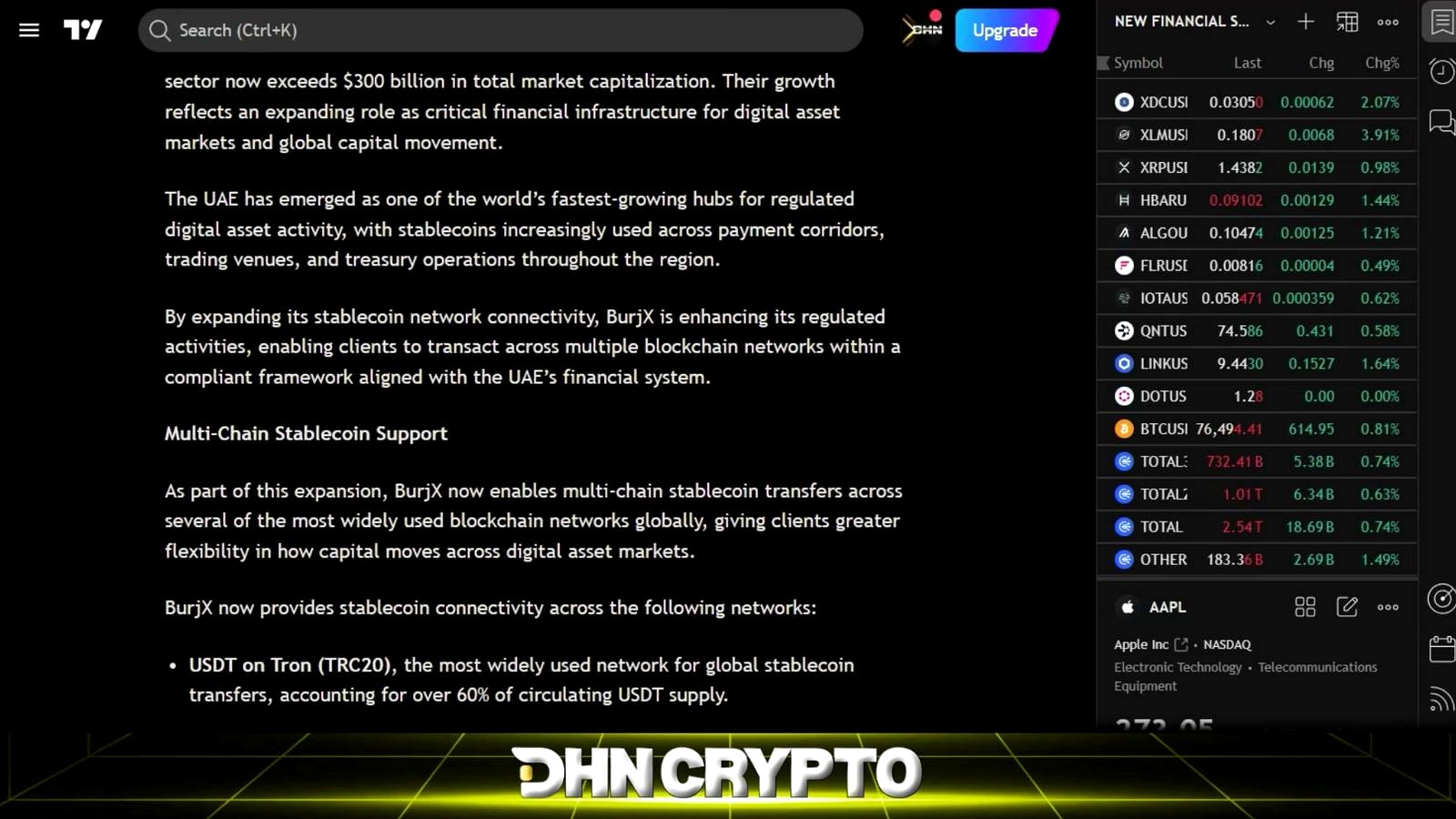
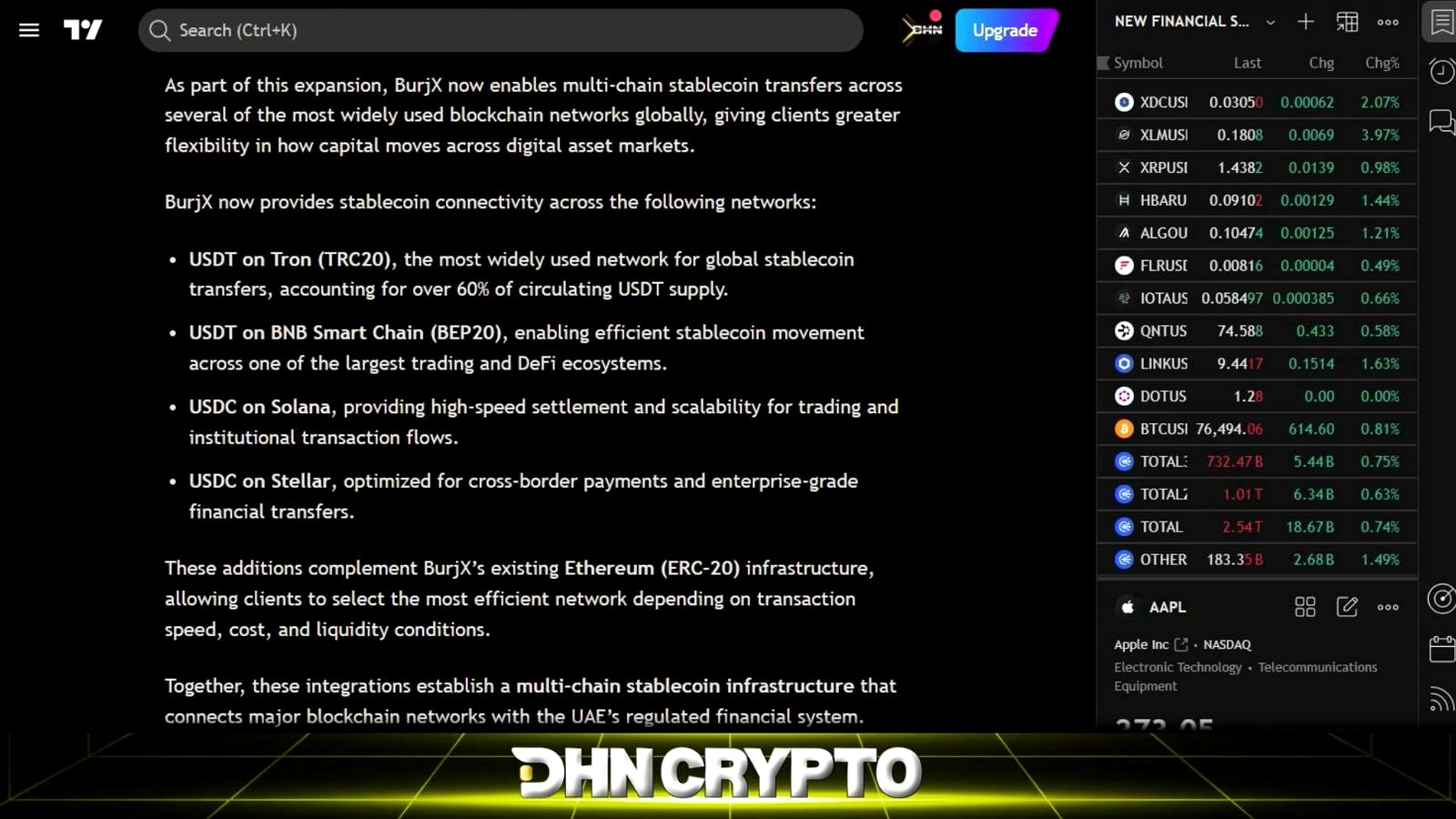
According to DHN CRYPTO, UAE-based exchange and custodian Burj X has expanded its stablecoin infrastructure under Abu Dhabi Global Market regulation to include Tron, BNB, Solana, and Stellar, adding to its existing Ethereum ERC-20 setup. The host framed Stellar’s inclusion as the headline point, noting XLM was up 4.2% in the last 24 hours to about $0.18 as the news circulated.
The more important claim is not the short-term price move. It is the infrastructure signal. DHN CRYPTO argues that this creates a multi-chain stablecoin framework linking major blockchain networks, with special emphasis on Stellar, to the UAE’s regulated financial system. In the host’s telling, that makes Stellar more than a speculative asset; it becomes part of a compliance-friendly payments stack inside a major Gulf financial center.
That interpretation fits a broader industry trend. Stablecoin adoption has increasingly favored networks optimized for transfer speed and low transaction costs rather than pure ideological decentralization. Ethereum still dominates in overall value, liquidity, and institutional familiarity, but operational flows, especially payments and treasury movement, often migrate to cheaper rails once products move from experimentation to production. Tron has long been a major settlement network for stablecoins, while Solana has gained attention for fast finality and lower fees. Stellar has spent years positioning itself around cross-border payments, tokenized fiat, and enterprise settlement.
Still, the claim is somewhat contrarian if taken as a sweeping market call. Bitcoin remains the market’s reserve asset, and Ethereum remains the leading smart-contract platform by developer depth and institutional mindshare. A regulated exchange supporting a network for stablecoin transfers is meaningful, but it is not the same thing as declaring a winner in crypto’s long-term value hierarchy.
Why This Matters Beyond XLM
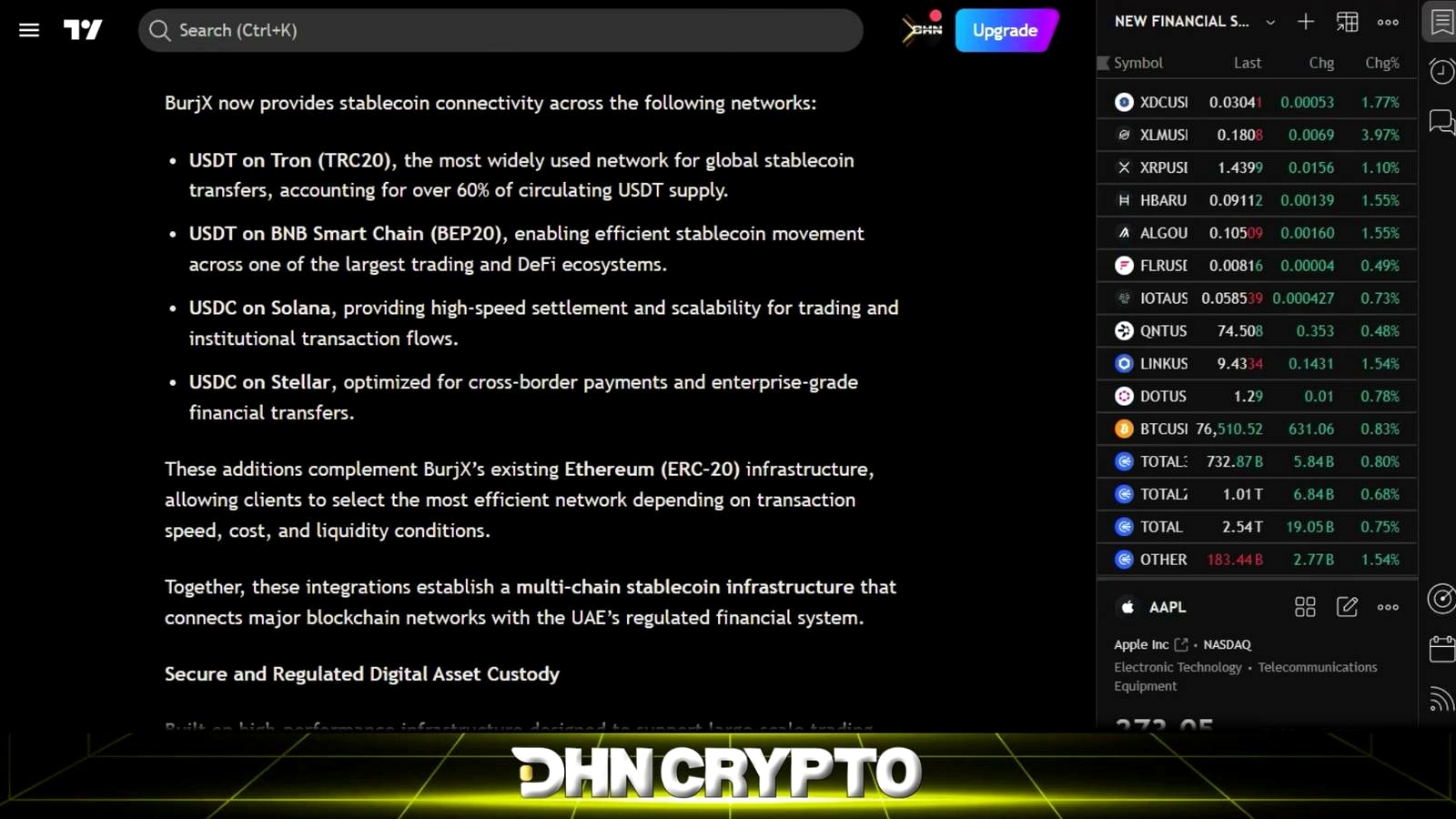
According to DHN CRYPTO, Burj X’s decision matters because it reflects how businesses choose infrastructure in practice: by balancing speed, cost, and liquidity. The exchange said clients can select the most efficient network depending on transaction speed, cost, and liquidity conditions. The host interpreted that as evidence that Ethereum remains useful for higher-value flows, while alternative networks are increasingly competitive on the operational side.
That distinction matters for Bitcoin investors too. Bitcoin may not be the chain a firm chooses for stablecoin settlement, but these buildouts still say something important about crypto market structure: utility is fragmenting. The asset that institutions hold on balance sheet is not always the network they use for transfers. In that world, Bitcoin’s role can remain dominant as collateral or macro hedge even while activity grows on other rails.
DHN CRYPTO pushed the argument further, saying the first 15 years of crypto were defined by Bitcoin and Ethereum laying the foundation, but the next phase could elevate altcoin networks that are faster and cheaper. He also suggested that over the next 4 to 5 years, these networks could become “very, very systemically important” to blockchain development.
That is a strong thesis, and the evidence in this case is directionally supportive but not definitive. The UAE has become one of the more active jurisdictions for digital-asset regulation and licensing, so integration there carries more weight than a casual exchange listing. The mention of Fireblocks is also notable. Institutional crypto infrastructure often becomes more credible when it sits inside familiar custody and wallet orchestration layers. DHN CRYPTO highlighted that Burj X’s setup uses Fireblocks’ MPC wallet technology to reduce single points of failure and support secure, compliant transfers across multiple blockchains.
The subtext is clear: adoption stories increasingly come from back-end infrastructure, not retail narratives. While traders focus on meme coins, AI tokens, or prediction markets, the quieter race is over who becomes the default plumbing for regulated digital money.
What Could Go Wrong
The biggest risk to the analyst’s thesis is that infrastructure support does not automatically translate into sustained token value capture. A network can be useful for stablecoin settlement without its native token becoming the primary beneficiary. That has been one of crypto’s recurring disconnects: rising usage does not always equal rising token demand.
There is also a meaningful difference between being one of several supported rails and being the preferred rail. Burj X added Tron, BNB, Solana, and Stellar alongside Ethereum. That is diversification, not exclusivity. If the highest volumes ultimately settle on Tron or Ethereum, the market could end up overstating Stellar’s strategic advantage.
Another challenge is competitive pressure. Payments-focused blockchains have overlapping narratives, and stablecoin issuers tend to follow liquidity first. The host made much of the fact that XRP was not included, but one exchange’s infrastructure mix does not settle the wider competition among cross-border payment networks. Nor does it address the possibility that future institutional flows consolidate around a smaller set of chains than today’s market expects.
For Bitcoin holders, the counterargument is straightforward: none of this weakens BTC’s core investment case as digital gold, collateral asset, or macro hedge. If anything, a multi-chain world can strengthen Bitcoin’s position as the neutral reserve asset sitting above an increasingly busy application layer. So while DHN CRYPTO presents this as evidence that “what worked before won’t work now, ” the alternative reading is that crypto is specializing rather than rotating away from Bitcoin.
What to Watch Next
The next test is not price alone. Traders should watch whether Burj X or similar regulated venues disclose actual stablecoin flow growth on Stellar, Solana, Tron, or BNB after these integrations. Repeated adoption by regulated Middle East platforms would strengthen the thesis more than a single announcement.
For market participants, two signals matter most. First, whether more Abu Dhabi- or Dubai-linked firms adopt the same multi-chain setup. Second, whether enterprise custody providers such as Fireblocks deepen support around these rails in ways that increase real settlement volume. If that happens, the argument that alternative payment-focused networks are gaining institutional relevance becomes much harder to dismiss.
FAQ
What is Abu Dhabi Global Market in crypto?
Abu Dhabi Global Market, or ADGM, is a financial free zone with its own regulatory framework. In crypto, its significance comes from licensing and supervising digital-asset businesses under a formal regulatory structure, which gives integrations there more credibility than activity in lightly regulated jurisdictions.
What is MPC wallet technology?
MPC stands for multi-party computation. In crypto custody, it allows private-key operations to be split across multiple parties or devices so that no single point holds the entire secret. Institutions use it to improve security and operational controls compared with simpler wallet models.
Why would firms use Stellar or Tron instead of Ethereum for stablecoins?
The usual tradeoff is cost and speed. Ethereum often offers deeper liquidity and stronger institutional familiarity, but alternative networks can be cheaper and faster for transfers. For payment and settlement use cases, those operational differences can matter more than brand dominance.
Does stablecoin adoption on a blockchain help that chain’s token price?
Sometimes, but not always. A network can see more transaction activity without creating large direct demand for its native token. The market often prices in expected future utility, but token appreciation depends on fee mechanics, staking design, speculation, and whether usage actually scales.
How does this compare with Bitcoin’s role in crypto markets?
Bitcoin is generally treated differently. It is more often viewed as a reserve asset, store-of-value trade, or macro vehicle than as a stablecoin settlement rail. That means infrastructure growth on payment-focused chains does not necessarily come at Bitcoin’s expense; the two can serve different roles in the same market.
Video Reference

An Indian crypto journalist covering the developments in the Bitcoin and blockchain industries. Her work helps readers understand key changes in the world of digital assets.