Markets are caught between two very different forces: improving crypto regulation and institutional adoption on one side, and a fresh geopolitical risk premium on the other. According to Thinking Crypto, Bitcoin’s recent dip toward $71,000 does not yet derail a broader relief rally that could push BTC to $80,000 before a deeper retest.
The Core Thesis: A Relief Rally Is Intact, but Not Risk-Free
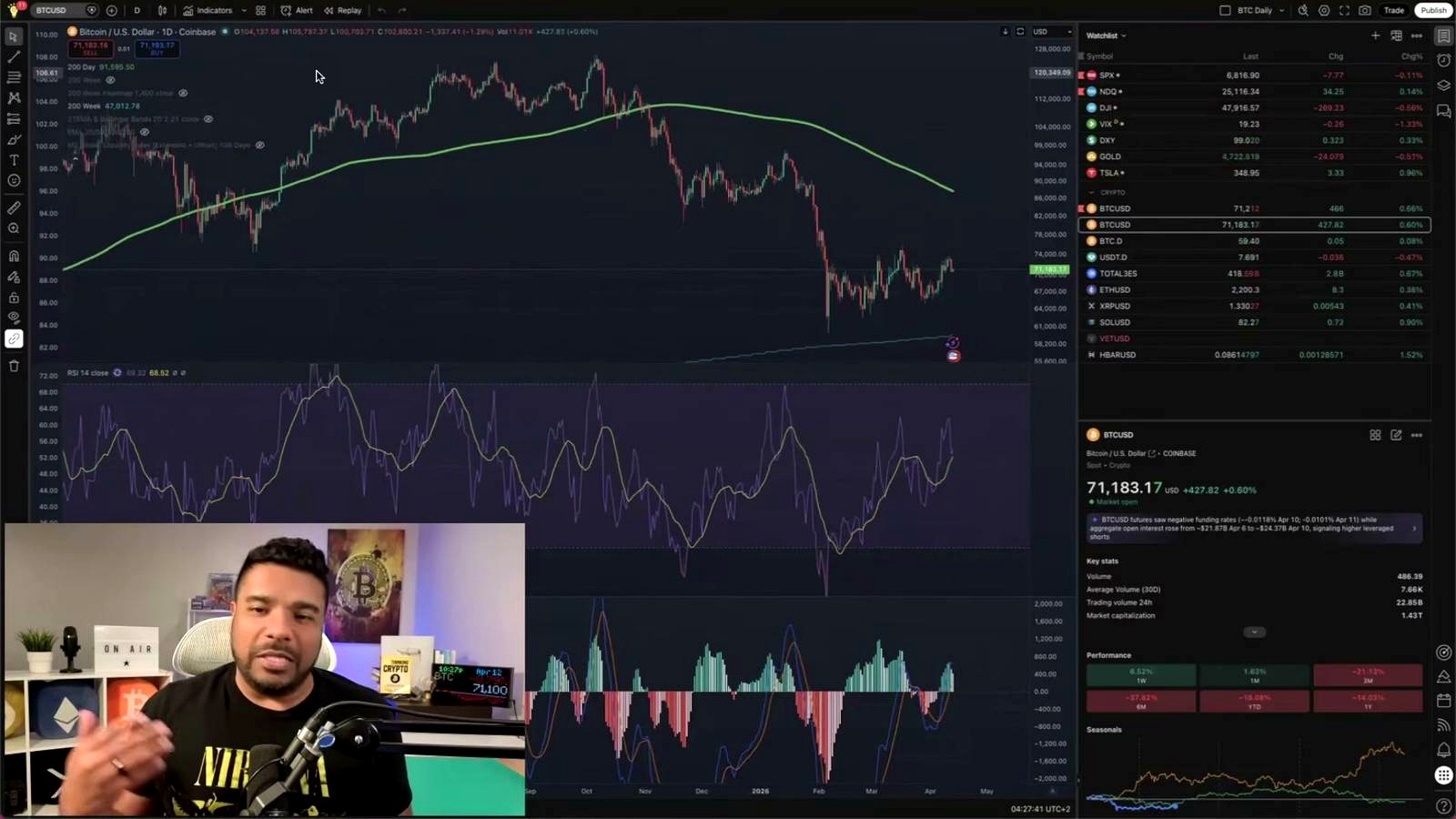
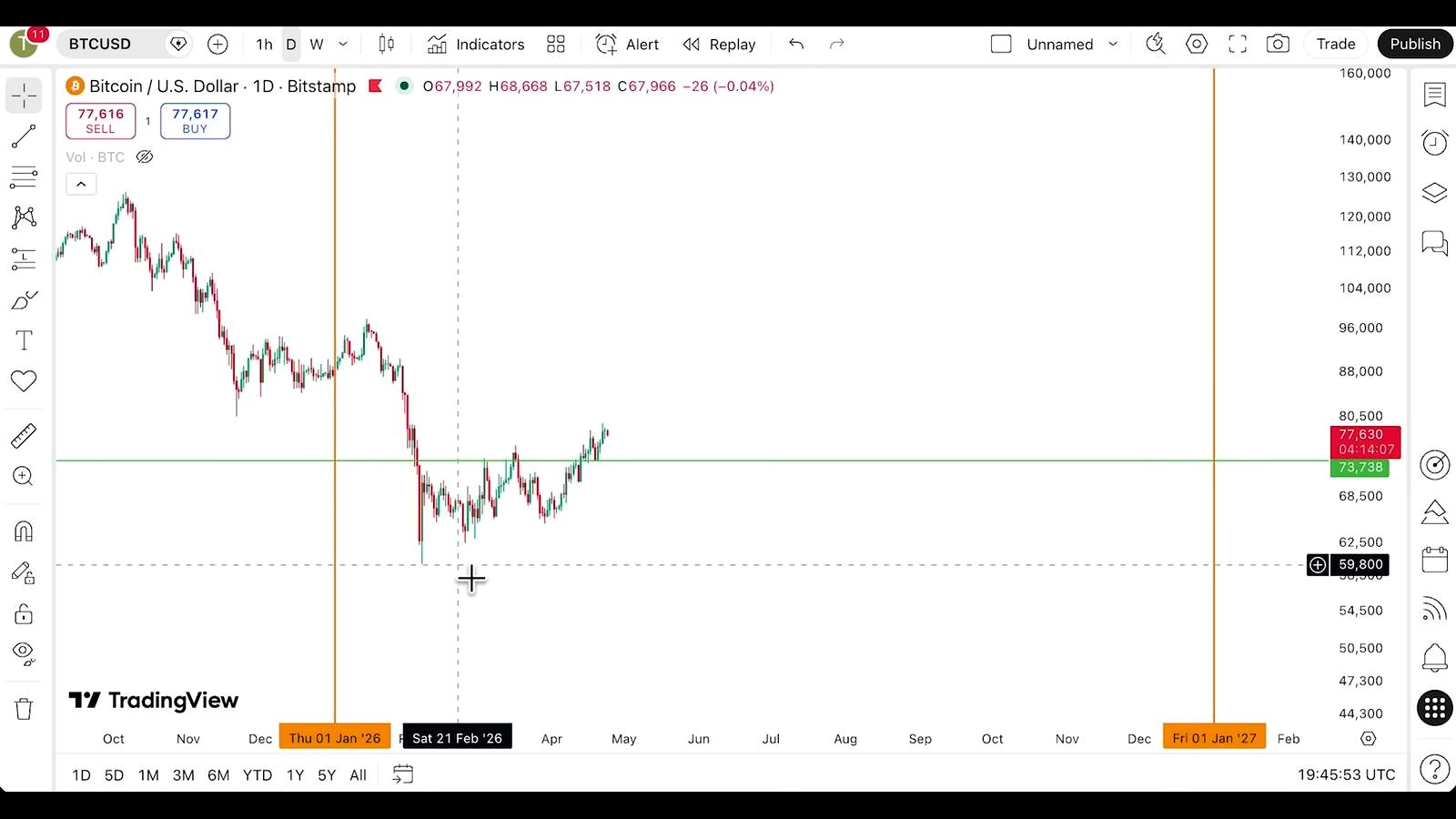
According to Thinking Crypto, Bitcoin remains in a constructive short-term setup despite a pullback from roughly $73,000 to about $71,000, which the host framed as relatively modest given the broader trading range. His main technical argument is that the daily MACD still favors bulls, while the RSI is not yet overbought, leaving room for further upside. On the weekly chart, he said the MACD has flipped green for the first time “in a very long time, ” while RSI is moving away from oversold territory. From that backdrop, the host said he sees a relief rally that could take Bitcoin to $80,000, followed by a rollover to retest the lows.
That is a nuanced but not fully bullish call. It is not a straight shot to new highs; it is a tactical bounce thesis inside a more cautious broader structure. In current market context, that sits somewhere between consensus and contrarian. Many traders have been looking for continuation after Bitcoin’s post-halving consolidation, but plenty of macro-sensitive investors still see crypto as vulnerable to any equity-led risk-off move.
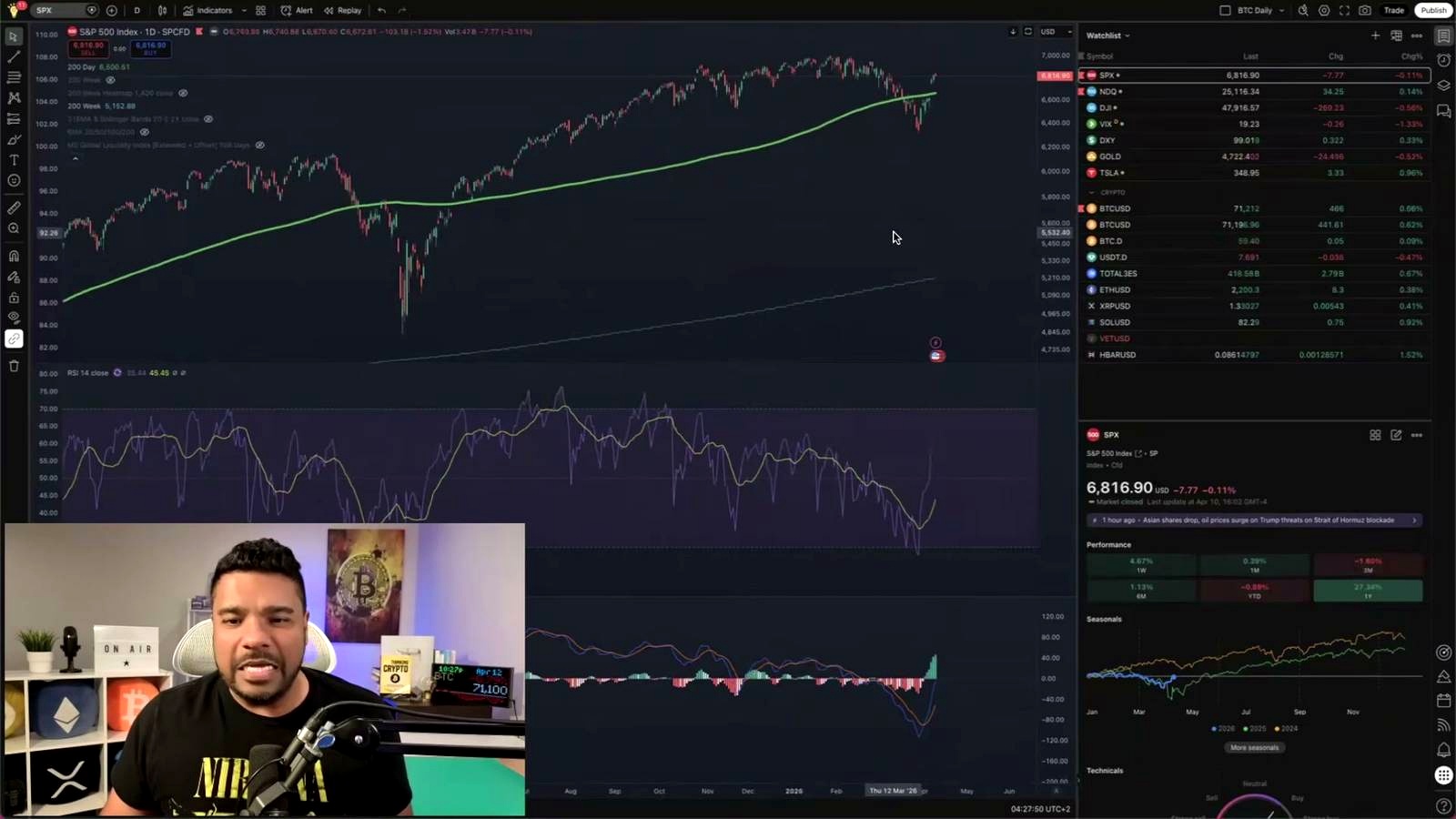
The broader backdrop partially supports the analyst’s case. Bitcoin often responds well when equities remain firm, real yields stop rising, and liquidity expectations improve. The host also noted that the S&P 500 still shows strength on the daily chart, with bulls in control and RSI not overbought. If stocks hold up, that tends to give BTC room to grind higher. But the challenge is obvious: geopolitical shocks can override technical setups quickly, especially if they hit oil, inflation expectations, or broader risk appetite.
Why This Matters Now: Adoption and Regulation Are Still Advancing

Thinking Crypto tied the market setup to a bigger structural thesis: that regulation and institutional rails are continuing to improve even during a choppy price environment. That matters because one of the biggest questions for this cycle is whether crypto can sustain institutional inflows beyond spot Bitcoin ETFs and beyond the usual retail-led momentum bursts.
The host pointed to fresh evidence that corporate Bitcoin adoption is not disappearing. He cited Arkham data showing SpaceX holds $603 million in Bitcoin, equal to 8,285 BTC in Coinbase Prime custody, even as the company reportedly swung from an $8 billion profit to a nearly $5 billion loss ahead of an IPO push. Thinking Crypto argued that if SpaceX goes public while still carrying Bitcoin on its balance sheet, it could set an important precedent because SpaceX is not a crypto-native company.
That point is notable. Public-market investors have already seen crypto treasury models in pure-play or crypto-adjacent firms. What would be different here is the normalization of Bitcoin as a reserve asset inside a major non-crypto operating business. Even so, readers should treat this as a signal of persistence, not proof of a new treasury wave. One company holding BTC through market volatility is constructive, but it does not by itself confirm broad corporate adoption.
The regulatory angle may be more important. Thinking Crypto highlighted the European Central Bank’s backing for an EU plan to centralize supervision of major crypto firms under the Paris-based ESMA watchdog, while noting resistance from smaller states including Ireland, Luxembourg and Malta. He also cited industry commentary that European banks and corporates are moving from education to execution in stablecoins, with firms that had board approval now preparing to go live after roughly 18 months of earlier exploratory discussions.
Supporting Analysis: Stablecoins, ETFs and a Split Market Structure

The strongest part of the host’s broader bull case is not the $80,000 target itself. It is the claim that the market’s plumbing is getting built out even while price action remains uneven. He framed the combination of regulation, ETFs and new institutional products as the setup for a future “super cycle.”
On stablecoins, Thinking Crypto cited a projection that transaction volumes could reach $719 trillion by 2035 and rival Visa and MasterCard by 2039, helped by a $100 trillion generational wealth transfer to younger crypto-native cohorts. The exact long-range forecast is inherently speculative, but the directional point is hard to dismiss. Stablecoins have become one of crypto’s clearest product-market fits, especially in payments, cross-border settlement and dollar access. If Europe’s MiCA regime gives institutions enough clarity to launch with confidence, that could reinforce crypto’s utility story even if token prices lag in the short term.
The host also pointed to a second amendment from Bitwise for a Hyperliquid ETF and noted that Bloomberg ETF analyst Eric Balchunas said the fund could launch imminently. He added that Bitwise Europe listed a fully backed Hyperliquid staking ETP and that the token was up roughly 200% over the past year. That supports a wider point: ETF product expansion is no longer confined to Bitcoin and Ethereum. Market access is broadening, though that does not guarantee durable demand for every listed product.
At the same time, the transcript shows a market that is far from uniformly healthy. Thinking Crypto noted that a $1.6 billion Ether Machine SPAC deal collapsed due to unfavorable market conditions, and that the firm still holds more than $1 billion in ether on its treasury. Dynamics Corporation is set to receive a $50 million termination payment as the merger unwinds. The host said some digital asset treasury companies could collapse if the cycle drags on and prices weaken further. That is a critical counterweight to the super-cycle narrative: institutionalization can expand while weaker balance-sheet structures still fail.
What Could Go Wrong
The most immediate threat to the analyst’s Bitcoin thesis is the one he mentioned at the start: escalation around Iran and the Strait of Hormuz. If that conflict pushes energy prices sharply higher, reignites inflation fears, or causes a broader equity selloff, Bitcoin could trade less like digital gold and more like a high-beta risk asset. In that scenario, a move to $80,000 could be delayed or canceled altogether.
There is also a technical risk to the setup. Relief rallies often look convincing until they run into heavy overhead supply, especially after long periods of sideways chop. The host himself said he expects a rollover to retest lows after the bounce. That means this is not a thesis for blind dip-buying; it is a trading view that depends on momentum staying intact.
Another risk the host touched on but did not fully unpack is internal crypto fragility. The failed Ether treasury SPAC suggests not every institutional structure is robust enough to survive a weak tape. If more crypto treasury vehicles, overleveraged funds or speculative altcoin products begin to crack, Bitcoin could face contagion pressure even if its own fundamentals remain stronger.
Finally, the political optics are a wildcard. Thinking Crypto sharply criticized the World Liberty Financial controversy and said Trump-linked crypto ventures, including meme coins, make the industry look worse to outsiders. If high-profile crypto scandals dominate headlines while lawmakers debate market structure, that could slow the very legitimacy and policy progress bulls are counting on.
What to Watch Next

For Bitcoin, the first trigger is simple: whether BTC can hold above the recent pullback zone around $71,000 and reclaim momentum after stalling near $73,000. If it does, traders will likely focus on whether the move has enough breadth to extend toward the $80,000 level Thinking Crypto outlined.
Beyond price, watch three areas. First, any escalation in Middle East tensions and the market reaction in equities and oil. Second, whether European stablecoin and crypto infrastructure launches accelerate under MiCA. Third, whether institutional crypto products keep advancing despite setbacks like the collapsed $1.6 billion Ether Machine SPAC. If product expansion continues while Bitcoin holds support, the relief-rally thesis stays alive. If macro cracks first, it does not.
FAQ
What is a relief rally in Bitcoin?
A relief rally is a rebound that follows a period of weakness or consolidation, but does not necessarily signal the start of a full new bull leg. Traders often treat it as a countertrend or transitional move unless price breaks major resistance and holds it.
Why do traders watch MACD and RSI for BTC?
MACD is a momentum indicator that can help show whether bullish or bearish momentum is strengthening. RSI measures how stretched price is on the upside or downside. When RSI is not overbought, traders often argue there is room for further upside before a move becomes overheated.
Why would a SpaceX Bitcoin holding matter to crypto markets?
If a major non-crypto company carries Bitcoin onto public markets, investors may view that as further normalization of BTC as a treasury asset. It would not guarantee a wave of copycat buying, but it could strengthen the case that Bitcoin is becoming acceptable on mainstream corporate balance sheets.
How does MiCA affect Bitcoin and stablecoins in Europe?
MiCA, the EU’s crypto framework, is designed to replace fragmented national rules with a single regional regime. For institutions, that can reduce legal uncertainty and make it easier to launch custody, trading, tokenization and stablecoin products across Europe.
What happened the last time Bitcoin approached major round-number resistance?
Round numbers like $70,000 or $80,000 often attract heavy trading because traders cluster orders around them. Historically, Bitcoin can break through these levels quickly in strong momentum phases, but it can also stall there as early buyers take profit and short-term traders fade the move.
Original Source

An Indian crypto journalist covering the developments in the Bitcoin and blockchain industries. Her work helps readers understand key changes in the world of digital assets.