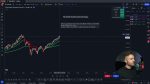
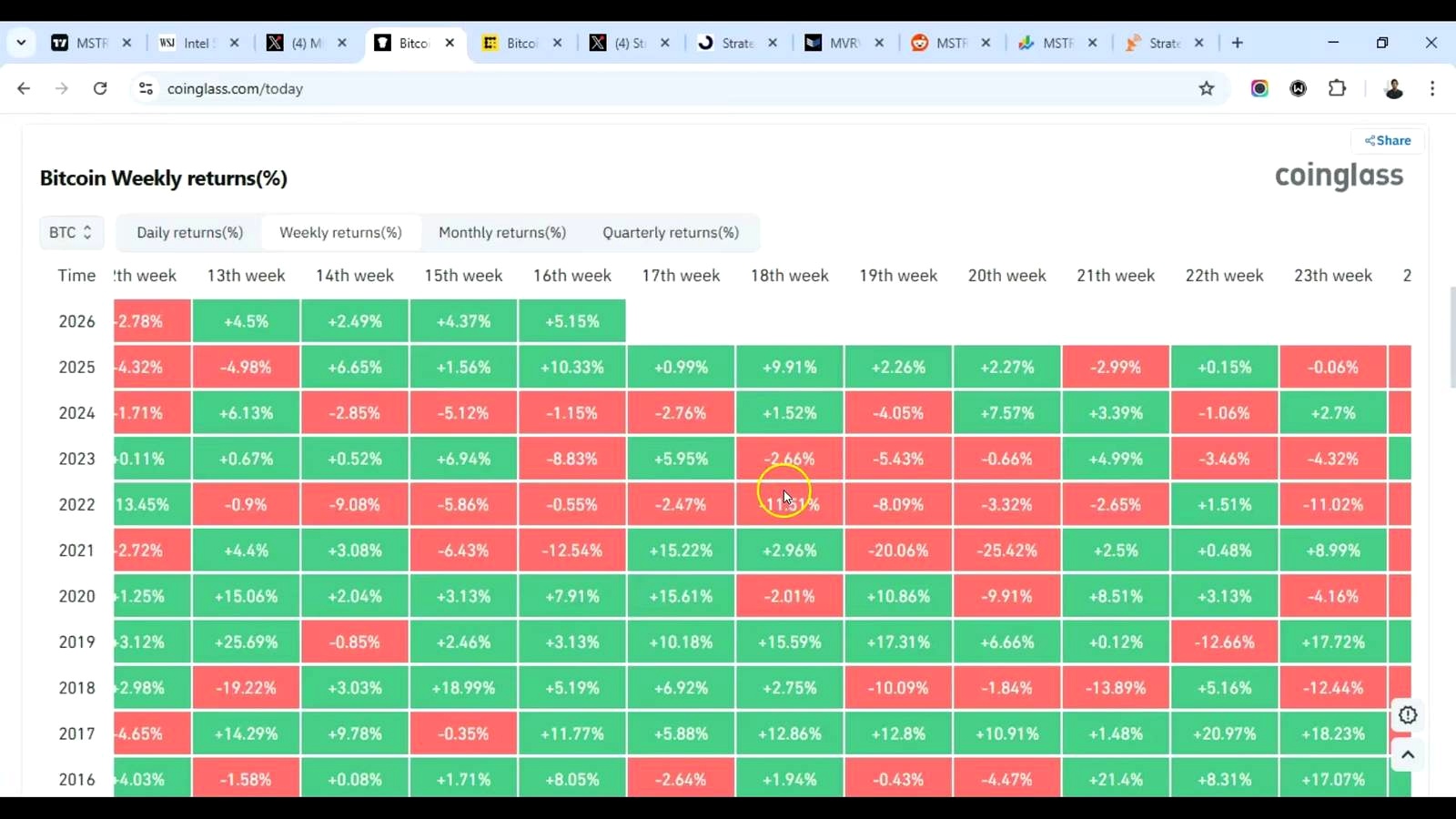
Can a trader prepare for a Bitcoin washout without trying to call the exact bottom? That is the tension at the center of Kay Trading’s latest market setup, which argues for automation over prediction as BTC approaches key downside liquidity zones.
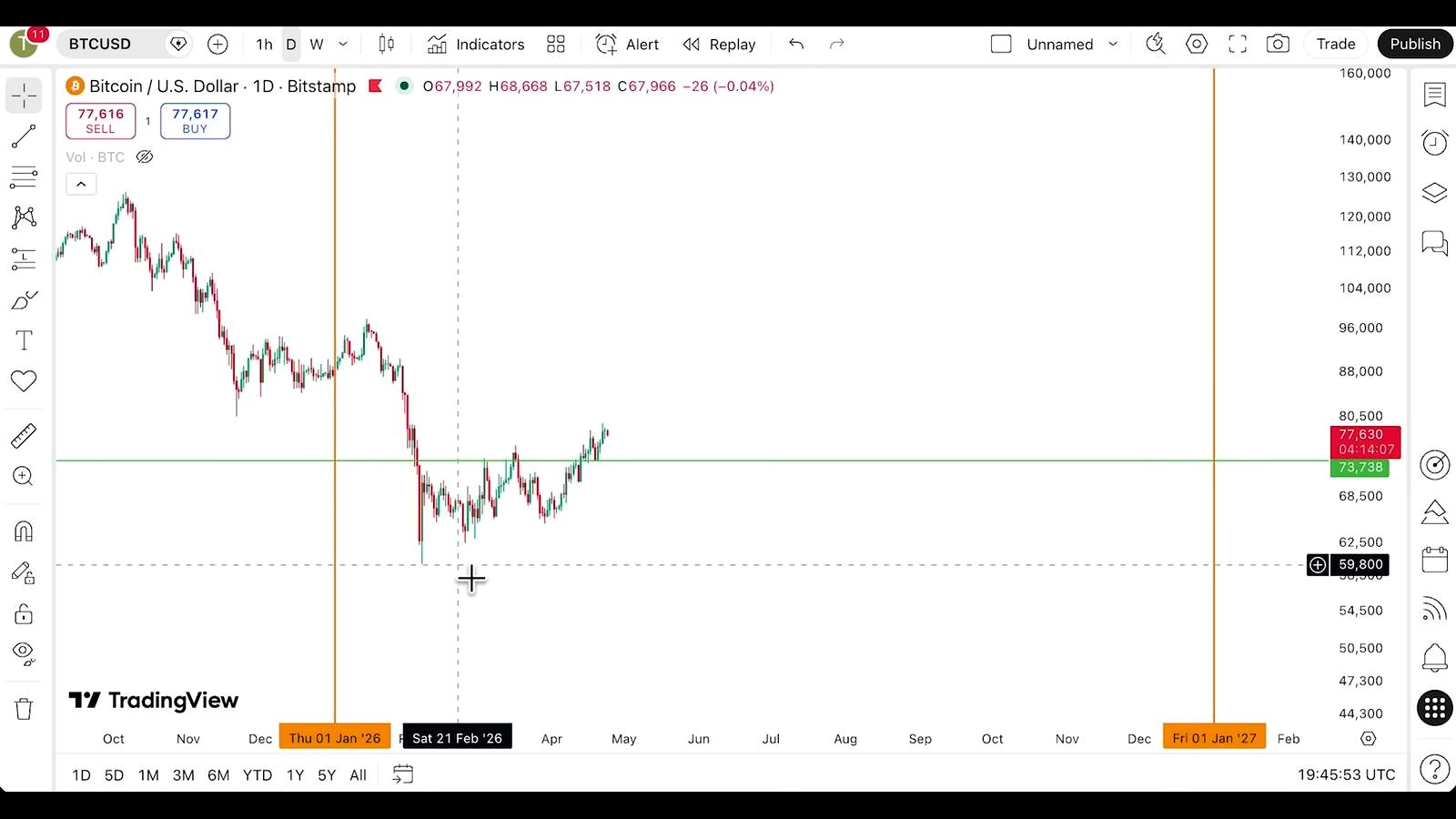
According to Kay Trading, the most practical way to approach a possible Bitcoin bear-market low is not to guess the final wick, but to use an automated spot DCA bot that starts buying into weakness and keeps buying as price falls. The host’s current trigger is $58,000, a level he calls attractive because it lines up with the 0.618 Fibonacci retracement and sits above deeper liquidity zones clustered below.
The core idea: start early, buy mechanically, avoid emotional mistakes
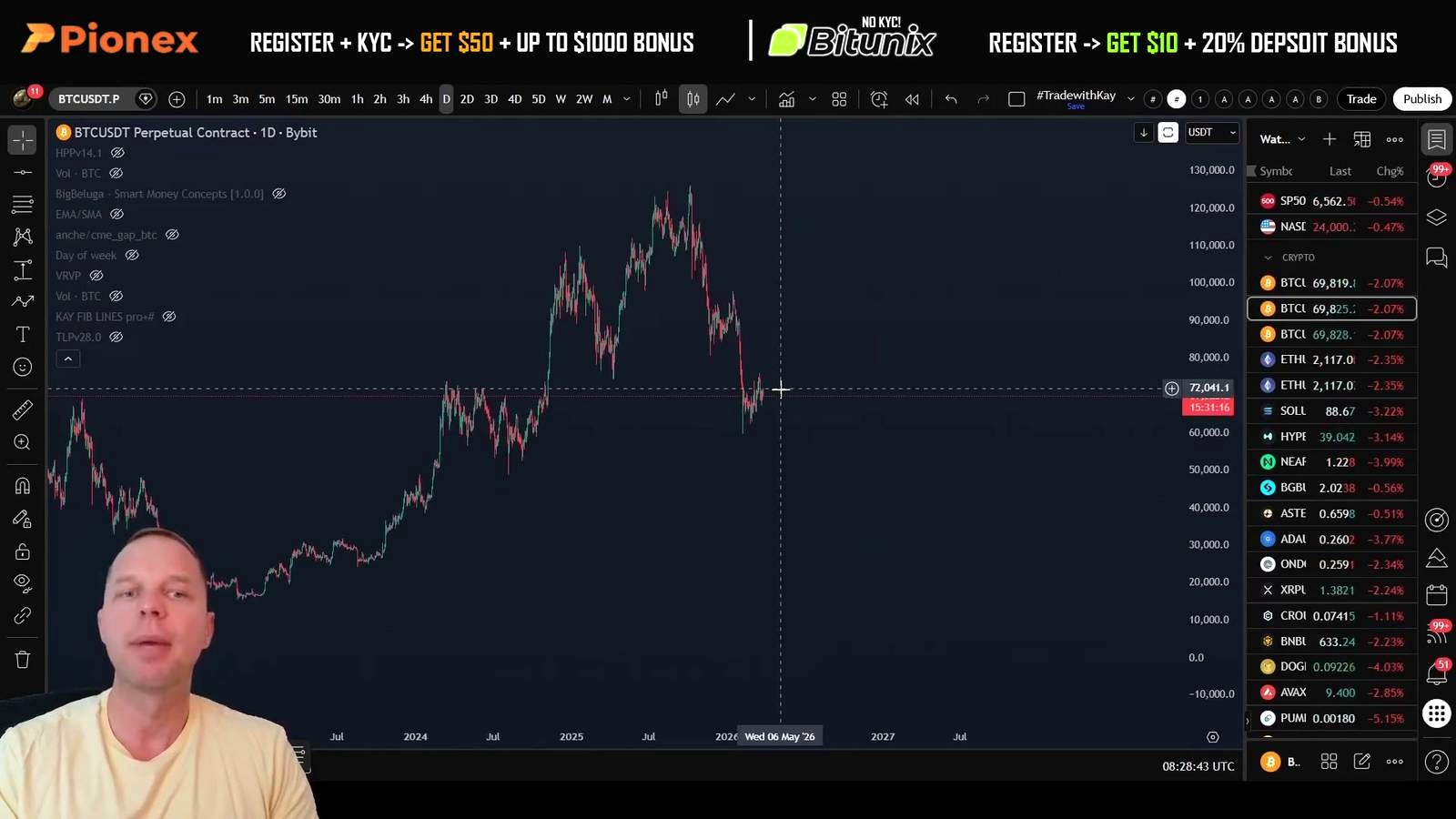
Kay Trading argues that most traders miss major bottoms because they freeze during fast selloffs, hesitate when price keeps dropping, or simply are not at the screen when the market moves. His answer is a spot-based dollar-cost averaging system that buys automatically every time Bitcoin falls by a fixed interval.
In the setup shown in the video, the bot buys every 0.7% lower, using equal-sized orders rather than increasing size as the market drops. The host emphasizes that this is a spot bot, not a leveraged product, so the goal is accumulation rather than short-term trading. If the market later recovers, he says he would typically move the accumulated Bitcoin or Ethereum into a spot account rather than let the bot auto-sell.
That distinction matters. Instead of using the bot’s take-profit setting as an exit, he treats it more as a placeholder. In practice, the plan is to hold the coins through a broader bull-market move if the average entry ends up favorable.
Why $58,000 matters in this setup
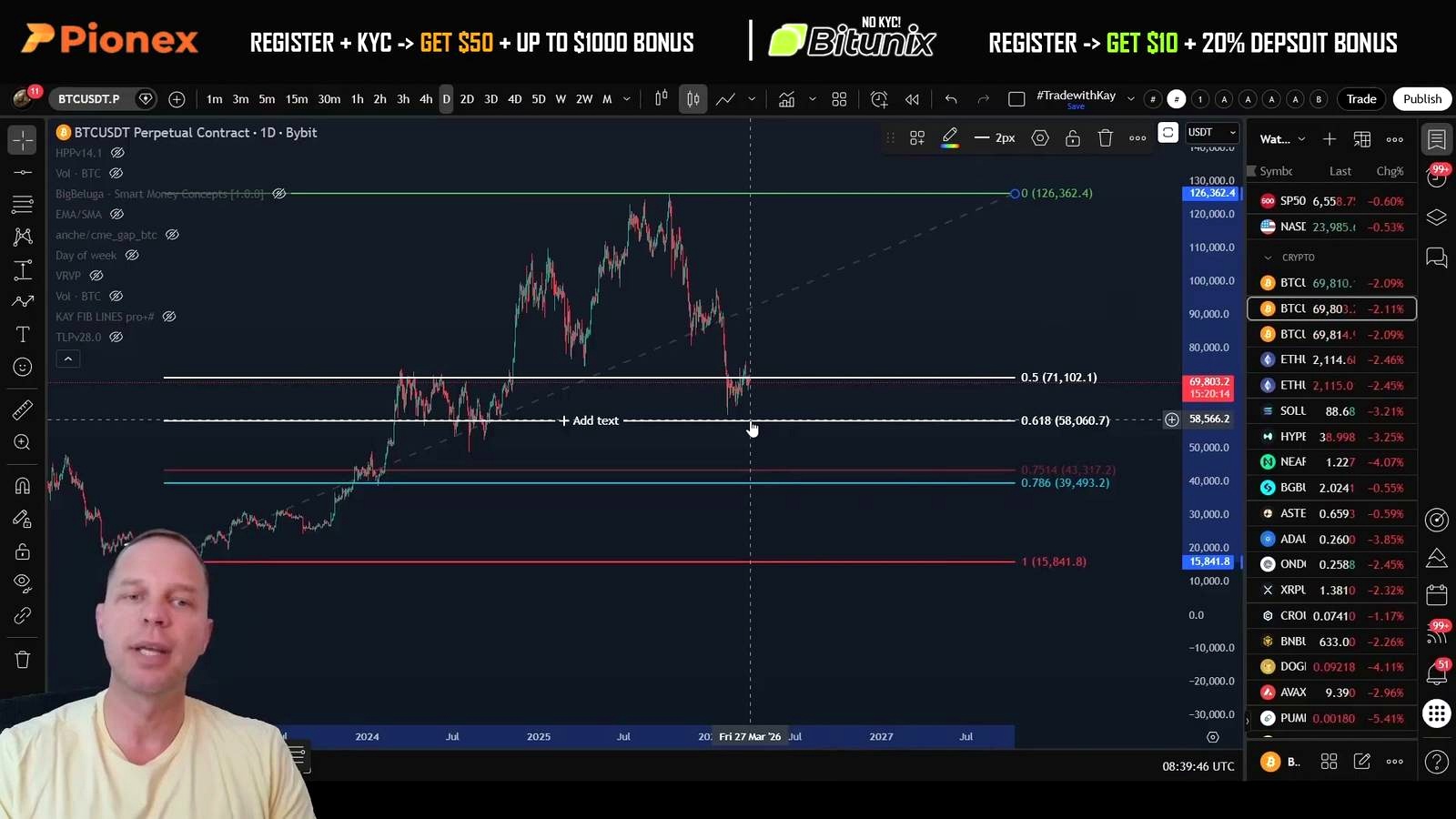
Kay Trading’s near-term Bitcoin thesis begins at $58,000. He says that level is “very interesting” because of the 0.618 Fibonacci level, and because liquidation data suggest there is still meaningful liquidity below current price.
Using a 2-year liquidation heat map from CoinGlass, the host highlights several downside zones:
- $58,000 as an initial entry area
- $54,000 and $53,000 as notable liquidity pockets
- $47,000 as another area with significant liquidity
- $46,000 as an additional lower zone mentioned in the setup
He also says prior bear markets have typically pushed down to the 0.786 Fibonacci retracement before the final leg lower ended, which is why he wants room to keep buying if Bitcoin falls beyond the first trigger.
That is also why he prefers opening multiple bots at different levels rather than committing everything at one price. The first one would wait in standby at $58,000, while later bots could be staged lower, such as around $54,000 or $47,000.
What the backtest from the 2022 bear market showed
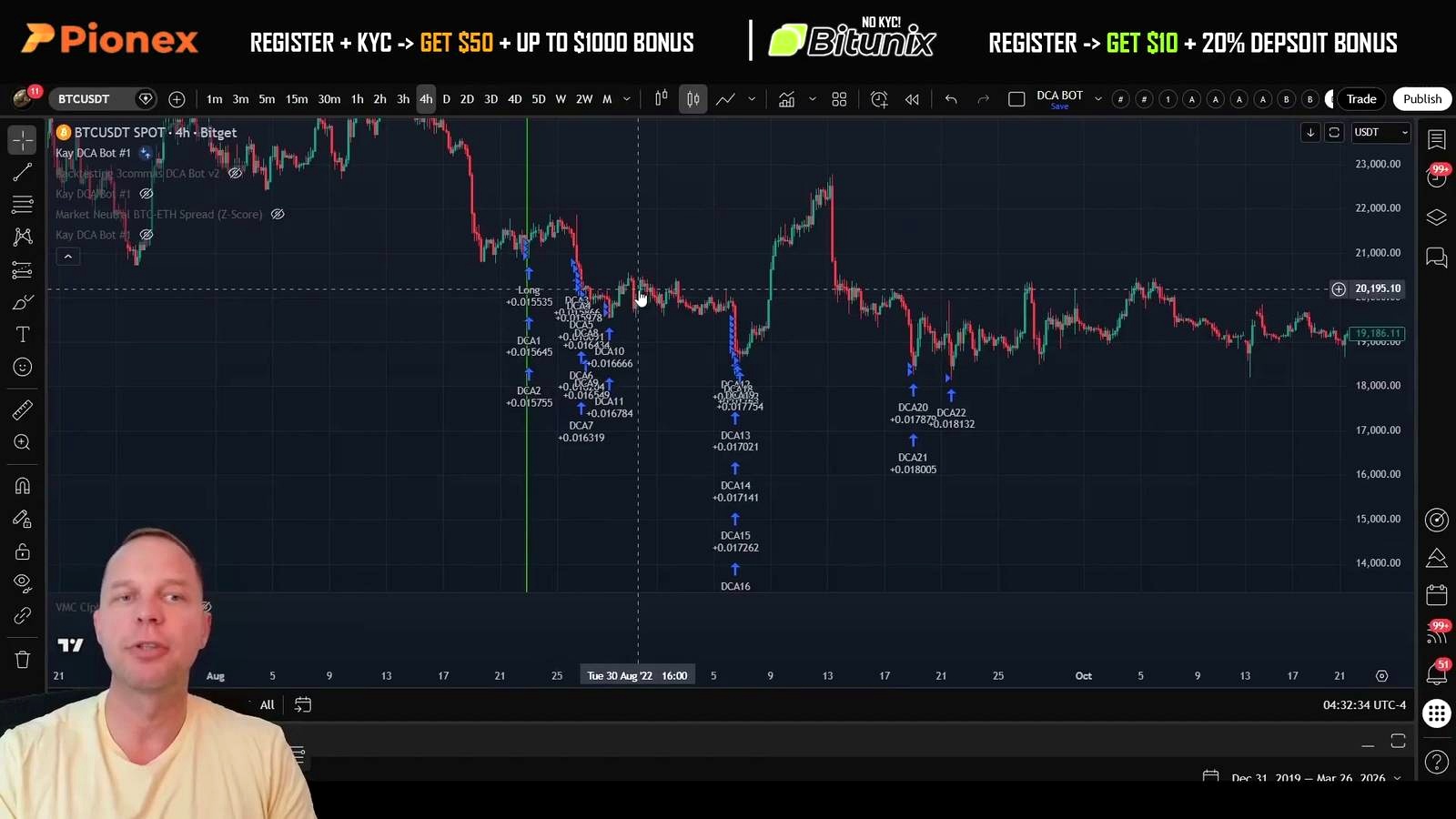
The strongest evidence in the video comes from a backtest based on Bitcoin’s 2022 bear market. Kay Trading used a start date around August 23, 2022 on the 4-hour chart, after what he described as a bearish flag breakdown.
In that example, the bot began buying with Bitcoin around $21,340 and purchased every 0.7% lower. The result was a long series of entries through the decline rather than a single perfect buy at the lows.
Key figures from that backtest:
- Starting area: $21,000 to $22,000
- Exact starting price cited: $21,340
- Total preset buy orders: 50
- Orders filled in the example: 44 (the host briefly also mentions 45)
- Last purchase price cited: $14,767
- 50th buy order would have been at: $13,871
- Approximate bear-market bottom referenced: $15,500
- Average purchase price shown: just under $17,878
- Host’s rounded estimate: around $17,600 to $17,000
The takeaway is straightforward: even without buying the exact bottom near $15,500, the average cost basis still landed in the high $17,000 range. For the host, that is the point of the strategy. It does not need precision if the average entry remains strong enough to benefit from the next cycle higher.
How the current bot would be sized
Kay Trading gives unusually concrete detail on position sizing. A sample bot with 50 buy orders, a $100 base order, and $100 safety orders would require roughly $5,000. For his current Bitcoin plan, though, he says the first bot would be closer to $10,000, and specifically shows an investment figure of $10,212.
That bot would sit inactive until BTC hits the trigger price of $58,000. Once activated, it would keep buying lower in 0.7% increments.
He also notes that the capital barrier is relatively low for smaller users. On one example, the minimum investment per order is $1.06. On Pionex, the minimum funding for the full bot settings shown is just under $40. In another illustration, he mentions entering a maximum investment of $500 on Pionex.
Projected average prices if Bitcoin drops further
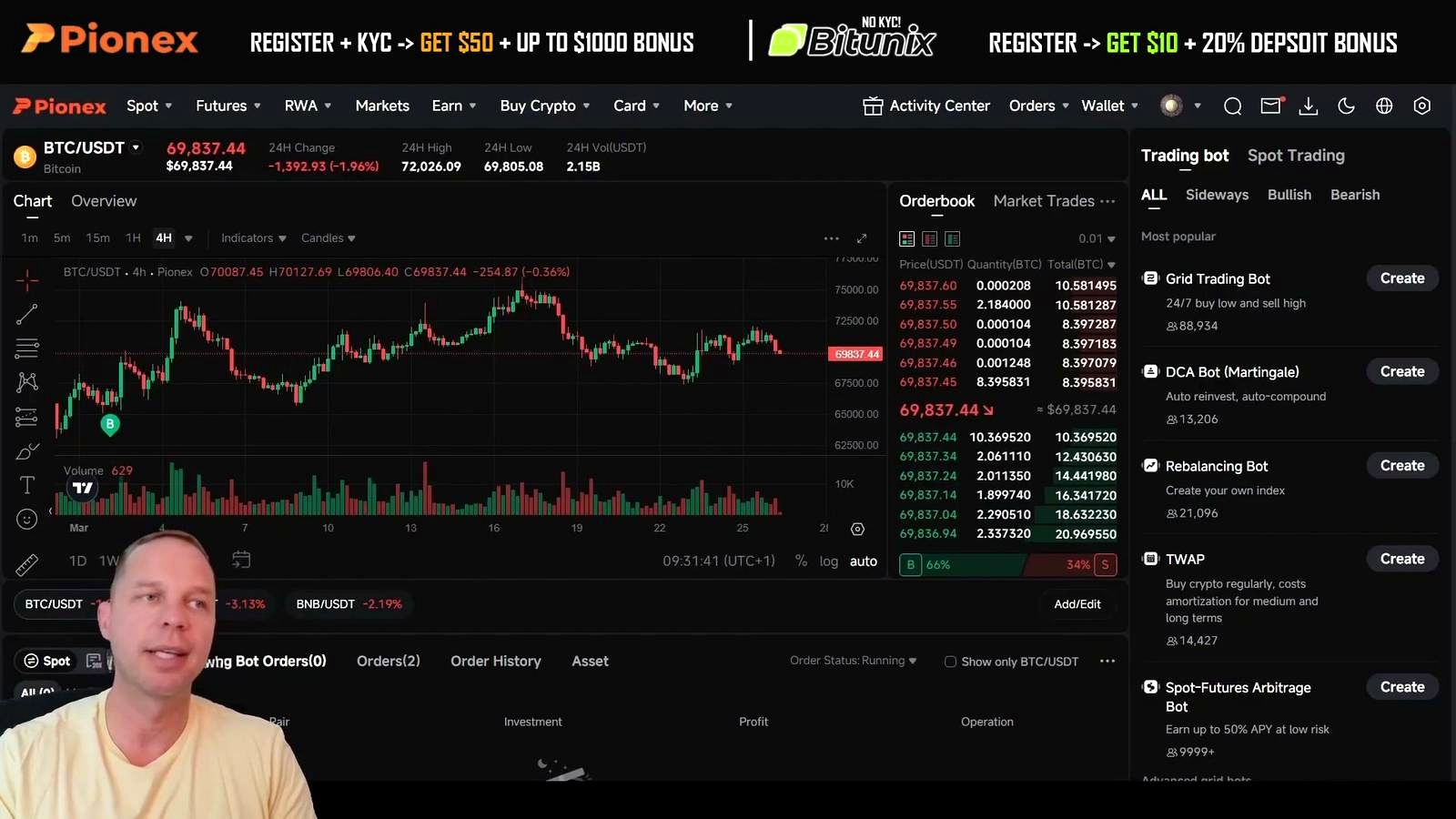
The current setup becomes more interesting when the host previews what happens if Bitcoin falls through lower liquidity zones.
If Bitcoin starts triggering the bot at $58,000 and then drops to around $53,000, Kay Trading says the bot would have bought 12 times and produced an average purchase price of $55,633.
If the selloff deepens toward $39,000 to $40,000, he estimates the bot would have filled roughly 43 to 45 orders, resulting in an average purchase price of about $48,300 to $48,500.
He extends the same logic to a hypothetical second bot starting at $54,000. In that scenario, if Bitcoin fell to around $40,000, the average purchase price for that second bot would be roughly $46,700 to $46,900.
Those estimates are central to his argument: a trader does not need to predict the absolute low if the buying ladder still creates a cost basis that can turn profitable on a rebound.
Why he avoids early profit-taking
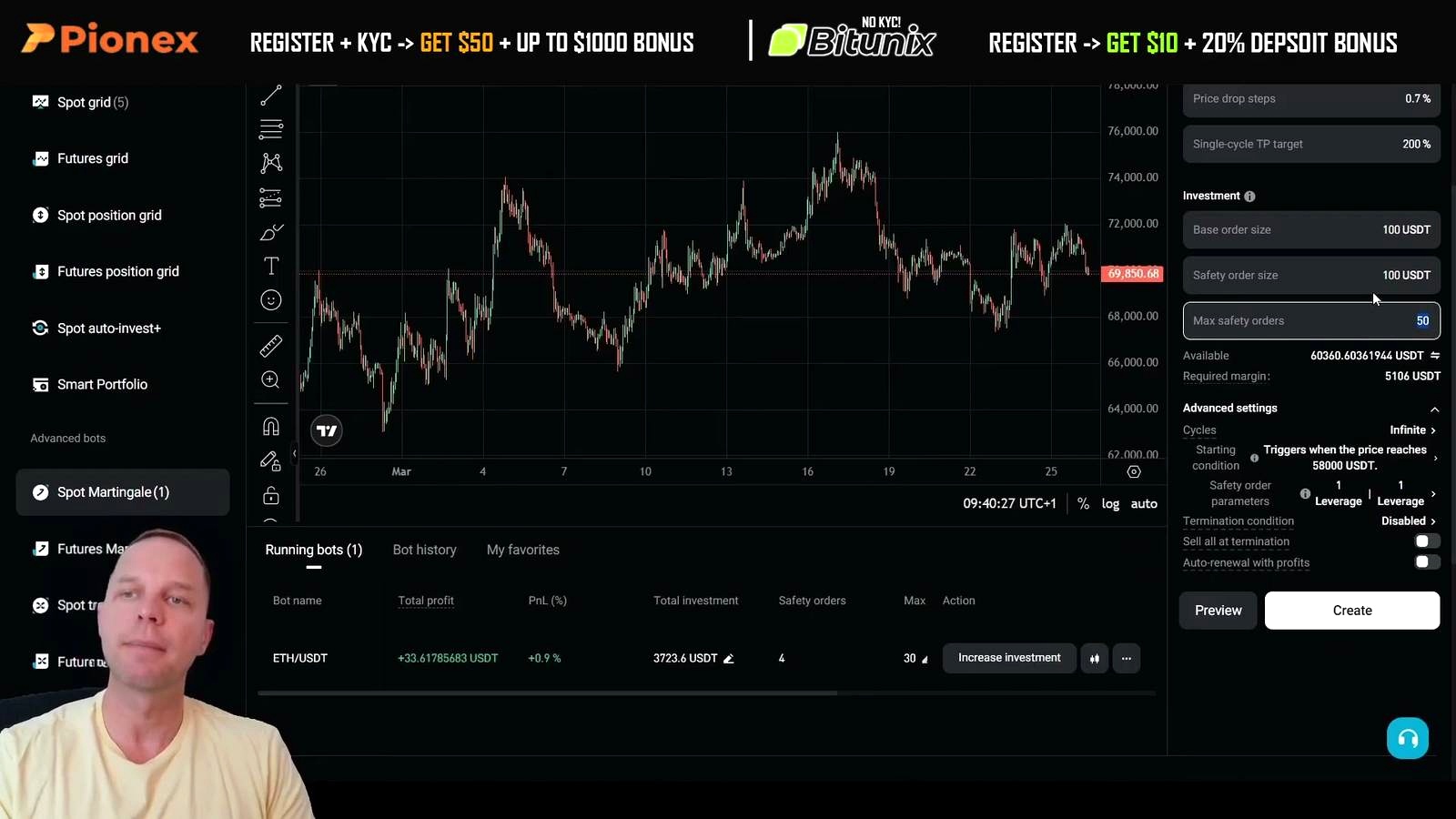
Kay Trading’s usual strategy elsewhere uses a 1% take profit, but that is not the approach here. In this bottom-fishing setup, he sets take profit much higher, often at 200%, and even mentions 300% as an option. That is mostly to prevent premature selling while the bot is accumulating.
The host says that if he had used a simple fixed exit after the 2022-style accumulation, he might have captured 300%. But he argues the larger move in the subsequent bull market could have reached 500% or even 600%, making early exits counterproductive for a long-term spot position.
That logic is why he prefers to terminate the bot without selling the coins. On Bitget and Pionex, he says, accumulated holdings can be transferred into the spot account instead of being liquidated automatically.
What to watch next
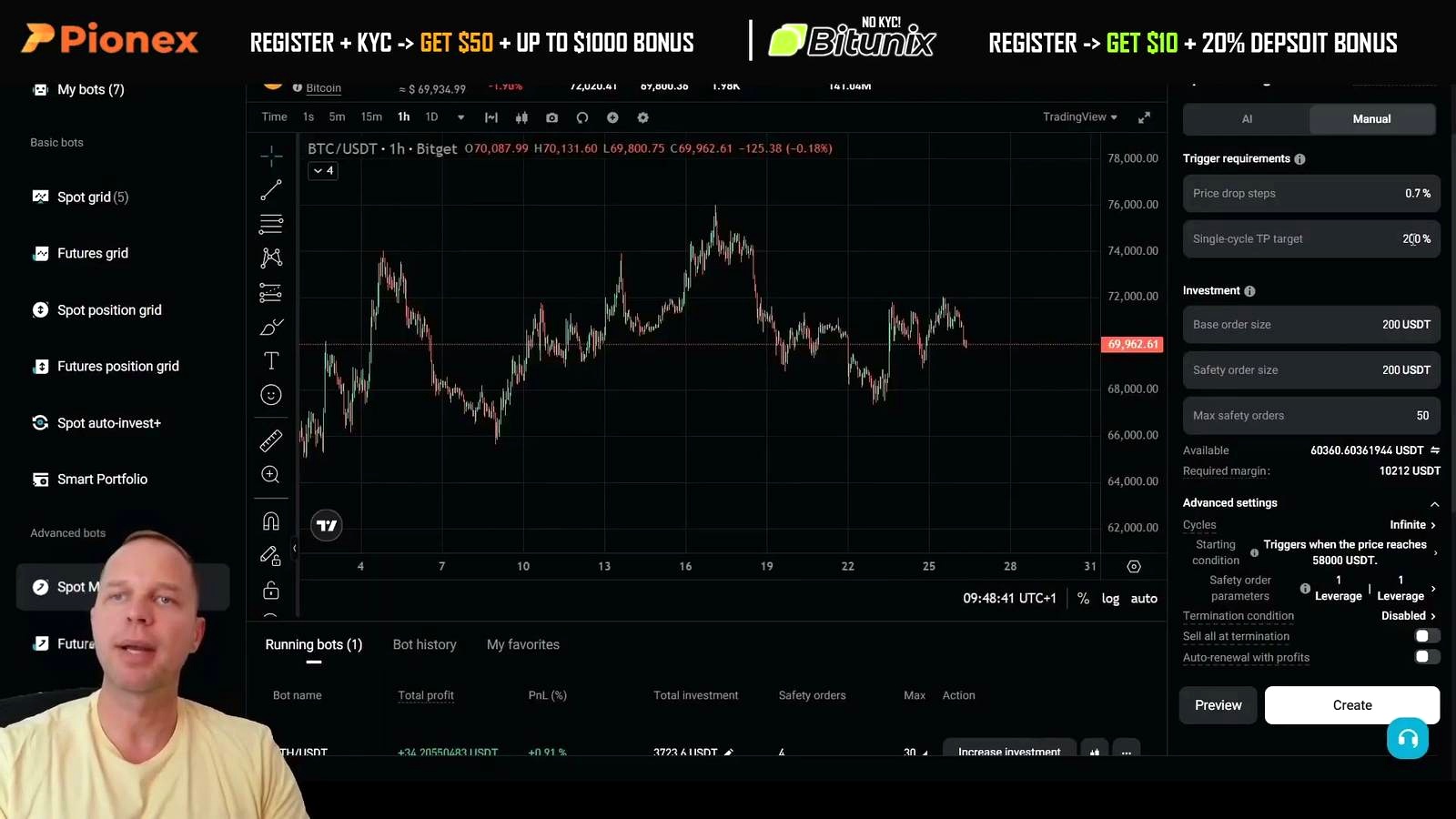
The next marker in this framework is simple: whether Bitcoin reaches $58,000 and activates the first bot. If it does, the host will be watching whether price stabilizes near the first liquidity pocket around $53,000 to $54,000, or continues into deeper zones near $47,000, $46,000, or even $40,000.
He also leaves room for a more severe flush. Although the heat map shown did not display much below the mid-$40,000 area, he says lower outcomes remain possible and can be handled either by adding more safety orders, opening another bot, or making a one-time extra spot purchase to lower the average cost further.
For traders who share his premise, the real signal is not a headline price target. It is whether a staged, rules-based buy system can deliver a manageable average entry through a volatile final leg down.
FAQ
What is Kay Trading’s main Bitcoin entry level right now?
The host’s first trigger is $58,000. He links that level to the 0.618 Fibonacci retracement and treats it as the point where a standby DCA bot should become active.
How often would the bot buy if Bitcoin starts falling?
In the setup shown, the bot places another buy every 0.7% drop. The order size stays flat, with the multiplier left at 1.
What did the 2022 backtest imply for average cost?
Starting near $21,340 and buying through the decline, the example produced an average entry just under $17,878, even though the final bottom was closer to $15,500. The gap shows how the strategy aims for a strong average, not a perfect bottom tick.
Does this strategy use leverage or liquidation risk?
No. Kay Trading describes it as a spot bot. He explicitly says there is no liquidation risk in the same way there would be with leveraged trading, because the bot is simply buying and holding spot coins.
What lower Bitcoin levels does the host want traders to monitor?
Beyond $58,000, he highlights liquidity and possible reaction zones around $54,000, $53,000, $47,000, and $46,000, while also modeling a deeper downside case near $39,000 to $40,000.
Video Source

An Indian crypto journalist covering the developments in the Bitcoin and blockchain industries. Her work helps readers understand key changes in the world of digital assets.