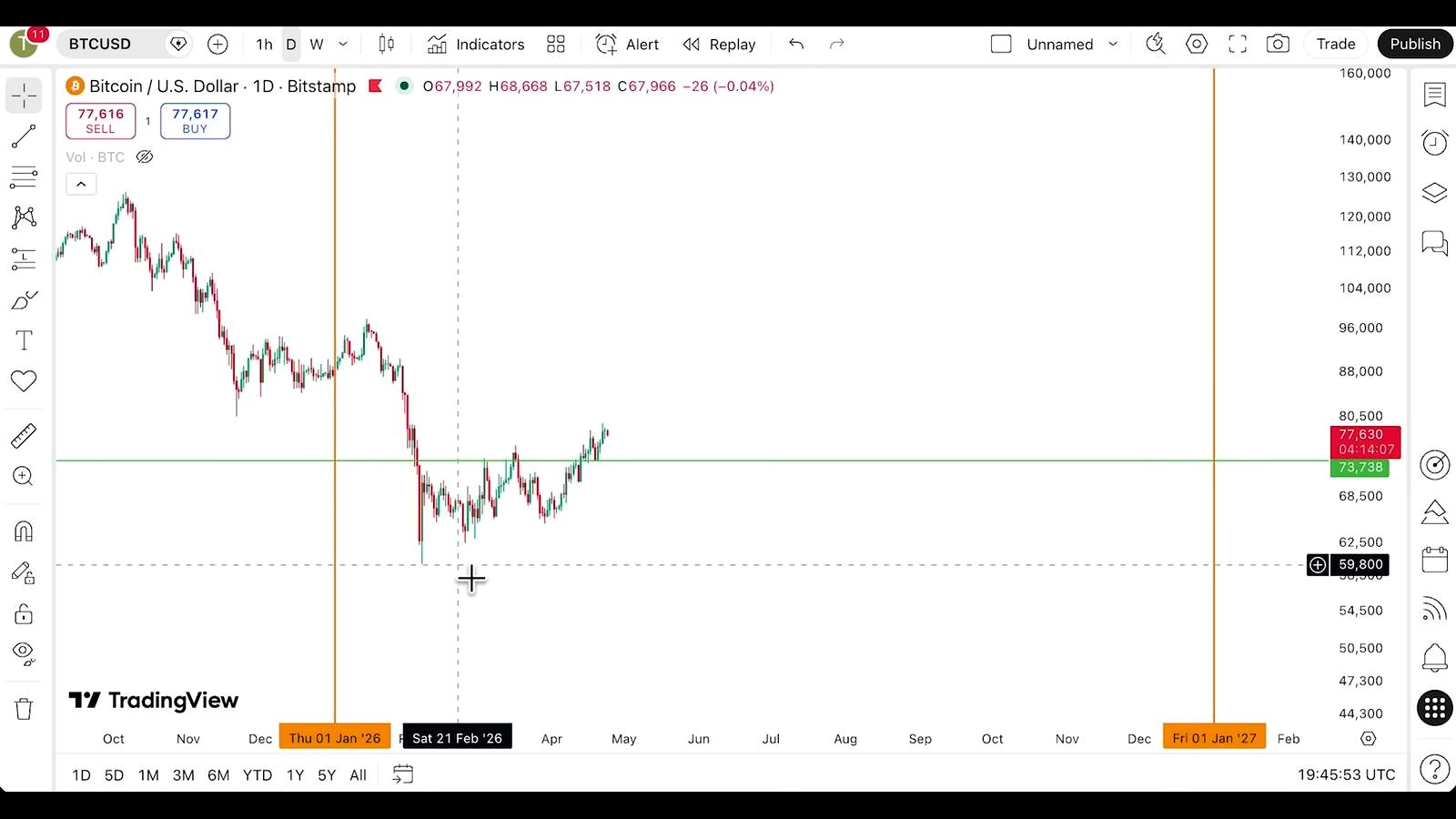
Is the next big BTC move being built by new financial demand, even as the broader market looks too comfortable? That is the tension running through a new discussion from The Bitcoin Macro, where long-term bullishness on Bitcoin sits alongside a warning that investors may be underpricing macro stress.
Bitcoin’s bull case, in this view, is getting a new demand engine

According to The Bitcoin Macro, one of the most consequential developments for Bitcoin is not a short-term chart setup but the emergence of financial instruments that can channel more capital into BTC indirectly.
The host says preferred-style securities tied to Bitcoin accumulation are gaining attention because they can appeal to investors who want yield while still getting exposure to a Bitcoin-centered strategy. He points to structures where issuers sell preferred securities into the market, reserve some capital for interest payments, and use the rest to buy Bitcoin.
That matters because it creates a feedback loop. If demand for those securities rises, more issuance can follow, and more Bitcoin can be bought with the proceeds. The analyst says this mechanism could become more powerful as additional products are built on top of those instruments, including funds that blend them with other assets to reduce volatility.
In his telling, this is not just another niche trade. It is a growing pipeline for BTC demand that could expand over the next 6 to 12 or 18 months, depending on regulation.
Key figures mentioned
- Yield cited on a preferred structure: 11.5%
- Expected window for more related products: 6 to 12 or 18 months
- One sign of strong demand: the security traded over par last week
Why this demand matters more than the altcoin washout

The Bitcoin Macro argues that Bitcoin should not be treated as just another part of the crypto complex. The host draws a sharp distinction: altcoins do not lead Bitcoin; they follow it, often with what he calls extraordinarily high beta.
That framing shapes his interpretation of the recent damage across the rest of the market. He says the vast majority of altcoins have been demolished, but he does not expect tens of thousands of tokens to go to zero. Instead, he sees a purge mainly as capital evaporating from speculative corners or moving elsewhere.
The larger point is that Bitcoin remains the asset setting the direction. In that framework, the destruction across altcoins does not invalidate Bitcoin’s trajectory. If anything, it clarifies where long-term conviction sits once speculative excess is stripped away.
He does leave room for some non-Bitcoin assets to retain utility, but he makes clear that this is separate from Bitcoin’s role. BTC, in his view, is the dominant monetary asset, while a handful of other crypto networks may end up serving narrower use cases.
The deeper driver: people are moving out on the risk curve to catch up

According to The Bitcoin Macro, the speculative behavior seen across crypto and prediction markets is not merely casino-style excess. The host ties it to a generational squeeze caused by inflation and declining purchasing power.
He argues that many younger people no longer feel they are trying to keep up financially. They are trying to catch up. That pushes them toward higher-risk bets, whether in crypto or other speculative markets, because the traditional path to building wealth feels increasingly out of reach.
His example is blunt: he says buyers now cannot get a car for less than $40,000, using the cheapest Tesla as a rough reference point. That kind of pressure, he argues, changes investor psychology. People start buying “lottery tickets” across the risk spectrum because they feel forced there by monetary debasement and rising costs.
That same backdrop supports Bitcoin over the long term in his framework. If more investors come to believe BTC will continue to reflect the dollar’s degradation as fiat currency is debased, then holding Bitcoin-linked instruments becomes easier to justify despite volatility.
The warning: the market may be far too relaxed about macro risk
For all the structural optimism around Bitcoin, The Bitcoin Macro warns that the broader market is showing dangerous overconfidence.
The host says investors appear too confident in the administration’s ability to manage the uncertainty it has created. He also points to pockets of exuberance in AI-linked equities, inflation pressure that is helping energy names, and a rotation within the S&P that looks less like healthy resilience and more like shifting risk from one side of the boat to the other.
His main signal to watch is the bond market. Rather than seeing a classic flight to safety into short-term Treasuries, he says the more important force now is fear of inflation. He describes that pressure as a potential dam ready to break, with the 10-year Treasury yield becoming the key indicator.
That is where he expects the first real clue about market direction. In his view, bond traders are unlikely to tolerate long-term inflation the way they did in 2022. He expects them to move faster this time.
Deficits, currency debasement, and why Bitcoin stays central

According to The Bitcoin Macro, the structural case for Bitcoin rests on fiscal reality as much as market mechanics. The host says he does not see U.S. deficits falling below $2 trillion in a meaningful way. He adds that even if the figure reaches $1.8 trillion, he still does not see a path back to $1 trillion, let alone a balanced budget.
That matters because widening deficits, especially during economic weakness, imply more borrowing, more policy support, and ultimately more currency debasement. He argues that governments will be pushed to run larger deficits simply to keep the economy going as unemployment rises and benefits expand.
In that system, Bitcoin is not just a high-beta macro trade. He presents it as a structural response to a financial regime that cannot easily exit debt expansion and monetary dilution.
The host also links this to a broader thesis associated with Jeff Booth: policymakers use inflationary debasement to offset the deflationary force of technological progress. In the current moment, he says, that technological force is accelerating through AI.
AI disruption could make the macro backdrop even more unstable
The Bitcoin Macro argues that rapid AI adoption is already affecting the labor market faster than many investors appreciate. The host says the pace of change over the last 3 to 6 months has been striking, with industries being disrupted and layoffs spreading into the tens of thousands.
He says this is not a call for imminent market collapse. It is a warning that economic disruption may be arriving faster than consensus expects. He points to new college graduates struggling to land entry-level jobs and even mentions “last mile” delivery work coming under pressure from drones and automation.
That matters for Bitcoin because a more disrupted economy could lead to slower growth, wider deficits, and a renewed political need for monetary support. The host is skeptical that policymakers could simply let a recession and a 10% or 20% drawdown in stocks run their course without returning to money creation.
That skepticism reinforces the same core BTC thesis: if the system remains cornered into more debt, more deficits, and more debasement, Bitcoin’s relevance rises.
What to watch next
The near-term question from this discussion is not whether The Bitcoin Macro is bullish on Bitcoin. It clearly is. The more urgent issue is whether macro stress arrives before the new Bitcoin demand channels fully scale.
The host’s watch list is narrow and specific. First, watch whether Bitcoin-linked preferred and fund structures continue attracting capital, especially when they trade over par and enable more BTC purchases. Second, watch the bond market, especially the 10-year, for signs that inflation fears are reasserting themselves. Third, watch deficits and labor-market stress, particularly if AI disruption keeps intensifying.
If those pieces move in the direction he expects, the setup is clear: broader markets could struggle with mispriced risk while Bitcoin gains from both structural capital inflows and a worsening fiat backdrop.
FAQ
Why does The Bitcoin Macro separate Bitcoin from altcoins?
Because the host sees Bitcoin as the asset that drives the crypto market, not one that reacts to it. In his framework, altcoins are higher-beta expressions of Bitcoin’s direction rather than true leaders.
What is the practical significance of trading “over par”?
In the discussion, trading over par signals strong investor demand for the preferred-style security. The host says that can allow issuers to sell more into the market and direct more proceeds into Bitcoin purchases.
Did the video give a specific Bitcoin price target?
No specific BTC price target was given. The discussion focused on structural demand, deficits, bond-market signals, and macro conditions rather than a near-term price forecast.
What single market signal does the host seem to trust most?
Bonds. He says investors should watch the bond market first, especially the 10-year Treasury, because bond traders may respond to inflation risk faster than equity investors.
How does AI fit into a Bitcoin thesis?
The host connects AI to faster economic disruption, job losses, and potential pressure for larger deficits and looser policy. In that chain of events, Bitcoin benefits as an alternative to a system leaning further into debasement.
Reference Video

An Indian crypto journalist covering the developments in the Bitcoin and blockchain industries. Her work helps readers understand key changes in the world of digital assets.