Could Bitcoin jump in steps rather than climb in a straight line? That is the tension at the center of a new Bitcoin News Alerts video, which argues that the market may be underestimating how quickly BTC can reprice if capital keeps colliding with fixed supply.
According to Bitcoin News Alerts, the path to $2 million per Bitcoin is not built on slow, gold-like gains but on the idea that Bitcoin moves in violent multiples once demand overwhelms available supply. The host anchors that thesis in comments from Samson Mow, corporate accumulation led by Michael Saylor, and a broader shift in institutional access through ETFs and wealth platforms.
The core thesis: Bitcoin does not move like gold
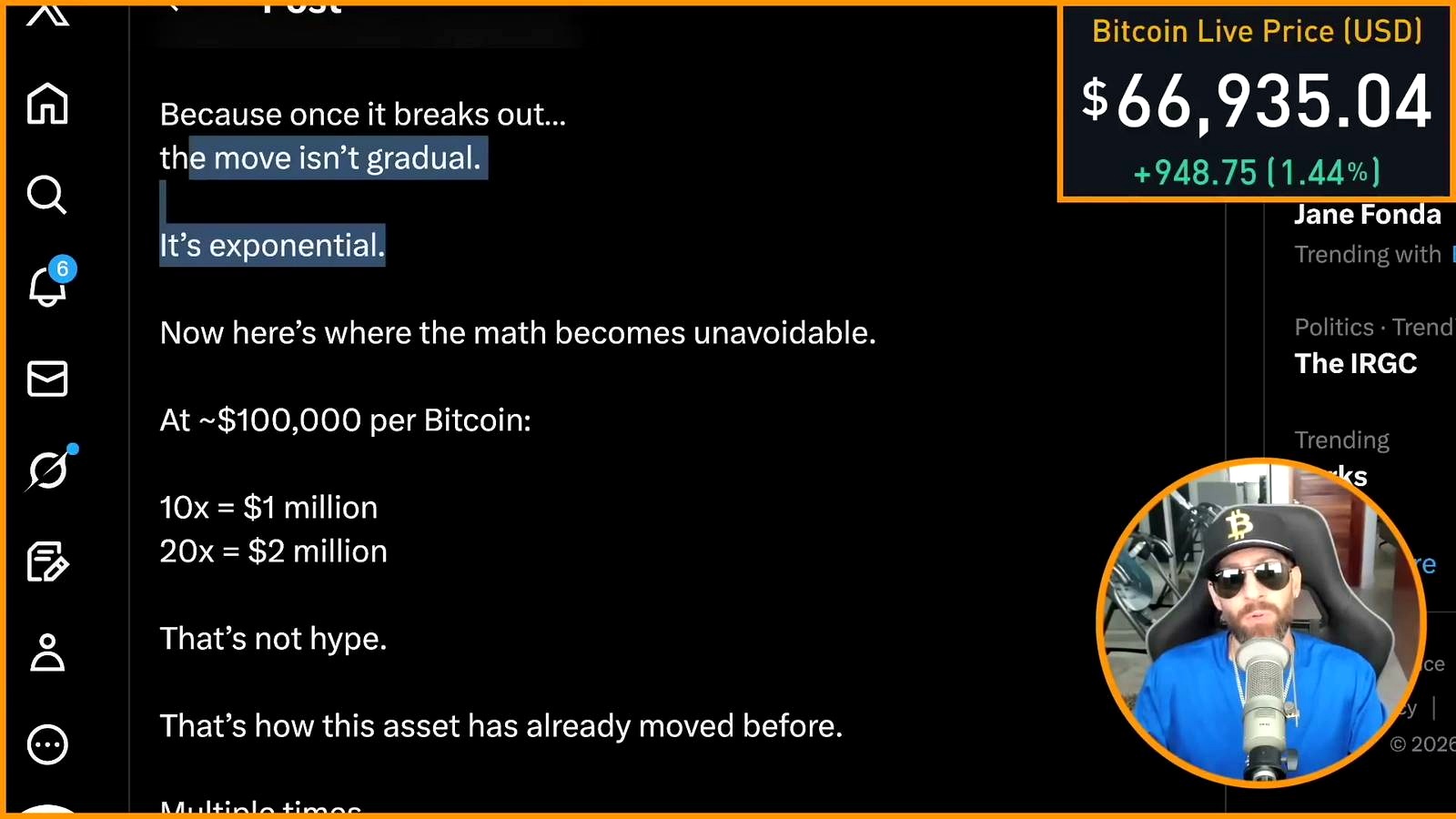
Bitcoin News Alerts argues that many investors are still modeling BTC like a traditional macro asset, expecting gradual moves toward $100,000 or $150,000. The host says that is the wrong framework. In his telling, Bitcoin is a “supply shock asset” that reprices exponentially when it breaks out, not incrementally.
That distinction matters because the bullish case here is not merely that Bitcoin rises. It is that it rises in multiples. The video cites Samson Mow’s view that Bitcoin can still deliver 10x to 20x moves despite its scale. Using the host’s simple math, a base price of $100,000 implies:
- 10x = $1 million
- 20x = $2 million
The host contrasts this with precious metals. Gold, he says, almost achieved a 2x market-cap expansion, while silver did a 3.4x. His conclusion is that Bitcoin, even at large scale, can still outperform those moves because it is more liquid globally and can be transmitted instantly, unlike physical metals.
Why the supply shock argument is getting louder
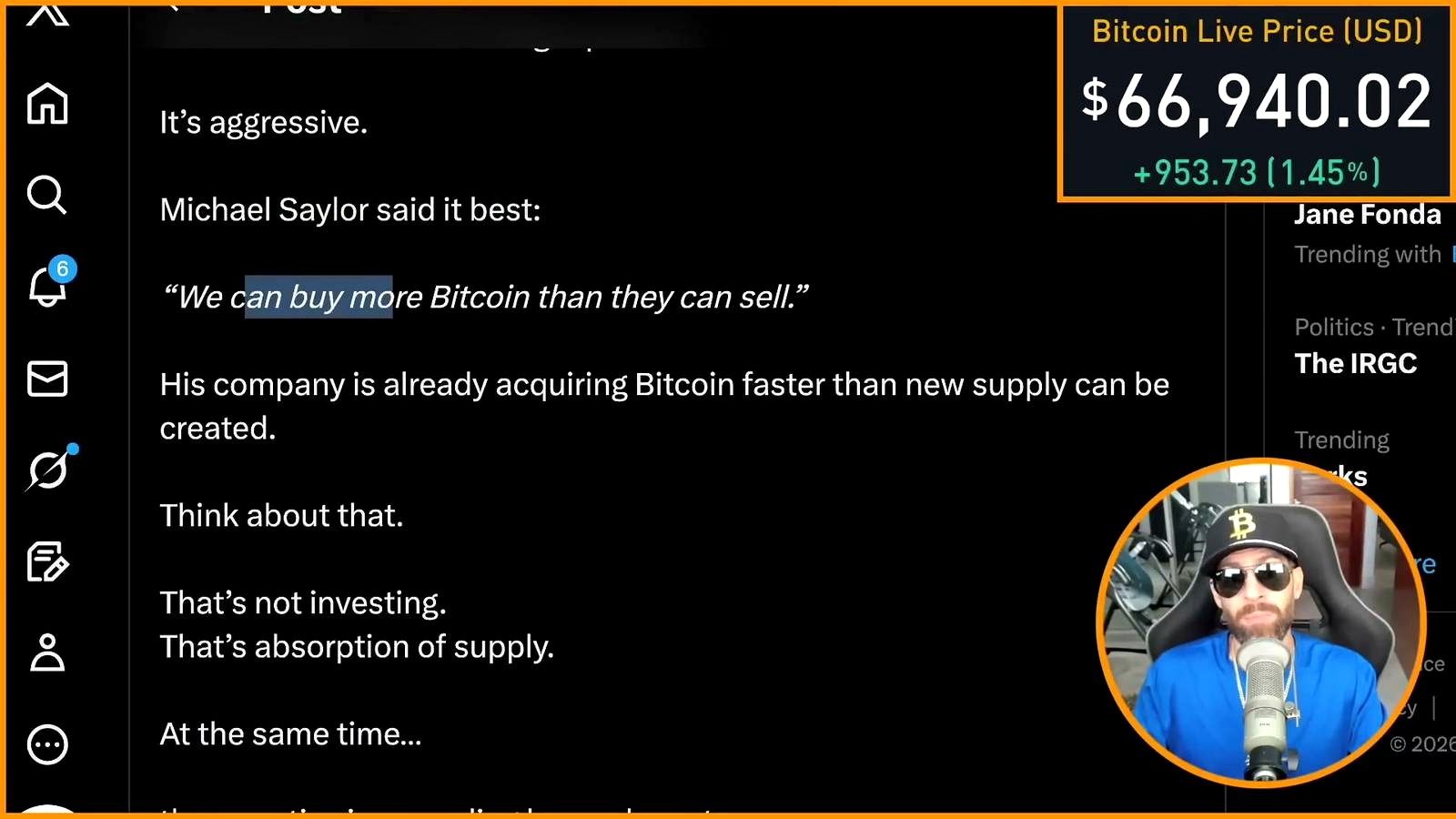
Bitcoin News Alerts says this cycle looks different because demand is no longer passive. The host points to Michael Saylor’s line that “we can buy more Bitcoin than they can sell, ” framing it as evidence that large buyers are already absorbing newly available supply rather than just speculating on price.
The video gives several concrete figures to support that claim. It says Saylor is in “pole position” with more than 760,000 BTC and is currently purchasing five times the daily issuance. The host also says Saylor has announced a $42 billion capital raise to buy more Bitcoin.
That is only part of the demand story presented. The host says BlackRock’s IBIT holds roughly 800,000 BTC, making it even larger than Saylor’s stack, and notes that these flows sit on top of broader institutional channels that include sovereign wealth funds, retirement plans and 401(k) capital.
The article’s central market implication is straightforward: if large buyers keep absorbing coins faster than miners and sellers can replenish liquidity, price may not drift upward. It may gap.
Small reallocations, huge numbers
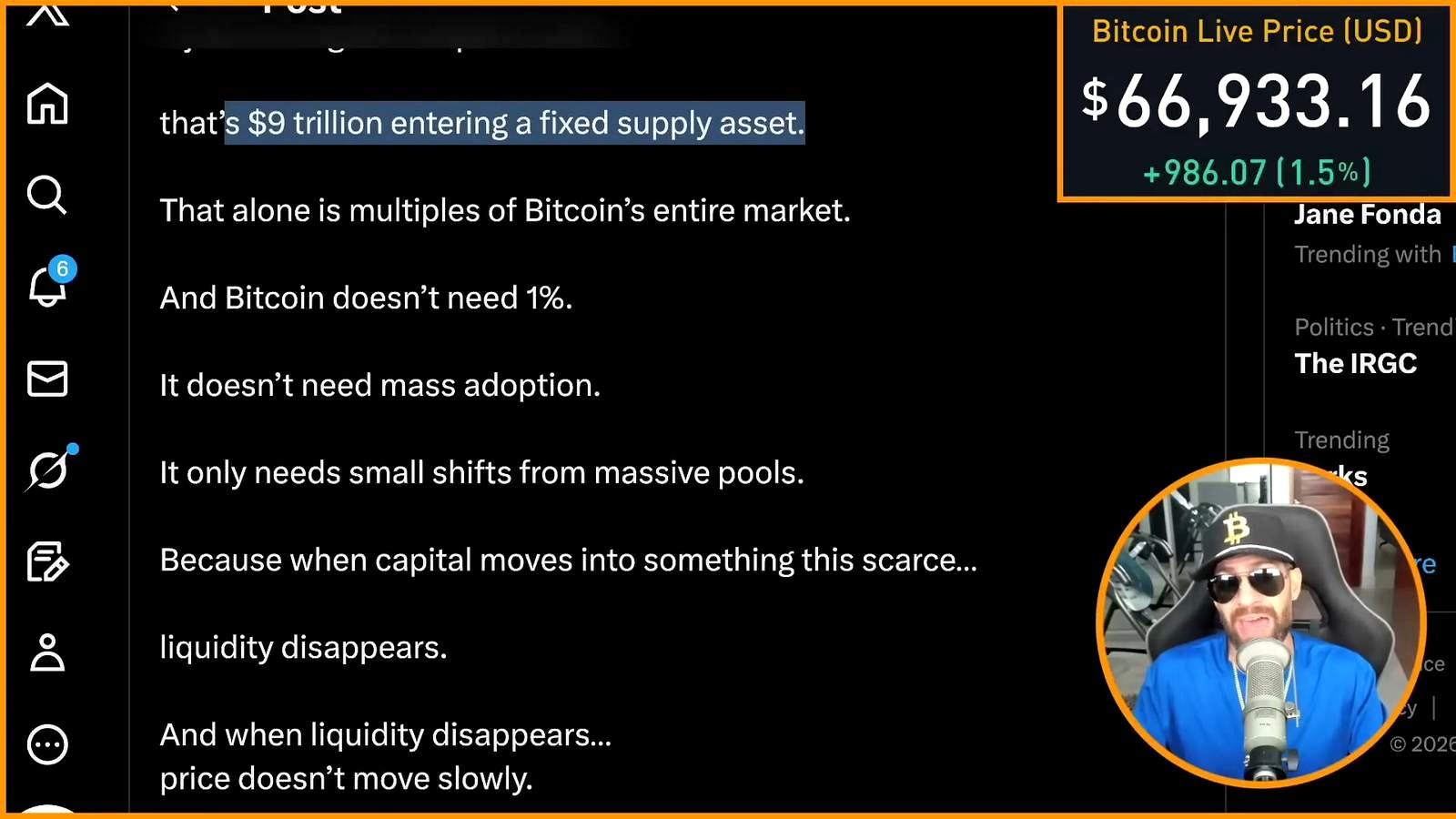
Bitcoin News Alerts builds the long-term case by comparing Bitcoin’s current size to global capital pools. The host says Bitcoin today is only a $1.34 trillion asset, though he earlier references it as being around the $2 trillion mark. Against that, he places a much larger global asset base of nearly $900 trillion, broken down as:
- Real estate: $330 trillion
- Bonds: $300 trillion
- Money: $120 trillion
- Equities: $115 trillion
The host’s point is that Bitcoin does not need universal adoption to reprice dramatically. It only needs a small reallocation from very large pools. In the video’s framing, even 1% of global capital moving into Bitcoin would mean $9 trillion entering a fixed-supply asset.
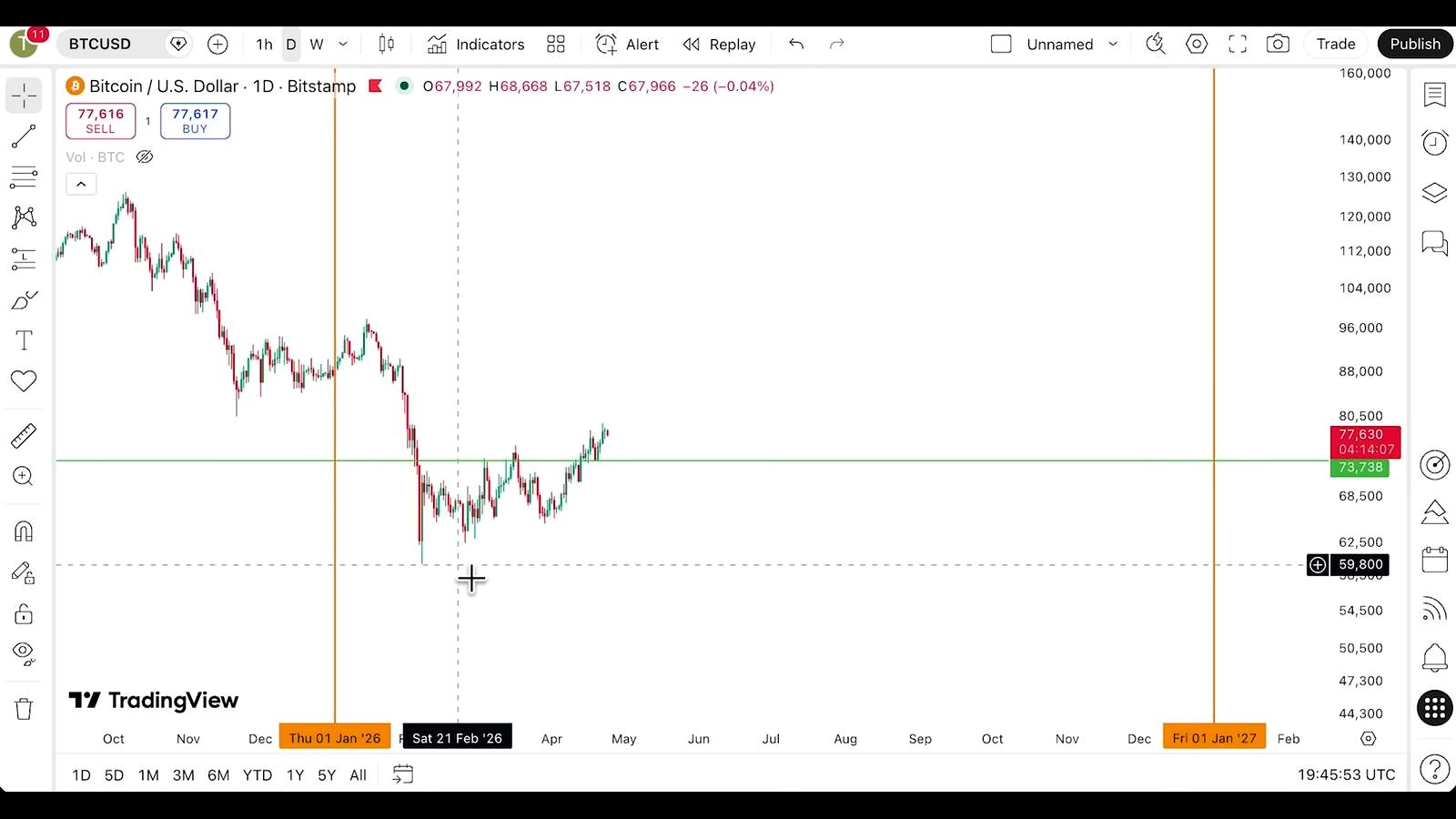
That is why the host maps out a staircase rather than a straight line: first $200,000, then $500,000, then $1 million, then $2 million. At that stage, he argues, Bitcoin would stop being viewed mainly as a risk asset and start being treated as a global macro reserve layer and store of value.
Politics and narrative are now part of the bull case

Bitcoin News Alerts also argues that the narrative is moving beyond crypto-native circles. The host highlights comments from Donald Trump, who said Bitcoin is “very powerful” and that many people now want to transact in crypto. In the video’s interpretation, that matters because public endorsement from a major political figure can widen the audience and accelerate capital flows.
The host adds that the Trump family has a mining connection through a partnership with Hut 8, and says they are already among the larger miners. He uses that point to suggest that Bitcoin’s adoption story now spans politics, mining and financial markets at the same time.
There is also a geopolitical angle in the video. The host claims Bitcoin has recently outperformed traditional markets during conflict tied to Iran, presenting BTC as a hedge during instability. The specific figures he gives are:
- Bitcoin: up 5%
- S&P 500: down 4%
- Gold: down over 13%
He says those moves began after strikes involving the US and Israel on Iran on February 28. The broader point is less about one headline event and more about positioning Bitcoin as an alternative store of value during war, inflation and monetary debasement.
The “great rotation” from gold to Bitcoin

Another strand of the video centers on capital leaving metals for BTC. Bitcoin News Alerts cites Grant Cardone’s statement that Bitcoin “should be” at $280,000 right now. The host links that to what he calls a “great capitulation” from gold and precious metals into Bitcoin.
To illustrate the liquidity contrast, the host relays Cardone’s anecdote that a friend holding $10 million in gold bars was offered only 70% of spot value. He contrasts that with Bitcoin’s 24/7 global market, where he says sellers can transact at market value without suffering a similar physical-market discount.
The argument here is not just ideological. It is structural: Bitcoin is being portrayed as easier to price, easier to move and easier to monetize than physical stores of value.
Wall Street access keeps expanding
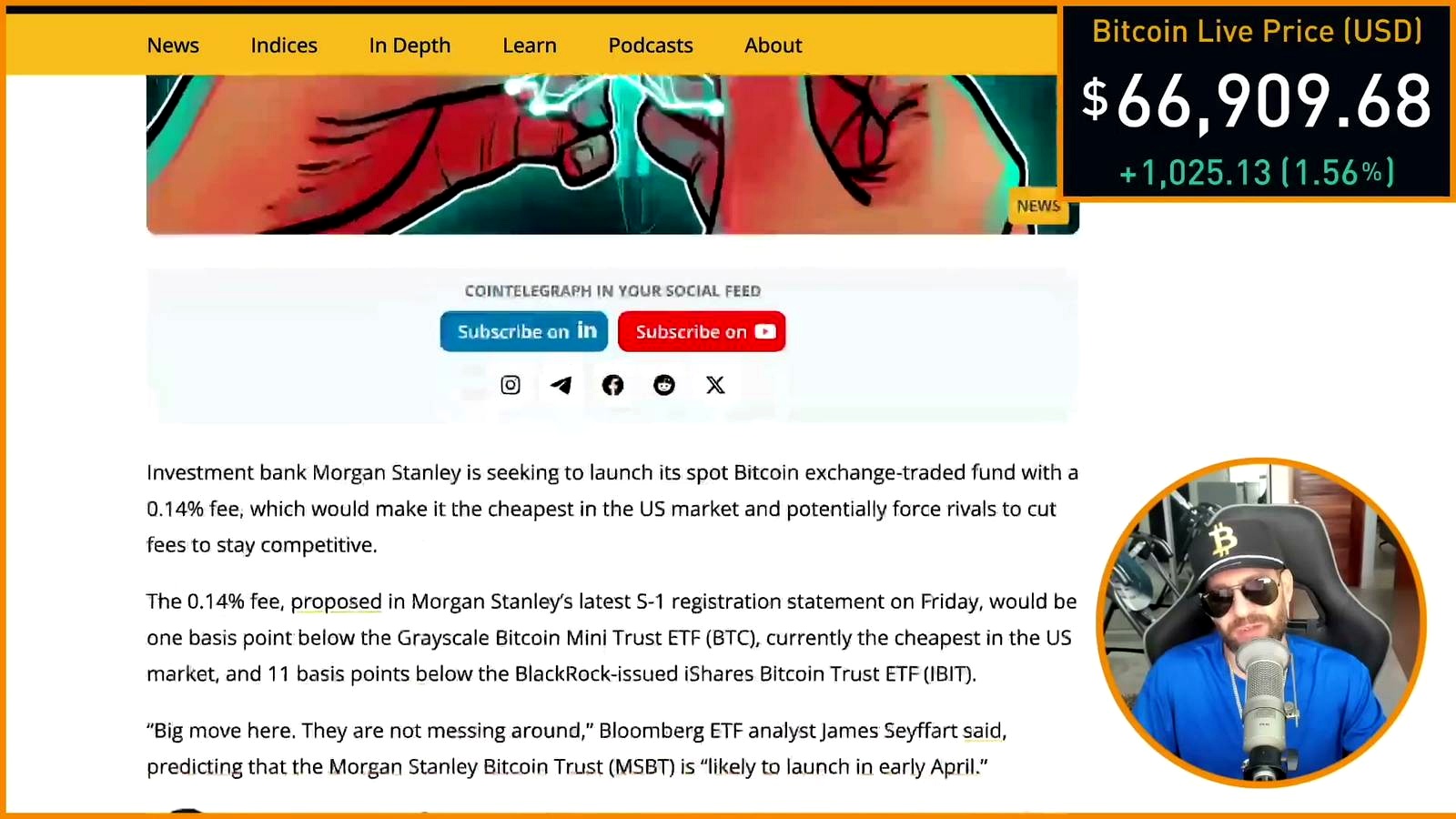
One of the more actionable developments in the transcript is Morgan Stanley’s proposed spot Bitcoin ETF. Bitcoin News Alerts says the bank has filed for a fund with a 0.14% fee, which would be the lowest in the US market if approved.
The host says that would undercut the current cheapest US Bitcoin ETF at 0.15% and come in 11 basis points below BlackRock’s IBIT. He adds that the proposed ticker is MSBT and that launch is expected in early April, pending approval.
Why does that matter? Because Morgan Stanley’s distribution network is enormous. The video cites roughly 16,000 financial advisors managing $6.2 trillion in client assets. A lower-cost in-house product could make Bitcoin easier to recommend across that base. The host also says the broader US spot Bitcoin ETF market stands at $83 billion.
He extends that logic to retirement money. The video references $40 trillion in US retirement accounts and roughly $14 trillion specifically in 401(k)s, arguing that any opening for Bitcoin allocations would unlock another major source of demand.
What to watch next

The video ultimately comes down to one question: can access and demand keep accelerating faster than available Bitcoin supply? Bitcoin News Alerts says the key markers are institutional accumulation, ETF fee competition, retirement-account access and whether BTC continues to outperform gold in stress periods.
The host also leans on the idea of an “Omega candle, ” a term he attributes to Samson Mow for a $100,000 daily price spike. In the example given, that would push Bitcoin to $167,000 in a single day. He contrasts that with a “God candle” of $10,000 and even speculates about a future $1 million single-candle move. Those are not forecasts grounded in new data in the transcript, but they show how aggressively the channel views Bitcoin’s repricing potential if a true liquidity squeeze hits.
For now, the thesis is clear: if Bitcoin keeps attracting institutional capital while supply stays fixed, the move may look less like a steady climb and more like a series of abrupt resets. That is the scenario behind the $2 million target, and the reason the host says the market still does not fully grasp what a supply shock in Bitcoin could look like.
FAQ
What exact numbers did the video use for the $2 million Bitcoin case?
The host’s framework starts with $100,000 BTC. From there, a 10x move points to $1 million, and a 20x move points to $2 million. He also sketches interim levels at $200,000 and $500,000.
Why does the video say Bitcoin can move faster than gold?
The argument is based on market structure. Gold is described as constrained by physical-market frictions, while Bitcoin trades globally, around the clock, and can move across both spot markets and ETFs. The host uses Cardone’s story about gold being bid at 70% of spot to underscore that contrast.
Which institutional buyers were highlighted?
The video names Michael Saylor and BlackRock most directly. It says Saylor controls 760,000+ BTC and is buying 5x daily issuance, while BlackRock’s IBIT holds roughly 800,000 BTC.
What is the significance of Morgan Stanley’s ETF filing?
In the host’s view, price access matters almost as much as price itself. A proposed 0.14% fee could pressure rivals, and Morgan Stanley’s 16,000 advisors overseeing $6.2 trillion in assets could broaden Bitcoin distribution to affluent clients.
Did the video give a near-term BTC target besides $2 million?
Yes. It cites Grant Cardone’s claim that Bitcoin should already be at $280,000, and it references an “Omega candle” concept implying a $100,000 one-day move, which in the host’s example would send BTC to $167,000.
Original Source

Omar Al-Sharif lives and works in the UAE and is involved in the blockchain technology industry. He writes articles on Bitcoin and digital assets as a personal passion, explaining complex topics in simple and understandable language.