Is this just another panic-driven BTC drop, or the kind of macro stress that forces policymakers to open the liquidity taps again? That tension sits at the center of Savvy Finance’s latest breakdown, which pairs near-term market fear with a much bigger long-term crypto thesis.
According to Savvy Finance, the immediate selloff in Bitcoin may be less important than the policy response that could follow it. The channel argues that if global markets keep straining under war risk, higher oil, refinancing pressure and tighter financial conditions, governments and central banks will not tolerate a deep collateral collapse. In that framework, BTC weakness now could be setting up a later liquidity-driven rebound.
The core call: policymakers won’t allow a full unwind

Savvy Finance frames Raoul Pal’s argument around one simple claim: after 2008, officials learned that once collateral breaks, the broader system breaks with it. The host says that means modern downturns are less likely to be allowed to become classic recessions and more likely to trigger intervention designed to support asset prices and financial plumbing.
That matters for Bitcoin because the analyst ties crypto’s next phase to liquidity, not just sentiment. He says the system is too indebted to absorb a major collapse on its own. If markets deteriorate enough, more liquidity is expected to arrive, either directly through central banks or increasingly through the banking system.
Savvy Finance highlights several concrete thresholds and figures from the discussion:
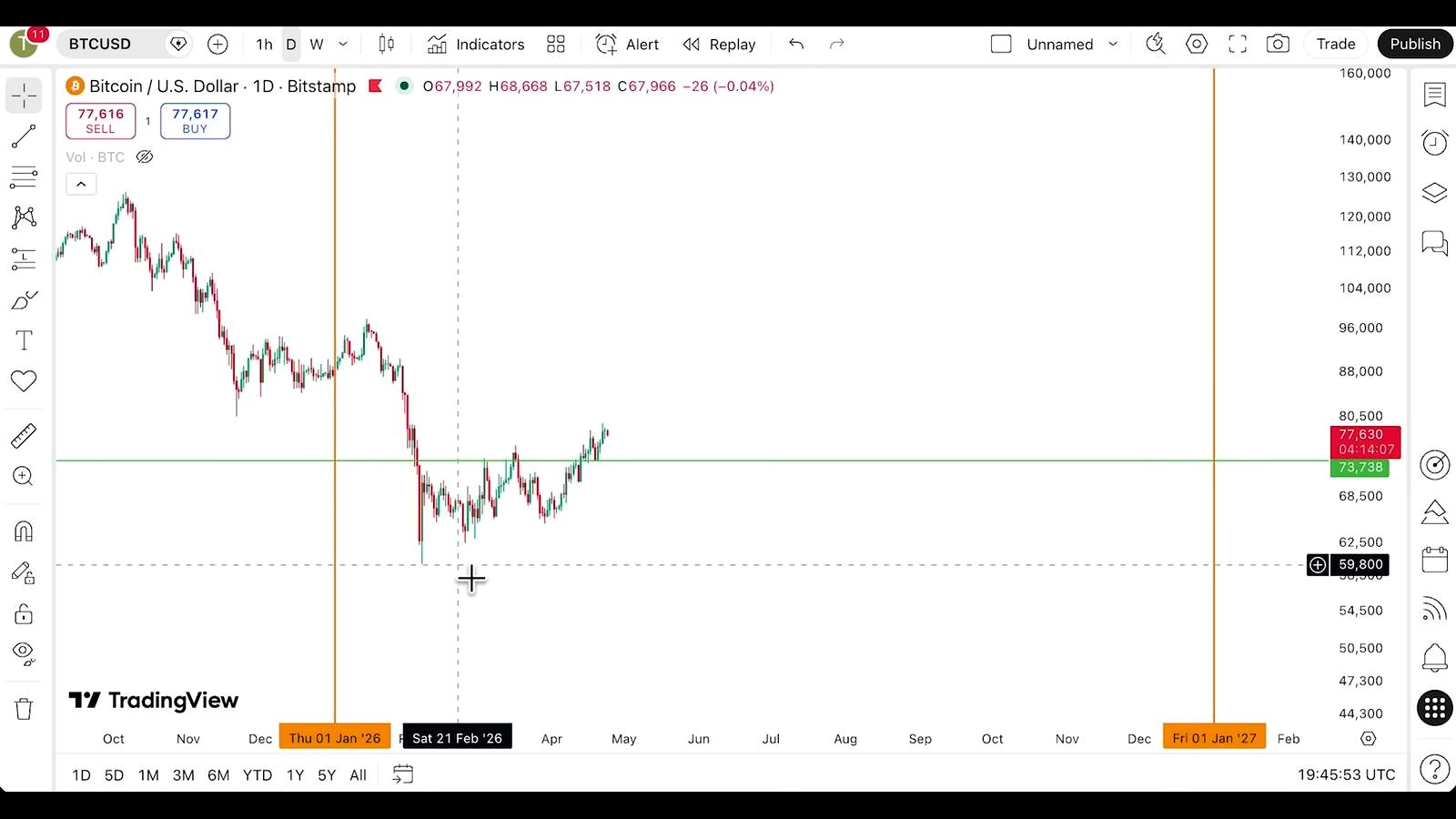
- Bitcoin fell to the mid-$60,000s on Friday.
- Pal said an oil move of 100% year over year has historically coincided with recession.
- He pointed to the possibility of intervention if the S&P 500 falls more than 25%.
- He described ongoing currency debasement of about 8% per year as the way the system avoids implosion.
The host’s takeaway is direct: in an overleveraged world, authorities are more likely to debase the currency than allow a cleansing collapse in collateral. For Bitcoin holders, that is the key bullish macro link.
Why the banking system matters more than the central bank balance sheet

Savvy Finance says the mechanism is changing. Rather than relying only on central bank balance sheet expansion, Pal argues policymakers want liquidity to move through banks because lending pushes funds into the real economy more effectively.
The host points to changes tied to ESLR as evidence of that shift. In his telling, the goal is to let banks absorb more Treasuries, lend more freely and effectively “lever up” the system if needed. He also says officials may try to remove the ESLR entirely, referencing what was done during the pandemic period.
That distinction matters because Savvy Finance does not present this as a one-off rescue. He presents it as a broader playbook: cut rates, ease constraints, let banks transmit liquidity and keep collateral from spiraling lower.
The channel also ties this to a larger capital need coming from AI and automation. Governments, the host says, cannot fund that buildout on their own. Private credit creation and bank-driven leverage would therefore become central to the next growth phase.
Why this macro shock is being framed differently from 2022

Savvy Finance acknowledges the fear hanging over markets. The host cites the US-Iran war, an oil shock tied to Iran’s blockade of the Strait of Hormuz, and broad uncertainty across risk assets. He also notes that many investors are scarred by 2022, when there was “nowhere to hide.”
But he says Pal distinguishes the current moment from the inflationary surge that followed the pandemic and the Russia-Ukraine war. Back then, the argument goes, the world faced a severe mismatch: demand snapped back, supply lagged, factories could not keep up, and energy and food shocks made inflation worse. Savvy Finance says Pal does not see that same full set of conditions in place now.
Instead of a replay of 2022, the host says Pal expects a sharp slowdown that pressures policymakers into action. The channel’s point is not that markets are healthy. It is that the system has become conditioned to respond before a full-scale debt and collateral unwind can take hold.
The bigger bull case isn’t just liquidity, it’s AI using crypto rails

According to Savvy Finance, the more underappreciated part of Pal’s thesis is not macro at all. It is the idea that artificial intelligence could massively expand crypto’s addressable market.
The host says many investors still think about crypto adoption mainly in terms of institutions or stablecoin payments. Pal’s argument, as relayed by Savvy Finance, goes much further: AI agents may eventually transact across blockchains, hold multiple assets, manage treasuries and use decentralized finance rails automatically.
Several numbers anchor that claim:
- Roughly 6 billion people use the internet today, according to the discussion.
- There are about 8.5 billion humans, and Pal speculated there could be 8.5 billion AI agents doing microtransactions.
- The US dollar does not divide below 1 cent, which Pal used to argue that machine economies may need many different crypto assets or tokens.
Savvy Finance argues that if AI agents become economic actors, crypto stops being just a speculative asset class and becomes infrastructure. In that world, agents could transact on networks such as Solana, Ethereum and SUI, use DeFi for treasury management, and allocate capital algorithmically.
The host also extends that idea into asset management. He says Pal expects major disruption as functions now handled by firms, compliance stacks and capital allocators get compressed into software and agents. He even connects meme coins to “instantaneous capital formation, ” describing them as an early prototype for how token-based fundraising could evolve.
Tokenization, digital identity and data markets

Savvy Finance says Pal’s AI-crypto thesis depends on more than payments. It also requires digital identity, trust systems and tokenized data markets.
The host describes a future in which data becomes tokenized into transferable packets of information. Those tokens could be bought and sold in large marketplaces, often invisibly to end users because agents would be trading with other agents. He also says Web3’s old promise, read, write, own, could reappear here in a more concrete form, including the possibility of users monetizing their own data.
That is a different kind of Bitcoin-adjacent thesis than the usual ETF-flow story. Savvy Finance is effectively saying the next crypto expansion could be driven by utility at machine scale, not just by retail speculation or institutional treasury demand.
Secondary signals from Japan and the funding gap

Savvy Finance also points to Japan as a supporting example. The host says Japan has made a similar shift toward reigniting bank lending, steepening the yield curve and relying more on private-sector financing. He notes that Japanese banks have not meaningfully lent for 30 years, but says that may be changing.
He uses the same section to stress the scale of future capital needs. A Middle Eastern pool of capital cited in the interview was described as having around $300 billion, but Pal argued that is too small relative to the need. Savvy Finance emphasizes the conclusion: the world needs trillions and trillions of dollars, which again points back to banking-system leverage and abundant liquidity.
What to watch next for Bitcoin

Savvy Finance leaves readers with two things to monitor. The first is macro stress: oil, debt refinancing pressure, and any deeper crack in broader markets. In this thesis, worsening conditions are not automatically bearish if they become severe enough to trigger a liquidity response.
The second is structural adoption. If crypto rails start gaining traction as infrastructure for AI agents, digital identity and tokenized data, the host believes the market may need to rethink the scale of the opportunity entirely.
For now, Bitcoin sits between those two forces. On one side is a risk-off market that has already pushed BTC into the mid-$60,000s. On the other is a thesis that says policymakers will not permit a full collateral unwind and that crypto may be moving into a much larger utility cycle than investors expect.
FAQ
Why does Savvy Finance think Bitcoin could benefit from bad macro news?
Because the channel’s thesis is built on response, not on the shock itself. If market stress becomes severe enough, officials may add liquidity to stabilize collateral and credit conditions, which has historically supported risk assets.
Did Savvy Finance give a specific BTC price target?
No specific upside Bitcoin price target was given. The transcript mentions BTC falling to the mid-$60,000s, but the bullish case is directional and macro-driven rather than tied to a fixed target.
What is the main difference between this view and a standard “Fed will print” argument?
The emphasis is on banks, not just central banks. Savvy Finance says policymakers increasingly want liquidity to move through bank lending, with ESLR-related changes helping the private banking system expand credit.
How does AI fit into the crypto thesis?
The channel says AI agents could become constant users of crypto rails for payments, treasury management, asset allocation, identity and data exchange. That would expand crypto’s market far beyond human users alone.
What are the key numbers mentioned in the video?
The main figures were mid-$60,000s for Bitcoin, 100% year-over-year oil change, 25% downside in the S&P 500 as a possible intervention trigger, 8% annual currency debasement, 6 billion internet users, 8.5 billion humans, 8.5 billion possible AI agents, 1 cent as the lower unit of the dollar, 30 years of weak Japanese bank lending, and roughly $300 billion in cited Middle Eastern capital versus the need for trillions.
Source Video

An Indian crypto journalist covering the developments in the Bitcoin and blockchain industries. Her work helps readers understand key changes in the world of digital assets.