What if one of the most important signals for Bitcoin demand is not BTC’s chart at all, but a preferred share quietly trying to get back to $100? That is the tension at the center of Kenzo Finance’s latest breakdown of Strategy’s capital machine.
According to Kenzo Finance, Strategy’s preferred share STRC is more than a yield product. It is a funding mechanism built to stay near its $100 par value, allowing the company to keep issuing shares, raising cash, and converting that cash into more Bitcoin. The key recent data point: after going ex-dividend on March 13, 2026, STRC returned to par in 9 trading days, faster than its historical average of 10 trading days.
The real story is the Bitcoin-buying flywheel

Kenzo Finance argues that STRC matters because Strategy can use it to run an almost continuous funding loop. When STRC trades at or near $100, the company can sell new shares through an at-the-market, or ATM, program. That lets Strategy raise capital directly in the open market without a traditional secondary offering, then use the proceeds to buy more BTC.
The host describes STRC as a perpetual preferred share with an 11.5% annual dividend paid monthly. Its price is meant to stay anchored near $100. If it trades above par, Strategy can reduce the dividend, making the shares a bit less attractive and cooling demand. If it falls below par, the company can raise the dividend, improving the yield and helping pull the price back up.
That mechanism, in Kenzo Finance’s telling, is not incidental. It is the core design feature that keeps Strategy’s fundraising efficient. If STRC drifts too far below par, issuing new shares becomes less attractive economically. The host gives a simple example: if Strategy were selling new STRC at $95, it would be raising capital at a 5% disadvantage versus par.
The numbers behind Strategy’s Bitcoin stack

Kenzo Finance cites the following figures for Strategy’s Bitcoin position and funding structure:
- 762,999 BTC held by Strategy
- $57.69 billion total purchase cost
- $75,690.4 average price per coin
- 21 million BTC eventual Bitcoin supply cap
- 3.6% of all Bitcoin that will ever exist, held by Strategy
The analyst frames that accumulation as the result of deliberate financial engineering rather than one-off buying. Alongside equity raises and convertible notes, instruments like STRC sit at the center of that process.
Why the 9-day recovery matters

The most actionable point in the video is not a Bitcoin price target. It is the speed of STRC’s recovery after its ex-dividend dip.
Kenzo Finance says stocks usually drop around the ex-dividend date because cash is leaving the company, and STRC is no different. The important metric is how quickly it gets back to par. Data cited from STRC.live shows STRC has historically needed about 10 trading days to recover to $100 after going ex-dividend. This time, it took 9 trading days.
The host sees that as a sign of strong demand for the instrument and, by extension, a healthier capital-raising machine for future Bitcoin purchases. One extra day may sound small, but Kenzo Finance notes that when a company is deploying tens of millions of dollars per week into BTC, the difference between 9 and 10 days can matter.
How last week’s Bitcoin buy fits the pattern

Kenzo Finance links STRC’s temporary weakness below par to a smaller recent Bitcoin purchase by Strategy. The company bought 1,031 BTC for about $76.66 million at an average price of $74,326 per coin. The host says that purchase was relatively modest compared with some of Strategy’s recent buys because STRC had not yet fully recovered to $100.
In that interpretation, the preferred share’s recovery speed directly influences the pace of BTC accumulation. If STRC is still climbing back from its ex-dividend dip, Strategy’s ability to issue fresh preferred shares through the ATM program is more constrained. Once it is back at par, the machine can run at fuller speed again.
What STRC is, and what it is not
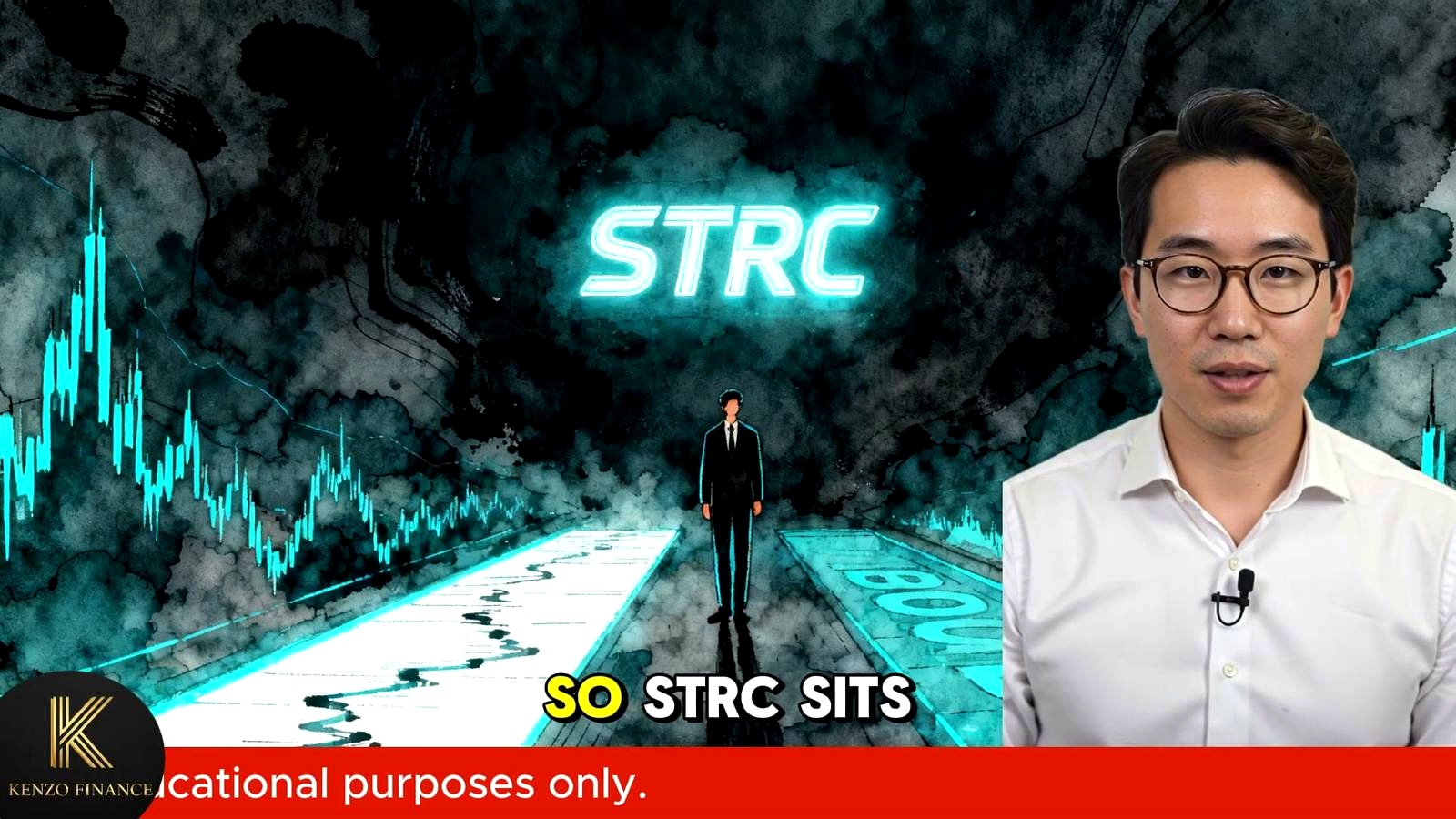
Kenzo Finance describes STRC as a hybrid instrument. It is not a common stock in the usual sense because its price is anchored and it pays a fixed dividend. It is also not a bond, because it is perpetual and does not mature. The host says financial professionals view it as a short-duration, high-yield credit instrument.
That framing matters because it explains why investors may find STRC attractive even outside the Bitcoin story. In the analyst’s view, the combination of a par anchor and an 11.5% annual payout gives Strategy a useful middle-ground financing tool. The yield attracts buyers, and the anchored structure helps the company keep the instrument near the level where it can efficiently issue more shares.
The risks Kenzo Finance highlights

The host does not present the system as risk-free. Kenzo Finance identifies three main pressure points.
- Bitcoin downside: if BTC falls sharply and stays down, sentiment around Strategy’s balance sheet and long-term financial health could weaken, making it harder for STRC to stay near par.
- Higher interest rates: if market yields rise significantly, an 11.5% dividend may look less compelling, forcing Strategy to offer a higher payout and raising its cost of capital.
- Dilution and balance-sheet burden: ongoing issuance of preferred shares adds obligations to Strategy’s balance sheet, something existing shareholders may question.
These are not presented as signs of imminent failure. They are the conditions the host says investors should monitor if they want to understand whether the mechanism remains durable.
This model is already spreading beyond Strategy

Kenzo Finance also points to a second company using a similar playbook. Strive, trading under the ticker ASST, has its own preferred-share instrument called SATA. The figures cited in the video are:
- 12.75% annual dividend for SATA
- Recent trading around 90 to 92.5
- STRC dividend at 11.5%
The host says SATA’s higher dividend likely reflects either Strive’s shorter operating record, a need to attract investors, or a market perception of higher risk. The broader takeaway is that preferred-equity structures tied to Bitcoin treasury strategies are no longer unique to Strategy.
For Bitcoin, Kenzo Finance sees that as a meaningful development. If more public companies build funding structures specifically designed to accumulate BTC over time, the cumulative impact could be a deeper institutional bid and a larger share of Bitcoin removed from liquid circulation.
What to watch next

According to Kenzo Finance, the clearest near-term indicators are not abstract macro narratives but measurable corporate finance signals.
- Watch whether STRC stays near $100 after future ex-dividend dips.
- Track whether recovery times remain around 9,10 trading days or start getting longer.
- Compare the size of Strategy’s BTC purchases with where STRC is trading at the time.
- Monitor SATA as a test of whether this funding model works beyond one company.
- Follow changes in rates, regulation, dividend taxation, and treasury rules that could affect preferred-share structures.
The article’s central lesson is straightforward: if Strategy’s capital instrument keeps snapping back to par, the company’s Bitcoin accumulation engine stays alive. And if similar structures spread, Bitcoin demand may increasingly come from engineered corporate funding loops rather than discretionary one-off buys.
FAQ
Why does STRC keep returning to $100?
Kenzo Finance says the share is built around a $100 par value. Strategy can adjust the dividend to influence demand: lower it if the stock trades above par, raise it if the stock falls below par.
Why did Kenzo Finance focus on 9 trading days?
Because the host treats recovery speed as a live measure of Strategy’s fundraising capacity. A return to par in 9 trading days versus the historical 10 means less downtime for the ATM program.
What was the recent Strategy Bitcoin purchase mentioned in the video?
The video cites a buy of 1,031 BTC for about $76.66 million, at an average price of $74,326 per coin. Kenzo Finance says it was smaller partly because STRC had not yet fully recovered to par.
How large is Strategy’s Bitcoin position relative to total supply?
Kenzo Finance puts Strategy’s holdings at 762,999 BTC, or about 3.6% of Bitcoin’s fixed 21 million supply cap.
Is STRC the only instrument like this?
No. Kenzo Finance points to Strive’s SATA, which offers a 12.75% annual dividend and recently traded around 90 to 92.5. The host presents that as evidence the model may spread across more companies.
Original Source

John Burnell focuses on Bitcoin infrastructure, wallet security and blockchain technology. He writes educational articles explaining how Bitcoin works and how the technology evolves.