Gold’s surge has complicated one of crypto’s favorite narratives: that Bitcoin is the cleaner hedge. After a rebound from February lows, the question is whether BTC has finally started to regain relative strength, or whether the move is just another pause before gold pulls further ahead.
Core thesis: the BTC-gold bounce may be a trap
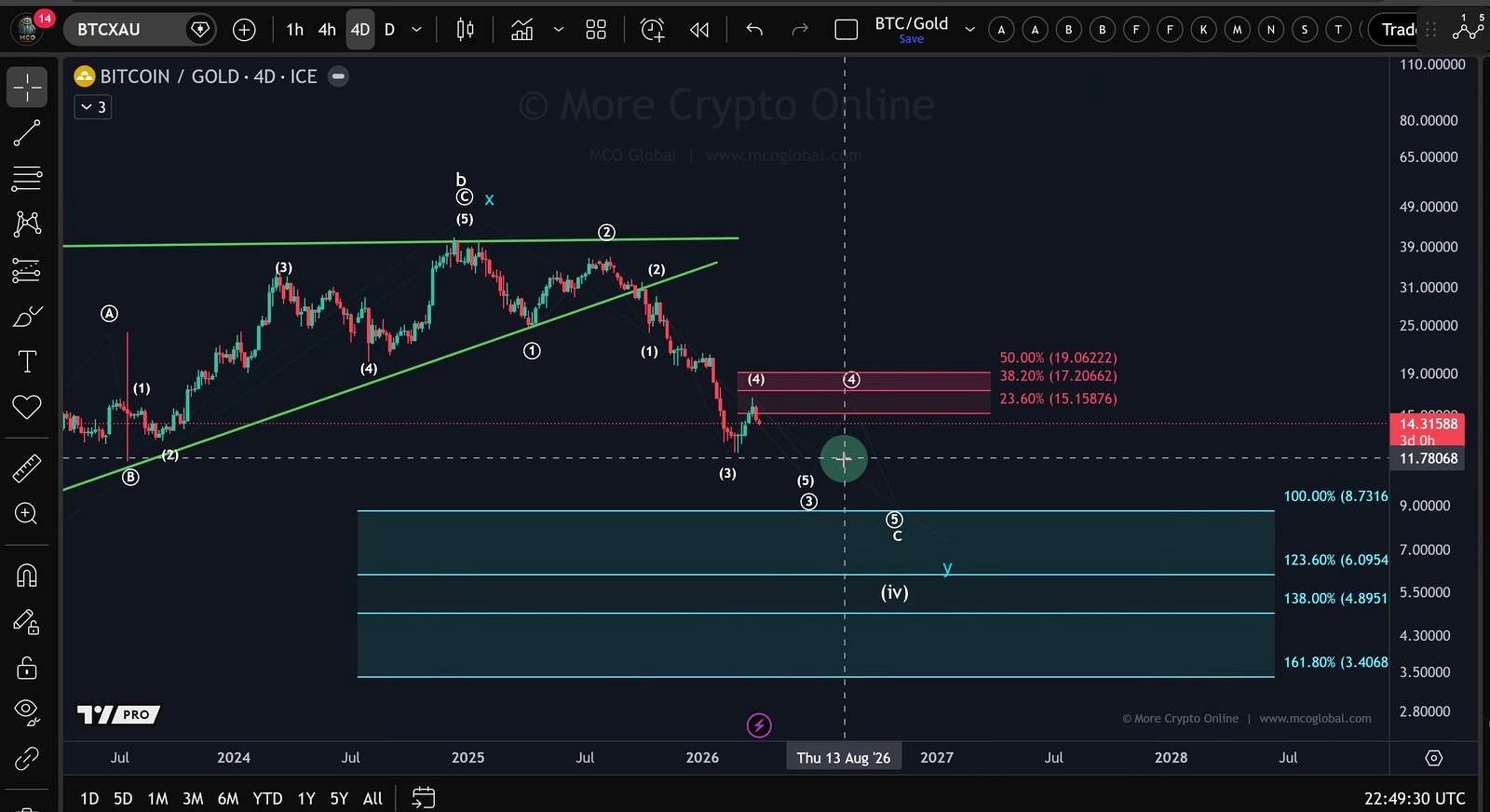
According to More Crypto Online, the recent rebound in the BTC/XAU ratio does not mark a durable turn. The analyst argues that Bitcoin versus gold is still tracing out a larger corrective structure that began after a major top in March-April 2021, with an initial decline into the end of 2022, followed by a countertrend rally that slightly exceeded the 2021 highs into late 2024 and early 2025. In his Elliott Wave framework, that rally was a B-wave, not a new bull leg, and the current weakness is the expected C-wave lower.
That framing matters because it implies the market has not yet completed its reset against gold. More Crypto Online says the ratio appears to be in the later stages of the decline, but still likely needs another leg lower, a wave five, after the recent bounce. He points to a possible downside target around 8.7 on the BTC/XAU chart and says that could mean Bitcoin loses another 40% to 50% versus gold from current levels. He also notes that after a break below a technical line in September 25, BTC/XAU had already fallen roughly 64% to 65%.
In broader market context, this is a relatively contrarian message for crypto traders who focus mostly on Bitcoin’s dollar price. BTC can rise in USD terms and still underperform gold if bullion rises faster. That distinction has become more relevant as precious metals have benefited from persistent macro uncertainty, central-bank buying, and demand for non-sovereign stores of value. Bitcoin still trades with a risk-asset component at times, while gold often benefits when growth expectations weaken or real-world geopolitical stress rises. In that sense, a bearish BTC/XAU call does not necessarily require outright Bitcoin doom; it requires gold to remain the stronger asset on a relative basis.
Why the analyst thinks the structure still points lower
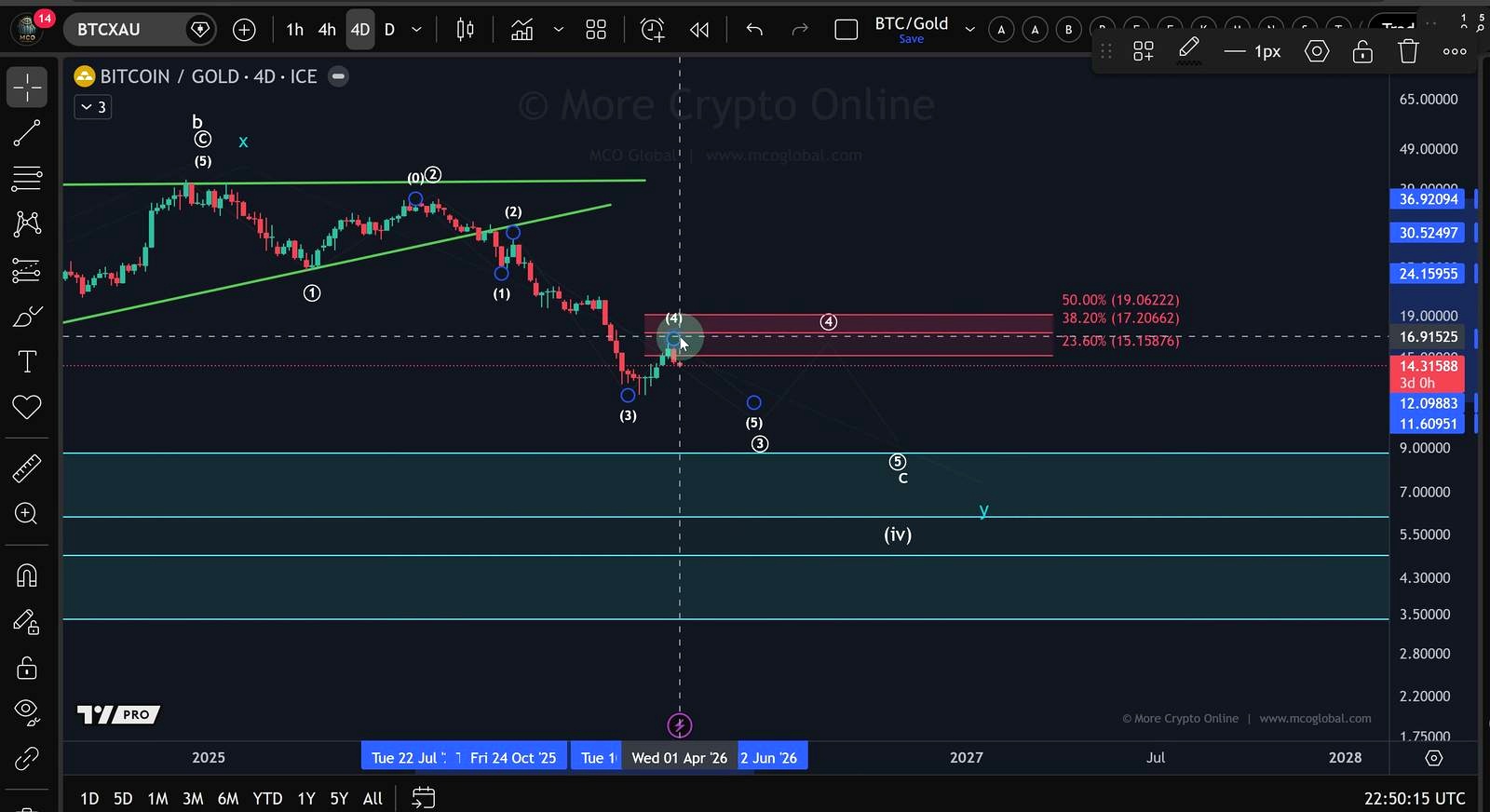
According to More Crypto Online, the key mistake traders are making is treating the move off the February lows as proof of a trend reversal. In his view, the rebound fits a textbook fourth-wave rally within a larger five-wave decline. He describes it as a “counter trend bounce” or “deadcat bounce” into resistance, rather than the start of a sustained phase of Bitcoin outperformance.
The technical detail behind that call is the retracement level. The host says the rebound moved into a typical wave-four resistance zone around the 38.2% retracement of the previous decline. In Elliott Wave analysis, that is a common place for a rally to stall before the final leg lower begins. If that interpretation holds, the next move should be another decline in BTC/XAU, with at least one more low and “probably two” before the correction is complete.
The larger historical claim is also central to the thesis. The analyst says BTC/XAU has been in a long-term uptrend since around 2010, marked by higher highs and higher lows, but with momentum slowing over time. In that telling, the current drawdown is not a complete regime break. It is a correction inside that larger secular uptrend. That nuance is important: More Crypto Online is not arguing that Bitcoin permanently loses its edge to gold, but that the relative drawdown likely persists for much of 2026 before the bigger trend can reassert itself.
That is a subtle but useful distinction for portfolio construction. Investors deciding between BTC and gold are not just asking which asset goes up; they are asking which one delivers better risk-adjusted performance during a given macro window. If the ratio keeps falling, gold may remain the cleaner defensive asset even if Bitcoin performs adequately in absolute terms.
What could go wrong with this bearish BTC/XAU thesis
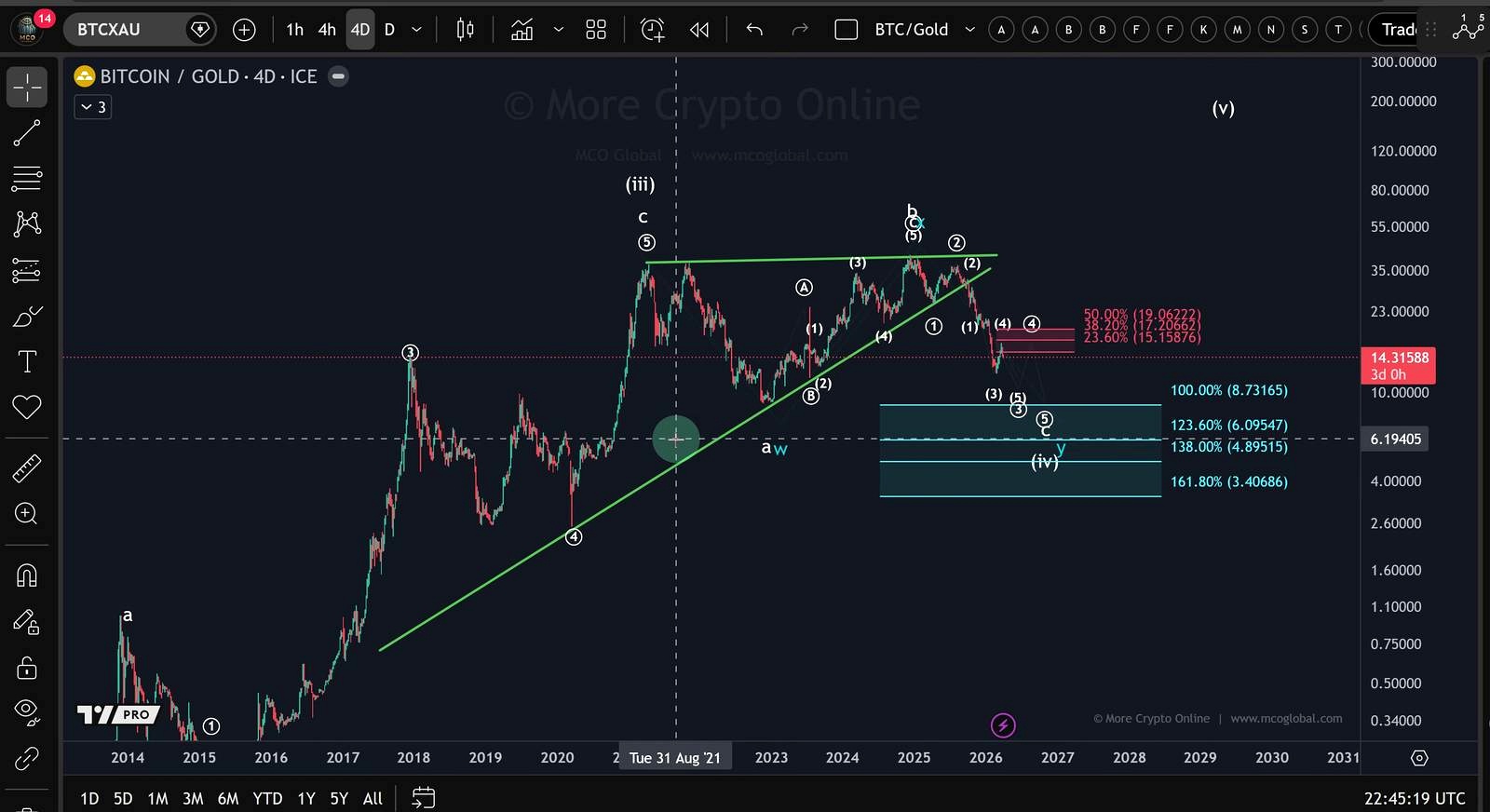
The obvious risk to the call is that the rebound from the February low is not a fourth-wave bounce at all, but the beginning of a larger trend reversal. More Crypto Online’s framework depends heavily on the idea that the recent rally should fail below resistance and transition into a final decline. If BTC/XAU decisively pushes above that resistance zone and holds it, the wave count becomes far less convincing.
There is also a broader issue with ratio analysis during regime shifts. Gold and Bitcoin can both behave as alternatives to fiat debasement, but they do not react to catalysts on the same timeline. A strong crypto-specific catalyst, such as renewed ETF inflows, a sharp improvement in liquidity conditions, or a broad risk-on move in digital assets, could cause Bitcoin to outperform gold faster than a purely structural model anticipates.
Another counterargument is that gold’s recent strength may itself be overstretched. If metals are already deep into a crowded momentum trade, even a modest consolidation in gold could improve BTC/XAU without requiring heroic Bitcoin upside. The analyst alludes to stronger assets outperforming weaker ones, but relative strength can rotate quickly once macro pricing shifts.
Finally, Elliott Wave analysis is inherently interpretive. Its supporters see pattern recognition and probabilistic road maps; critics see flexible labeling that can be revised after the fact. That does not make the framework useless, but it does mean traders should treat the 8.7 target as a scenario, not a certainty.
What to watch next
The first trigger is whether BTC/XAU rejects from the recent resistance zone tied to the 38.2% retracement. If the ratio rolls over and starts printing fresh relative lows, that would support the analyst’s view that wave five is underway. A sustained push toward the 8.7 area would strengthen the case that Bitcoin still has meaningful underperformance left versus gold.
The invalidation signal is simpler: if the ratio breaks above the recent resistance area and holds there, the “deadcat bounce” thesis weakens. Beyond the chart itself, traders should also monitor whether macro conditions continue to favor defensive assets. If gold keeps attracting safe-haven demand while Bitcoin trades more like a growth-sensitive asset, the relative trend may stay under pressure deep into 2026.
FAQ
What does BTC/XAU mean?
BTC/XAU is the price of Bitcoin measured in gold rather than dollars. XAU is the market symbol commonly used for one troy ounce of gold. When BTC/XAU rises, Bitcoin is outperforming gold; when it falls, gold is outperforming Bitcoin.
Can Bitcoin go up in dollars and still be bearish against gold?
Yes. Relative-performance charts measure one asset against another, not against cash. If Bitcoin rises 10% in dollar terms but gold rises more over the same period, BTC/XAU will still fall.
What is a B-wave and C-wave in Elliott Wave analysis?
In a standard corrective pattern, price often moves in three parts: A, B, and C. The A-wave is the first move against the prior trend, the B-wave is a countertrend rebound, and the C-wave is the next leg in the correction. Traders using the framework often look for the C-wave to complete the larger pullback.
Why compare Bitcoin to gold instead of just looking at BTC/USD?
Because BTC/USD only shows whether Bitcoin is gaining or losing against the dollar. BTC/XAU asks a different question: is Bitcoin the better store-of-value trade than gold right now? That matters for investors choosing between two non-yielding alternative assets.
What happened after previous major BTC/XAU corrections?
The analyst argues that prior corrections after the 2013 top and in 2020 also unfolded as three-wave structures before the longer-term uptrend resumed. Traders who agree with that reading see the current weakness as another reset within a secular trend, not necessarily a permanent breakdown.
Source Video

An Indian crypto journalist covering the developments in the Bitcoin and blockchain industries. Her work helps readers understand key changes in the world of digital assets.