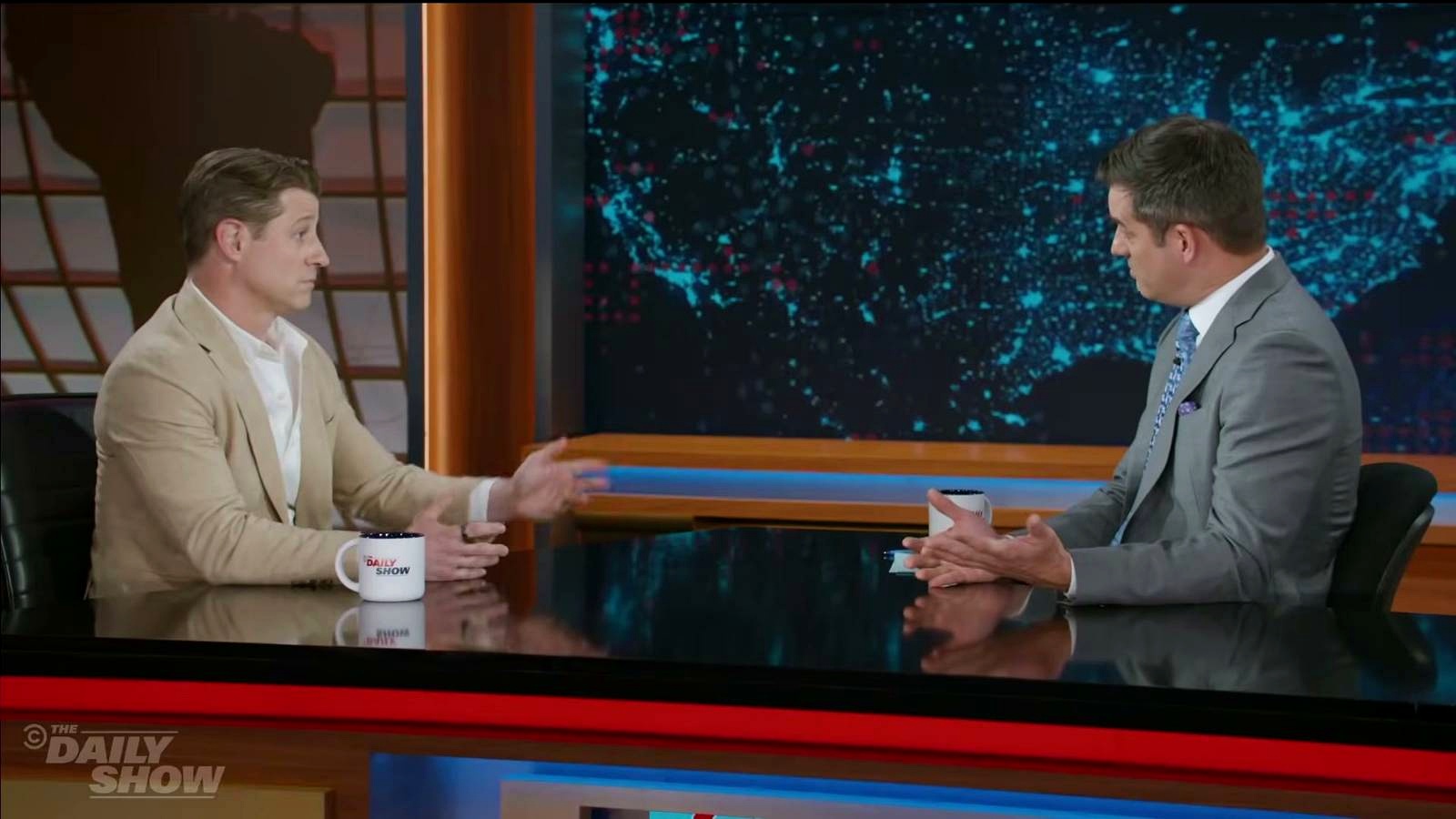
As Bitcoin pushes deeper into the financial mainstream, the debate around what exactly investors are buying has not gone away. According to The Daily Show, actor and author Ben McKenzie argues that crypto’s latest legitimacy push still rests on the same unresolved problem: trust in people, not code.
The Core Thesis: crypto is being sold as trustless, but McKenzie says it never was

According to The Daily Show, McKenzie’s central claim is blunt: crypto is “a scam, ” or at minimum a market structure built on misinformation, weak disclosures and salesmanship dressed up as technological inevitability. His argument turns on a simple distinction. Money, he says, is a social construct backed by trust, and crypto’s pitch that computer code can replace that trust is, in his words, “a lie” and a “fundamental misunderstanding of what money is.”
He uses the FTX collapse as his cleanest example. McKenzie notes that Sam Bankman-Fried is now serving 25 years in federal prison for fraud, and says the scheme hinged on changing “a single line of code” that let him borrow customer assets. For McKenzie, that undercuts one of crypto’s oldest slogans: if people write code, people can also manipulate it.
That argument lands at an awkward moment for the market. Bitcoin is no longer a fringe asset traded only on offshore exchanges. Spot ETFs, large custodians and deeper institutional participation have changed its buyer base and softened some of the sector’s early image problem. In that sense, McKenzie’s critique is more contrarian today than it was in the aftermath of the 2022 blowups, when exchange failures and lending collapses dominated headlines.
Still, his broader point about trust has not disappeared. Even in Bitcoin’s more mature phase, investors still depend on custodians, ETF issuers, brokerages, lawmakers, developers and market makers. The “trustless” ideal is strongest at the protocol level, but much of the real-world investment stack around Bitcoin remains highly trust-dependent. That is precisely why scandals outside the Bitcoin network itself can still hit sentiment across the entire asset class.
Why this matters now: Bitcoin may be mainstream, but the politics and marketing around it are intensifying

According to The Daily Show, McKenzie argues that the industry’s real objective is to avoid being treated like traditional investments under U.S. law. He says people buying crypto in hopes of profits “through no work of [their] own” are making an investment in the plain-language sense, yet the industry resists securities-style regulation because disclosure rules would force firms to reveal more about who is taking customer money and what they are doing with it.
That critique reflects one of crypto’s longest-running battles in Washington: whether tokens should be regulated primarily as securities, commodities, payment instruments or something else entirely. Bitcoin occupies a special position in that debate. It is generally treated more favorably than most other digital assets because it lacks a central issuer and is widely viewed by U.S. regulators as a commodity rather than a security. But that distinction often gets blurred in public debate, especially when critics discuss “crypto” and “Bitcoin” interchangeably.
McKenzie does exactly that at points in the interview. He says “Bitcoin is full of lies, ” then broadens the criticism to celebrity endorsements, scams, criminality and exchange misconduct. For readers, that conflation matters. The failure of FTX, Celsius and many celebrity-promoted tokens exposed severe problems in crypto finance, but those are not the same thing as a failure in Bitcoin’s underlying consensus mechanism. Serious market participants increasingly separate Bitcoin-the-asset from crypto-the-industry, and that is one reason institutional capital has continued to enter BTC even after the sector’s reputational damage.
The host also raises another live issue: political monetization. McKenzie claims that the U.S. president and his family have benefited “to the tune of billions of dollars” via cryptocurrency over roughly a year and a half. Whatever readers make of that specific allegation, the broader concern is real. As crypto becomes politically useful, it also becomes easier to market, lobby and package in ways that may outrun investor protections.
The supporting points: celebrity marketing, retail psychology and who actually owns crypto

According to The Daily Show, McKenzie traces part of crypto’s surge back to the pandemic, when boredom, stimulus-era speculation and aggressive advertising pulled in new retail users. He singles out celebrity campaigns, saying stars were paid in “real dollars” to persuade consumers to convert their own dollars into crypto assets. He also says the target audience skewed heavily male and young, describing young men as a particularly risk-tolerant demographic and therefore easier marks for speculative marketing.
That claim aligns with a familiar pattern from prior cycles. Retail-heavy crypto booms often accelerate when easy access, social proof and fear of missing out combine. The message is rarely just financial upside. It is social identity: smart people are early, brave people take risk, doubters get left behind. McKenzie paraphrases the Matt Damon-era ad style as an appeal to masculinity and shame avoidance as much as investment logic.
He points to Celsius as another example of how that psychology can persist even after losses. In his telling, he interviewed multiple victims of the platform’s collapse and says all of them still believed in crypto afterward. For him, that shows how effectively the industry shifts blame back onto users through slogans like “do your own research, ” even when the average buyer lacks the tools to evaluate counterparty risk.
He also cites polling to argue the market remains smaller than the online discourse suggests. McKenzie says only 5% to 6% of the population is really into crypto, while another roughly 10% is “playing around with it.” If so, that leaves about 84% of the country outside the space. That framing is politically useful for critics: crypto may feel culturally dominant online, but it is still not the default financial behavior of most Americans.
One more claim from the interview is likely to draw scrutiny. McKenzie says Jeffrey Epstein secretly funded Bitcoin development in 2015 via the MIT Media Lab, and adds that Blockstream received funding from Epstein while discussing reporting around Adam Back and speculation over Satoshi Nakamoto’s identity. Even where pieces of that timeline overlap with prior public reporting around Epstein’s ties to academic and tech circles, readers should separate guilt-by-association arguments from protocol-level analysis. Unsavory backers can taint an ecosystem’s reputation without proving that Bitcoin itself is fraudulent.
What Could Go Wrong With McKenzie’s Thesis

The largest weakness in McKenzie’s case is that it often treats Bitcoin as interchangeable with the worst behavior of the broader crypto industry. That was a stronger rhetorical move in the wake of exchange collapses, but it is less clean today. Bitcoin has survived multiple bankruptcies, enforcement waves and fraud scandals without its core network being reversed or administratively rescued. For many investors, that resilience is the point.
There is also a real counterargument on regulation. While McKenzie says the industry does not want proper oversight, Bitcoin exposure is now increasingly being accessed through heavily regulated wrappers, including public-market ETFs and large brokerages. That does not eliminate risk, but it does weaken the idea that every buyer is operating in a disclosure vacuum.
Another challenge is market behavior itself. If Bitcoin continues attracting sovereign, institutional and treasury demand, critics who frame it mainly as a retail con may find the thesis harder to sustain. Assets can begin as speculative vehicles and still mature into durable macro instruments if liquidity, custody and policy support deepen over time.
What would most strongly validate McKenzie’s view? A renewed cycle of hidden leverage, widespread exchange failures, major custodial losses or evidence that political and celebrity marketing are again driving unsophisticated buyers into structurally opaque products. What would weaken it? Continued institutional adoption, cleaner market plumbing and a clearer separation between Bitcoin and the more failure-prone corners of crypto speculation.
What to Watch Next
The next test is not rhetorical but structural. Watch whether Bitcoin adoption continues to shift toward regulated vehicles rather than offshore venues and yield schemes. Monitor U.S. policy around market structure and disclosure, especially any attempt to draw a brighter line between Bitcoin and other tokens. On the market side, the key question is whether new inflows are coming from long-term allocators or returning retail momentum. If the next leg up is driven mainly by leverage, celebrity-style promotion and memecoin spillover, McKenzie’s critique will regain force quickly. If it is driven by ETFs, treasuries and custody infrastructure, his broad-brush attack on Bitcoin will look less complete.
FAQ
What does “trustless” mean in Bitcoin?
In Bitcoin, “trustless” usually means users do not need to trust a single intermediary to verify ownership or settle transactions. The network relies on open-source software, distributed nodes and consensus rules. In practice, though, many investors still trust exchanges, custodians or ETF issuers to access BTC.
How is Bitcoin different from companies like FTX or Celsius?
Bitcoin is a decentralized network and asset. FTX and Celsius were centralized businesses built around trading, custody and lending. Their failures exposed counterparty and governance risk, not necessarily a failure in Bitcoin’s base-layer protocol.
Why do some critics say Bitcoin should be treated like a security?
Critics often argue that many people buy digital assets mainly to profit from the efforts of others, which resembles an investment contract. Bitcoin is usually treated differently from most tokens because it has no central issuer and is widely viewed by U.S. regulators as a commodity.
What happened the last time retail speculation dominated crypto markets?
The pandemic-era boom brought in a wave of new users, celebrity endorsements and heavy leverage. That cycle ended with major failures including FTX, Celsius and other firms, wiping out large amounts of retail capital and triggering a broad repricing of risk across digital assets.
What would a more regulated Bitcoin market look like?
It would likely mean more trading and custody through registered firms, better disclosures around conflicts and reserves, tighter separation of customer assets, and fewer opaque yield products. For many investors, spot ETFs are one example of that trend, even if they do not resolve every risk around the broader crypto market.
Content Source

Omar Al-Sharif lives and works in the UAE and is involved in the blockchain technology industry. He writes articles on Bitcoin and digital assets as a personal passion, explaining complex topics in simple and understandable language.