With Bitcoin trading as both a macro hedge and a high-beta risk asset, the central question for investors is whether the easy upside is already gone. According to Savvy Minds Connect, relaying Michael Saylor’s latest long-term framework, the answer is no: Bitcoin is still early by global capital-market standards, and that is the core reason he thinks the asset has room to compound far beyond current expectations.
The Core Thesis
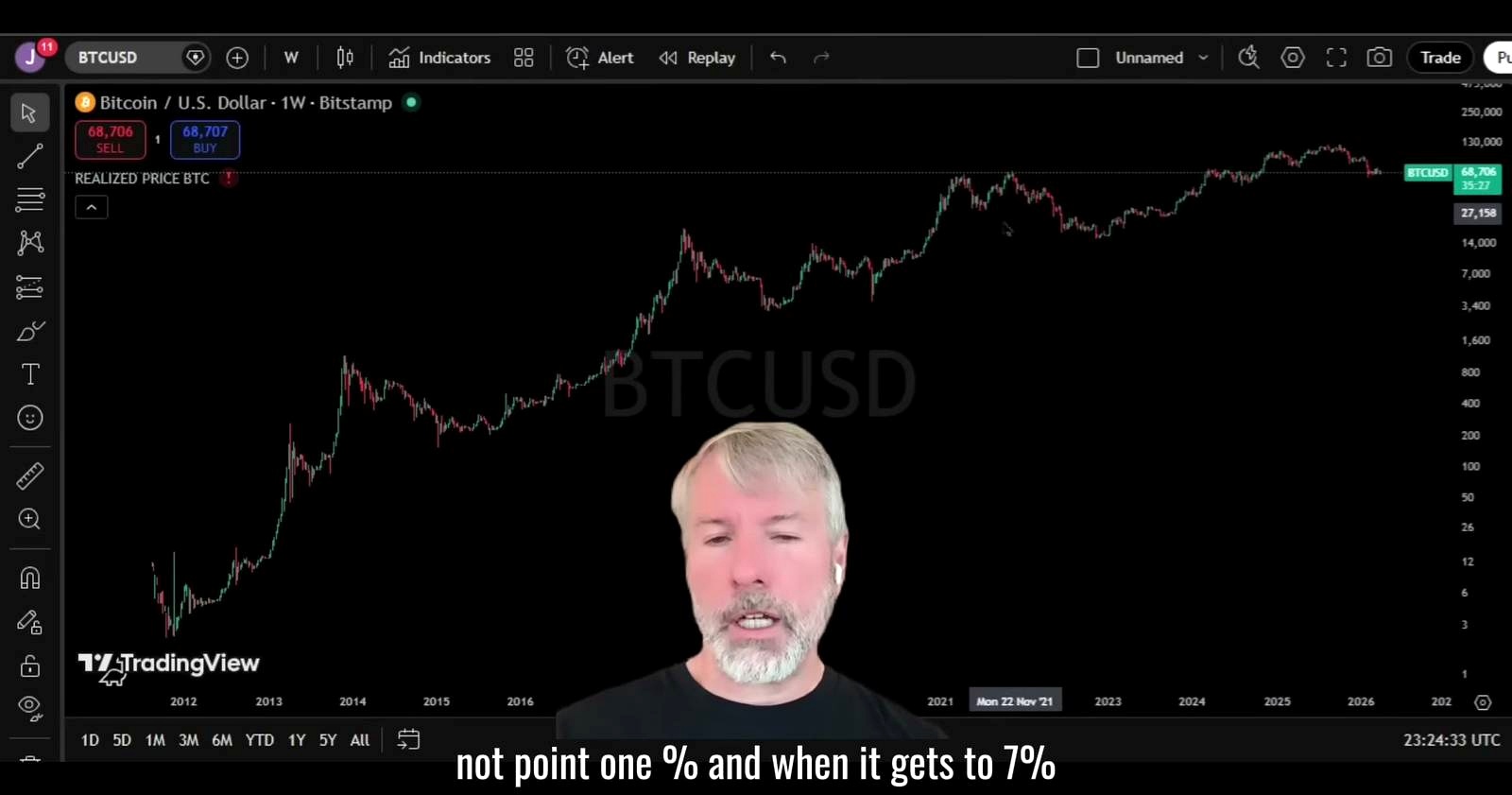
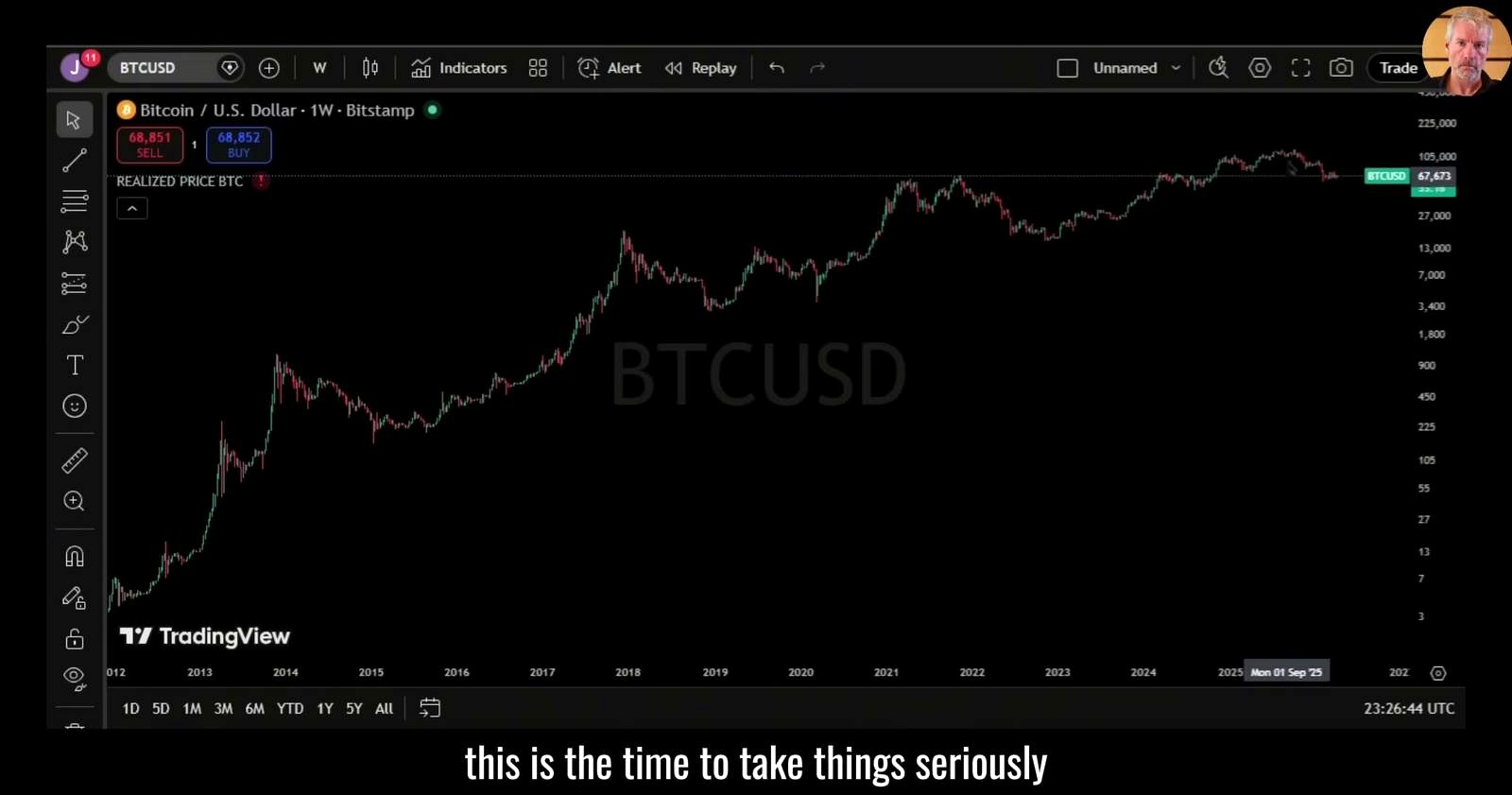
According to Savvy Minds Connect, Saylor’s central claim is that Bitcoin remains tiny relative to the pool of wealth it could eventually absorb as a global store of value. In the video, he says Bitcoin is currently about 0.1% of the world’s assets, or roughly $1.4 trillion out of $900 trillion. He pegs the global addressable market for long-term store-of-value capital at about $450 trillion, then argues Bitcoin could eventually rise to 7% of world assets. In his framework, that would imply a price of about $13 million per coin by 2045, roughly 21 years out.
That is an aggressively bullish view even by Bitcoin standards. The broad market already accepts the idea that Bitcoin is maturing into a macro asset, especially after spot ETF adoption and growing institutional treasury interest. But a path from a roughly trillion-dollar asset to a multi-hundred-trillion-dollar network would require more than cyclical inflows. It would require sustained global monetization: capital rotating out of real estate, bonds, equity proxies for inflation protection, and possibly parts of gold’s role as reserve collateral.
Saylor’s thesis sits on a familiar but still controversial foundation: Bitcoin as “digital capital” rather than simply a speculative token. That framing has become more mainstream over time, yet the scale of his target remains far outside consensus. Many institutional models now treat Bitcoin as a potential competitor to gold or as a non-sovereign reserve asset. Far fewer assume it captures a meaningful slice of the entire global store-of-value complex.
Still, the argument matters because it reframes Bitcoin from a cycle trade into a generational repricing. If investors adopt that lens, corrections look less like thesis-breakers and more like entry points.
Why the Growth Path Matters
According to Savvy Minds Connect, Saylor does not argue for perpetual explosive growth at the current pace. He explicitly says Bitcoin has risen about 50% a year over the last four years, but expects that rate to slow as the asset gets larger. In the video, he describes a glide path from about 50% to 45%, then 40%, 35%, 32%, 30%, 28%, and eventually 25% annual growth.
That deceleration is central to the pitch. Saylor is not claiming Bitcoin can keep behaving like a small-cap asset forever. He is claiming it can mature into a larger, lower-volatility asset while still outperforming conventional benchmarks. He contrasts that path with equity indexes that he says have historically returned roughly 10% to 12%. He also suggests wealthy investors currently parking value in real estate, bond portfolios, and some equity indexes could gradually migrate toward Bitcoin as a superior long-term store of capital.
That point broadly aligns with a real market trend: Bitcoin volatility has fallen over long horizons compared with earlier cycles, even if it remains sharply volatile on shorter ones. In the video, Saylor compares conventional equity volatility through the VIX at around 15 to 16 with Bitcoin’s DVOL at roughly 55. He argues that if Bitcoin ever becomes a $200 trillion asset class, its volatility could fall toward 20, closer to a VIX near 15.
That is directionally plausible. Larger, more liquid asset classes typically compress volatility over time. But Bitcoin’s global, 24/7 market structure and leverage culture likely mean it will remain structurally more volatile than blue-chip equities. Saylor acknowledges as much, arguing that Bitcoin will “always” be somewhat more volatile because it is continuously tradeable and can be shorted with up to 100x leverage in offshore venues.
The Secondary Claims Driving the Bull Case
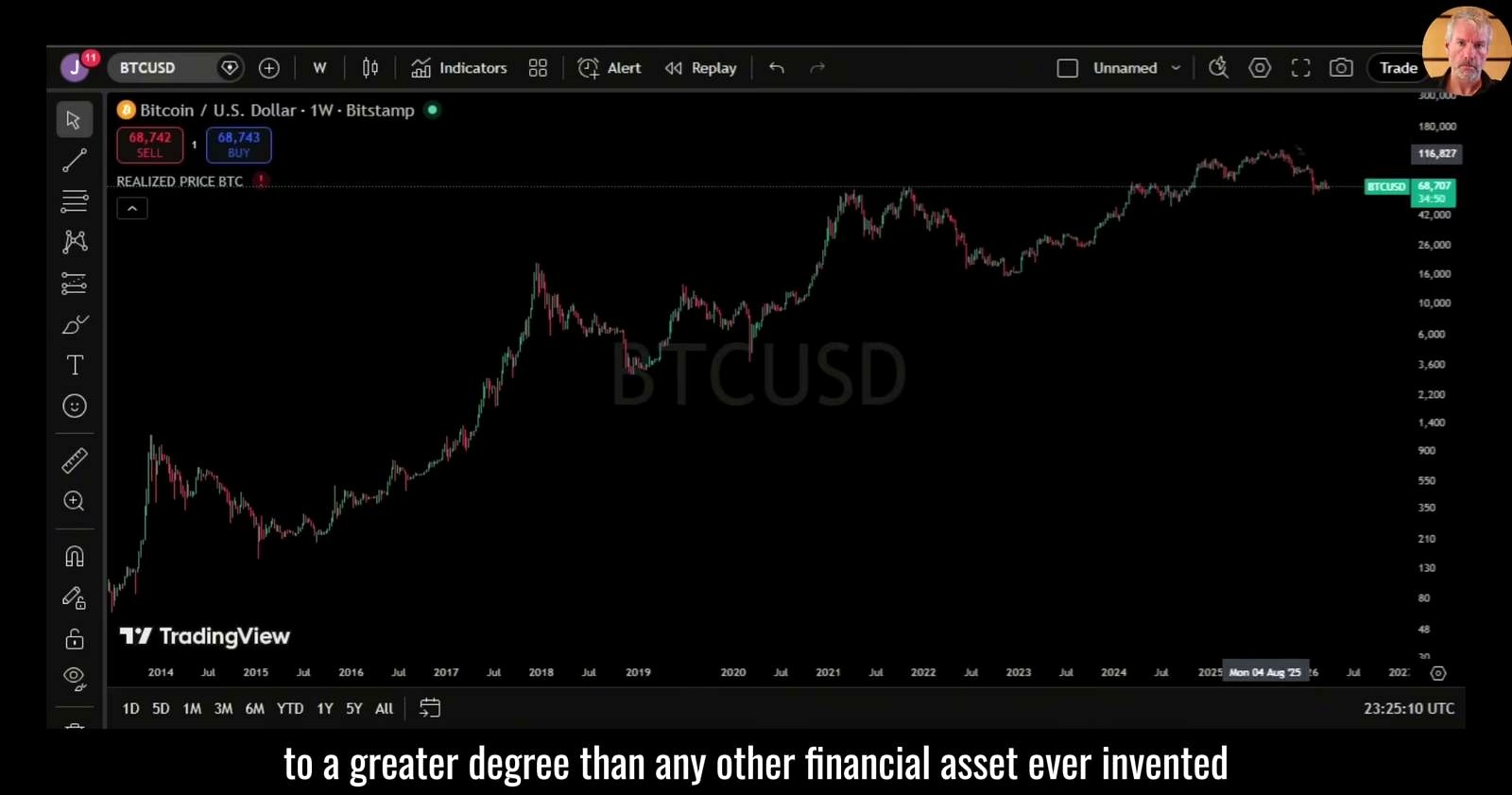
According to Savvy Minds Connect, another major pillar of Saylor’s argument is that Bitcoin outcompetes both consumer inflation and luxury-asset inflation. He says consumer products may appreciate at roughly 2% to 3% a year, while prime real estate in places like Palm Beach or the Hamptons could rise around 6% to 7%. In that framing, investors need to beat 2% if they want to preserve everyday purchasing power, and beat around 7% if they want to keep up with scarce luxury assets. His conclusion: Bitcoin “beats everything.”
He extends that thesis to accessibility. In the video, Saylor says Bitcoin empowers the world’s 8 billion people because it can be bought on an Android phone in small increments, citing an example of buying $40 a week. He frames that as a structural advantage over traditional assets, where access, custody, and minimum size often create barriers. He also makes one of the video’s most concrete illustrations: if one bitcoin reaches $13 million in 21 years, then owning 5 BTC would imply about $65 million in future nominal value.
That example is rhetorically powerful, but it is also where readers should separate aspiration from forecasting precision. Bitcoin’s fixed supply makes long-duration upside scenarios inherently convex if adoption keeps expanding. But there is a large difference between saying Bitcoin could continue monetizing globally and claiming a specific stack of 5 BTC is likely to make someone a multimillionaire on a set timeline.
The host then turns the message into a direct accumulation pitch, arguing that investors should keep building positions before Bitcoin rises to levels where “meaningful exposure” becomes unaffordable. That reflects a classic Bitcoin savings thesis: gradual accumulation matters more than market timing if the long-term monetization story holds.
What Could Go Wrong
The cleanest way to break this thesis is straightforward: Bitcoin fails to capture the share of global wealth Saylor expects. A move from roughly 0.1% to 7% of world assets is not just a price forecast; it is a geopolitical and financial-system forecast. It assumes continued regulatory normalization, no fatal protocol-level failure, persistent institutional demand, and ongoing preference for a non-sovereign digital asset over incumbents like gold, real estate, and government debt.
There are also risks the video does not seriously engage. One is policy risk. Governments may tolerate Bitcoin ownership while resisting its deeper monetization into banking, pensions, sovereign reserves, or cross-border settlement. Another is competition for capital. Even if Bitcoin remains dominant among crypto assets, investors still allocate across equities, AI-driven growth sectors, private markets, and yield-bearing instruments. Capital does not rotate into Bitcoin in a vacuum.
Then there is the macro problem. Bitcoin has increasingly behaved like a liquidity-sensitive asset during periods of tight monetary policy. If real yields stay elevated or global growth weakens sharply, long-duration speculative demand can stall. The thesis also assumes adoption outruns dilution from leverage cycles, custody concentration, and ETF-driven market structure shifts that could amplify correlation with traditional risk markets rather than reduce it.
Most of all, a long-term bullish thesis can be right while the path remains brutal. Drawdowns of 50% or more have historically been part of Bitcoin’s maturation process.
What to Watch Next
If investors want to test Saylor’s framework in real time, the key signals are not just price. Watch whether Bitcoin’s share of global investable wealth continues to rise across cycles, whether institutions keep adding it to treasury and fund mandates, and whether volatility trends lower as market depth increases.
More concretely, the thesis gains credibility if Bitcoin keeps attracting capital beyond retail speculation: corporate treasury adoption, ETF inflows that persist outside momentum bursts, and broader treatment as reserve collateral or strategic savings. It weakens if Bitcoin remains mostly a cyclical trading vehicle, with adoption stalling each time macro liquidity tightens.
The real trigger is simple: is Bitcoin becoming infrastructure for global savings, or is it still mainly a high-conviction trade? That answer will matter more than any single annual price target.
FAQ
What does it mean when Bitcoin is described as a “store of value”?
A store of value is an asset people expect to preserve purchasing power over time. Gold is the traditional example. Bitcoin advocates argue its fixed supply and decentralized design make it a digital version of that role, though with much higher volatility.
How is Bitcoin’s volatility different from stock-market volatility?
Stock volatility is often tracked by measures like the VIX, which reflects expected swings in U.S. equities. Bitcoin has its own volatility benchmarks, and it tends to trade more sharply because it is global, trades 24/7, and is widely used with leverage.
Why do some investors compare Bitcoin with real estate and bonds?
The comparison comes from capital allocation. Investors use real estate, bonds, and some equity exposure not just for growth but to store wealth over time. The Bitcoin bull case says some of that savings function could migrate into a scarce digital asset.
What would need to happen for Bitcoin to reach multi-million-dollar prices?
Bitcoin would likely need far broader global adoption as a long-term savings asset, deeper institutional ownership, continued regulatory acceptance in major economies, and a much larger role in portfolios currently dominated by gold, real estate, or fixed income.
Has Bitcoin’s growth rate historically slowed as it matured?
Yes. Earlier cycles produced much larger percentage gains because Bitcoin started from a tiny base. As market capitalization rises, sustaining those returns becomes harder. That is why many long-term bulls expect lower but still above-market growth over time rather than endless parabolic upside.
Original Source

An Indian crypto journalist covering the developments in the Bitcoin and blockchain industries. Her work helps readers understand key changes in the world of digital assets.