When macro fear rises, investors usually want to know which asset actually behaves like protection and which one simply sounds like it should. That question matters more now because the gap between gold’s latest run and Bitcoin’s trading behavior has forced a harder look at whether BTC is really “digital gold” or still a high-beta risk asset wearing a monetary narrative.
The Core Thesis
According to tastylive, the cleanest answer to the “digital gold” debate is: not yet. The analyst argues that Bitcoin shares some of gold’s core monetary features, scarcity, no cash flow, and sensitivity to loose monetary policy, but the market data no longer supports the idea that the two play the same role in a portfolio.
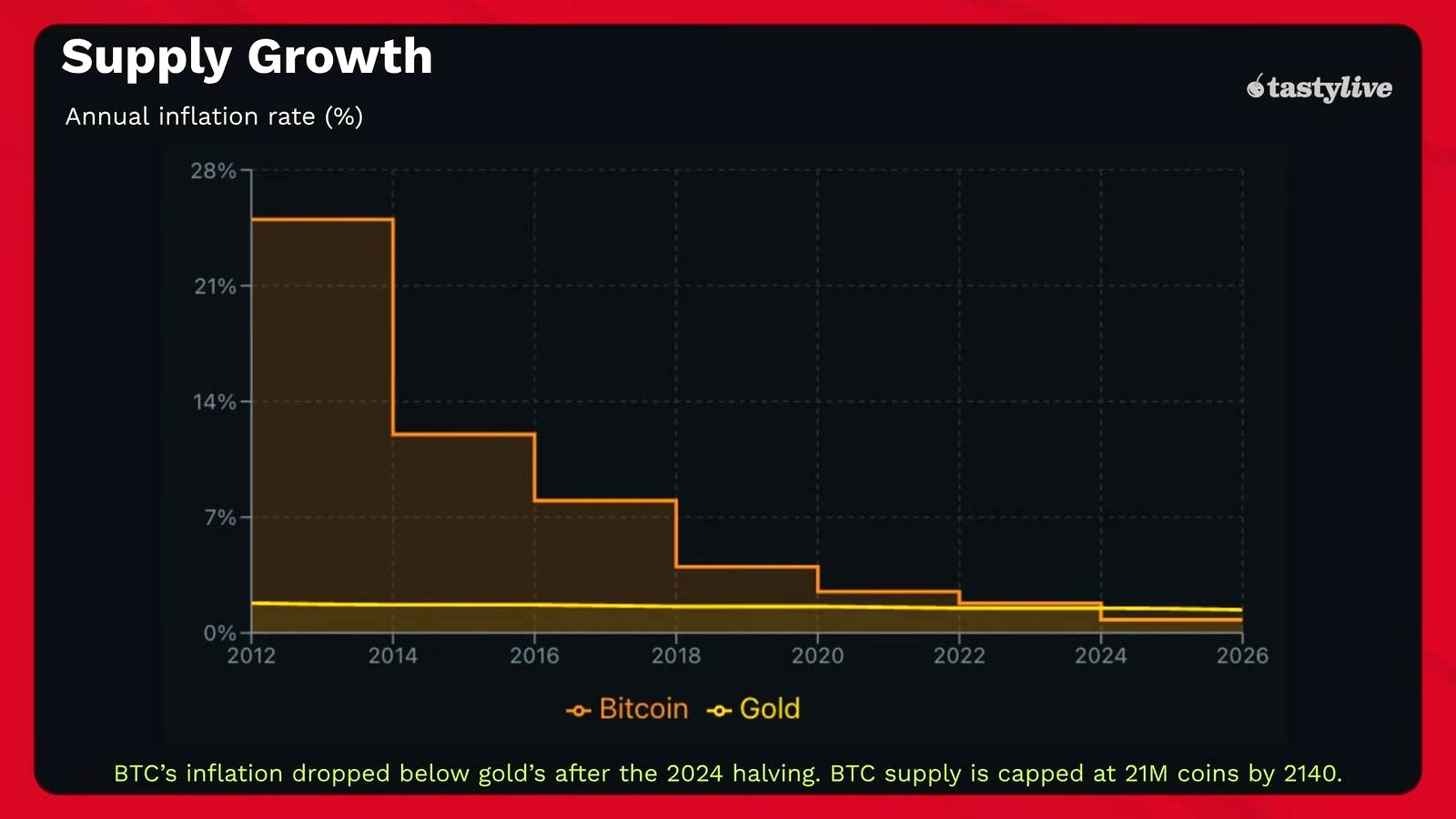
The bullish comparison is straightforward. Gold’s above-ground supply grows by roughly 1.5% a year, while Bitcoin’s inflation rate fell below gold’s after the 2024 halving and now sits at about 0.8%, with total supply capped at 21 million coins by 2140. The host also points to a period from November 2022 to November 2024 when the assets moved with relatively tight correlation: gold gained about 67% and Bitcoin surged nearly 400%.
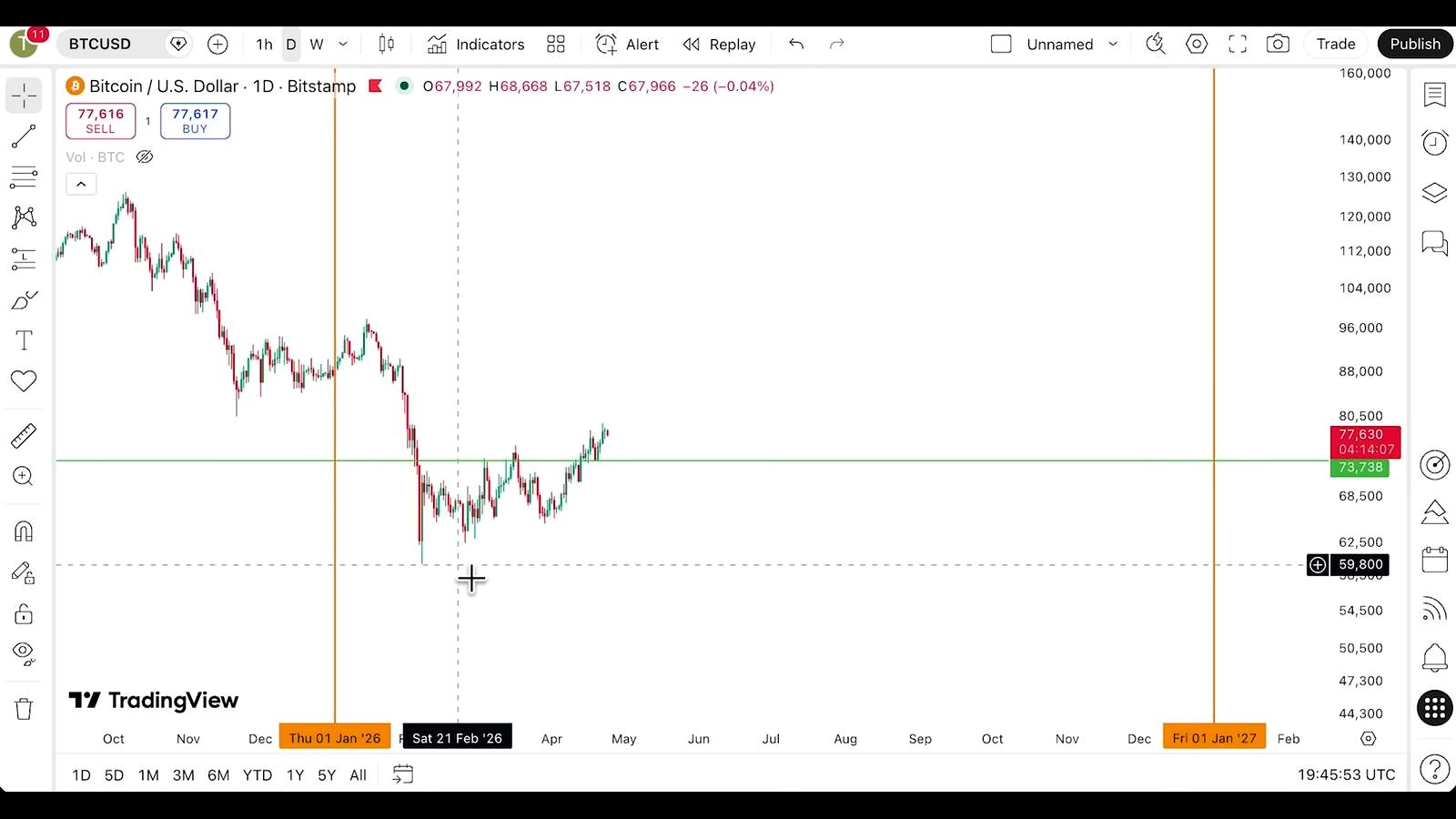
But tastylive argues that the comparison broke down in 2025. In the analyst’s telling, gold climbed from roughly $2,600 an ounce to above $5,600 by the start of 2026, a move of about 115% in roughly 14 months. Bitcoin, by contrast, hit an all-time high of $126,000 in October 2025 before sliding to around $68,000, down about 46% from the peak.
That framing is notable because it cuts against one of crypto’s most persistent narratives. In broader market terms, Bitcoin has long oscillated between two identities: a scarce monetary asset and a levered expression of global liquidity. When real yields fall and liquidity expands, both narratives can work at once. When markets de-risk, the second identity tends to dominate. That has been one of the central tensions of BTC trading for years, and tastylive is firmly in the camp that says recent data favors the “risk asset” interpretation over the “safe haven” one.
Why the Gold Comparison Is Getting Harder to Defend
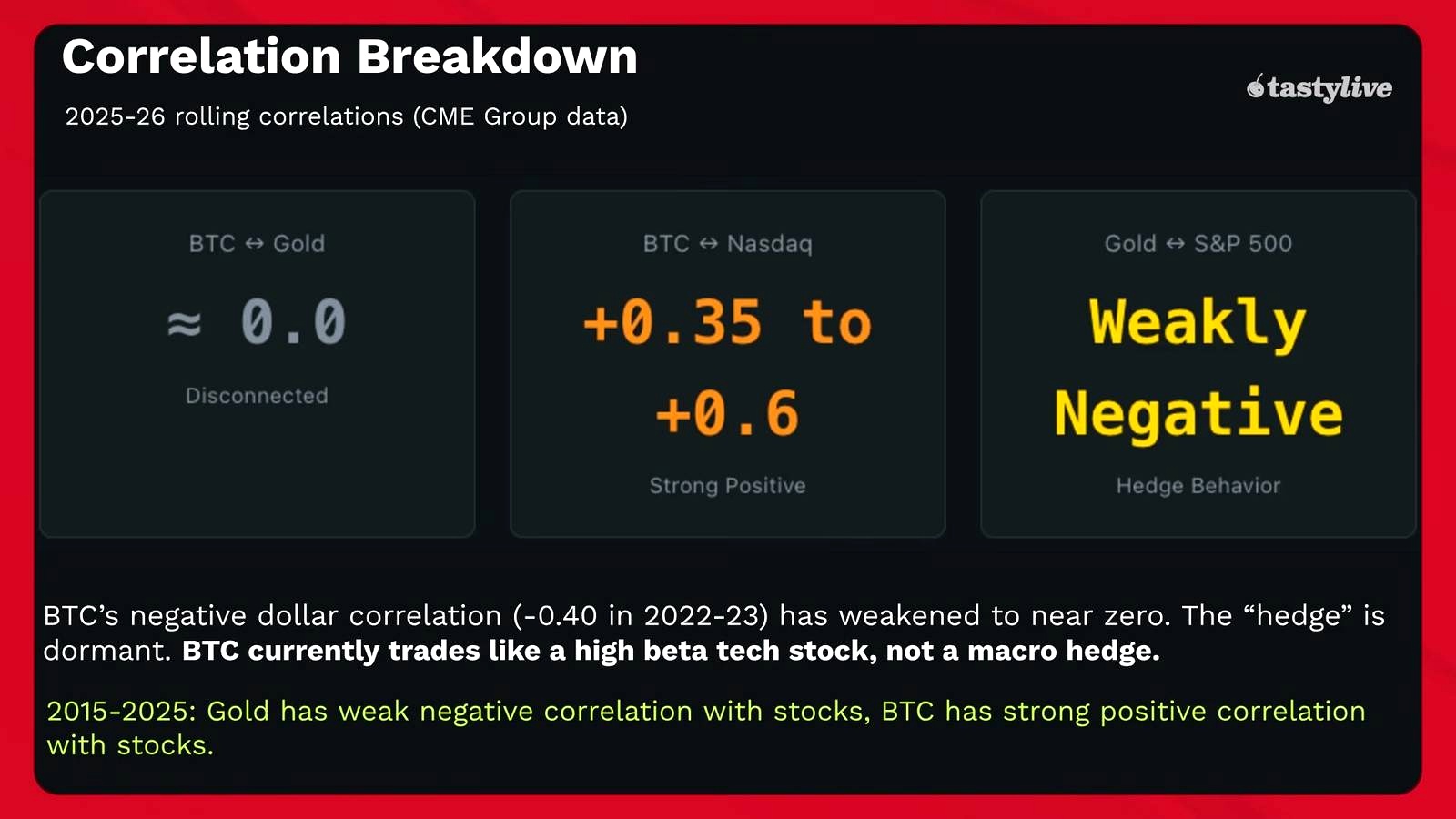
According to tastylive, the sharpest evidence is in correlation and volatility. Entering 2026, Bitcoin’s correlation with gold had weakened to “basically zero, ” while its correlation with the Nasdaq stayed consistently positive in a range of roughly 0.35 to 0.6. The analyst’s conclusion is blunt: if Bitcoin were truly digital gold, it should behave like gold during market stress. Instead, he says, it has recently traded more like a high-beta tech stock.
The volatility comparison strengthens that case. Gold’s yearly realized volatility runs at about 15%, while Bitcoin’s annualized volatility still sits around 50% to 55%, or roughly 3.5 times gold’s. Tastylive does add an important caveat: Bitcoin’s volatility has been falling on a secular basis. In its earlier years, annualized volatility regularly hit triple digits and at one point traded above 200%. The ratio of Bitcoin volatility to gold volatility has compressed from more than 10 times to around 3.5 times by early 2025.
That part aligns with a broader institutional view of Bitcoin’s maturation. As spot access has improved, market depth has grown, and BTC has become more widely held, volatility has gradually come down. But lower volatility is not the same as safe-haven behavior. For many macro desks, the real question is not whether Bitcoin is becoming more stable over time. It is whether it can decouple from equities during stress and preserve capital when portfolios need ballast. On that test, gold still has the stronger case.
Tastylive also emphasizes market structure. Gold’s market cap is around $31 trillion, while Bitcoin is closer to $1 trillion, meaning BTC is only about 4% of gold’s total value. The host says that difference matters for liquidity: a sale of 100,000 BTC, worth about $6.8 billion at current prices, would represent roughly 13% of Bitcoin’s daily trading volume and could trigger an estimated 25% price drop over a short period. An equivalent size in gold would amount to around 5% of daily turnover and might move price by closer to 2%.
That makes Bitcoin structurally more explosive in both directions. The same shallower liquidity that makes it vulnerable during liquidation events is also what gives it outsized upside during inflows.
What Could Go Wrong With This Thesis

The strongest counterargument is that tastylive may be right about Bitcoin’s current behavior but early in calling the long-term role. Bitcoin is only about 18 years old, while the host notes gold has a roughly 5,000-year track record. A younger asset going through price discovery should look more volatile and more correlated to liquidity-sensitive assets, especially while institutional ownership is still expanding.
There is also a regime question. Correlations are not static. Bitcoin can trade like a tech proxy in one macro environment and like a non-sovereign store of value in another. If confidence in sovereign debt, fiat credibility, or capital controls became the dominant global concern, the market could start rewarding Bitcoin’s censorship resistance and fixed supply more directly. Under that scenario, the “digital gold” case would look less like branding and more like delayed convergence.
The analyst also leaves out some crypto-specific upside catalysts that could weaken the bearish interpretation of current correlations. Network effects, treasury adoption, ETF-driven accessibility, and improving derivatives infrastructure can all deepen liquidity over time. If that process continues, Bitcoin’s volatility could compress further and make its portfolio role look more distinct from pure risk assets.
Still, the immediate invalidation of the digital-gold claim would not come from ideology. It would come from another genuine crisis in which Bitcoin again sells off alongside equities while gold outperforms. If that pattern keeps repeating, the branding gets harder to defend outside crypto-native circles.
What to Watch Next
Investors testing this thesis should watch three things. First, monitor Bitcoin’s correlation with the Nasdaq versus gold over the next major risk-off stretch. If BTC stays in the 0.35 to 0.6 range with equities and near zero with gold, tastylive’s argument holds. Second, watch volatility compression. If Bitcoin can move from the current 50% to 55% annualized zone materially lower without losing its upside asymmetry, the asset’s portfolio case strengthens. Third, pay attention to crisis performance. Tastylive highlights March 2020, early 2025, and March 2026 as useful reference points. The next macro shock may matter more than any narrative debate.
FAQ
What does “high-beta tech stock” mean when applied to Bitcoin?
It means an asset that tends to amplify moves in growth-oriented equities. If the Nasdaq rises, Bitcoin may rise more. If the Nasdaq sells off, Bitcoin may fall harder. That is different from a classic safe haven, which would ideally hold steady or rally during stress.
Why does volatility matter so much in the digital-gold debate?
A store-of-value asset is expected to preserve purchasing power with relatively manageable drawdowns. Gold can be volatile, but tastylive cites annual realized volatility near 15%, versus Bitcoin at roughly 50% to 55%. That gap affects position sizing, portfolio construction, and whether institutions treat the asset as protection or as a tactical risk allocation.
What is “monetary premium”?
Monetary premium is the portion of an asset’s value that comes from collective belief in its scarcity, durability, and usefulness as money-like collateral or savings, rather than from cash flow. Gold and Bitcoin are often discussed this way because neither generates earnings like a business.
How is Bitcoin’s market cap relevant to whether it can behave like gold?
Size affects liquidity. Gold’s market cap, cited by tastylive at around $31 trillion, allows very large flows to move through the market with less impact. Bitcoin, at around $1 trillion, is easier to move with concentrated buying or selling. That helps explain why BTC can surge faster than gold but also fall much harder.
What would a portfolio allocation to gold and Bitcoin look like under tastylive’s framework?
According to tastylive, one reasonable framework is roughly 5% to 10% in gold for stability and downside protection, and about 1% to 5% in Bitcoin as a high-conviction asymmetric upside bet. That is not a universal rule, but it captures the analyst’s central point that the two assets may belong in portfolios for different reasons.
Video Reference

Omar Al-Sharif lives and works in the UAE and is involved in the blockchain technology industry. He writes articles on Bitcoin and digital assets as a personal passion, explaining complex topics in simple and understandable language.