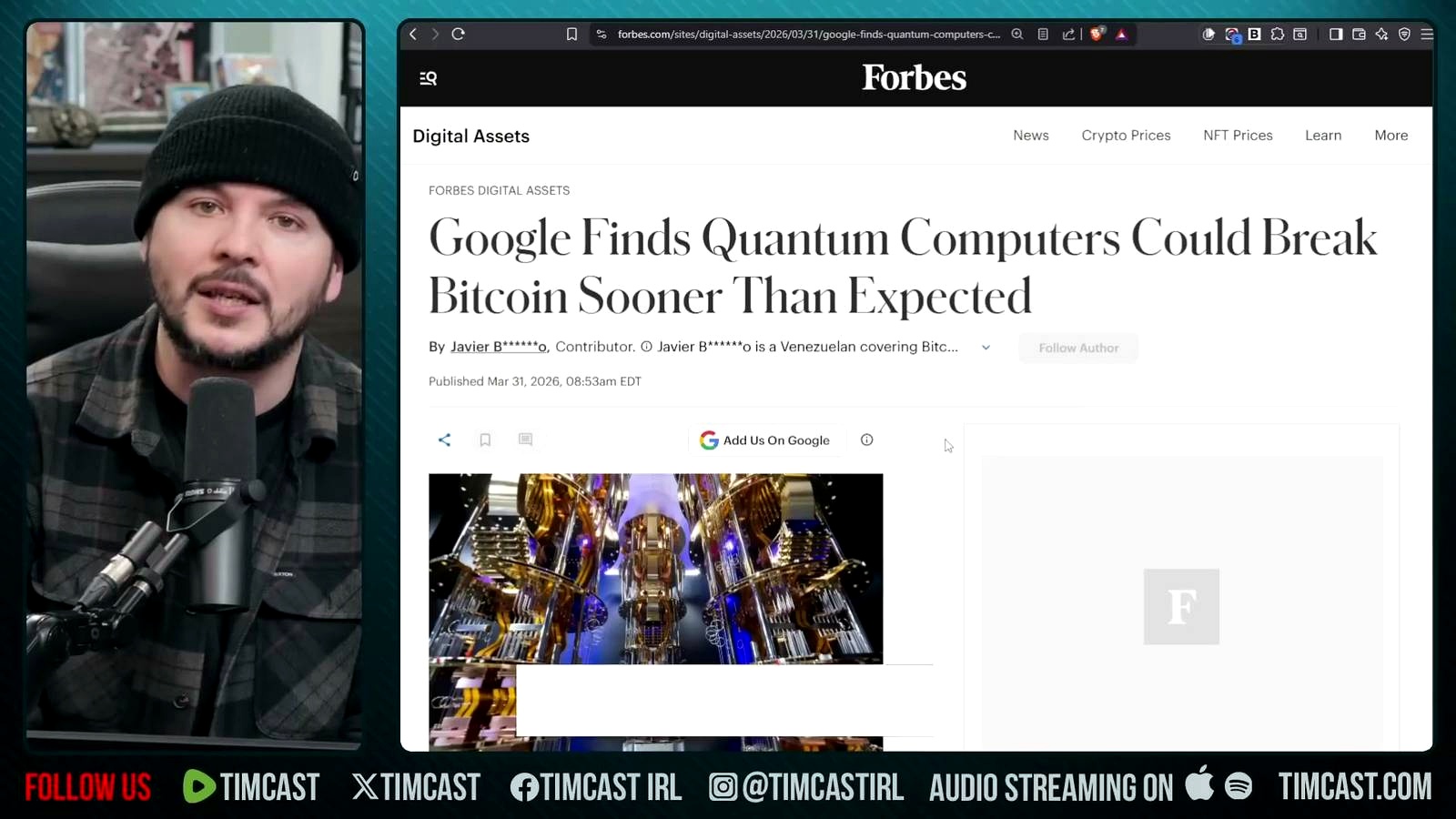
Could Bitcoin’s biggest long-term threat be arriving faster than the market expected? A Timcast segment argues that Google’s latest quantum research has sharply shortened the timeline for a potential cryptographic break, even if the actual attack is not possible yet.
Google’s paper changes the timeline, not the immediate reality
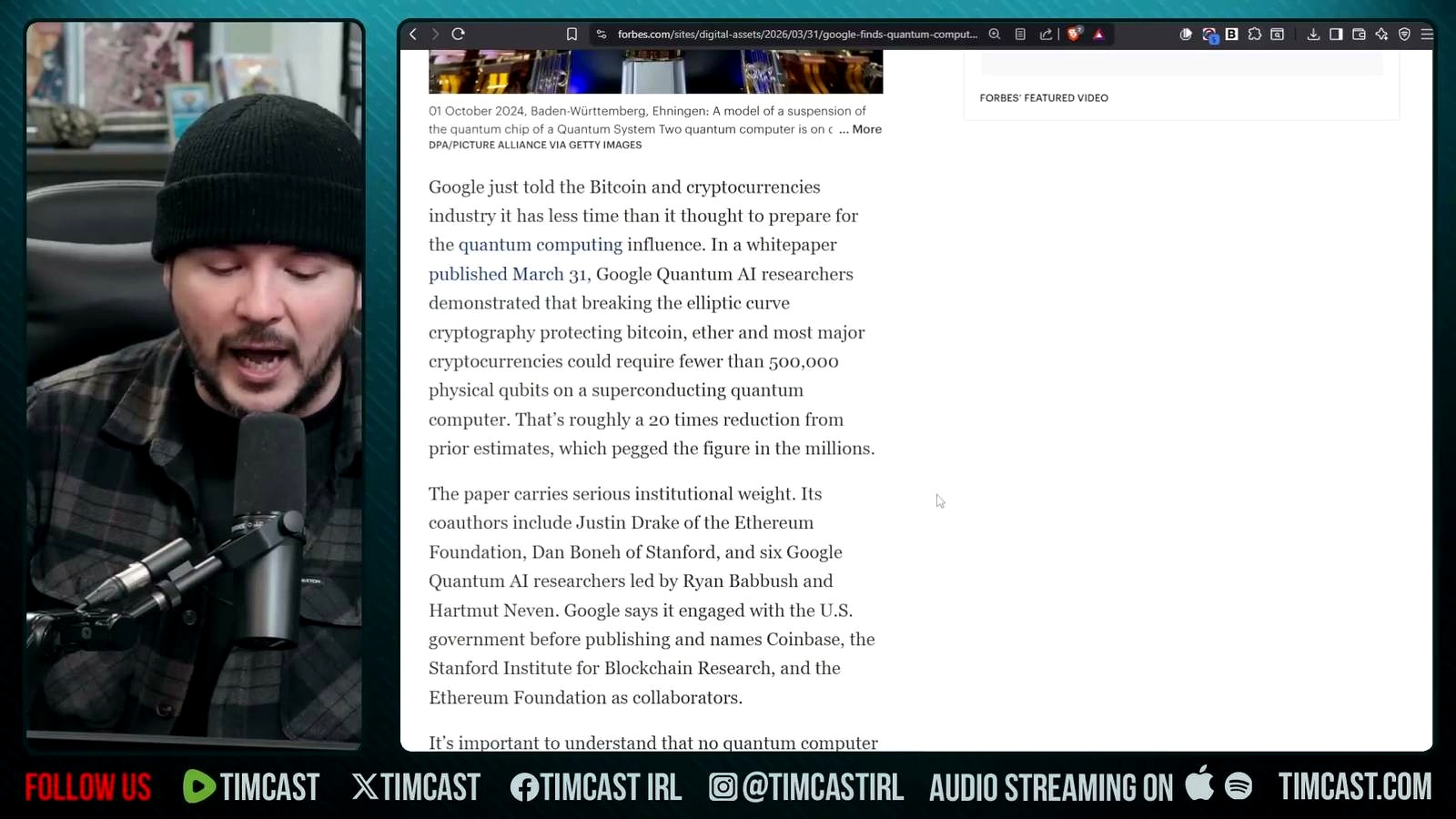
According to Timcast, the most important development is not that Bitcoin or Ethereum can be broken today, but that Google researchers now say the hardware threshold needed to attack the elliptic curve cryptography behind major cryptocurrencies may be far lower than earlier estimates suggested.
The host cites a March 31 white paper from Google Quantum AI researchers saying that breaking the elliptic curve cryptography used by Bitcoin, Ether, and most major cryptocurrencies could require fewer than 500,000 physical qubits on a superconducting quantum computer. Timcast stresses that this would represent roughly a 20x reduction from prior estimates that placed the requirement in the millions.
That matters because Bitcoin’s security model depends on the assumption that deriving a private key from a public key is computationally infeasible with existing machines. The host says quantum computing threatens that assumption directly. In the framing presented on the show, this is less a routine research update and more a warning that the distance between theory and a real-world attack is shrinking.
What the paper says, and what it does not say
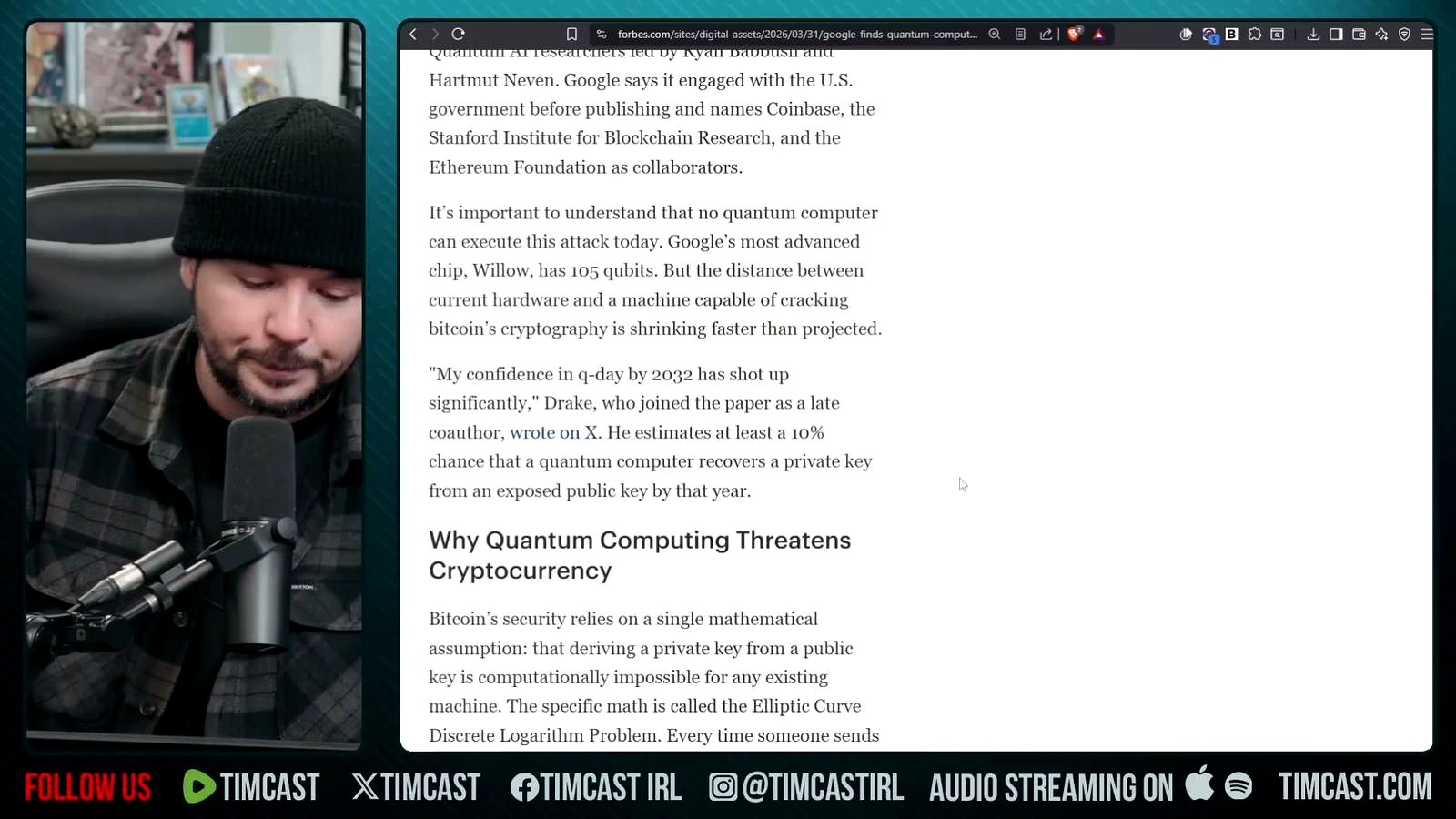
Timcast also makes a key distinction that traders and long-term holders should not miss: no quantum computer can execute this attack today. The segment notes that Google’s most advanced chip, called Willow, has 105 qubits, still far below the level described in the paper.
That gap remains enormous. But the host’s point is that the market has been pricing quantum risk as distant and abstract, while this research suggests the path may be shorter than many assumed. Timcast quotes Ethereum Foundation researcher Justin Drake, a co-author on the paper, as saying his confidence in “Q-Day” by 2032 has increased significantly. Drake also estimates at least a 10% chance that a quantum computer could recover a private key from an exposed public key by that year.
The show frames that as a meaningful shift in probabilities rather than proof of imminent failure. Put simply: the paper does not say Bitcoin is broken now. It says the cost of breaking its cryptography may be falling faster than expected.
Why Bitcoin’s signature system is the focal point
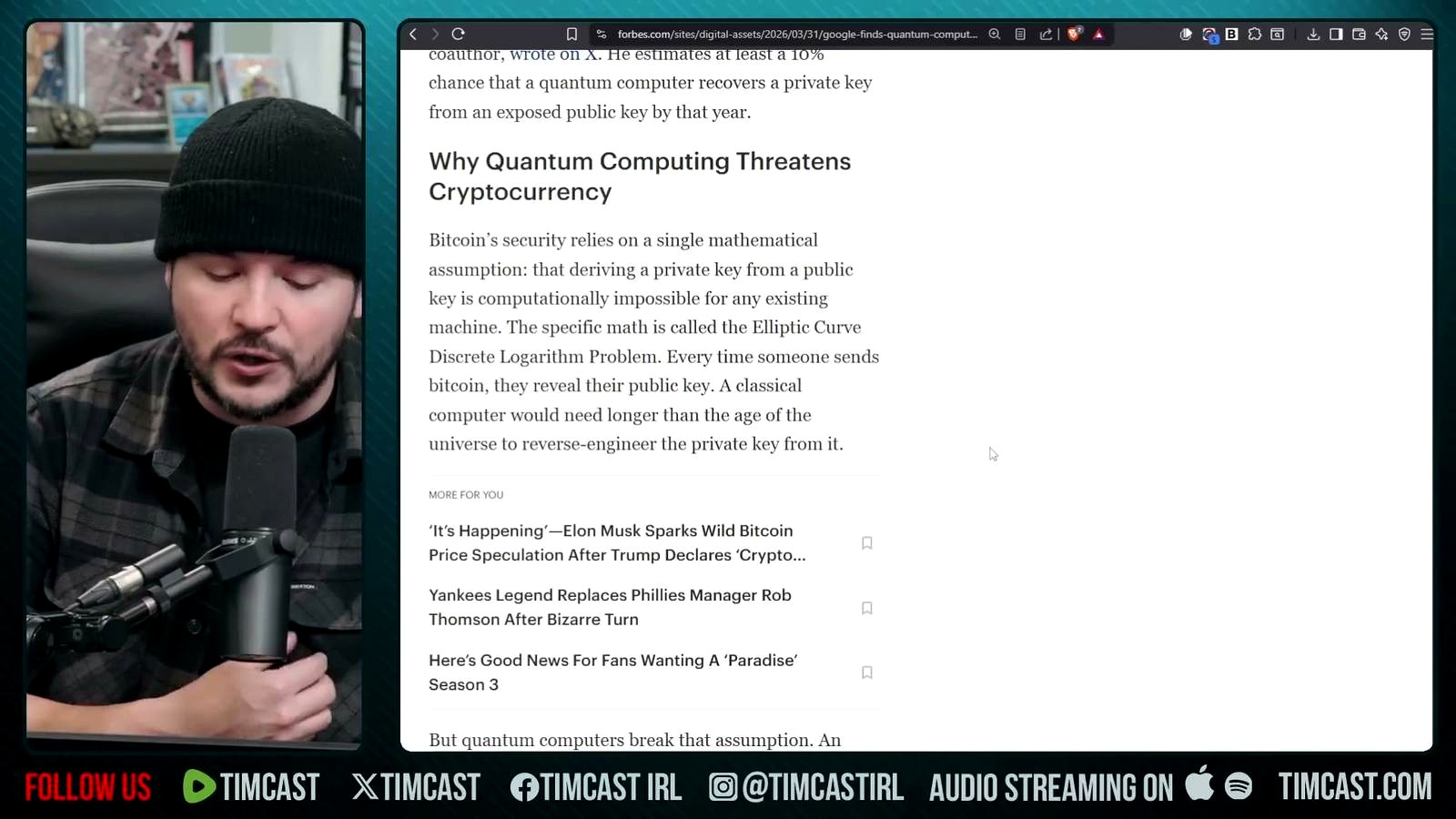
Timcast explains the issue through Bitcoin’s use of elliptic curve cryptography, specifically the mathematical problem that prevents someone from deriving a private key from a public key. On a classical computer, the host says, reversing that relationship would take longer than the age of the universe.
Quantum computing changes the equation because Shor’s algorithm, first published in 1984, can solve the elliptic curve discrete logarithm problem exponentially faster than classical methods. In the scenario discussed on the show, a sufficiently stable, error-corrected quantum computer could derive a private key, forge a digital signature, and drain a wallet.
Timcast repeatedly emphasizes one practical implication: if private keys can be recovered from exposed public keys, then the security assumptions behind Bitcoin transactions are no longer reliable. That is the core threat, not a vague fear that “AI” or new hardware will somehow disrupt crypto.
The more urgent concern: disclosure may lag behind capability
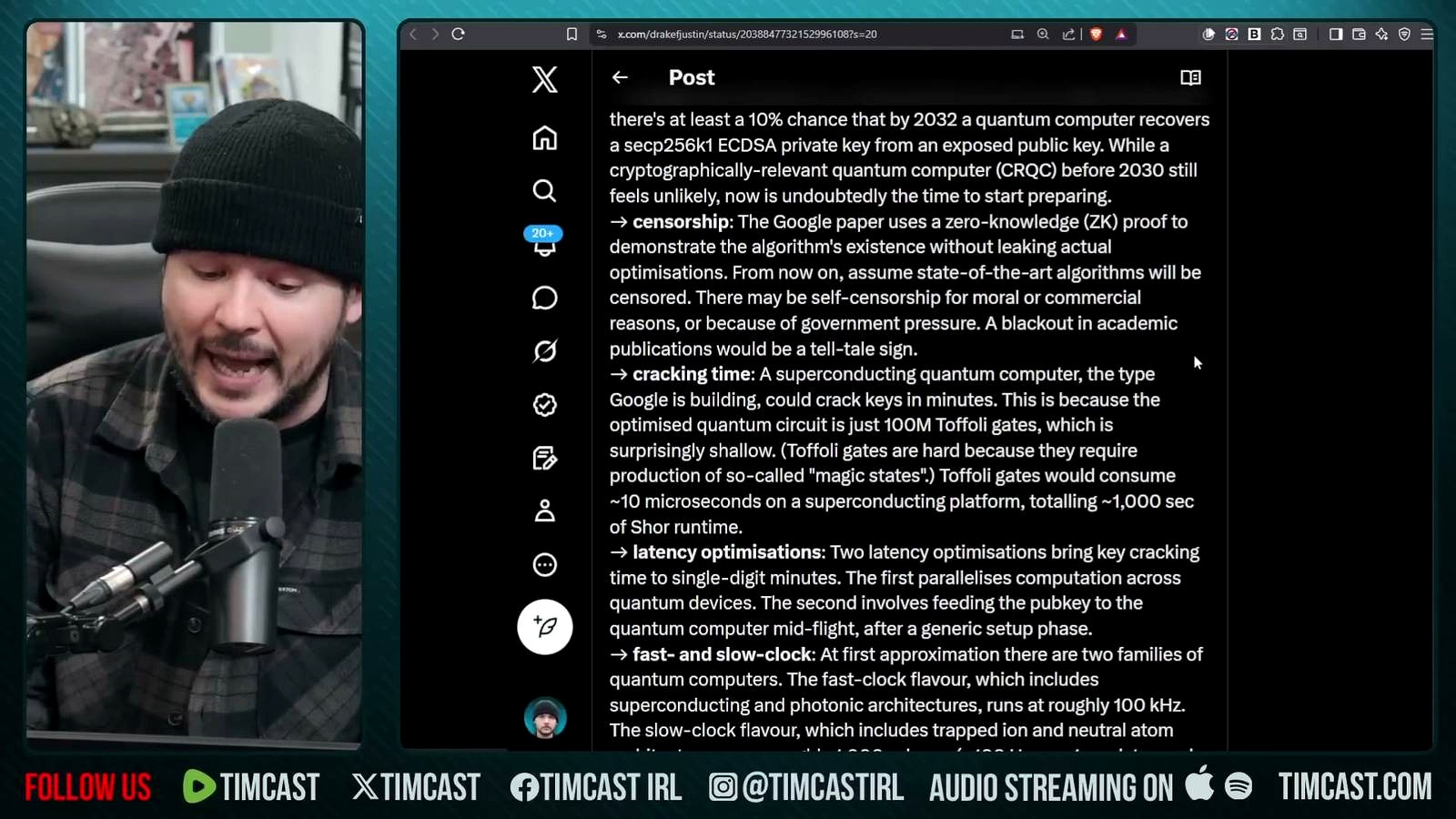
Where Timcast goes beyond the technical summary is in its interpretation of how such breakthroughs might be handled. The host says researchers and institutions may withhold key optimizations rather than publish a full roadmap for breaking cryptocurrency signatures.
He cites Drake’s comment that the Google paper uses a zero-knowledge proof to demonstrate the algorithm’s existence without exposing actual optimizations, and highlights the idea that state-of-the-art algorithms may be censored for moral, commercial, or government-pressure reasons. In Timcast’s telling, that creates a troubling possibility: the public may learn that the risk is real only after the underlying capability is much closer than expected.
The host characterizes this as a race between protocol upgrades and quiet advances in quantum computing. His argument is straightforward: if publication is partial, and if institutions fear destabilizing markets, then investors may not get a clean warning signal before the threat becomes critical.
Concrete figures from the segment
- March 31: date of the Google white paper referenced in the segment
- Under 500,000 physical qubits: estimated requirement to break elliptic curve cryptography on a superconducting quantum computer
- 20x reduction: improvement versus prior estimates in the millions
- 105 qubits: qubit count of Google’s Willow chip cited by the host
- 2032: year by which Justin Drake says his confidence in “Q-Day” has risen significantly
- 10%: Drake’s estimated chance that a quantum computer could recover a private key from an exposed public key by 2032
- 1,000 logical qubits: figure cited in Drake’s post for the algorithm aimed at 256-bit elliptic curve signatures
- 256-bit: elliptic curve size discussed in the segment
- 100 million Toffolis: optimized quantum circuit size cited by the host from Drake’s comments
- Minutes: the attack timeframe repeatedly described if a sufficiently capable superconducting quantum computer existed
Timcast’s market takeaway is blunt
Timcast argues that the crypto industry now has a shrinking window to harden itself against quantum attacks. The host presents the Google result as a signal that “the clock is ticking, ” not because the attack can be launched tomorrow, but because confidence in the old timeline has weakened.
He also raises the scenario that a state actor or another major power could make similar progress. That point is speculative in the segment, but it serves the host’s larger warning: if the capability emerges outside a controlled disclosure process, the market could face a disorderly repricing.
The strongest version of that argument is not that Bitcoin necessarily goes to zero, but that a network built on cryptographic trust cannot afford ambiguity about whether its signatures remain secure. Once confidence in that foundation cracks, valuation becomes secondary.
What to watch next
According to Timcast, the next milestone is not a headline claiming Bitcoin has been cracked. It is whether the industry accelerates work on post-quantum cryptography and whether new research continues to reduce the hardware burden required for an attack.
For now, the host acknowledges that quantum computers capable of carrying out the attack do not exist. That leaves time for mitigation. But the segment’s central message is that the buffer may be thinner than many Bitcoin holders believed.
Watch three things from here: whether more papers push the estimate below 500,000 qubits, whether institutional voices grow more confident about a 2032-era risk window, and whether Bitcoin ecosystem leaders begin treating quantum migration as an immediate engineering priority rather than a distant theoretical problem.
FAQ
Is Timcast saying Bitcoin can be hacked right now?
No. Timcast explicitly says no quantum computer can perform this attack today. The warning is about a faster-moving timeline, not a current network breach.
Why does exposed public-key risk matter so much?
Because the segment focuses on signature security, not mining or wallet passwords. If a powerful enough quantum machine can derive a private key from a public key, it could forge a valid signature and move funds without the owner’s consent.
What is the biggest new number investors should pay attention to?
The standout figure is fewer than 500,000 physical qubits. Timcast treats that as the most important update because it is a major drop from prior estimates in the millions.
Did the segment give any BTC price target?
No specific Bitcoin price target was given. The host discussed cryptographic risk, possible market fallout, and his own holdings, but did not set a formal upside or downside target.
What would count as confirmation that the threat is getting closer?
In the segment’s framing, confirmation would look like more research reducing qubit requirements, stronger institutional language around “Q-Day, ” and visible movement toward post-quantum upgrades across major crypto ecosystems.
Reference Video

An Indian crypto journalist covering the developments in the Bitcoin and blockchain industries. Her work helps readers understand key changes in the world of digital assets.