Something strange may be hiding inside this market anxiety. While rising 10-year yields are usually framed as bad news for the broader economy, the setup around Bitcoin looks more complicated—and potentially far more interesting.
That tension is why the 10-year Treasury yield is suddenly impossible to ignore. If traditional markets crack under the pressure of higher yields, Bitcoin may not follow the same script.
Why the 10-year yield is suddenly at the center of the story
The focus here is specific: a rising 10-year yield pushing pressure onto traditional markets such as stocks and real estate. The question is not simply whether the economy feels weak. The real question is how Bitcoin reacts when bond yields surge.
That issue has become more politically charged as well. Donald Trump has openly attacked Jerome Powell over high interest rates, arguing rates should be cut immediately. He has also posted that the Fed rate is at least three points too high and said, in all caps, that rates should be lowered.
That pressure is not coming from one direction. Treasury Secretary Scott Bessant is also on record saying he is focused squarely on getting the 10-year yield down.
What the 10-year yield actually means
The 10-year Treasury is basically a government debt security used to support government spending and obligations. More precisely, the 10-year is technically a Treasury note.
- Treasury bills: under one year, from four to 52 weeks
- Treasury notes: two to 10 years
- Treasury bonds: 20-year or 30-year maturities
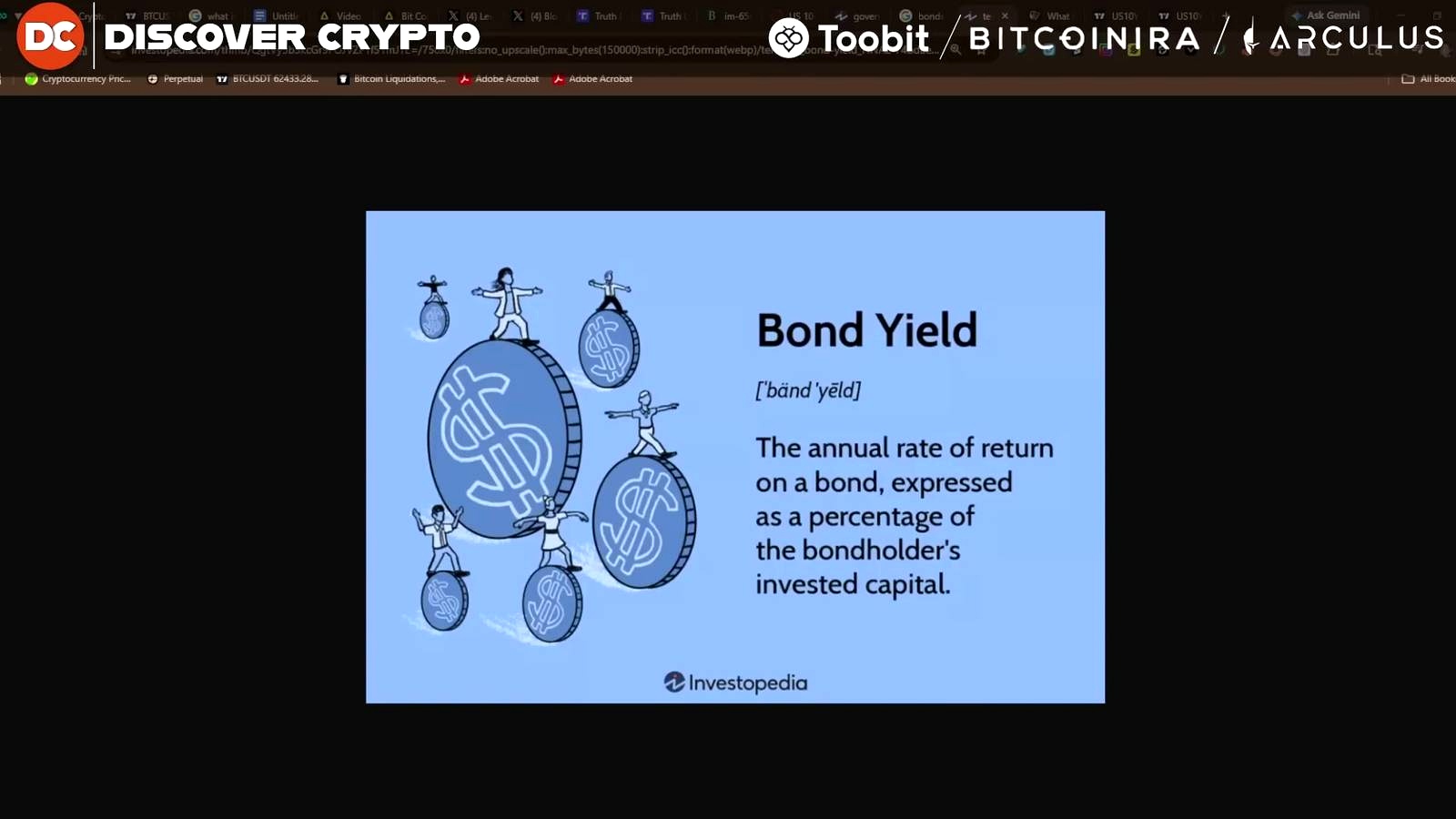
When people talk about the 10-year yield, they mean the annual rate of return on that bond, expressed as a percentage of the investor’s capital. If the yield is 3%, that means $3 annually for every $100 invested.
The market stress point investors are watching
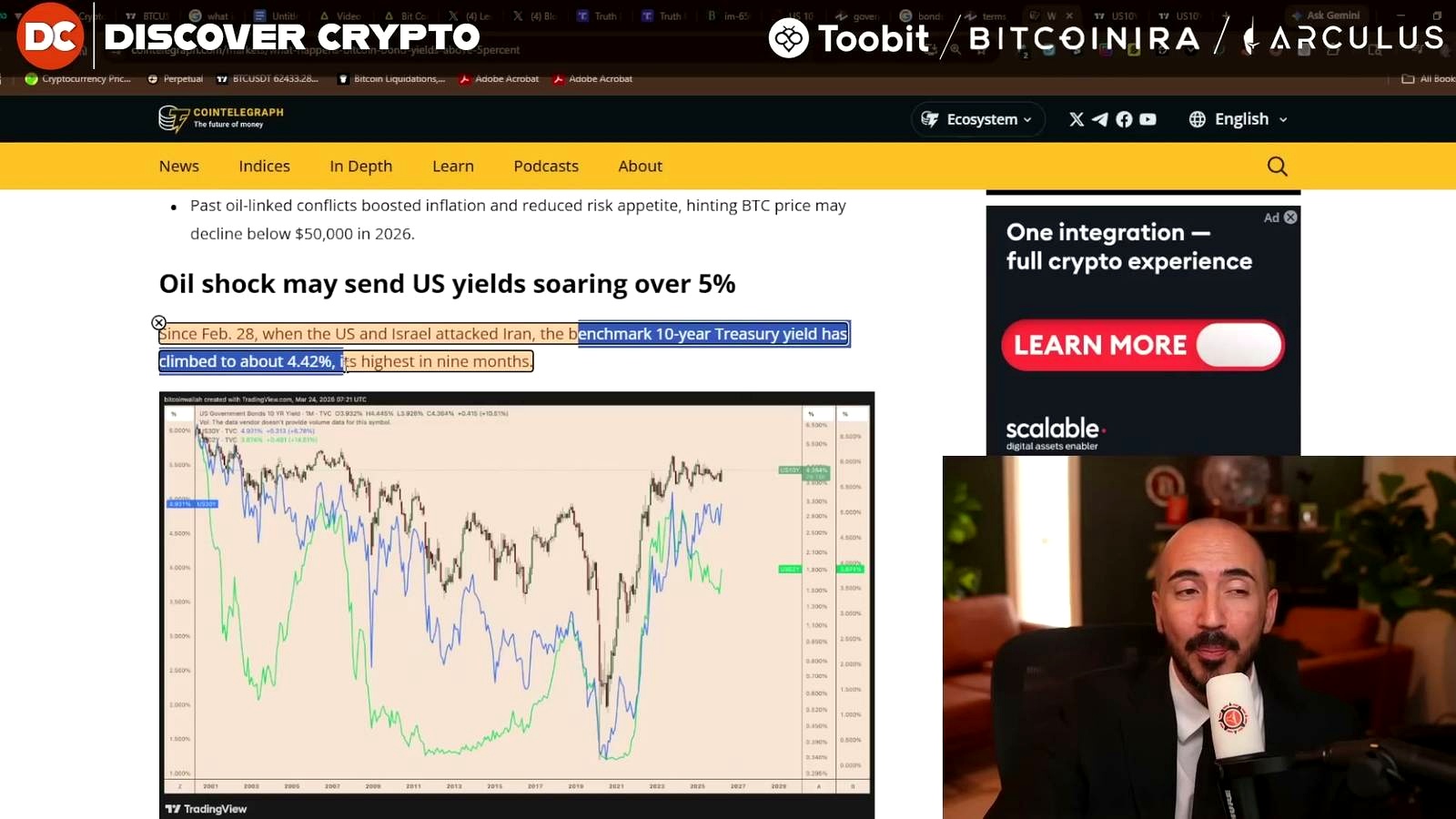
The deeper concern is what happens if U.S. bond yields move sharply higher. Since February 28, when the U.S. and Israel attacked Iran, the benchmark 10-year yield climbed to around 4.42%, the highest level seen in nine months.
Some technical chartists are now looking at a possible move toward 6.4% if a symmetrical triangle breakout fully plays out. A more cautious chart target in the same discussion points closer to 5.93%.
Even that lower target would still be dramatic. Another nearby resistance area is around 5.26%.
A chart pattern already hit its target
On the daily chart, an upside-down head and shoulders pattern had been identified weeks earlier. After a failed breakout that pushed yields lower, the completed move was measured from the top of the head to the neckline and then projected from the neckline breakout.
According to that setup, yields moved basically right to the projected target.
The bigger breakout now getting attention
On the weekly chart, attention shifts to a symmetrical triangle pattern. The potential breakout area is close to where yields are now, and the projected move from that pattern points to roughly 5.93%.
The more aggressive 6.4% target has also been discussed by technical chartists. But even without going that high, the larger implication is the same: yields may still be climbing.
So what does that mean for Bitcoin?
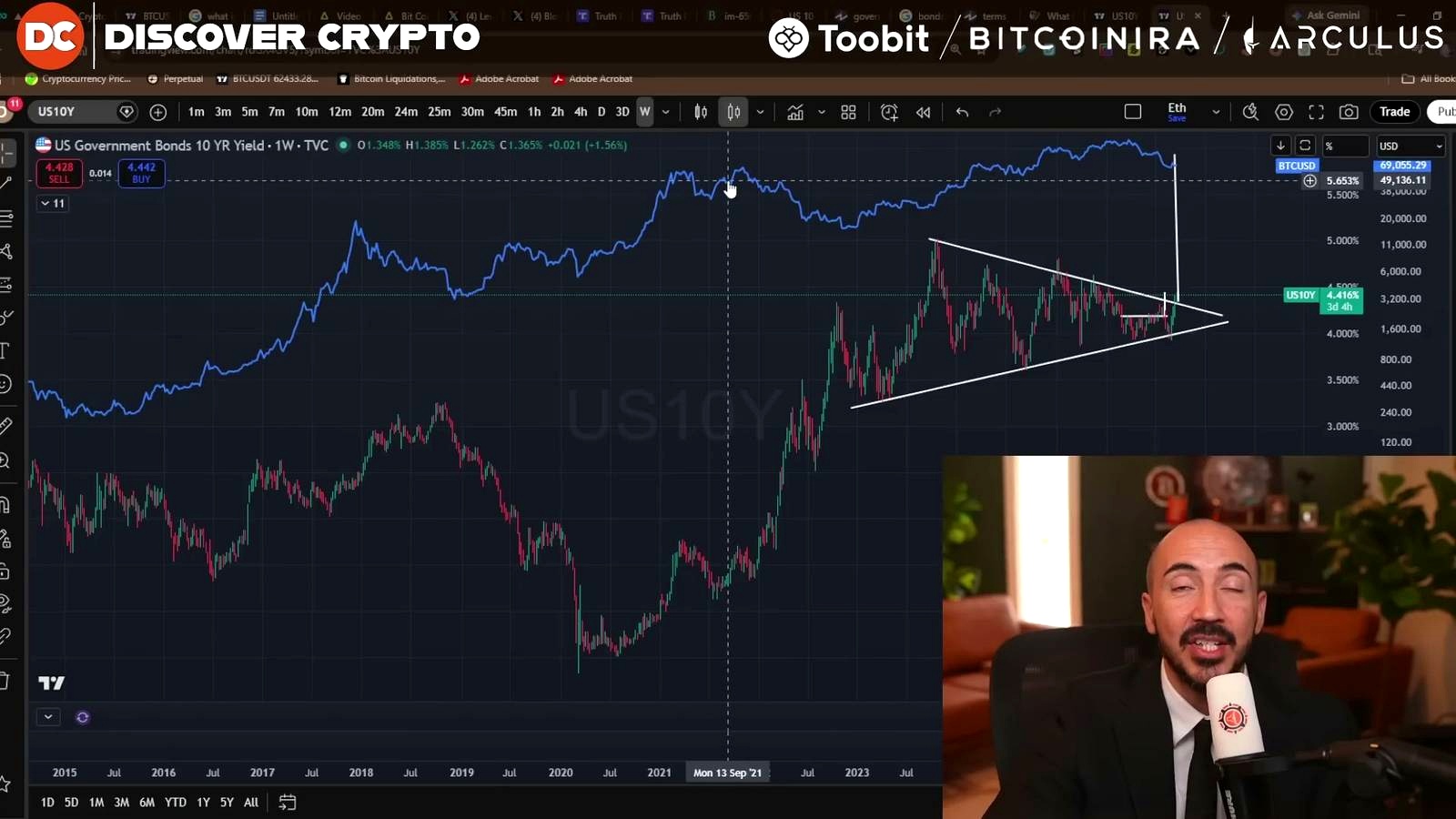
This is where the story turns. Looking across most of Bitcoin’s trading history since 2012, the 10-year yield and Bitcoin appear to move in tandem more often than many people might expect.
That does not mean every top and bottom is perfectly identical. But the overlap is hard to dismiss.
The long-term pattern looks surprisingly similar
Using a chart that overlays the U.S. 10-year yield with Bitcoin, the pattern described is consistent:
- When interest rates rose, Bitcoin rose
- When interest rates hit a downtrend, Bitcoin also entered a downtrend
- When rates found local lows, Bitcoin often found lows too
- When rates climbed again, Bitcoin tended to climb as well
Because Bitcoin moved from under $100 to above $100,000 over time, the comparison requires a log chart for Bitcoin. Even then, the relationship still appears visible.
March 2020 stands out
One of the clearest examples came in March 2020. Interest rates found a bottom, and Bitcoin also found a bottom. As rates started to soar, Bitcoin also surged.
That vertical move in rates came before Bitcoin’s top in April 2021. Later in 2021, Bitcoin formed a double top in April and November, with a lull in the middle. The 10-year yield showed a similar pause.
The recent two-year stretch may matter most
The stronger argument may not even be the full historical chart. It may be the last 833 days.
Over that period—more than two years—the correlation appears to have returned in a meaningful way:
- Yields rose and Bitcoin rose
- Yields fell and Bitcoin pulled back or consolidated
- Both found bottoms around the same time
- Both reversed higher around the same time
- Both peaked around similar windows
There are small timing differences. At some points, rates fell a little sooner than Bitcoin. But local bottoms still showed up in roughly the same zones.
Why this could flip the usual market narrative
If interest rates continue climbing, the expectation in this view is straightforward: the stock market goes down, real estate goes down, and other assets get dragged lower too. Used cars, gold, and more could feel that pressure.
But Bitcoin may not behave like the rest.
That is the unusual part. The recent data suggests that a spike in rates—while painful for many traditional assets—could actually be supportive for Bitcoin. If the 10-year yield keeps pushing higher, Bitcoin may benefit instead of breaking down with everything else.
The key idea in one sentence
What looks like an economic warning sign for traditional markets may be a bullish signal for Bitcoin.
What investors are really watching now

The debate is no longer just about whether rates are high. It is about whether the 10-year yield is setting up for another leg higher, and whether Bitcoin continues following that same path.
That is why the bond market, Jerome Powell, Trump’s demands for lower rates, and Bitcoin’s next move are suddenly tied together in one tense, fast-moving narrative.
FAQ
What is the main question around Bitcoin and the economy?
The core question is whether a rise in the 10-year yield—strong enough to hurt traditional markets—could actually be good for Bitcoin.
Why does the 10-year yield matter so much?
It is a major market rate tied to government debt, and rising yields can pressure assets like stocks and real estate.
What level is the 10-year yield at now?
It climbed to about 4.42%, described here as the highest level in nine months.
What targets are chartists watching for the 10-year yield?
Some are watching for 6.4% from a symmetrical triangle breakout, while a more conservative target mentioned is around 5.93%, with possible resistance near 5.26%.
How has Bitcoin reacted to rising yields in this analysis?
The chart comparison suggests Bitcoin has often risen when yields rise, and weakened or consolidated when yields fall.
What happened in March 2020?
Both the 10-year yield and Bitcoin found bottoms around that time, and both then moved higher.
Does the recent data still support the correlation?
Yes. The last 833 days are described as showing significant correlation between the 10-year yield and Bitcoin.
Why are Trump and Jerome Powell part of this story?
Trump has criticized Powell over high rates and demanded cuts, while the discussion around the 10-year yield has become central to broader market concerns.
What is the article’s biggest takeaway?
If the 10-year yield keeps climbing, it may hurt many traditional assets—but the recent pattern suggests Bitcoin could respond very differently.
Source

John Burnell focuses on Bitcoin infrastructure, wallet security and blockchain technology. He writes educational articles explaining how Bitcoin works and how the technology evolves.